Author: admin

  • Why AI Workflow Automation Will Change the Way You Scale Your Operations

    Why AI Workflow Automation Will Change the Way You Scale Your Operations

    In the traditional business landscape, growth has always been tied to a sobering reality: to do more, you must hire more. This linear relationship between revenue and headcount has long been the primary "scaling tax" that keeps lean organizations from becoming giants and large enterprises from remaining agile.

    However, we are entering an era where this fundamental law of physics for business is being rewritten. AI workflow automation is no longer just a tool for efficiency; it is the new engine of operational leverage. At Pure Technology Consulting, we view this shift not as a minor upgrade to your tech stack, but as a total reimagining of what it means to scale.

    The Scaling Paradox: Why Linear Growth Fails

    For decades, the roadmap to expansion was predictable. If you wanted to double your output, you doubled your team, your office space, and your management overhead. This created a "scaling paradox" where the more a company grew, the more complex and fragile it became. Communication silos formed, human error multiplied, and the very agility that made the company successful began to erode under the weight of manual processes.

    AI workflow automation shatters this paradox. By decoupling operational capacity from headcount, businesses can now achieve exponential growth with a linear: or even flat: cost structure. When you automate the decision-making logic and the repetitive execution of tasks, your "digital workforce" scales instantly to meet demand without requiring a single recruitment fee or onboarding period.

    Conceptual art showing exponential business scaling through AI workflow automation compared to linear growth.

    From Local Presence to Global Reach: The AI Local Boost Blueprint

    A primary example of how automation creates this leverage can be found in how we approach market visibility. In the past, managing a multi-location brand required a small army of SEO specialists to maintain local relevance.

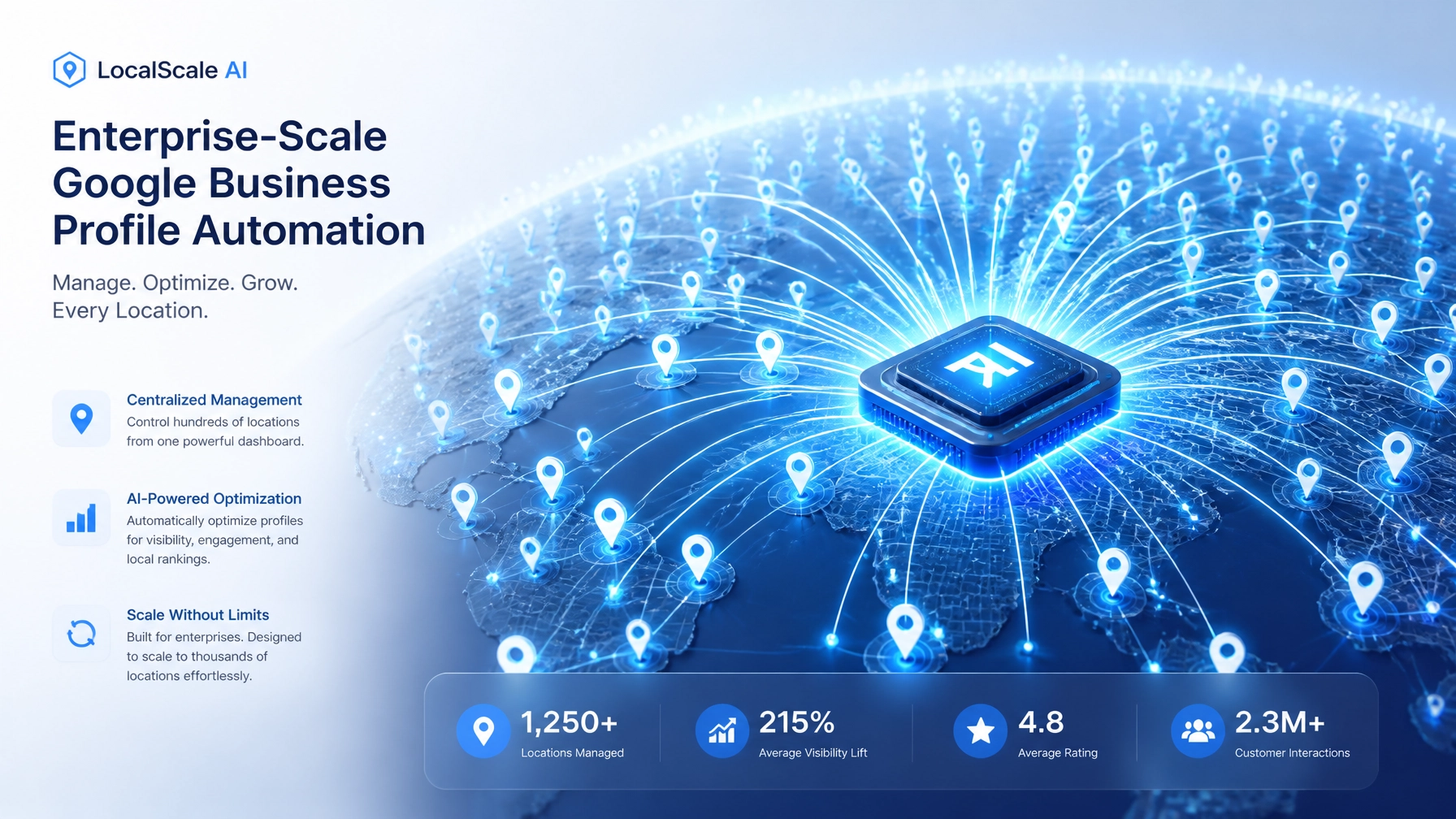
    Through our proprietary engine, AI Local Boost, we’ve demonstrated that high-level automation can handle the heavy lifting of Google Business Profile management, local citations, and reputation management at scale. This isn't just about posting updates; it's about using intelligent algorithms to analyze local search trends and adjust presence in real-time. For an executive looking to scale, this means a single operator can manage the digital footprint of hundreds of locations with the same precision as a single storefront.

    This type of automated SEO infrastructure allows our clients to pivot from local players to regional powerhouses without the traditional lag time of manual content creation and optimization.

    The Architecture of Intelligent Interoperability

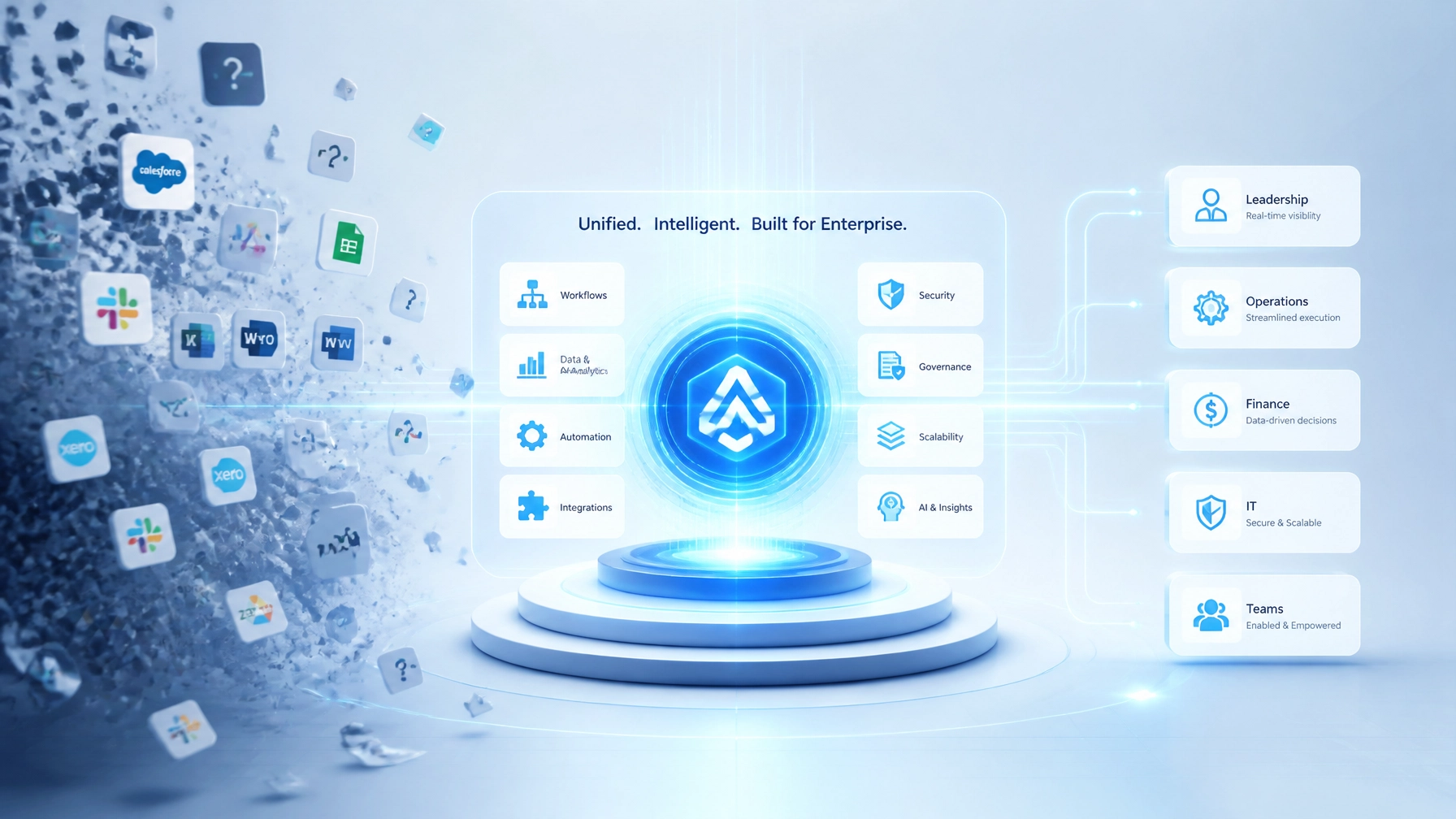
    True scaling happens when your systems talk to each other without human intervention. Most companies suffer from "data silos": pockets of information trapped in CRM, accounting, and project management tools that require manual "bridge-building" by employees.

    Custom web applications are the solution to this fragmentation. At Pure Technology Consulting, we specialize in building bespoke middleware and platforms that serve as the nervous system of your business. Whether it’s integrating debt agency telephony with complex call attribution or building GPS-logging accountability tools for field operations, the goal is the same: seamless data flow.

    When information moves automatically from a lead capture form to a fulfillment contract and then into a billing cycle, you eliminate the 40–70% of cycle time traditionally lost to "manual handoffs." This is the core of an optimized operating model.

    Illustration of a custom web application acting as a digital nervous system for automated business data flow.

    Visibility at Scale: ChainHQ and FTP Inform

    As operations grow, visibility often diminishes. It’s the "fog of war" that hits every CEO when they can no longer see every moving part of their machine. This is where specialized automation tools like ChainHQ and FTP Inform become strategic assets.

    Scaling a supply chain or a complex logistics network requires more than just spreadsheets. ChainHQ provides the architectural backbone for managing complex workflows that involve multiple stakeholders, ensuring that governance and compliance are baked into the process rather than added as an afterthought.

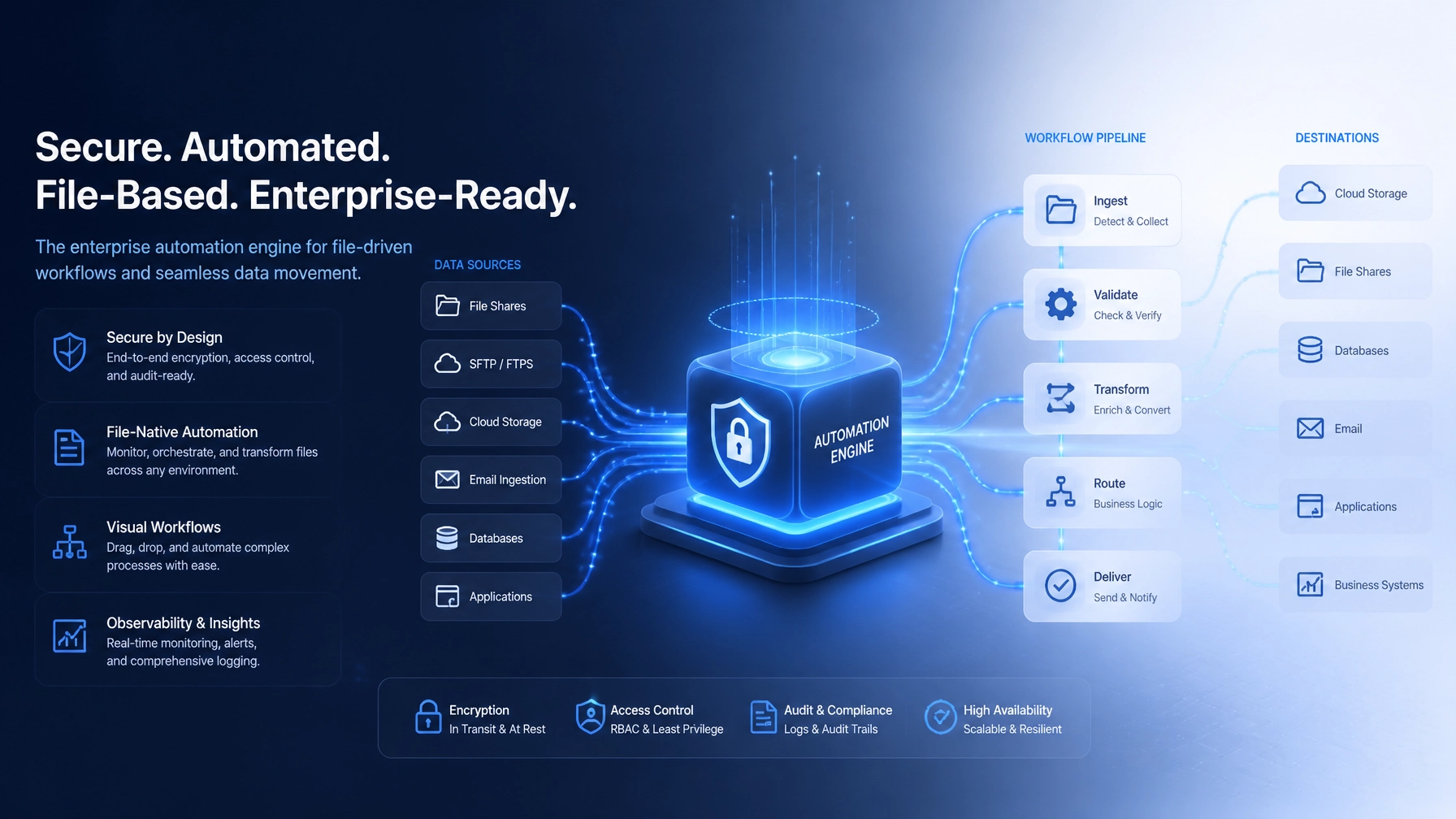
    Similarly, FTP Inform solves a deceptively simple but critical scaling bottleneck: data ingestion. In many industries, scaling means dealing with a massive influx of external data files. Without an automated way to monitor, alert, and process these incoming streams, your team spends their day playing "data janitor." By automating the monitoring and reporting of these data exchanges, we free up senior talent to focus on strategy rather than system maintenance.

    High-Stakes Automation: Lessons from Healthcare and Fintech

    Scaling isn't just about doing things faster; it's about doing them more accurately in environments where the cost of error is catastrophic. Our work in healthcare and fintech provides the perfect proof-of-work for this.

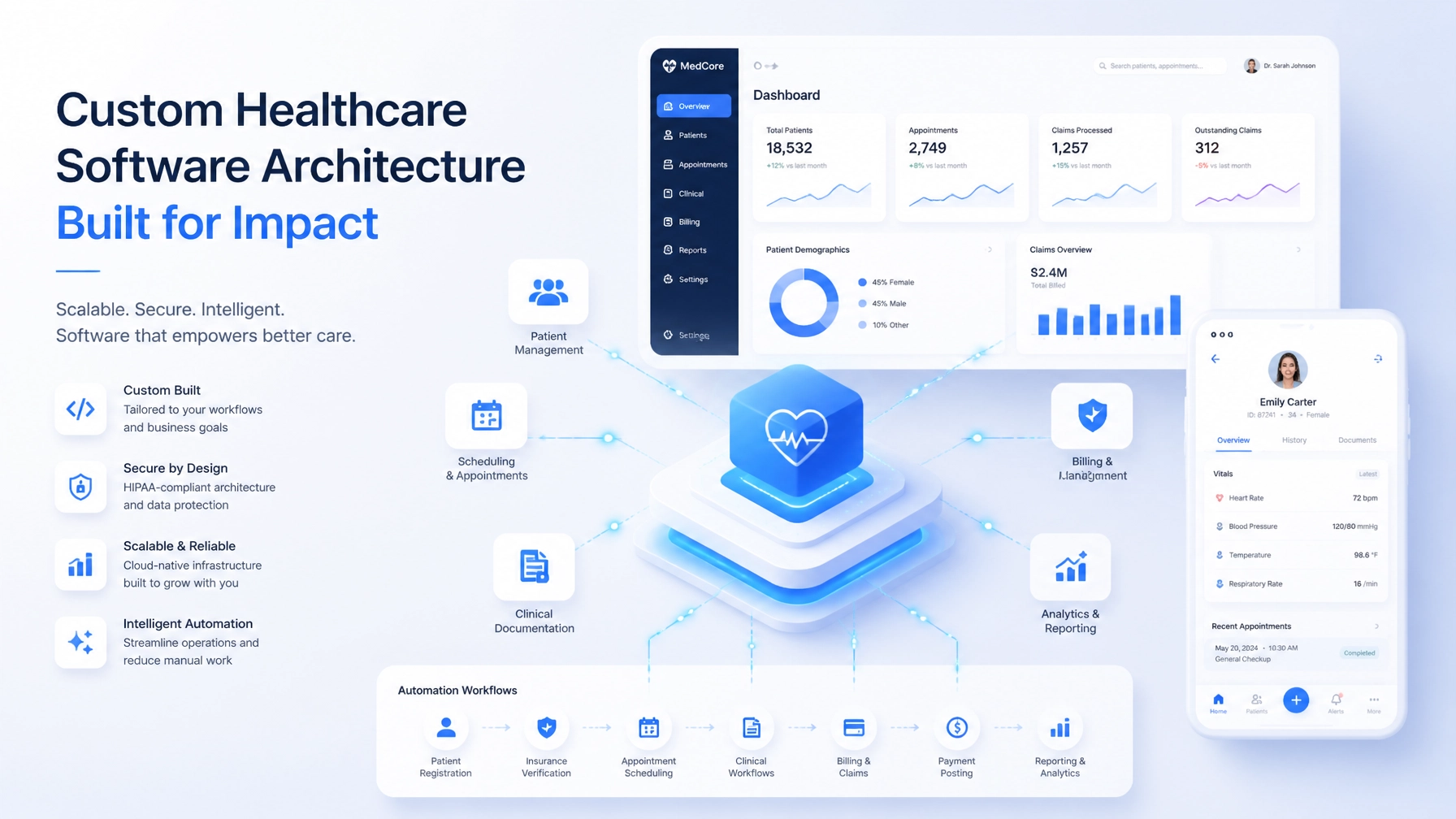
    Consider our EHRIO Pro platform. In the healthcare sector, matching patients with providers requires navigating a maze of 70-question intakes, HIPAA compliance, and complex eligibility rules. Doing this manually is a recipe for burnout and liability. By building high-level matching engines and automated intake workflows, we’ve shown that even the most "human-centric" industries can scale their impact through technology.

    The same principles apply to our fintech and debt recovery integrations. When you are dealing with thousands of automated telephony interactions and attribution points, the system must be flawless. We bring these proven, high-stakes capabilities into sectors like legal and accounting, where the "professional services" model has traditionally been the hardest to scale without excessive hiring.

    Digital icons for healthcare and legal services representing automated compliance and professional scaling.

    The Roadmap to AI-Driven Transformation

    If you are looking at your current operations and wondering where to begin, the answer isn't "automate everything at once." The key to a successful transformation is a structured approach:

    1. Workflow Audit: Identify the processes that have the highest "manual drag" and the lowest strategic value.
    2. Custom Architecture: Avoid the trap of "SaaS sprawl." Instead of buying ten different subscriptions that don't talk to each other, invest in a custom web app or integration layer that fits your specific business logic.
    3. Governance & Compliance: As you scale, ensure your automated systems have the necessary guardrails. This is especially critical in regulated industries like healthcare and finance.
    4. Continuous Optimization: AI systems are not "set and forget." They require a roadmap for evolution as your business model grows.

    At Pure Technology Consulting, we don’t just build software; we architect the future of your company’s growth. We focus on high-ticket, bespoke development that turns your operational bottlenecks into competitive advantages.

    Conclusion: The New Frontier of Growth

    The window for early adoption of AI workflow automation is rapidly closing. The companies that will lead their industries in 2030 are those making the strategic decision today to stop scaling through headcount and start scaling through intelligence.

    Whether you are looking to automate complex healthcare intakes, streamline a national logistics network, or dominate local search across a hundred markets, the technology exists to make your vision a reality. It’s time to move beyond the linear and embrace the exponential.

    If you’re ready to discuss how a custom-built automation strategy can transform your operating model, we invite you to take the next step. Our team is prepared to audit your current workflows and design a roadmap that positions you for limitless scale.

    To learn more about our bespoke development and automation services, visit us at https://puretechconsult.com or schedule a discovery call at +1 (803) 921-0969.

    Amin Said, Founder of Pure Technology Consulting LLC
    https://puretechconsult.com
  • The Ultimate Guide to AI Workflow Automation: How to Scale Without Adding Headcount

    The Ultimate Guide to AI Workflow Automation: How to Scale Without Adding Headcount

    For years, the standard operating procedure for a growing business was simple: as revenue increases, so does the headcount. You hit a capacity ceiling, you hire another coordinator, another analyst, or another specialist. This linear relationship between growth and payroll is exactly what keeps many high-performing firms from achieving true exponential scale.

    As we move through 2026, the landscape has fundamentally shifted. At Pure Technology Consulting, we’re seeing a new breed of organization emerging: one that decouples growth from headcount through sophisticated AI workflow automation. The goal isn’t to replace people; it’s to remove the "operational drag" of manual, repetitive tasks, allowing your existing team to focus on high-value, strategic decision-making.

    This guide outlines how to leverage custom-built automation to scale your operations while maintaining a lean, high-margin team.

    The Strategy: Breaking the Linear Growth Trap

    Traditional automation followed a "if this, then that" logic. It was rigid. If a document didn't look exactly like the template, the system broke. AI workflow automation changes the game by introducing intelligence into the process. We are no longer just moving data from point A to point B; we are interpreting it, classifying it, and making informed decisions along the way.

    For executives, the question isn’t "Can we automate this?" but "Should we automate this to create operational leverage?" Strategic scaling requires looking at your workflows through the lens of ROI. If a process requires 20 hours of manual data entry or document review every week, that’s not just a cost: it’s a bottleneck that prevents your senior talent from performing the work they were actually hired to do.

    Rising exponential curve of blue geometric shapes symbolizing scalable business operations through AI automation.

    Mapping the Path to Intelligent Scaling

    Before you write a single line of code or invest in a platform, you must map your existing operating model. We categorize workflows into three tiers of automation potential:

    1. High-Volume, Low-Complexity: Data entry, invoice processing, and lead routing.
    2. Unstructured Data Interpretation: Reviewing legal documents, medical intakes, or customer sentiment analysis.
    3. Complex Orchestration: End-to-end processes that involve multiple software systems, logic-based triggers, and human-in-the-loop approvals.

    At Pure Technology Consulting, we specialize in Tier 2 and Tier 3. For example, our work with EHRIO Pro demonstrates the power of intelligent matching. In healthcare settings, matching patients with the right providers or services used to require an 70-question manual intake and hours of clinical review. We built a matching engine that handles the heavy lifting of data interpretation, ensuring compliance and precision while freeing up clinicians for patient care. This isn't just "software"; it’s a custom-built solution for a complex, HIPAA-adjacent workflow.

    The Technology Stack: Custom Builds vs. Off-the-Shelf

    While generic SaaS tools have their place, they often fail when faced with the specific nuances of a professional services firm or a specialized industry. A "one-size-fits-all" CRM cannot account for the specific GPS logging and rep accountability required in field operations, nor can it handle the intricate telephony integrations needed for debt agency call attribution.

    This is where bespoke development provides a competitive advantage. When we build custom web applications, we aren't just giving you a dashboard; we are building an integration layer that connects your legacy systems of record with modern AI models.

    Consider ChainHQ, a proprietary framework we utilize to provide visibility across supply chains and internal workflows. By integrating this type of logic into a custom build, a company can automate the monitoring of vendor performance and trigger alerts based on real-time data discrepancies: tasks that would otherwise require a full-time operations manager.

    From Rule-Based to Agentic: The New Operating Model

    The biggest shift in 2026 is the rise of Agentic AI. Unlike standard automation, AI agents can act autonomously within a set of constraints. They don’t just alert you that a contract is missing a signature; they can identify which clause is causing the delay, draft a clarification based on your firm's historical preferences, and queue it for your review.

    We apply this level of sophistication to several key areas:

    1. Document Intelligence and Extraction

    In legal and accounting sectors, the sheer volume of unstructured data is the primary barrier to scaling. AI agents can now "read" thousands of pages of discovery or tax documents, extract key financial metrics, and flag inconsistencies with nearly 100% accuracy.

    2. Local Market Presence at Scale

    For firms that rely on local reputation, managing presence across hundreds of locations is a headcount nightmare. We developed AI Local Boost to handle Google Business Profile automation. It manages reviews, updates, and local SEO signals across multiple branches simultaneously. This allows a single marketing director to do the work that previously required an entire agency team.

    3. Secure Data Hand-offs

    Scaling often leads to security vulnerabilities. FTP Inform is our answer to the need for secure, automated file handling. When you are processing high volumes of sensitive client data, you need an automated pipeline that ensures compliance and notification without manual oversight.

    Integrated AI agents managing secure data, healthcare compliance, and business workflow orchestration.

    Implementation Framework: How We Approach a Workflow Audit

    When a client approaches us for a custom automation project: typically in the $10k+ range: we follow a structured roadmap to ensure the solution fits the operation, not the other way around.

    • Discovery & Scoping: We identify the "operational drag" points. We look for workflows that involve high-ticket stakeholders doing low-ticket tasks.
    • Architecture Design: We design the integration layer. How will the AI "talk" to your existing database? Where are the human-in-the-loop checkpoints?
    • Pilot & Iteration: We don't believe in "set it and forget it." We deploy a proof-of-concept (often using elements of our proven pillars like D2D Tracking for field accountability) to measure the reduction in cycle time.
    • Scaling: Once the logic is verified, we roll the automation out across the department, providing full documentation and training for your lean team.

    Proven Capabilities, Not Prototypes

    Scaling without adding headcount is no longer a visionary "someday" goal: it is a current requirement for staying competitive. Whether it's building HIPAA-compliant matching engines for healthcare or integrating complex telephony systems for fintech, our approach is rooted in bringing proven capabilities to your specific vertical.

    We don't start from scratch. We bring the expertise gained from building high-level matching engines, GPS accountability logs, and automated SEO tools to your unique business problem. This ensures that your custom build isn't a science experiment; it’s a reliable engine for growth.

    Take the Next Step Toward Operational Leverage

    If your growth is currently constrained by your ability to hire and train new staff, you are facing an architectural problem, not a talent problem. The right custom web application combined with intelligent AI workflow automation can act as a "force multiplier" for your existing team.

    Are you ready to audit your workflows and identify where custom software beats a bloated payroll?

    Book a discovery call with our team to explore a bespoke roadmap for your organization.

    Request a Workflow Audit


    Amin Said, Founder of Pure Technology Consulting LLC
    Phone: +1 (803) 921-0969
    https://puretechconsult.com

  • Bespoke AI Solutions Explained in Under 3 Minutes: The Future of Enterprise Efficiency

    Bespoke AI Solutions Explained in Under 3 Minutes: The Future of Enterprise Efficiency

    The term "AI" has been hollowed out by over-marketing, yet the underlying technology remains the most significant lever for operational transformation in a generation. For the executive leadership team, the question isn’t whether to adopt AI, but how to do so without creating a fragmented ecosystem of generic tools that don't actually solve core business friction.

    In under three minutes, let’s define the future: Bespoke AI.

    Bespoke AI is the antithesis of the "off-the-shelf" SaaS model. While generic AI tools provide a broad, shallow layer of utility, bespoke solutions are engineered specifically for your proprietary data, your unique workflows, and your specific regulatory requirements. It is the difference between buying a generic suit and having one tailored to your exact measurements; one "fits," but the other allows for peak performance.

    The 180-Second Breakdown: Why Bespoke AI is the Enterprise Standard

    1. Context is Everything: Generic models are trained on the public internet. Bespoke AI is trained on your institutional knowledge, your client history, and your specific methodology.
    2. Elimination of Operational Drag: Instead of asking your staff to change how they work to fit a new software’s limitations, bespoke AI is built to automate the exact bottlenecks within your existing operating model.
    3. Ownership and Security: You aren't just renting a license; you are building an asset. Bespoke solutions prioritize your governance and compliance frameworks, ensuring that sensitive data remains within your controlled environment.
    4. Competitive Moats: If everyone in your industry uses the same generic AI tool, no one has a competitive advantage. Custom development creates unique capabilities that your competitors simply cannot buy off a shelf.

    Custom-built AI software architecture representing a unique competitive advantage for enterprises.

    Beyond the Hype: The Strategic Stakes of Custom Development

    When we discuss digital transformation at Pure Technology Consulting, we focus on high-level strategy rather than technical hype. The current "subscription fatigue" hitting many enterprises is a direct result of purchasing disconnected SaaS tools that promise efficiency but deliver data silos.

    For high-ticket operations: particularly in the legal, accounting, and healthcare sectors: the stakes are too high for "good enough" software. A generic intake form or a standard document classifier doesn't account for the nuance of a complex litigation case or the specific compliance requirements of a medical matching engine. This is where the roadmap to bespoke development begins.

    Proof of Concept: Lessons from EHRIO Pro

    To understand the power of bespoke engineering, look at how we approached the healthcare sector with EHRIO Pro. In high-stakes medical environments, accuracy isn't a goal: it's a requirement. We developed complex matching engines and 70-question intake workflows that handle HIPAA-adjacent data with precision.

    EHRIO Pro isn't just a product; it’s a demonstration of how custom-built logic can manage massive datasets to produce actionable, human-centric outcomes. By applying this same level of rigor to the legal and accounting sectors, we help firms automate the "heavy lifting" of data reconciliation and client onboarding, allowing their high-value partners to focus on strategy rather than administration.

    The Shift from Generic SaaS to Custom Web Applications

    Many organizations are realizing that "there’s an app for that" is no longer a viable strategy for enterprise scale. Instead, the focus has shifted toward building unified, custom web applications that serve as the "brain" of the company.

    Custom web apps allow for:

    • Deep Telephony Integration: Much like our work in the fintech and debt agency space, where we integrated call attribution and telephony data directly into the workflow, custom apps ensure that every touchpoint is captured and analyzed.
    • GPS and Accountability: For field operations, our work with D2D Tracking proves that custom apps can provide real-time GPS logging and representative accountability that off-the-shelf CRM modules simply miss.
    • Automated Governance: When your software is bespoke, compliance is "baked in," not "bolted on."

    Integrated custom web application hub connecting enterprise systems for automated workflow and governance.

    Case Study in Visibility: AI Local Boost

    Efficiency isn't only internal; it's also about how your firm interfaces with the market. Generic SEO tools often require manual oversight and constant tweaking. We developed AI Local Boost (AILB) as a proof of concept for how AI can automate local SEO and Google Business Profile management.

    AILB demonstrates our ability to take a complex, recurring task: maintaining local search dominance: and turn it into a streamlined, automated engine. For a law firm or an accounting practice with multiple locations, this type of bespoke automation ensures that the brand remains authoritative and visible without requiring a dedicated marketing team to manually update profiles every week.

    Bridging the Gap: Bringing High-Level Automation to Professional Services

    We don't start from scratch. We bring proven capabilities from the most demanding industries: Fintech, Healthcare, and Field Operations: into the professional services arena.

    The same logic that powers a debt agency’s telephony integration can be used to manage a law firm’s billable hours and client communications. The same matching engine that powers EHRIO Pro can be recalibrated to match complex tax code requirements to specific client portfolios in an accounting firm.

    This is the visionary path forward: using custom software to turn your firm's specific expertise into a scalable, automated asset.

    Why the $10k+ Investment Makes Sense

    For an executive looking at a $10,000+ custom development engagement, the ROI isn't found in a simple feature list. It is found in:

    1. Cycle Time Reduction: Cutting the time from lead to onboarded client by 50% or more.
    2. Error Reduction: Eliminating manual data entry across multiple legacy systems.
    3. Throughput: Increasing the volume of cases or audits a firm can handle without increasing headcount.
    4. Intellectual Property: Building software that belongs to you, increasing the overall valuation of your firm.

    Scalable growth pillars representing the high ROI and long-term value of bespoke enterprise AI solutions.

    The Roadmap to Transformation

    The transition to a bespoke AI operating model follows a structured strategy:

    • Discovery & Audit: We examine your existing legacy systems and identify where manual workarounds are slowing you down.
    • Architecture & Governance: We design a roadmap that prioritizes data security and seamless integration with your current tech stack.
    • Implementation of Proprietary Engines: Whether it’s leveraging the data flow logic of FTP Inform to handle supply chain communications or using ChainHQ's methodology for workflow transparency, we deploy proven architectures tailored to your needs.
    • Continuous Optimization: Unlike SaaS, which remains static, bespoke software evolves with your business.

    Final Thoughts: The Cost of Inaction

    In an era where AI is democratized, the only way to maintain a premium position is through proprietary technology. Relying on generic tools is a race to the bottom: it commoditizes your services.

    Bespoke AI solutions are not just about "efficiency"; they are about defining how your enterprise will lead in an automated world. By investing in custom web apps and high-level automation today, you are securing your firm's place as a visionary leader for the next decade.

    If you are ready to move beyond generic solutions and explore what a tailored automation roadmap looks like for your organization, let’s begin the discovery process.


    Amin Said, Founder of Pure Technology Consulting LLC
    https://puretechconsult.com
    +1 (803) 921-0969

  • The Ultimate Guide to AI Workflow Automation: Everything You Need to Succeed with Bespoke Systems

    The Ultimate Guide to AI Workflow Automation: Everything You Need to Succeed with Bespoke Systems

    In the current landscape of digital transformation, "automation" is no longer a buzzword: it is the baseline for survival. However, as we move deeper into 2026, a clear divide has emerged between companies that use generic, off-the-shelf SaaS tools and those that leverage bespoke AI workflow automation. The former are often trapped in "integration hell," trying to force their unique business logic into rigid software templates. The latter: the visionaries: are building custom operating models that treat AI as a core team member rather than just a tool.

    At Pure Technology Consulting, we view AI workflow automation as the art of the possible. It is about moving beyond simple "if-this-then-that" logic and into the realm of agentic systems that can interpret, decide, and act. This guide explores how high-ticket custom systems can redefine your operational efficiency and why a bespoke approach is the only way to achieve true competitive advantage.

    The Evolution of the Operating Model: From Static to Intelligent

    Traditional automation was transactional. You moved a file from point A to point B. AI-powered workflow automation is transformational. It involves minimizing manual intervention in complex, adaptive processes that learn and improve over time. Instead of just moving the file, a bespoke system understands the content of that file, determines its priority, cross-references it with your CRM, and triggers a personalized response: all without a human clicking a single button.

    For executives in high-stakes industries like legal, accounting, and healthcare, the value isn't just in "saved hours." It’s in risk mitigation, data integrity, and the ability to scale without a linear increase in headcount. When you build a bespoke system, you aren't just buying software; you are codifying your firm's intellectual property into a digital engine.

    Visualizing the evolution from rigid software to intelligent bespoke AI workflow automation systems.

    Architecture of a Bespoke AI System

    To succeed with custom automation, you must understand the three pillars of a modern intelligent workflow:

    1. The Orchestration Engine: This is the "brain" that manages task coordination across your departments. It tracks the status of a process and maintains flexibility to adapt based on real-time insights.
    2. Adaptive ML Models: These provide the intelligence. Whether it’s predictive models for forecasting revenue or natural language models for interpreting complex legal contracts, these models are tuned to your specific data.
    3. The Data Integration Framework: Bespoke systems thrive on connectivity. Your automation must have deep, secure access to your ERP, CRM, and digital asset libraries to ensure a "single source of truth."

    Product Spotlight: FTP Inform and Secure Data Intelligence

    A prime example of how we approach these components is FTP Inform. While many businesses struggle with the manual management of file transfers and data ingestion, we developed FTP Inform to serve as a proof-of-concept for secure, automated data handling.

    In a bespoke engagement, we don't just give you a login; we integrate these capabilities directly into your workflow. For instance, if a client uploads a sensitive financial document, FTP Inform doesn't just store it: it triggers a custom automation that parses the data for anomalies, alerts the relevant partner, and updates the project management dashboard. This is the difference between a "tool" and a "system."

    Why Bespoke Development Beats "Leaky" SaaS

    Most SaaS products are built for the "average" user. But your business isn't average. When you rely on generic platforms, you often encounter the "leaky bucket" syndrome: data gets lost between integrations, or you have to change your proven business processes to fit the software's limitations.

    Custom web applications, on the other hand, are built around your existing excellence. For example, our work in the healthcare sector with EHRIO Pro demonstrates this perfectly. We built matching engines and 70-question intake systems that are HIPAA-adjacent and tailored to specific patient-matching logic. We didn't ask the clinics to change how they treat patients; we built the software to mirror their best practices.

    Abstract representation of secure, multi-layered data architecture for custom software and AI integration.

    Strategic Implementation: A Roadmap for Executives

    Implementing a bespoke AI workflow requires a strategic approach rather than a purely technical one. Here is how we guide our clients through the process:

    1. The Discovery and Audit Phase

    We start by identifying "operational drag." This involves looking at high-volume tasks that require human decision-making but follow a discoverable pattern. We often find these in intake processes, contract analysis, or multi-location reporting.

    2. Prototyping with Proprietary Assets

    At Pure Technology Consulting, we don't start from a blank page. We bring "authority anchors" to every project. Whether it’s leveraging our experience with ChainHQ for complex supply chain logistics or using the logic behind AI Local Boost to automate Google Business Profile management for multi-location firms, we use our existing proprietary tech to accelerate your custom build.

    3. Scaling Through Agentic AI

    Once the foundation is set, we deploy AI agents. These aren't just chatbots; they are autonomous workers. According to recent research, over 52% of companies now see the automation of complex, multi-step workflows as the primary benefit of agentic AI. These agents can handle the "first pass" of a legal discovery or an accounting audit, leaving your high-level experts to handle the final review.

    Authority Anchors: Proven Success in Complex Verticals

    We bring a wealth of experience from highly regulated and high-volume industries. Our prior work serves as the blueprint for your future system:

    • Fintech & Debt Management: We have integrated complex telephony systems with call attribution and automated debt recovery workflows.
    • Ops & Field Services: Our D2D Tracking solutions include rep accountability and GPS logging, ensuring that field data is as accurate as office data.
    • Local SEO & Marketing: Through AI Local Boost, we have mastered the art of automating local presence at scale, a capability we often integrate into bespoke CRM builds for regional service providers.

    Agentic AI command center managing automated data workflows across legal, healthcare, and finance sectors.

    The Pure Technology Consulting Difference

    We are not just a software agency; we are a strategic partner. When you work with us, you are working with a team that understands the executive's need for governance, compliance, and a clear ROI. Our founder, Amin Said, personally oversees the visionary direction of our high-ticket engagements, ensuring that every line of code serves a business objective.

    If your current systems feel like they are holding you back rather than propelling you forward, it is time for a workflow audit. We specialize in taking the complexity of your daily operations and turning it into a streamlined, AI-powered competitive advantage.

    Ready to Automate Your Excellence?

    Transitioning from manual chaos to bespoke automation is a 2-to-6-week journey that can redefine your next decade of growth. Whether you need a custom HIPAA-compliant matching engine or a global data ingestion system, we have the architectural expertise to build it.

    Contact us today to schedule a consultation:
    Phone: +1 (803) 921-0969
    Website: puretechconsult.com/schedule

    Explore our insights and case studies on our blog or view our video walkthroughs to see our bespoke systems in action.

    Amin Said, Founder of Pure Technology Consulting LLC
    https://puretechconsult.com

  • The Ultimate Guide to AI Workflow Automation: Everything You Need to Succeed

    The Ultimate Guide to AI Workflow Automation: Everything You Need to Succeed

    The landscape of modern business is no longer defined by who can work the hardest, but by who can build the smartest systems. As the CFO of Pure Technology Consulting, I’ve seen firsthand how the conversation in boardrooms has shifted. We’re moving away from "How do we hire more people to handle this growth?" and toward "How do we architect a system that grows without needing a linear increase in headcount?"

    This is the promise of AI workflow automation. It isn’t just about replacing a few manual clicks with a script; it’s about creating a visionary operating model where intelligence is baked into every layer of your business process. In this guide, we’re going to explore how to move beyond basic automation into the realm of intelligent orchestration.

    Redefining Workflow Automation for the AI Era

    For years, "automation" meant simple, rule-based triggers. If X happens in your CRM, then do Y in your email marketing tool. While useful, these legacy systems were brittle. If the data looked slightly different than expected, the whole thing broke.

    AI workflow automation changes the game by introducing reasoning. Instead of just following a path, the system understands the context. It uses natural language processing (NLP) to read a contract, machine learning (ML) to predict a customer’s needs, and intelligent document processing to extract data from a blurry invoice.

    At Pure Technology Consulting, we view AI automation as the "integration backbone" of a modern enterprise. It’s the difference between a static assembly line and a self-correcting ecosystem.

    Intelligent neural network nodes representing the backbone of modern AI automation and digital transformation.

    The Strategic Stakes: Why Automation is an Executive Priority

    From a strategic perspective, the "cost of inaction" is becoming the single greatest risk for mid-market and enterprise firms. When your competitors are using AI to respond to RFPs in minutes while your team takes days, the gap isn't just operational: it’s existential.

    1. Operational Leverage: You want to decouple your revenue from your headcount. By automating high-volume repetitive tasks, you allow your high-ticket talent to focus on strategy and relationship building.
    2. Data Integrity: Human error is the silent killer of profitability. AI systems don’t get tired; they catch inconsistencies in legal documents or accounting ledgers that a human eye might miss after eight hours of work.
    3. Scalability at Zero Marginal Cost: Once an AI workflow is built and integrated, processing 1,000 documents costs nearly the same as processing ten. This is how you prepare for 10x growth without a 10x increase in overhead.

    How AI Workflows Actually Function

    Understanding the anatomy of an intelligent workflow is crucial for any leader looking to invest in bespoke software development. We break it down into four primary phases:

    1. The Input Layer (Data Collection)

    This is where the system "senses" the world. Whether it’s an email coming into a support desk, a new file uploaded to an FTP server, or a lead form on a website, the AI pulls information from structured and unstructured sources.

    2. The Cognitive Layer (Processing & Interpretation)

    This is the "brain." The system cleans the data, categorizes it, and interprets intent. For example, in a legal context, the AI might identify whether a document is a Non-Disclosure Agreement or a Master Service Agreement and highlight the liability clauses.

    3. The Decision Layer (Orchestration)

    Based on the interpretation, the system determines the next best action. Should it approve the document? Should it route it to a human for review? Should it trigger a payment?

    4. The Action Layer (Execution)

    The workflow executes the task: sending the email, updating the ERP, or generating a custom report.

    Visual representation of an AI intelligence hub managing complex business process automation cycles.

    Proof of Concept: Beyond Generic SaaS with ChainHQ

    While many businesses try to patch together various SaaS tools, the most successful organizations realize that generic solutions often create more silos. This is where proprietary architecture like our ChainHQ comes into play.

    ChainHQ serves as a prime example of how we approach complex web applications and automation. Instead of a "one-size-fits-all" approach, we use ChainHQ to demonstrate how disparate systems: telephony, CRM, and internal databases: can be chained together into a singular, intelligent flow. For our clients in fintech and debt recovery, this means taking call attribution data and automatically triggering specific legal workflows without a single manual entry. It’s about building a bespoke "nervous system" for your business rather than just buying another software subscription.

    A Roadmap for Implementation: Where to Start

    If you’re looking to transform your operations, you can’t automate everything at once. You need a roadmap.

    Identify High-Impact Workflows

    Look for "bottleneck" processes. These are usually:

    • High-volume tasks that require human decision-making.
    • Processes involving unstructured data (emails, PDFs, voice notes).
    • Workflows that require real-time responses to changing conditions.

    The "Human-in-the-Loop" Pattern

    One of the biggest mistakes companies make is trying to remove humans entirely too soon. A visionary approach uses AI as a "Co-Pilot." The AI handles 90% of the heavy lifting and presents the final 10% to a human expert for a "sanity check." This ensures compliance and quality while still realizing massive efficiency gains.

    Integration is Everything

    Your automation is only as good as its connection to your systems of record. We specialize in building custom web apps that act as the glue between your legacy systems and modern AI models. Whether it’s integrating with a specialized healthcare database or a global ERP, the goal is a seamless flow of data.

    Futuristic data bridge connecting legacy software systems through an intelligent AI integration backbone.

    Industry-Specific Power Pillars

    At Pure Technology Consulting, we don’t just build software; we apply proven capabilities to specific high-stakes industries.

    • Healthcare & EHRIO Pro: We’ve mastered HIPAA-adjacent workflows, such as 70-question intake forms and matching engines that connect patients with providers. Our EHRIO Pro platform demonstrates our ability to handle sensitive data and complex logic at scale.
    • Legal & Accounting: We take the same rigor from healthcare and apply it to the "document-heavy" worlds of law and finance. Imagine an AI that doesn't just store files, but understands the lifecycle of a case or an audit.
    • Local SEO & AI Local Boost (AILB): For businesses looking to dominate local markets, we developed AI Local Boost. It’s a testament to our ability to automate Google Business Profile updates and local signals, turning a manual marketing task into an automated growth engine.
    • Field Operations: Through our work with D2D Tracking, we’ve built systems for rep accountability and GPS logging, proving that AI automation can extend from the office all the way to the field.

    Common Pitfalls to Avoid

    As you embark on this journey, keep these three warnings in mind:

    1. Over-Complicating the MVP: Start with one clear, high-value workflow. Prove the ROI, then expand.
    2. Neglecting Data Security: Especially in legal and healthcare, "off-the-shelf" AI tools can pose a security risk. This is why we advocate for bespoke, secure environments.
    3. Ignoring the Culture: Automation can be scary for employees. Frame it as "giving them superpowers" rather than "replacing their roles." When the AI handles the data entry, they get to do the work they actually enjoy.

    Human hand interacting with a bespoke software interface representing the synergy of AI and human talent.

    The Future is Bespoke

    The era of "buying an app for that" is maturing into the era of "building a system for us." To truly succeed in AI workflow automation, you need more than a tool: you need a strategy. You need a partner who understands the technical architecture of custom web development and the strategic needs of a growing business.

    Whether you are looking to streamline your document processing, automate your client intake, or build a complex SaaS solution from the ground up, the path forward starts with a clear vision and a robust integration strategy.

    Are you ready to stop managing manual tasks and start leading an automated enterprise? We’re here to help you scope the roadmap.

    Ready to discuss your custom automation roadmap?
    Book a discovery call today or visit our video walkthroughs to see our work in action.

    Contact Us:
    Phone: +1 (803) 921-0969
    Website: https://puretechconsult.com

    Amin Said, Founder of Pure Technology Consulting LLC
    https://puretechconsult.com

  • 7 Mistakes You’re Making with AI Workflow Automation (and How to Fix Them)

    7 Mistakes You’re Making with AI Workflow Automation (and How to Fix Them)

    The promise of artificial intelligence is no longer a futuristic concept: it is the current engine of operational excellence. As a CFO or executive leader, you likely view AI workflow automation as the ultimate lever for scaling your business without a linear increase in headcount. However, the bridge between "implementing AI" and "realizing transformative ROI" is often paved with common, yet expensive, errors.

    At Pure Technology Consulting, we’ve seen organizations invest six figures into automation only to find themselves with faster-running chaos. True digital transformation isn’t about just adding a "bot" to a task; it’s about architecting a bespoke operating model where technology and strategy align.

    Here are the seven most common mistakes businesses make when automating their workflows: and the visionary strategies required to fix them.


    1. Automating an Inefficient, Broken Process

    The most dangerous thing you can do is automate a process that was never optimized to begin with. If your manual workflow for client onboarding is convoluted, riddled with redundant steps, and relies on fragmented communication, adding AI will only accelerate those errors. You end up with "automated chaos," where mistakes reach your clients at machine speed.

    The Fix: Conduct a comprehensive workflow audit before writing a single line of code. At Pure Technology Consulting, we recommend a "First Principles" approach: deconstruct the workflow to its desired outcome and rebuild it for an AI-first environment. Ask yourself: if we started this department today with modern technology, would this step even exist?

    Digital art showing a chaotic manual process transformed into a streamlined AI workflow grid.

    2. Over-Reliance on "One-Size-Fits-All" SaaS Solutions

    Many firms attempt to solve complex, high-ticket operational hurdles with generic off-the-shelf SaaS tools. While these platforms are excellent for simple tasks, they often lack the deep integration and security protocols required for enterprise-level data handling. This results in "SaaS sprawl," where your data is trapped in silos that don't talk to each other.

    The Case for Custom Architecture (FTP Inform):
    Consider how we approach secure data transfers. For organizations handling high volumes of sensitive documentation: such as legal firms or accounting practices: generic file-sharing tools often fall short of compliance and automation needs. We developed FTP Inform as a testament to how specialized, custom-built automation can streamline the "unstructured data" problem. By creating bespoke triggers that alert the right stakeholders and trigger downstream workflows the moment a file hits a server, we transform a simple file transfer into a strategic data event.

    The Fix: Evaluate whether your problem is a generic task or a core business differentiator. If it’s the latter, a custom web application or a deeply integrated automation layer will always outperform a generic subscription service.

    3. Neglecting Data Integrity and the "GIGO" Principle

    Garbage In, Garbage Out (GIGO) is a law of nature in AI automation. If your underlying data: your CRM records, your financial logs, or your client history: is inconsistent or poorly formatted, your AI will make flawed decisions. An AI-powered credit scoring automation is useless if the input data lacks standardized formatting.

    The Fix: Prioritize data hygiene as a foundational project. Before launching a wide-scale automation, implement data validation layers. This ensures that every piece of information entering your automated ecosystem is verified, cleaned, and categorized.

    4. Failing to Build "Human-in-the-Loop" for High-Stakes Compliance

    In industries like healthcare or finance, full 100% autonomy can be a liability. A common mistake is removing human oversight entirely in an effort to maximize speed. This creates a "black box" where decisions are made without a clear audit trail or a safety net for edge cases.

    The Proof of Concept (EHRIO Pro):
    Our work with EHRIO Pro serves as a perfect example of how to balance high-level automation with human intelligence. Built for healthcare environments where HIPAA-adjacent workflows and complex intakes are the norm, EHRIO Pro utilizes a 70-question intake matching engine. It automates the heavy lifting of data collection and initial categorization but is designed to present that data to a human expert for the final decision.

    The Fix: Design your custom software with "checkpoints." Use AI to handle the 90% of repetitive processing, but flag the 10% of high-complexity cases for senior advisory review. This protects your brand and ensures compliance.

    Professional overseeing custom software automation through a human-in-the-loop digital interface.

    5. Ignoring Governance and the "Scalability Wall"

    When initial automations succeed, it’s tempting to scale as fast as possible. However, without a centralized governance framework, you will eventually hit the "Scalability Wall." This is the point where you have so many disconnected automated scripts and triggers that a single update to one system breaks five others.

    The Solution (ChainHQ):
    Strategic automation requires a centralized "command center." We built ChainHQ to demonstrate the power of managing complex, multi-step chains of command and supply chain logic. By centralizing the logic of how different tasks interact, you can scale indefinitely without the risk of systemic collapse.

    The Fix: Before scaling, establish an Automation Center of Excellence (CoE). Use a platform-first mindset where every new automation must adhere to your organization's architectural standards.

    6. Neglecting the Local Feedback Loop and Reputation

    Automation often focuses inward on operational efficiency while forgetting that a business exists in an ecosystem of customers. Many companies automate their backend but fail to automate the "last mile" of the customer experience: specifically, how that efficiency translates into local visibility and reputation.

    The Local Impact (AI Local Boost):
    We developed AI Local Boost to solve this specific gap. It’s not enough to have a great internal workflow; your excellence must be visible. By automating Google Business Profile management and review responses, we ensure that the efficiency our clients achieve internally is reflected in their local SEO and public reputation. It’s an "outward-facing" automation that drives top-of-funnel growth while the backend automation handles the fulfillment.

    The Fix: Ensure your automation roadmap includes milestones for customer-facing impact. Every hour saved in the back office should theoretically lead to a faster response time or a better service experience for the client.

    Network visualization of AI-powered local reputation management and customer service impact.

    7. Measuring Activity Instead of Outcomes

    Finally, the most common executive mistake is measuring the success of AI automation by "tasks completed" rather than "business outcomes." Processing 1,000 invoices per hour is an activity. Reducing your payment cycle from 30 days to 12 days is an outcome.

    The Fix: Define your KPIs based on business impact. We help our clients look at metrics like:

    • Cycle Time Reduction: How much faster are we delivering value?
    • Error Rate Mitigation: How much did we save by avoiding manual re-work?
    • Throughput per Employee: How much more revenue can our current team manage?

    Transforming Your Strategy

    AI workflow automation is the most potent tool in the modern CFO's arsenal, but it requires a visionary's perspective to implement correctly. It is not a "set it and forget it" solution; it is a continuous process of refinement, integration, and strategic alignment.

    If you are looking to move beyond simple triggers and into the world of bespoke, high-performance custom applications that truly move the needle, we are here to help. Whether it’s architecting a complex matching engine like EHRIO Pro or securing your data pipelines with tools like FTP Inform, our focus is on building the infrastructure for your company’s next decade of growth.

    Ready to audit your current workflows and identify the high-ticket opportunities for custom automation?

    Book a discovery call with our team to start your roadmap.

    Amin Said, Founder of Pure Technology Consulting LLC
    https://puretechconsult.com

    +1 (803) 921-0969

  • 7 Mistakes You’re Making with AI Workflow Automation (and How to Fix Them)

    7 Mistakes You’re Making with AI Workflow Automation (and How to Fix Them)

    As we navigate the business landscape of 2026, the question for most executives is no longer "Should we automate?" but "Why isn't our automation working as promised?"

    At Pure Technology Consulting, we’ve seen a massive shift in how firms approach digital transformation. The initial hype of 2023 and 2024 has matured into a pragmatic need for systems that actually move the needle on the P&L. Yet, many organizations are still falling into the same traps, treating AI automation as a "plug-and-play" miracle rather than a strategic operating model.

    If your automation initiatives are stalling, or if you’re seeing "silent failures" in your workflows, you’re likely making one of these seven common mistakes. Here is how to diagnose the drag and fix it for good.

    1. Automating the "Chaos Loop" (Broken Processes)

    The single most expensive mistake a CFO can oversee is the automation of an inefficient, manual process. If your current workflow is redundant, relies on messy spreadsheets, or involves three different people "checking" the same data point, automating it simply accelerates the chaos.

    The Fix: Before you write a single line of code or deploy an AI agent, you must perform a workflow audit. At Pure Technology Consulting, we advocate for the "Simplify, then Amplify" approach. We look at the bespoke requirements of your operation first. For example, when we work with healthcare or legal firms, we often utilize frameworks similar to our EHRIO Pro platform. It’s designed to handle complex, 70-question intakes and HIPAA-adjacent workflows by creating a structured matching engine first. By ensuring the logic is sound at the intake level, the automation that follows is clean, compliant, and actually reduces cycle time rather than just creating more digital noise.

    Digital visualization of streamlining chaotic manual processes into optimized AI workflow automation.

    2. The "SaaS Squeeze": Choosing Tools Over Strategy

    Many firms try to patch together ten different "No-Code" SaaS subscriptions to build an AI workflow. This leads to what we call the "SaaS Squeeze": where your data is siloed across various platforms, and you’re paying thousands in monthly seat licenses for tools that don't talk to each other.

    The Fix: Transition from a "tool-first" mindset to a "platform-first" mindset. Instead of trying to bend a generic CRM to fit your unique field operations, consider a custom-built web application. We’ve demonstrated this capability through proprietary projects like our D2D Tracking systems, where we integrated GPS logging and rep accountability into a single, cohesive interface. When your software is bespoke, the automation is baked into the architecture, not "bolted on" with fragile third-party integrations.

    3. Ignoring the "Garbage In, Garbage Out" Reality

    AI is only as visionary as the data it feeds on. We see many companies attempting to launch AI-driven customer service or predictive analytics while their underlying database is a graveyard of duplicates and inconsistent formatting. According to industry standards, bad data costs businesses trillions in wasted operational drag.

    The Fix: Implement strict data governance at the point of entry. This is where a consultative approach beats a software-only approach. We help clients build validation rules that act as gatekeepers. Think of how we use AI Local Boost for Google Business Profile automation. The success of that tool isn't just in the "posting": it’s in the structured way it handles local SEO data to ensure the AI isn't hallucinating information about your business locations. Clean data leads to clean automation.

    Strategic data purification transforming fragmented data into structured information for AI automation.

    4. The "Set-and-Forget" Fallacy

    Automation is often sold as a way to "fire your problems." In reality, automated workflows are living systems. APIs change, data schemas evolve, and AI models can "drift" over time. A silent failure in an automated billing cycle can go unnoticed for months, resulting in massive revenue leakage.

    The Fix: You need a monitoring and notification layer that keeps the humans in the loop when exceptions occur. This is why we developed FTP Inform. In complex enterprise environments, data transfers (FTP/SFTP) are often the backbone of the business, yet they are rarely monitored effectively. FTP Inform provides that missing visibility: alerting stakeholders the moment a file transfer fails or data isn't where it should be. High-ticket automation requires high-level oversight.

    5. Neglecting the User Experience (Internal and External)

    If your automated workflow makes life harder for your employees or creates a "robotic" and frustrating experience for your clients, it will fail. We see this often in debt agency telephony integrations or call attribution setups. If the AI doesn't feel human or the dashboard is too complex for a staff member to use, they will find manual workarounds.

    The Fix: Design for the "Human-in-the-Loop." Your custom web apps should be intuitive. When we build fintech or debt collection solutions, we focus on the UI/UX of the telephony integration. The goal is to empower the user with AI-driven insights in real-time, not to replace the human element entirely. The automation should be the "wind at the back" of your team, not a wall they have to climb over.

    A person interacting with a digital display symbolizing human-in-the-loop AI workflow integration.

    6. Scaling Too Fast Without Governance

    It’s tempting to see one successful automation and try to apply it to every department overnight. However, scaling without a centralized strategy leads to "Shadow IT," where different departments are running different (and often conflicting) automations.

    The Fix: Centralize your automation roadmap. This is a primary focus of our work with ChainHQ, where we manage complex supply chain and operations workflows. By having a central "headquarters" for your chains of command and data flow, you ensure that as you scale from one department to ten, the integrity of your operating model remains intact. You need a partner who understands how to bridge the gap between "cool tech" and "enterprise-grade infrastructure."

    7. Measuring Vanity Metrics Over ROI

    Processing 10,000 invoices an hour is a great stat, but if 20% of them have errors that require manual correction, you haven't actually saved money: you've just moved the bottleneck. Many firms measure "activity" instead of "impact."

    The Fix: Focus on high-level KPIs: Cycle Time Reduction, Error Rate improvement, and Throughput. At Pure Technology Consulting, we help our clients define these benchmarks before we build. Whether it’s a custom matching engine for a legal firm or a local SEO boost for a franchise, the goal is always a measurable increase in operational leverage.

    Moving Toward a Visionary Future

    AI workflow automation is the most powerful lever available to the modern executive, but it requires a surgeon’s precision, not a sledgehammer. At Pure Technology Consulting, we specialize in building the bespoke web applications and high-level automations that turn these "mistakes" into competitive advantages.

    We don't just sell software; we build the digital infrastructure that allows your company to scale without the traditional overhead. From HIPAA-adjacent healthcare workflows to complex fintech integrations, we bring proven capabilities to the table to ensure your transformation is both inspirational and, more importantly, profitable.

    Ready to audit your workflows and stop the operational drag?

    Let’s move past the "off-the-shelf" limitations and build something that fits your business perfectly. Reach out to our team to discuss your custom software and automation needs.

    Contact Us:
    Phone: +1 (803) 921-0969
    Schedule a Discovery Call: https://puretechconsult.com/schedule

    Amin Said, Founder of Pure Technology Consulting LLC
    https://puretechconsult.com

  • Why AI Workflow Automation Will Change the Way You Manage Your Team Forever

    Why AI Workflow Automation Will Change the Way You Manage Your Team Forever

    As we navigate through the second quarter of 2026, the definition of "effective management" has undergone a radical transformation. The days of the manager acting as a glorified traffic cop: manually routing tickets, chasing status updates, and triaging emails: are rapidly coming to an end. We have entered the era of the Autonomous Operating Model, where AI doesn't just assist your team; it orchestrates the very fabric of how work flows through your organization.

    At Pure Technology Consulting, we have seen this shift firsthand. It isn’t about replacing the human element; it’s about liberating it. When you remove the "operational drag" of routine decision-making, you empower your leaders to focus on high-level strategy, mentorship, and creative problem-solving. This is the roadmap to scaling a high-ticket service business without the proportional increase in management overhead.

    The Death of the "Human Middleware"

    For decades, middle management has functioned as "human middleware": the bridge between a client’s request and a technician’s execution. This layer of the business is often where the most friction occurs. Information gets lost, priorities are misinterpreted, and bottlenecks form as work waits for human approval.

    AI workflow automation solves this by applying consistent, high-velocity logic to every interaction. Imagine a system that doesn't just store data but understands it. When a new lead or a support request enters your ecosystem, an AI-powered engine can instantly analyze the intent, categorize the urgency, and assign the task to the specific team member whose current bandwidth and skill set are the perfect match for that requirement.

    This isn’t a futuristic concept; it is the baseline for competitive operations in 2026. By automating the "if-this-then-that" of daily management, you transform your team from a reactive group into a proactive powerhouse.

    AI workflow automation organizing chaotic data into streamlined business processes for improved team management.

    Scaling Expertise Through Custom AI Engines

    One of the primary challenges for legal, accounting, and high-level consulting firms is the "Intake Bottleneck." High-ticket clients require deep discovery, but your senior partners shouldn't be spending their hours on basic data collection.

    We’ve applied these principles to our proprietary builds, such as EHRIO Pro. In the healthcare sector, we developed complex matching engines and 70-question intake workflows that handle HIPAA-adjacent data with surgical precision. This type of bespoke automation doesn't just "save time": it ensures that by the time a human expert steps in, they are working with a perfectly curated set of data, ready for high-level decision-making.

    When we build custom web applications for our clients, we aren't just giving them a new dashboard. We are building a digital nervous system. Whether it’s automating local SEO dominance through AI Local Boost or managing complex telephony integrations for debt agencies, the goal is the same: to make the system smarter so the people can be more strategic.

    From Tactical Supervision to Strategic Orchestration

    When AI manages the workflow, the role of the manager shifts from supervision to orchestration. You are no longer checking if a task was done; you are analyzing the data to see how the process can be optimized.

    1. Real-Time Visibility and Governance

    Generic SaaS tools often provide data that is 24 hours old. In a custom-built automation environment, your visibility is instantaneous. You can see blockers the moment they arise. This is the level of governance we bake into tools like ChainHQ, where transparency and data integrity are paramount. If a workflow stalls, the system doesn't just report it; it can trigger contingency protocols to keep the project moving.

    2. Eliminating Decision Fatigue

    Managers make hundreds of micro-decisions every day. "Who should take this call?" "Is this document ready for review?" "Does this meet our compliance standards?" AI is exceptionally good at handling these micro-decisions. By offloading these to an automated engine, you preserve your team’s cognitive energy for the "Macro-Decisions": the ones that actually drive revenue and growth.

    3. Consistency at Scale

    Humans have bad days; AI does not. Automation ensures that every client receives the same high standard of service, every time. Whether it's the way files are managed via FTP Inform or the way a field rep’s GPS data is logged for accountability, the system provides a "floor" of quality that never wavers.

    Strategic oversight of a bespoke software automation ecosystem connecting team data and business operations.

    The Competitive Edge of Bespoke Automation

    There is a common misconception that you can achieve this level of transformation by simply stacking 20 different SaaS subscriptions. The reality is that "SaaS Sprawl" often creates more work, as your team now has to manage the integrations between those tools.

    The future belongs to the firms that invest in Custom Web Applications tailored to their unique operating models. At Pure Technology Consulting, we specialize in building these bespoke engines. We take the proven capabilities we've developed in fintech, healthcare, and professional services and apply them to your specific bottlenecks.

    For example, our work with debt agencies involved complex telephony integrations and call attribution. We didn't just give them a dialer; we gave them a system that understood which calls were most likely to convert based on historical data patterns. This is the difference between a "tool" and a "competitive advantage."

    What to Automate First: The Discovery Roadmap

    If you are looking at your current team and feeling the weight of operational drag, the question isn't if you should automate, but where you should start. We recommend focusing on the "High-Frequency, Low-Complexity" tasks first:

    • Intake and Onboarding: Use sophisticated matching engines to route clients to the right advisors.
    • Data Management and Transfers: Use secure, automated protocols like those found in FTP Inform to ensure data is where it needs to be, without manual intervention.
    • Routine Reporting: Stop spending Fridays building spreadsheets. Let the system surface the insights for you.
    • Local Market Dominance: Automate your Google Business Profile and local presence using the logic behind AI Local Boost to ensure you stay top-of-mind without manual posting.

    A strategic digital roadmap illustrating the growth path for businesses adopting AI workflow automation.

    A Vision for the Future of Work

    By 2027, the gap between "automated" firms and "manual" firms will be an unbridgeable chasm. The automated firm will be able to handle 5x the volume with the same headcount, all while providing a more personalized, responsive experience for their clients.

    The transition to AI workflow automation is a strategic pivot. It requires a partner who understands the nuances of software development, the complexities of data security, and the realities of high-stakes business operations. We bring the expertise from building EHRIO Pro and ChainHQ to your boardroom, helping you design a custom roadmap that fits your specific vision.

    Your team’s time is your most valuable asset. Stop wasting it on work that a machine can do better, faster, and more accurately. It’s time to move beyond managing tasks and start leading a legacy.


    Ready to Architect Your Autonomous Future?

    If you are ready to eliminate operational drag and scale your expertise through custom AI automation, let’s start the conversation. We provide bespoke consulting and development for firms that refuse to be slowed down by outdated workflows.

    Contact Pure Technology Consulting today:
    Phone: +1 (803) 921-0969
    Book a Discovery Call

    Amin Said, Founder of Pure Technology Consulting LLC
    https://puretechconsult.com

  • The Ultimate Guide to AI Workflow Automation: Everything You Need to Succeed in 2026

    The Ultimate Guide to AI Workflow Automation: Everything You Need to Succeed in 2026

    Welcome to 2026. If you’re reading this, you’ve likely realized that the "AI hype" of the early 2020s has matured into a fundamental shift in how business operates. We aren't just talking about chatbots anymore; we are talking about autonomous operating models.

    As a CFO, I look at automation through a specific lens: operational leverage. It’s not just about cutting costs, though that’s a nice side effect, it’s about expanding your capacity to generate revenue without a linear increase in headcount. In 2026, the winners aren't those with the biggest teams, but those with the most intelligent workflows.

    At Pure Technology Consulting, we’ve spent years building the infrastructure that makes this possible. This guide is designed to take you through the strategic landscape of AI workflow automation, showing you how to move from manual drag to high-velocity execution.

    The Paradigm Shift: From Task Automation to Agentic Workflows

    For years, automation was "if this, then that." You’d connect two apps, and a piece of data would move from Point A to Point B. In 2026, that’s baseline. The real competitive advantage lies in Agentic Workflows.

    Modern AI agents don't just follow a script; they interpret context, make decisions, and self-correct. They can ingest unstructured data, like a 50-page legal contract or a messy CSV from a legacy accounting system, and extract exactly what’s needed to trigger the next business action.

    Central AI core automating business workflows by processing unstructured data across different departments.

    Why Custom Development Beats Off-the-Shelf

    While SaaS tools have their place, high-ticket industries like legal, accounting, and healthcare require something more robust. You can't run a complex healthcare matching engine on a basic subscription service. This is why we focus on bespoke development.

    Take our proprietary product, EHRIO Pro, as an example. When we built EHRIO Pro, we didn't just automate a few emails. We created a matching engine capable of handling 70-question intakes and HIPAA-adjacent workflows. It’s a prime example of how custom AI automation can handle the nuance of professional services that a "one-size-fits-all" tool simply misses.

    The 6-Step Strategy for 2026 Implementation

    To succeed this year, you need a roadmap that prioritizes business impact over technical novelty. Here is the framework we use with our consulting clients:

    1. Identify Operational Drag

    Start where it hurts. Look for high-volume, repetitive processes that cause delays or human error. If your senior staff is spending ten hours a week on data entry or document routing, that is a prime candidate for a $10k+ custom automation engagement that pays for itself in months.

    2. Map the Decision Points

    Automation fails when it hits a "black box." You need to map out where decisions happen. In 2026, we use AI to handle these decision points. Instead of a human deciding if an invoice is "ready for payment," an AI agent trained on your specific business rules can validate line items, check against purchase orders, and flag only the anomalies for human review.

    3. Data Integrity and Governance

    Your AI is only as good as the data it accesses. This is where many firms stumble. Ensuring your data is structured, clean, and secure is the most critical step. We often integrate solutions like FTP Inform to ensure that data transfers, whether they are financial records or patient data, are handled with absolute security and transparency.

    4. Choose the Right Orchestration

    Will you use LLMs for reasoning? ML models for predictive analysis? Or a combination? In 2026, we often build "chains" of logic. This leads us to ChainHQ, our internal framework for managing complex AI sequences. By using a structured approach like ChainHQ, we ensure that each step of an automated process is logged, auditable, and scalable.

    5. Build with "Human-in-the-Loop"

    Even in 2026, total autonomy is a risk in high-stakes fields. Your workflow should include "checkpoints" where a human expert can provide a quick "yes/no" or adjustment. This maintains quality control while still reducing the manual workload by 90%.

    6. Test, Iterate, and Scale

    Don't automate your entire company on day one. Start with a pilot. Measure the cycle time reduction and the error rate. Once the ROI is proven, scale that logic to other departments.

    Visual representation of scaling AI automation from pilot projects to company-wide business operational growth.

    Case Study: Bringing Tech-Forward Ops to Professional Services

    We’ve seen incredible results by applying these pillars to sectors that were traditionally "slow" to change.

    In the Fintech and Debt Collection space, we’ve implemented telephony integrations and call attribution that automatically categorize conversations and update CRM records in real-time. This isn't just about recording calls; it’s about using AI to understand the sentiment and outcome of every interaction, then triggering the next step in the collection or sales funnel without a human lifting a finger.

    Similarly, for Lawyers and Accountants, we've shifted the focus to high-level automation. Imagine a legal firm where every incoming inquiry is automatically screened, documents are pre-filled using AI extraction, and the initial case brief is sitting on the attorney’s desk before they even finish their morning coffee. That is the reality we are building.

    Leveraging Local Presence: AI Local Boost

    For many of our clients, automation isn't just internal; it’s about how they interact with their local market. This is where AI Local Boost (AILB) comes into play.

    Marketing and SEO used to be a manual grind. In 2026, we’ve automated Google Business Profile updates and local SEO signals. AILB allows a business to maintain a visionary, inspirational presence in their local community without having to hire a full-time social media manager. It’s an "set and forget" engine that ensures when a potential high-ticket client searches for your services, you are the first thing they see.

    You can see some of our video walkthroughs to understand how these integrations work in practice.

    The CFO’s Bottom Line: ROI of Automation

    When I talk to other executives, they want to know the "buy-in." A custom, high-level automation project or a bespoke web app is an investment, often starting in the $10k+ range. But let’s look at the numbers:

    • Cycle Time: Reducing a 5-day process to 5 minutes.
    • Throughput: Handling 4x the volume without adding staff.
    • Compliance Risk: Eliminating human error in regulated data handling (e.g., HIPAA or Fintech compliance).

    If you are running a business in 2026 and you haven't audited your workflows for these opportunities, you are leaving margin on the table.

    A luminous rising graph illustrating increased profit margins and ROI through automated business workflows.

    Getting Started: Your 2026 Roadmap

    If you’re ready to move beyond basic tools and start building a bespoke automation strategy, the first step isn't buying software: it’s a conversation. We specialize in bringing proven capabilities from healthcare, fintech, and field operations into the legal and accounting worlds.

    We don’t start from scratch; we bring a toolkit of proprietary assets like ChainHQ and EHRIO Pro to give you a head start. Whether it’s GPS logging for field reps or complex matching engines for client intake, we have the architecture ready.

    Ready to see what's possible?

    Don't let operational drag hold back your vision. You can schedule a discovery call with our team to map out your 2026 automation roadmap. If you'd rather see the tech in action first, check out our blog for more insights on digital transformation.

    If you have specific questions about our process, feel free to reach out directly. My assistant, Emily, can help get you on the calendar for a deeper dive into your specific needs.

    Pure Technology Consulting is here to help you build the custom software and automation that doesn't just "work": it transforms.

    Amin Said, Founder of Pure Technology Consulting LLC
    Phone: +1 (803) 921-0969
    https://puretechconsult.com

  • Why AI Workflow Automation Will Change the Way You Scale Your Business

    Why AI Workflow Automation Will Change the Way You Scale Your Business

    By Amin Said

    Scaling a business has historically been a linear, often painful equation: to grow your revenue, you had to grow your headcount. More clients meant more administrative overhead, more project managers, and more manual data entry. In the traditional model, operational drag eventually catches up with growth, creating a "ceiling" where the cost of managing the business eats the profit of expanding it.

    As we move through 2026, that equation has been fundamentally rewritten. We are no longer in the era of "growth through hiring"; we are in the era of "growth through architecture." AI workflow automation is the catalyst that allows a lean, high-performing team to operate with the output of a much larger organization.

    At Pure Technology Consulting, we view automation not as a way to replace the human element, but as a way to liberate it. When you remove the friction of repetitive tasks, your best people are free to focus on strategy, relationship building, and high-value innovation.

    The Decoupling of Growth and Headcount

    The most significant shift in modern business strategy is the ability to decouple revenue growth from headcount. Research indicates that organizations leveraging AI-driven automation report 2.5× higher revenue growth and 3.3× better scalability outcomes compared to those stuck in manual processes.

    Traditional scaling requires adding layers of management and execution for every new tier of client acquisition. AI workflow automation breaks this link. By deploying intelligent systems that handle customer follow-ups, invoice generation, and data syncing across platforms, you can handle a 500% increase in volume with the same core team. This isn't just about efficiency; it’s about the underlying economics of your business.

    Centralized digital network hub expanding outward, representing scalable AI workflow automation and business growth.

    Case Study in Precision: EHRIO Pro and Intelligent Intake

    A prime example of how bespoke automation facilitates scaling can be found in our proprietary work with EHRIO Pro. In high-stakes industries like healthcare and legal services, scaling is often throttled by the complexity of intake and matching.

    When we developed the foundations for EHRIO Pro, the goal was to manage HIPAA-adjacent workflows and complex matching engines. Imagine a process requiring a 70-question intake form. Manually reviewing, categorizing, and matching those responses to the right service provider or legal expert would take hours of human labor per lead.

    By building a custom web application with automated logic, we enabled firms to process these intakes instantly. The system doesn't just collect data; it interprets it, scores it, and routes it. This allows a professional services firm to scale its client base ten-fold without hiring ten times the number of intake coordinators. It transforms a bottleneck into a competitive advantage.

    Moving Beyond "Rigid" Automation

    The old way of automating: often called "Robotic Process Automation" (RPA): was brittle. It relied on "if-this-then-that" rules. If a single variable changed, the workflow broke.

    Modern AI workflow automation is different. It utilizes AI Agents that can interpret unstructured data. Whether it's a messy email from a client or a non-standard PDF invoice, AI can extract the necessary context and decide on the next best action. This adaptability is what makes scaling possible in a volatile market. You no longer need to manually "fix" the automation every time a vendor changes their document format or a client sends an unconventional request.

    Adaptive digital energy flowing through a structured grid, illustrating flexible AI automation for complex businesses.

    Secure Infrastructure: FTP Inform and Data Governance

    As you scale, the volume of data moving in and out of your organization grows exponentially. For many of our clients in the fintech and legal sectors, this data movement represents a significant security and operational risk.

    This is where custom solutions like FTP Inform demonstrate their value. In a scaling business, you cannot afford to have data sitting in silos or moving through insecure channels. FTP Inform was designed to provide real-time notifications and transparency for file-based workflows.

    When a business scales, its "surface area" for errors increases. Automating the monitoring of file transfers and data integrations ensures that as you move from 100 files a day to 10,000, the integrity of your operations remains intact. This level of governance is a prerequisite for high-ticket custom web apps and enterprise-grade SaaS solutions. You can explore how we handle these complex integrations at https://ftpinform.puretechconsult.com.

    The Strategic ROI of "Found Time"

    The financial argument for AI automation is compelling. Recent industry data shows that 74% of companies using generative AI report measurable ROI, with many seeing a 60-90% reduction in manual activity. But the real ROI isn't just the money saved on labor: it’s the "found time" for your leadership.

    When a CEO or CFO is no longer buried in the minutiae of operational bottlenecks, they can focus on the "Visionary" work. They can look at the roadmap for the next two years rather than the fires of the next two hours. This shift from reactive to proactive management is what separates market leaders from those who are simply "busy."

    Digital hourglass transforming into a wide horizon, symbolizing strategic time saved through automated workflows.

    Local Dominance at Scale: AI Local Boost

    Scaling isn’t just internal; it’s about your footprint in the market. As you expand into new territories or offer new services, maintaining a consistent and dominant online presence becomes a logistical nightmare.

    Through AI Local Boost, we’ve demonstrated how automation can handle Google Business Profile management at scale. For a business with multiple locations or a broad service area, manually updating posts, responding to reviews, and optimizing local SEO is a full-time job.

    By automating these "Local SEO" pillars, we provide our clients with a way to scale their visibility without scaling their marketing department. It’s an example of how we bring proven automation capabilities: initially developed for high-growth field operations: into the professional services and legal/accounting sectors. You can see the impact of these strategies on our blog: https://blog.puretechconsult.com/category/blog.

    The Path to a Custom Solution

    Every business has a unique DNA. While off-the-shelf SaaS products can help with basic tasks, they often fall short when it comes to the core, proprietary workflows that give your business its edge. This is why we specialize in bespoke development and high-level automation consulting.

    Our engagements typically involve a deep discovery phase where we audit your existing operating model. We look for the "frictions" that are preventing you from reaching the next $10M or $50M in revenue. Whether it’s building a custom debt agency telephony integration or a GPS-logged rep accountability system for field sales, the goal is always the same: building a system that works for you, rather than you working for the system.

    Interconnected blue architectural blocks representing bespoke software development and scalable digital infrastructure.

    Bridging the Gaps with ChainHQ

    One of the biggest hurdles to scaling is the "fragmented tech stack." A typical scaling business might use 20 different software tools that don't talk to each other. This creates "data islands" and requires manual intervention to move information from one tool to another.

    ChainHQ serves as our proof-of-concept for how we solve this. By creating custom middleware and orchestration layers, we can link disparate systems: from CRM to ERP to custom web apps: into a single, cohesive workflow. When your data flows seamlessly, your business scales smoothly.

    If you’re ready to stop fighting your tools and start leveraging them, it’s time to look at a custom architecture built for your specific goals.

    Conclusion: Designing Your Future

    The future belongs to the firms that act as architects rather than just operators. AI workflow automation is the most powerful tool in the modern architect's kit. It provides the leverage needed to turn a vision into a scalable, high-margin reality.

    At Pure Technology Consulting, we don’t just build software; we build the engines of growth. From custom web apps to sophisticated AI integrations, we help you navigate the transition from a manual past to an automated, visionary future.

    If you are ready to explore how a custom-built automation roadmap can change the trajectory of your business, I invite you to schedule a consultation with our team. We specialize in high-ticket, bespoke solutions for leaders who are serious about scaling.

    Ready to automate your growth?
    Book a discovery call here or view our video walkthroughs to see our work in action.

    Amin Said, Founder of Pure Technology Consulting LLC
    https://puretechconsult.com
    +1 (803) 921-0969