Amin Said, Founder of Pure Technology Consulting LLC
For high-ticket enterprises, technology is no longer a support function operating in the background. It is part of the operating model: the structure that determines how quickly the business responds, how consistently teams execute, and how effectively leadership converts data into decisions.
That is why custom software should not be evaluated as another IT expense.
When a business relies on specialized workflows, complex integrations, proprietary data, or multi-location operations, custom web application development becomes a strategic investment. It gives the organization the ability to build around how it competes rather than forcing its processes into software designed for the average company.
The question is not whether custom software costs more than a subscription on day one. The more important question is whether your current software stack is quietly limiting growth, increasing labor dependency, and weakening your competitive position.
The real cost of software is operational friction
Off-the-shelf SaaS is often the right choice for standardized, non-differentiating functions. Payroll, email, basic collaboration, and general accounting do not usually require proprietary infrastructure.
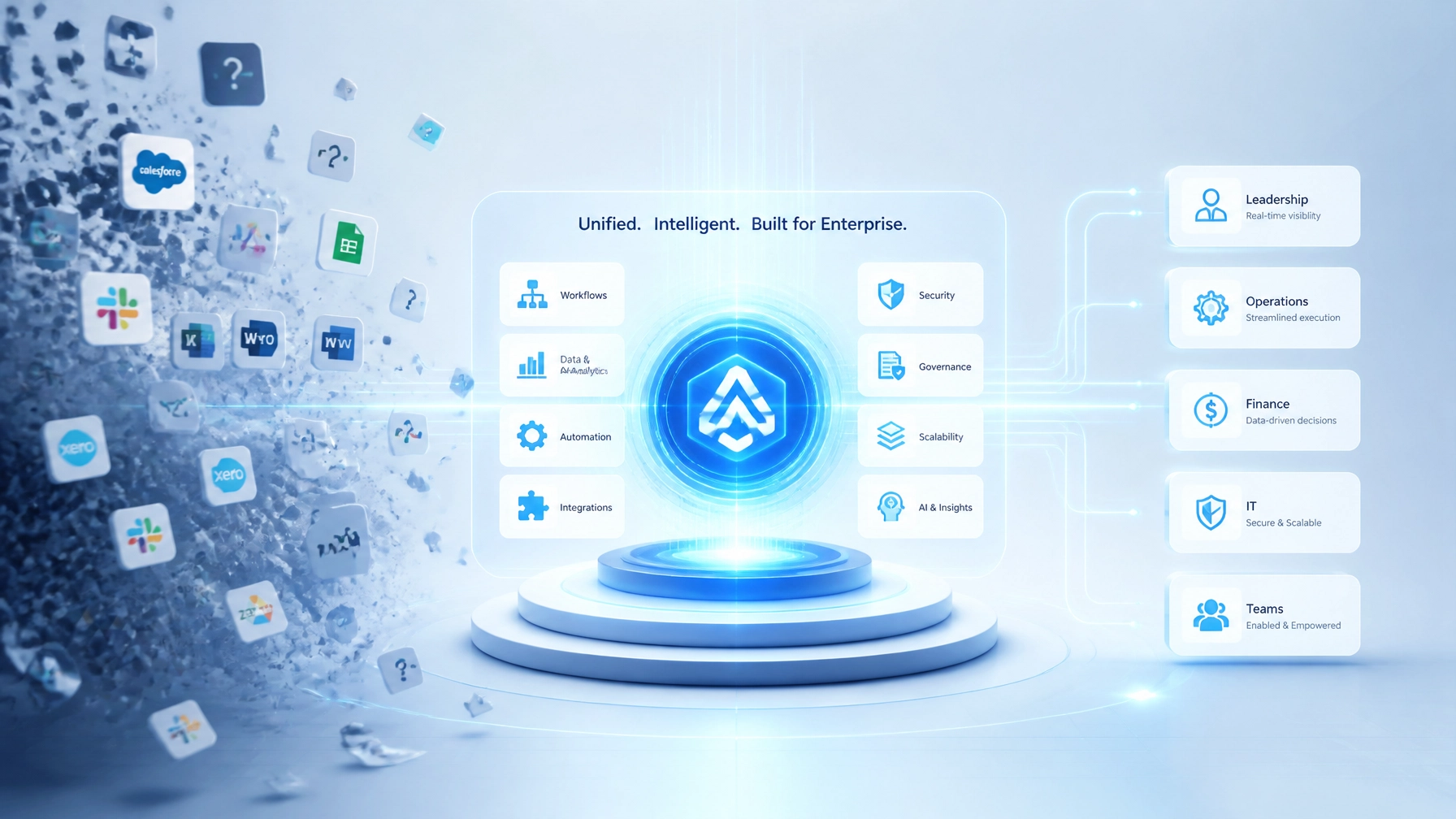
The challenge begins when a business uses a growing collection of generic tools to manage a process that is unique to its operating model.
A typical fragmented stack may include:
- A CRM for lead and customer records
- Separate intake and scheduling software
- Spreadsheets for exception handling
- Middleware for integrations
- Manual exports for reporting
- Additional tools to fill gaps in the original platforms
Each individual subscription may appear reasonable. Together, they create a system that depends on manual reconciliation and institutional memory.
Employees become the integration layer. They copy information between systems, check whether updates succeeded, resolve duplicate records, and create workarounds for processes the software cannot support. Leadership then receives reporting that is delayed, incomplete, or difficult to trust.
The result is not simply a higher technology bill. It is slower execution, greater error exposure, weaker visibility, and a business that must add people in order to scale.
PTC refers to this pattern as the enterprise automation paradox: adding more tools to create efficiency can ultimately make the operating environment more expensive and more difficult to manage.
Custom software turns your operating model into an asset
A custom application is valuable when it encodes the way your organization creates value.
That may include a proprietary intake process, a specialized routing model, a complex approval structure, location-aware inventory logic, or a customer experience that competitors cannot easily reproduce. Instead of treating these workflows as exceptions, custom software makes them part of the system’s foundation.
This creates several strategic advantages.
Your workflows become more precise
Generic platforms are designed for broad markets. They offer configuration options, but those options still exist within the boundaries of the vendor’s product model.
A custom system begins with your actual process. The software can reflect the decisions your team makes, the data it needs, the rules that govern exceptions, and the handoffs that determine speed and quality.
That precision reduces unnecessary steps and allows teams to work within a consistent operating framework.
Your data becomes more useful
Data scattered across multiple systems is difficult to govern and even harder to analyze. A custom architecture can create a shared data model that connects operational activity to business outcomes.
Executives can see where demand originates, where work is delayed, which locations are performing, and which process changes are producing measurable improvement.
The goal is not to collect more data. It is to create a reliable source of truth that supports better decisions.
Your technology can evolve with your strategy
A vendor’s roadmap is designed for its entire customer base. Your roadmap is designed around your growth priorities.
When your platform is custom-built, new capabilities can be planned around the organization’s direction. That may mean adding locations, introducing a new service line, connecting a partner ecosystem, or automating a workflow that did not previously exist.
This flexibility matters for enterprises competing in changing markets. Technology should support strategic movement rather than make the organization wait for a vendor to address an emerging need.

The build-versus-buy decision should begin with differentiation
The right question is not, “Can we buy a tool that does something similar?”
The better question is, “Is this capability central to how we compete?”
Custom development is most compelling when a process:
- Directly influences revenue, retention, service quality, or operational capacity.
- Requires coordination across several departments or systems.
- Contains proprietary rules or data that create an advantage.
- Must scale across locations, teams, customers, or business units.
- Cannot be measured reliably with the current technology stack.
If the process is standardized and has little strategic differentiation, buying is usually more efficient. If the process is core to the organization’s identity or growth model, ownership may create more value over time.
This is also where total cost of ownership becomes important. A fair comparison includes more than the initial development estimate or monthly subscription. It should account for:
- Licensing and per-user expansion
- Integration development and maintenance
- Manual reconciliation and administrative labor
- Reporting delays and data-quality issues
- Training and change management
- Vendor limitations and future migration risk
- Security, governance, monitoring, and support
A custom build requires greater planning and upfront investment. For high-ticket clients, a serious engagement is often a scoped investment of $10,000 or more, depending on architecture, integrations, data complexity, and compliance requirements. The purpose of that investment is not to create a larger software bill. It is to build infrastructure that can reduce recurring friction and support higher-value growth.
Proven architectures can transfer across industries
Custom software does not mean starting from an empty page. Experienced engineering partners bring patterns, frameworks, and lessons from previous high-complexity environments into new engagements.
At Pure Technology Consulting, our proprietary platforms demonstrate the range of systems we can architect and deploy.
In healthcare, EHRIO Pro demonstrates how intelligent 70-question intakes, matching engines, scheduling logic, and secure data workflows can be coordinated around a specialized patient journey.
In multi-location operations, ChainHQ demonstrates how a unified, location-aware architecture can replace isolated databases with centralized visibility, governed access, and scalable workflows.
In debt and financial operations, FTP Inform demonstrates how secure file ingestion, schema validation, data transformation, and workflow orchestration can replace fragmented enterprise tooling.
And through AI Local Boost, PTC has demonstrated how AI-driven content orchestration and Google Business Profile automation can support complex multi-location visibility programs.
These platforms are not presented as products for every business to purchase. They are proof-of-work examples. They show how PTC approaches architecture, automation, integrations, governance, and scale when a client’s operational requirements exceed what a standard platform can provide.

The premium approach is strategic before it is technical
A successful custom build does not begin with a list of screens. It begins with a business case.
Before development starts, leadership should be able to answer:
- Which process is creating the greatest operational drag?
- What does that friction cost in labor, delays, errors, or missed revenue?
- Which systems need to exchange data?
- What decisions should become automated, assisted, or more visible?
- Which controls are required for security, privacy, and governance?
- How will success be measured after launch?
This is the role of high-level automation consulting. The consultant is not simply translating a wish list into software. The consultant is helping leadership decide what should be built, what should remain standardized, and what sequence will create the greatest business leverage.
A disciplined roadmap may include workflow discovery, technical architecture, data modeling, integration planning, interface design, automation rules, reporting, security controls, and a phased deployment plan.
The result is a system designed to produce a measurable operating improvement: not a collection of features that looks impressive but fails to change how the business works.
Build the infrastructure your next stage requires
The strongest enterprises do not compete by owning the most software. They compete by operating with greater clarity, speed, and control.
Custom software becomes strategic when it removes the constraints that generic tools impose on a differentiated business. It gives leadership a way to unify data, automate decisions, improve governance, and scale execution without adding complexity at the same rate as revenue.
The investment is premium because the problem is important. A purpose-built platform can influence capacity, customer experience, margin, compliance, and the organization’s ability to pursue its next opportunity.
If your current systems are forcing your team to work around the business instead of supporting it, book a discovery call with Pure Technology Consulting. We can review your workflows, integration landscape, and growth objectives to determine where custom development or automation consulting would create the strongest return.
Contact Pure Technology Consulting
Phone: +1 (803) 921-0969
Amin Said, Founder of Pure Technology Consulting LLC
https://puretechconsult.com
Leave a Reply