Amin Said, Founder of Pure Technology Consulting LLC
High-volume operations rarely fail because a business lacks software. They slow down when critical work is distributed across too many systems, manual handoffs, fragile scripts, and files that require constant supervision.
That was the operating reality for a national debt collection agency that partnered with Pure Technology Consulting. Its teams relied on three separate enterprise tools, custom scripts, manual CSV exports, and spreadsheet-based reconciliation to move debt portfolio data through the organization.
The result was more than inconvenience. File validation delays affected recovery workflows, errors were difficult to trace, and compliance evidence was scattered across disconnected applications.
The solution was not another general-purpose platform. It was a custom file-based automation engine designed around the client’s actual operating model: FTP Inform.
For questions about custom automation and enterprise data workflows, contact Pure Technology Consulting at +1 (803) 921-0969.
The business challenge: high-volume files moving through disconnected systems
The client’s operation depended on structured files arriving from external partners. These files contained debt portfolios that needed to be checked, normalized, segmented, and routed into downstream workflows.
Before FTP Inform, that process involved several points of operational friction:
- Debt files arrived in different formats, including CSV, fixed-width text, and Excel workbooks.
- Teams manually checked file structures and investigated missing or invalid fields.
- Data moved between three separate enterprise systems through scheduled jobs and custom scripts.
- Spreadsheet reconciliation was used to identify discrepancies between systems.
- Compliance and operational activity were recorded in different places.
- A failed transfer or malformed file could delay work across the recovery process.
This is a common pattern in established organizations. The individual systems may each perform a useful function, but the operating model between them becomes the real bottleneck.
The client did not simply need file storage or a notification tool. They needed an integration layer capable of receiving data, understanding its structure, enforcing business rules, and creating a reliable record of what happened next.
Why a custom build was the right approach
Off-the-shelf software is often effective when an organization can adopt its standard workflows. That was not the case here.
The agency had specialized requirements around portfolio intake, account segmentation, dunning workflows, compliance controls, and downstream integrations. Replacing one legacy tool with another would have left the same fundamental problem in place: the business would still be adapting its processes to software that was not designed for its data movement model.
A custom system provided a different path.
Instead of treating file ingestion as an isolated technical task, Pure Technology Consulting designed FTP Inform as a coordinated operating layer. The platform could be shaped around the client’s file formats, validation rules, routing logic, and reporting requirements.
That approach created a foundation that could:
- Receive files securely.
- Detect and classify inbound data.
- Validate records against client-specific rules.
- Quarantine exceptions without stopping valid processing.
- Transform data into a canonical internal model.
- Route approved records to downstream workflows.
- Record each event for monitoring and auditability.

The FTP Inform architecture
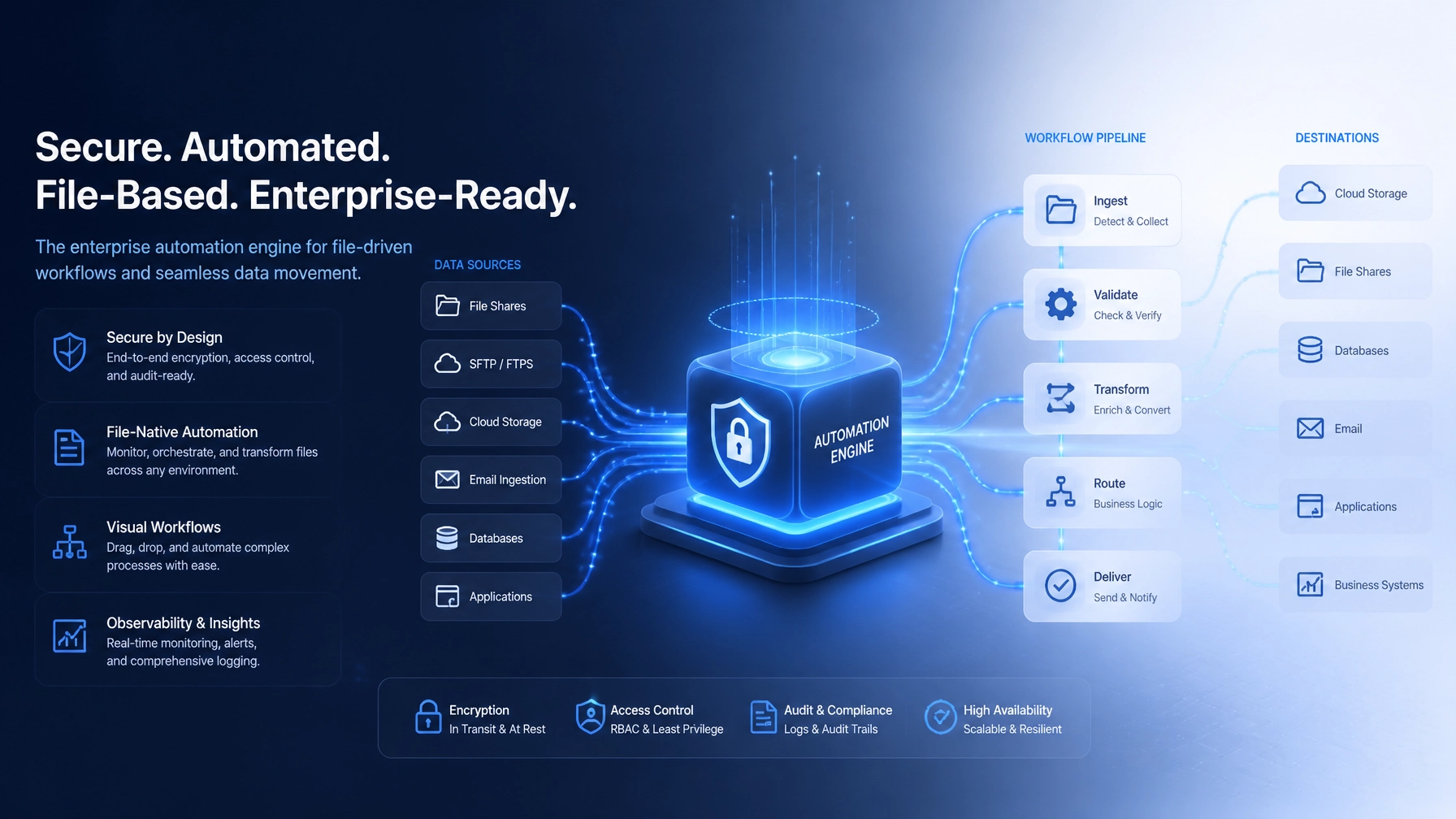
FTP Inform was engineered as a secure, multi-tenant file ingestion and orchestration platform. Its architecture separated the stages of processing so that each step could be monitored, tested, and improved independently.
Secure file ingestion
Each corporate client received an isolated ingestion endpoint. Automated listeners monitored inbound locations and initiated processing when new files arrived.
The design supported file-driven operations while applying modern security practices. Where available, SFTP was preferred because it encrypts authentication and data in transit. The FTP Inform user guide also recommends dedicated accounts, limited permissions, connection testing, and secure credential handling.
This distinction matters. Traditional FTP is not encrypted and should not be used for sensitive external data without appropriate compensating controls. For enterprise environments, secure transfer protocols, restricted access, and clear ownership should be part of the architecture rather than afterthoughts.
Schema validation and transformation
The ingestion engine inspected each file against a defined schema. It validated expected columns, data types, required fields, formatting rules, and business constraints.
Invalid records were not silently discarded or mixed with approved data. Instead, they were routed to an exception or quarantine process. Automated feedback reports made it easier for operations teams and external partners to understand what needed correction.
Validated records were transformed into a canonical data model. In practical terms, this meant different partner formats could be converted into a consistent internal structure before downstream processing.
That unified model reduced the need for separate scripts and one-off mappings across every connected system.
Rules-based workflow orchestration
Once data was validated and normalized, FTP Inform applied business logic to determine how accounts should move through the recovery operation.
Portfolios could be segmented according to factors such as:
- Aging buckets, including 30-, 60-, and 90-plus-day categories.
- Balance size.
- Historical recovery probability.
- Regulatory jurisdiction.
- Account status and operational priority.
The platform then connected those segments to downstream actions. These included dunning sequences, agent workload assignment, client reporting, telephony integrations, payment systems, and accounting ledgers.
The important capability was not merely automation for its own sake. It was the ability to make workflow decisions consistently from structured data.
Governance was built into the workflow
For financial operations, a successful file transfer is not enough. Leaders also need to know what happened to the data after arrival.
FTP Inform maintained an audit trail from the initial file drop through processing and final resolution status. That created a more complete operational record than the previous collection of disconnected logs and spreadsheets.
The system incorporated controls such as:
- Role-based access permissions.
- Encryption in transit and at rest.
- File and processing history.
- Validation results.
- Exception records.
- Contact-time window rules.
- Activity and integration logs.

This model reflects a broader principle in enterprise automation: governance should be designed into the process. When validation, permissions, and audit records are embedded in the workflow, compliance becomes easier to monitor and less dependent on manual memory.
Organizations modernizing legacy file transfers should also review current guidance on secure SFTP practices, including key-based authentication, access restrictions, and current encryption standards.
The measurable impact
Within 90 days of deployment across the client’s national operation, FTP Inform delivered measurable operational improvements:
- Three enterprise tools were consolidated into one unified proprietary platform.
- Cycle time decreased by 40%, accelerating the path from file ingestion to first-contact execution.
- Manual data-entry errors were eliminated from the core ingestion process through automated validation and exception handling.
- Manual intervention decreased by more than 75%, allowing staff to focus on complex negotiations and higher-value recovery activity.
- File processing failures moved upstream, where they could be identified and addressed before affecting downstream teams.
The value was not limited to labor savings. The organization gained a clearer operating model, stronger visibility into data movement, and a platform that could evolve with its requirements.

What this case study demonstrates for other enterprises
FTP Inform is a proof of concept for a broader category of custom software: file-based automation systems that connect legacy environments to modern workflows.
This approach can be relevant when an organization:
- Receives recurring CSV, Excel, XML, or fixed-width files from partners.
- Depends on manual file checks before data can be used.
- Maintains multiple systems with overlapping or inconsistent records.
- Needs exception handling rather than all-or-nothing imports.
- Requires audit trails for operational or compliance review.
- Has specialized business rules that standard SaaS products do not support.
- Needs a controlled modernization path instead of a disruptive replacement.
A custom build does not necessarily mean abandoning every existing system. In many cases, the better strategy is to introduce a purpose-built integration and orchestration layer that allows the business to modernize incrementally.
The architecture can begin with file monitoring and validation, then expand into transformation, routing, reporting, API integrations, and workflow intelligence.
When should a business consider a custom automation engine?
The decision should begin with the operating model, not a technology trend.
A custom solution becomes worth evaluating when the cost of manual coordination, errors, delays, and disconnected licenses exceeds the cost of designing a system around the business. That assessment should include:
- Current labor spent checking, correcting, and reconciling files.
- Revenue delayed by slow or failed processing.
- Compliance exposure created by incomplete records.
- Licensing and maintenance costs across existing tools.
- The strategic value of owning the workflow logic and data model.
- Future integration and reporting requirements.
Pure Technology Consulting begins this process with a workflow audit and technical roadmap. The expected deliverables may include solution architecture, secure ingestion endpoints, validation rules, transformation pipelines, dashboards, exception queues, integrations, and governance controls.
Build the operating layer your business actually needs
FTP Inform demonstrates how a focused custom system can replace fragmented enterprise tooling without forcing a business into a generic operating model.
The lesson is not that every organization needs an FTP platform. It is that high-volume operations benefit from technology designed around the movement of data, the decisions made from that data, and the controls required to trust the outcome.
Pure Technology Consulting brings proven capabilities from healthcare intake and EHR workflows, field operations tracking, debt-agency telephony integrations, and local SEO automation into complex custom development engagements. The objective is to create systems that reduce operational drag while giving leadership a clearer, more scalable foundation for growth.
To discuss a file-based automation project, request a workflow audit, or scope a custom integration layer, call +1 (803) 921-0969 or schedule a consultation.
Amin Said, Founder of Pure Technology Consulting LLC
https://puretechconsult.com
Leave a Reply