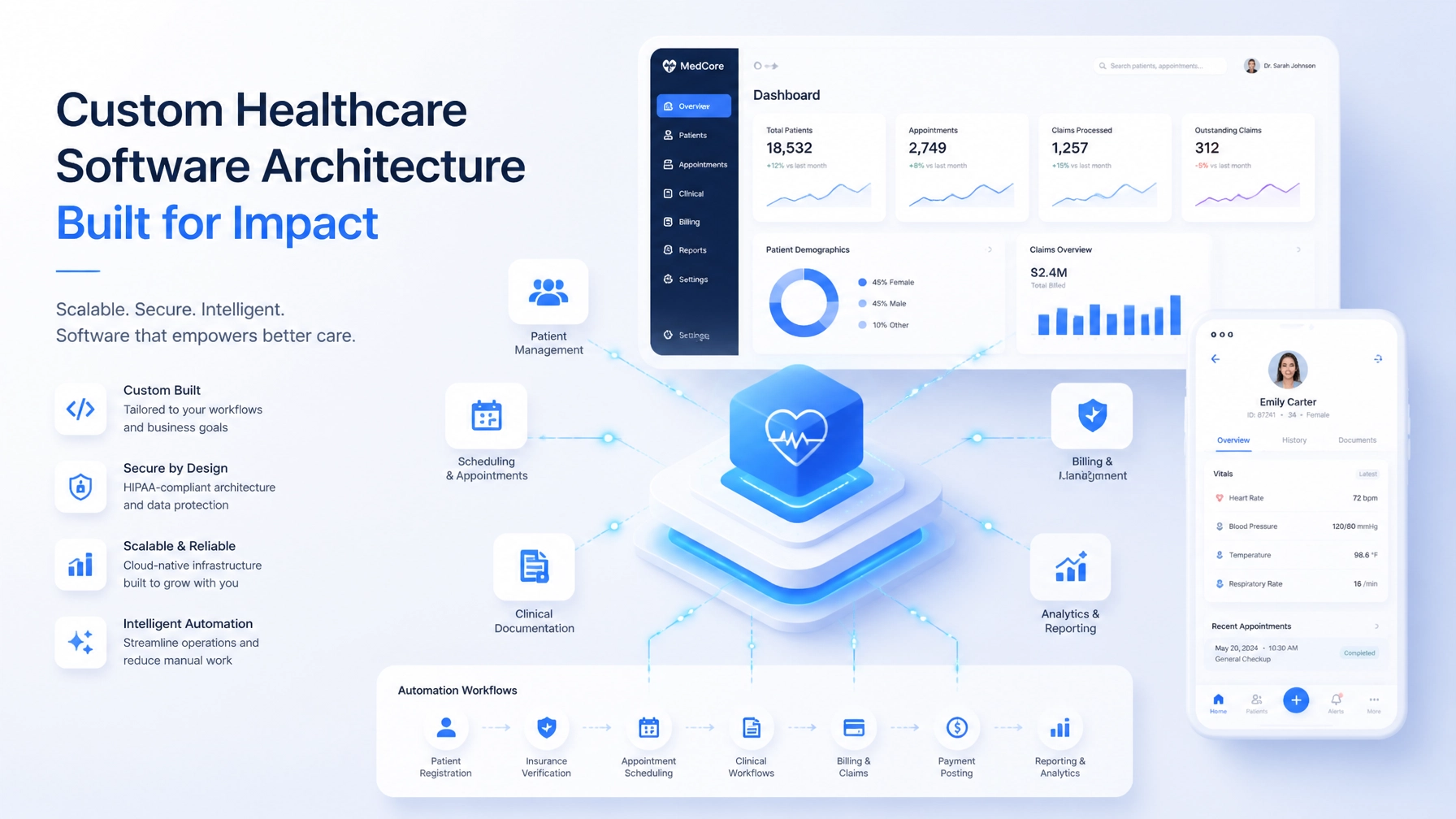
For a multi-site healthcare practice, growth can expose a costly technology problem: the practice may have an EHR for clinical records, a CRM for inquiries and referrals, and a scheduling platform for appointments, yet none of the systems share a complete view of the patient journey.
The result is familiar. Staff re-enter information, providers receive incomplete context, scheduling decisions depend on manual review, and leadership lacks a reliable operational picture across locations.
Pure Technology Consulting developed EHRIO Pro as a proof-of-concept for solving that problem through bespoke healthcare automation. The system demonstrates how one coordinated workflow can replace the operational role of three disconnected legacy systems:
- A CRM used to manage inquiries, referrals, and pre-visit activity
- An EHR used to store patient and clinical information
- A scheduling system used to manage provider availability and appointments
The goal was not to add another software layer. It was to create an operating model in which intake, matching, scheduling, and workflow updates move through a unified architecture designed around how the practice actually works.
The business challenge: three systems, one fragmented patient journey
The practice’s systems each performed a useful function. The problem was the space between them.
A new patient might begin with a phone call, website form, referral document, or message to the front desk. Staff then had to transfer information into a CRM, request additional intake details, check provider availability, determine whether a provider was appropriate, and manually enter the final information into the EHR and scheduling system.
That process created several forms of operational drag:
- Repeated data entry across multiple platforms
- Delayed scheduling while staff reviewed intake information
- Inconsistent routing between locations and providers
- Limited visibility into incomplete forms or stalled referrals
- Difficulty tracking the status of each patient before the first visit
- Increased risk that important information would be missed during handoffs
The practice did not necessarily need three more tools. It needed a coordinated workflow that could interpret information once and use it across the organization.
The strategic decision: build around the practice’s operating model
The first step was not selecting a vendor or connecting APIs. It was mapping the practice’s actual operating model.
Pure Technology Consulting evaluated how the practice handled:
- New patient inquiries and referrals
- Demographic and insurance collection
- Clinical history and reason-for-visit information
- Consent and authorization steps
- Provider specialties and location coverage
- Telehealth and in-person appointment rules
- Scheduling availability and escalation paths
- Staff review requirements
- Pre-visit communication and follow-up
This discovery process identified which decisions could be automated, which required human review, and which data elements needed to remain tightly controlled.
That distinction is important in healthcare. Automation should reduce repetitive work without obscuring responsibility. EHRIO Pro was therefore designed with configurable rules, review states, and audit-oriented workflow visibility rather than treating every decision as an unattended automation.
A 70-question intake workflow that adapts to the patient
The intake workflow was one of the system’s central capabilities.
Instead of presenting every patient with a static, lengthy form, EHRIO Pro uses a structured intake journey built around approximately 70 questions. The workflow can branch based on the patient’s answers, visit type, symptoms, history, location, and other practice-defined criteria.
The intake architecture can support information such as:
- Patient demographics and contact details
- Insurance and coverage information
- Medical history, medications, allergies, and prior procedures
- Current symptoms and reason for seeking care
- Preferences related to location, provider, or visit type
- Consent, communication preferences, and required acknowledgments
- Referral details and supporting documents
Conditional logic helps avoid asking irrelevant questions while still capturing a complete record when the patient’s situation requires additional context. A patient with a straightforward appointment may move through a shorter path. A patient with a more complex history may be routed through additional questions before scheduling is offered.
The system also normalizes responses into structured data. That means the information is not trapped in a PDF or an email inbox. It can be used by the matching engine, operational dashboards, staff work queues, and downstream EHR workflows.

A provider-patient matching engine built around real constraints
A major limitation of generic scheduling tools is that they often treat availability as the primary decision. In practice, the earliest open appointment is not always the right appointment.
EHRIO Pro demonstrates a provider-patient matching engine that considers multiple variables before recommending a routing path. Depending on the practice’s requirements, those variables may include:
- Clinical needs and specialty requirements
- Provider qualifications and service capabilities
- Accepted insurance plans
- Patient location preferences
- In-person or telehealth requirements
- Provider availability
- New-patient capacity
- Appointment type and expected duration
- Practice-defined escalation or review conditions
The matching engine can apply configurable rules and scoring logic to identify the best operational fit. It can also separate high-confidence matches from cases that require staff review.
This creates a more deliberate scheduling process. Instead of asking staff to interpret the entire intake manually, the system presents a recommended path with the relevant reasoning and exceptions visible. Staff remain involved where judgment is necessary, while routine routing becomes faster and more consistent.
Replacing the CRM-to-EHR handoff
The system’s value is not limited to the patient-facing intake form. The larger opportunity is the elimination of the manual handoff between front-office workflows and clinical systems.
In the proof-of-concept architecture, an intake record can progress through defined stages:
- New inquiry or referral received
- Patient begins the intake workflow
- Required information is validated
- Matching logic identifies provider and location options
- Insurance or authorization requirements are flagged
- Staff review is requested when rules require it
- Appointment availability is presented
- Scheduling information is synchronized
- Relevant intake data is prepared for the EHR
- Pre-visit tasks and communications are triggered
This approach replaces the CRM’s isolated pipeline with a workflow state that connects directly to operational activity. It also reduces the need for staff to copy information from one system into another.
Where an existing EHR remains the system of record for clinical documentation, the custom application can operate as an orchestration layer. It coordinates intake and pre-visit workflows while respecting the practice’s existing clinical and administrative systems.
Integration designed for security and accountability
Healthcare automation requires more than functional integration. Patient information must be handled according to the practice’s compliance obligations, internal policies, vendor agreements, and technical controls.
For that reason, EHRIO Pro is framed as a HIPAA-adjacent workflow automation architecture, not as a substitute for a complete compliance program. The final deployment environment would need to be evaluated against the practice’s specific legal, administrative, and technical requirements.
Relevant design considerations include:
- Role-based access to sensitive workflow data
- Encryption in transit and at rest
- Controlled API access and authentication
- Audit-oriented activity logging
- Data minimization between systems
- Defined retention and deletion policies
- Secure handling of uploaded documents
- Clear human review and escalation paths
- Vendor and business associate requirements
The technical implementation may use secure APIs and healthcare data standards where supported by the practice’s EHR and connected systems. The exact integration strategy depends on the existing environment, available interfaces, data ownership, and operational constraints.

The operational impact of replacing disconnected workflows
The business outcome is a more coherent patient onboarding process across locations.
By bringing intake, matching, and scheduling into one coordinated workflow, the practice can work toward:
- Less manual data entry for front-desk teams
- Faster movement from inquiry to scheduled appointment
- More consistent provider and location routing
- Earlier visibility into missing information
- Fewer avoidable handoff errors
- Better coordination between administrative and clinical teams
- More useful reporting across locations and workflow stages
These outcomes should be measured against the practice’s baseline rather than assumed. A practical measurement plan could include time from referral to scheduling, intake completion rates, manual touches per patient, exception volume, rescheduling activity, and staff time spent on pre-visit administration.

What this proof-of-concept demonstrates
EHRIO Pro is not presented as a standalone product for practices to purchase. It is proof of work demonstrating Pure Technology Consulting’s ability to design and build complex healthcare workflows around a client’s operating model.
The same engineering principles can be applied to a custom engagement involving:
- Multi-location intake architecture
- Conditional 70-question forms
- Provider-patient matching engines
- CRM and EHR workflow orchestration
- Scheduling and availability logic
- Secure document and consent handling
- Staff dashboards and exception queues
- Audit-oriented automation controls
- Operational reporting and performance visibility
This healthcare capability is part of a broader body of work that includes Thrive and EHRIO matching engines, detailed intake workflows, field-operations accountability systems, debt-agency telephony integrations, and local SEO automation through AI Local Boost.
For a growing practice, the right question is not simply whether another SaaS subscription can be added. The more strategic question is whether the current technology stack supports the patient journey, staff responsibilities, compliance requirements, and growth plan.
When three systems perform separate functions but create one fragmented operation, bespoke development may provide a more durable path forward.
Plan the next version of your healthcare operating model
Pure Technology Consulting works with healthcare organizations that need more than disconnected integrations. We help leadership teams define the workflow, data model, automation rules, and technology roadmap required to support scalable operations.
To discuss a custom healthcare automation initiative, call +1 (803) 921-0969 or book a discovery consultation. No obligation is required to begin the conversation.
For additional context, read Beyond Off-the-Shelf: How We Built EHRIO Pro to Automate an Entire Healthcare Practice.
Amin Said, Founder of Pure Technology Consulting LLC
https://puretechconsult.com
Leave a Reply