Author: admin

  • From Local SEO to Enterprise-Grade Automation: Inside AI Local Boost, a Proof of What Custom Development Can Do

    From Local SEO to Enterprise-Grade Automation: Inside AI Local Boost, a Proof of What Custom Development Can Do

    By Amin Said, Founder of Pure Technology Consulting LLC

    For growth-focused local businesses, inconsistent lead flow is rarely caused by a single marketing problem. More often, it reflects a wider operational gap: Google Business Profiles are not updated consistently, reviews are answered too slowly, local content is difficult to coordinate, and marketing activity remains disconnected from the systems that manage customers and revenue.

    For a single location, these issues may be manageable. For a multi-location business, franchise group, or agency portfolio, they become a technology challenge.

    Pure Technology Consulting built AI Local Boost to address that challenge. The platform began as a local SEO automation system and evolved into a proof-of-concept for what custom web application development, bespoke AI solutions, and enterprise automation consulting can deliver when software is designed around a real operating model.

    AI Local Boost demonstrates that local visibility can become more than a marketing task. With the right architecture, it can become an integrated, measurable, and scalable business system.

    The business problem: local visibility does not scale through manual effort

    Local service businesses depend heavily on discovery through Google Search and Google Business Profile listings. For chiropractors, physical therapy clinics, counseling centers, specialty medical practices, permanent jewelry brands, and other service businesses, strong local visibility can influence calls, direction requests, consultations, and bookings.

    However, maintaining that visibility requires continuous execution:

    • Publishing location-specific Google updates
    • Adding relevant photos, videos, and media
    • Responding to positive and negative reviews
    • Keeping business information accurate across channels
    • Requesting reviews after completed customer interactions
    • Connecting local marketing activity to CRM, scheduling, POS, and communication systems
    • Reporting on performance across locations

    The problem is not that business owners lack strategic intent. The problem is that the workflow is repetitive, distributed, and difficult to govern.

    At scale, organizations typically face two unsustainable choices. They can hire a large team to manage every profile manually, increasing labor costs and the likelihood of inconsistent execution. Or they can allow profiles to become stagnant, reducing the frequency and relevance of the activity that supports local discovery.

    AI Local Boost was created to replace that tradeoff with a structured automation layer.

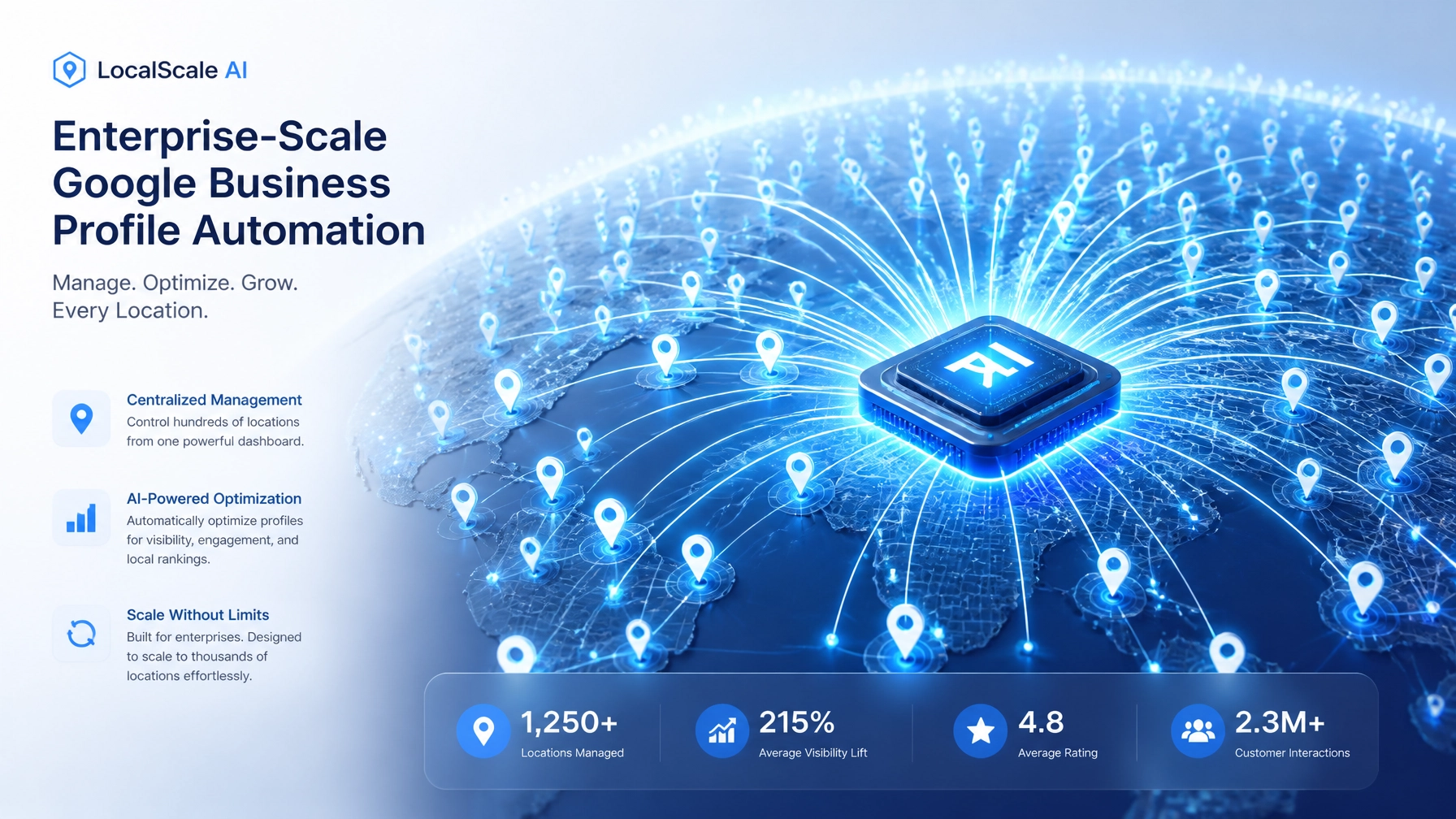
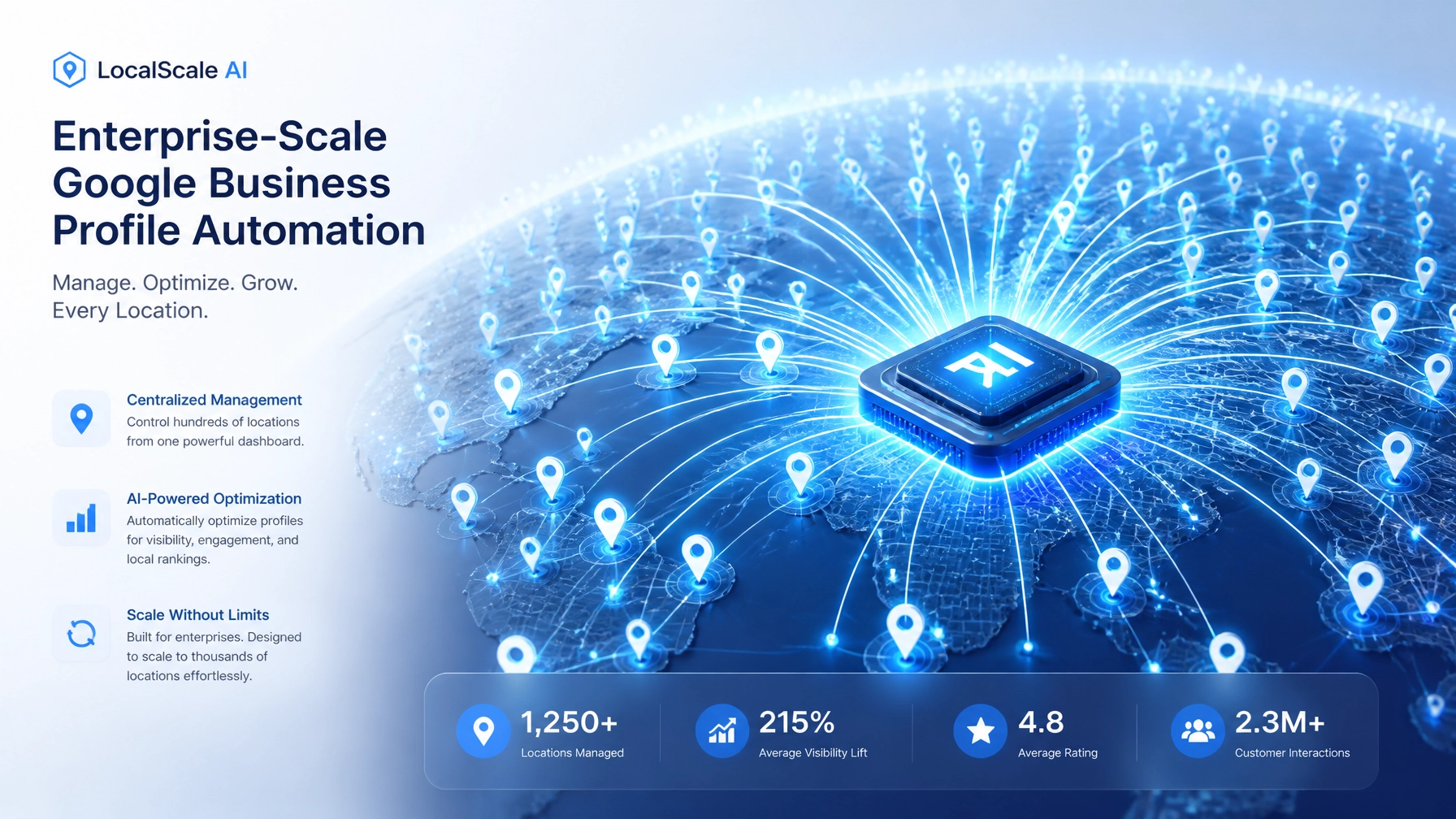
    AI content orchestration engine for automated local SEO workflows

    The architecture: a multi-tenant system built for scale

    AI Local Boost was not designed as a simple content scheduler. Its purpose was to support multiple organizations, brands, users, and locations through a shared technology foundation.

    That required a multi-tenant SaaS architecture. In practical terms, the platform needed to serve many customers while ensuring that each organization’s data, business profiles, integrations, users, and workflows remained properly separated.

    This architecture included several foundational capabilities:

    Tenant-aware data modeling

    Every important record is associated with the correct organization, location, and operating scope. This enables a single application to support:

    • Platform administrators
    • White-label partners
    • Client administrators
    • Regional managers
    • Location-level users

    A corporate team can view portfolio-wide performance, while a local manager can work within the locations they are responsible for. The system provides centralized visibility without giving every user unrestricted access.

    Role-based access control

    In enterprise automation, access control is not merely a security feature. It defines how work moves through the organization.

    AI Local Boost was structured so users can access the tools and data appropriate to their responsibilities. A corporate administrator may manage brand standards and reporting. A regional manager may oversee a group of locations. A local operator may review content or approve responses for one profile.

    This allows local teams to act with the necessary context while preserving governance at the corporate level.

    White-label infrastructure

    A serious white-label platform requires more than changing a logo and color palette. Partners may need their own branded environment, client hierarchy, workflow policies, user permissions, and reporting structure.

    AI Local Boost was designed to support those requirements within a centralized infrastructure. That allows a partner or enterprise team to present a cohesive software experience without building and maintaining an entire SaaS platform from the ground up.

    For high-ticket buyers, this is an important distinction. The goal is not to resell a collection of features. The goal is to create reusable operational infrastructure.

    The AI workflow: automate execution without eliminating judgment

    The AI layer within AI Local Boost was designed as an orchestration system rather than an unrestricted content generator.

    The platform evaluates context such as industry, location, audience, services, brand language, and workflow rules before generating or recommending an action. This makes the output more relevant to the business and more consistent across its locations.

    A typical governed workflow can include five stages:

    1. Context collection: The system gathers business information, location details, services, brand guidelines, and campaign objectives.
    2. AI recommendation: The platform generates a post, review response, media concept, or follow-up action.
    3. Validation: Configured rules evaluate tone, timing, required information, and tenant-specific standards.
    4. Routing: The action is sent for human approval, scheduled publication, or automated execution based on policy.
    5. Recording: The result is stored for reporting, auditing, and future optimization.

    This suggest-and-approve model is especially valuable for reputation management. AI can analyze the sentiment and context of a review, then draft a response. A business can decide whether that response requires human review or qualifies for a trusted automation rule.

    The objective is not to remove people from every process. It is to reserve human attention for decisions that require judgment while automating repetitive execution.

    Connecting local SEO to the rest of the business

    Local SEO becomes more valuable when it is connected to operational events.

    A completed purchase, patient visit, consultation, or service appointment can trigger a review request. A new promotion can generate coordinated content across relevant channels. A change in business information can be reflected across connected platforms. Performance data can be brought into a unified reporting view.

    AI Local Boost was designed to connect with systems such as:

    • CRMs
    • POS platforms
    • Scheduling tools
    • Email and SMS providers
    • Social channels
    • Review and reputation workflows
    • External business applications

    The platform’s integration strategy reflects a broader principle in business automation consulting: software should connect systems around how the business actually operates.

    When teams no longer need to copy information between disconnected tools, the organization gains more than efficiency. It gains a clearer relationship between marketing activity, customer engagement, and business outcomes.

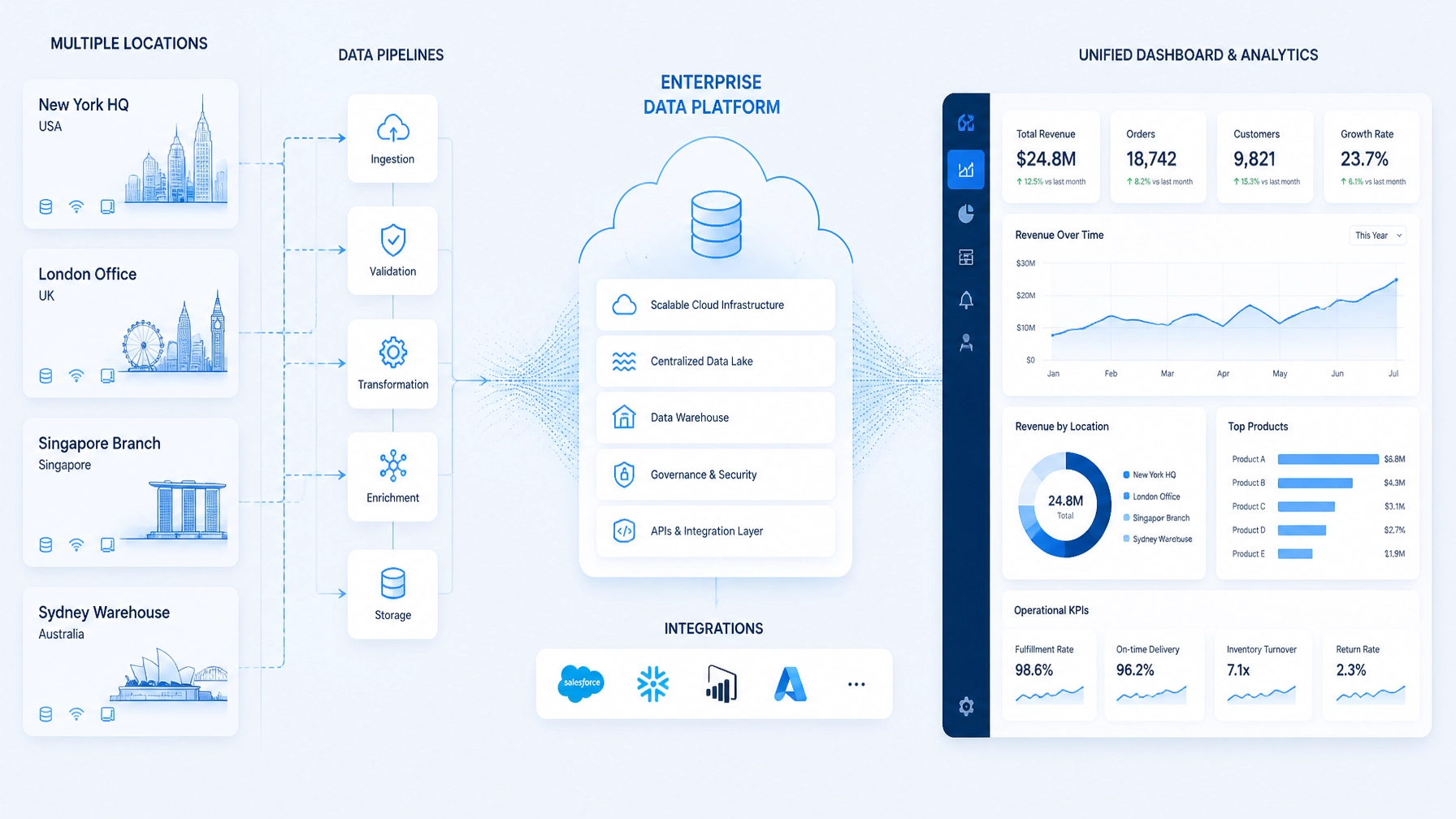
    Multi-location business dashboard for local SEO performance and workflow management

    The results: measurable visibility and reclaimed operating capacity

    AI Local Boost was built to address two linked outcomes: improve local visibility and reduce the administrative effort required to maintain it.

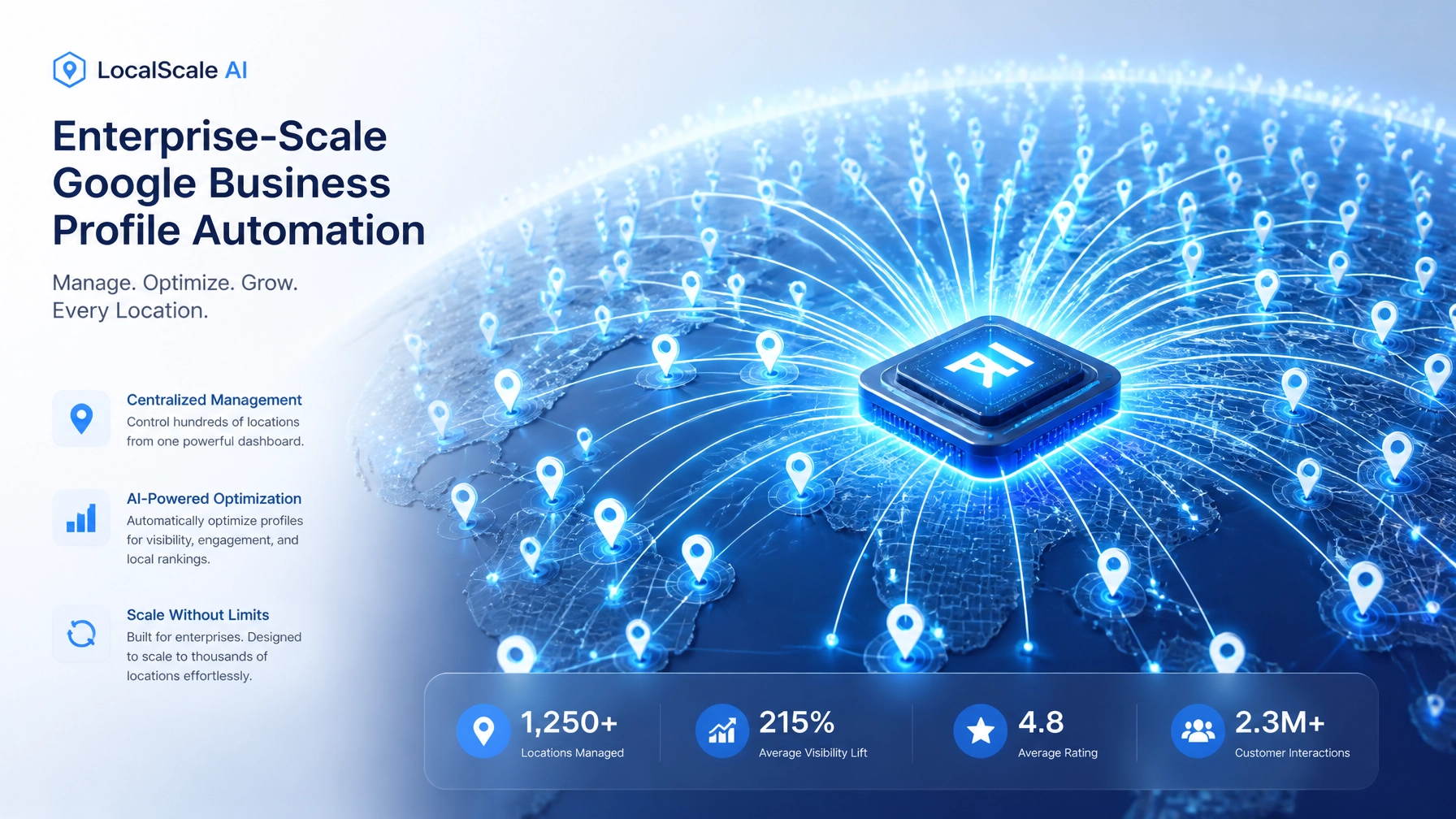
    In the deployment context documented by Pure Technology Consulting, the platform was designed to manage 500+ Google Business Profile locations without requiring human intervention for every routine action. It also supported integrations with more than 6,000 external tools, enabling review requests and related workflows to originate from events across the broader business ecosystem.

    Reported performance outcomes included:

    • A 25% increase in call and direction click-through rates
    • Up to a 340% increase in local leads within the documented measurement period
    • Consistent profile activity across a large multi-location portfolio
    • Faster, more context-aware review response workflows
    • Reduced administrative dependence on manual profile management

    Results will vary by market, baseline visibility, location quality, offer strategy, and implementation discipline. The more important lesson is architectural: when repetitive local marketing processes are connected to data, rules, approvals, and reporting, they can be managed as an operating system rather than a series of isolated tasks.

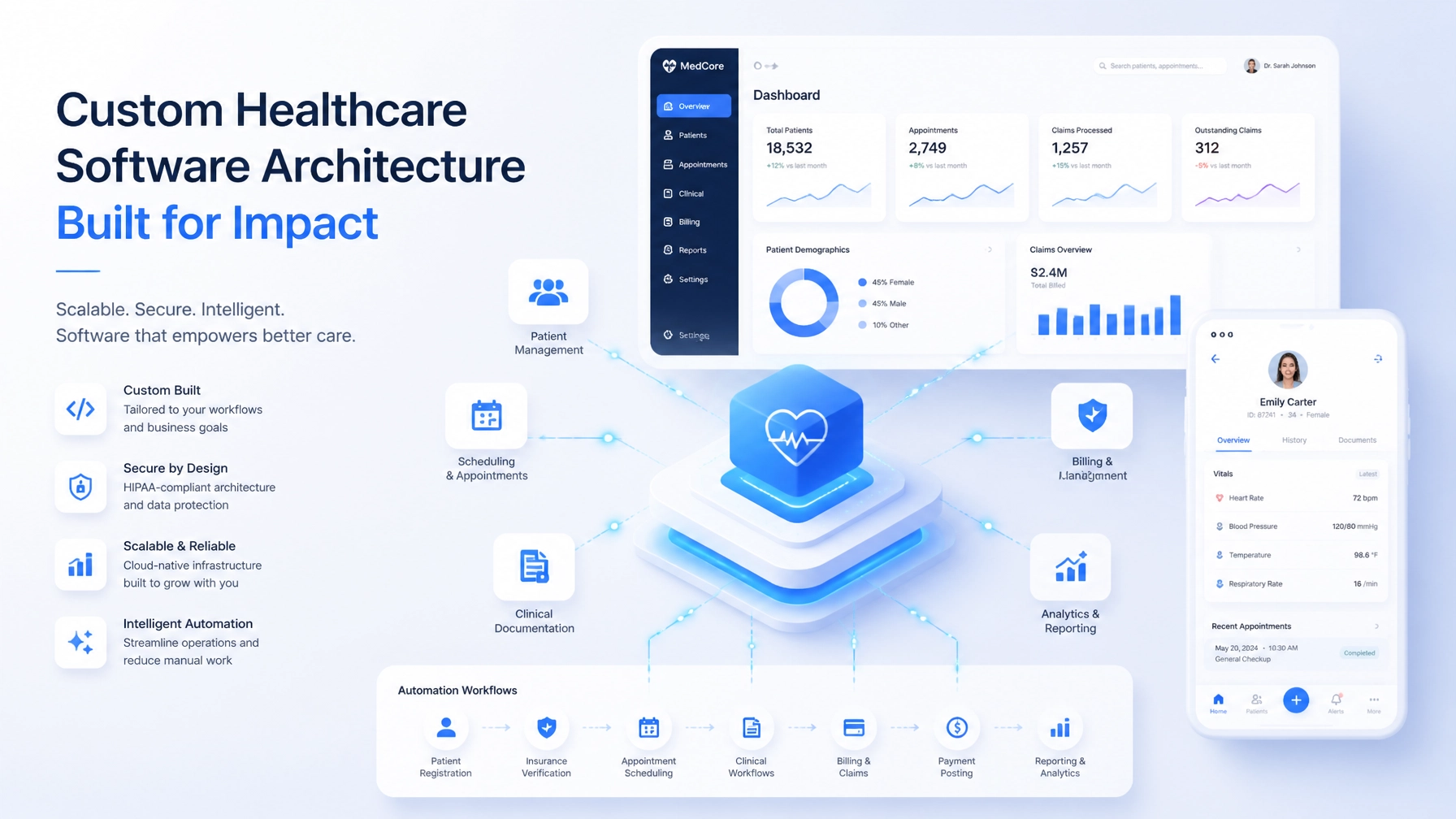
    Abstract visualization of connected data, AI workflows, and scalable business automation

    AI Local Boost is one proof point in a broader engineering practice

    AI Local Boost is not an isolated experiment. It is one example of how Pure Technology Consulting develops scalable, complex systems for organizations whose processes do not fit neatly into standard SaaS products.

    Other proprietary builds demonstrate the same engineering approach in different environments:

    • ChainHQ uses unified, location-aware architecture to help multi-location businesses reduce data silos and coordinate operations across branches, regions, and corporate teams. Read the ChainHQ case study.
    • EHRIO Pro demonstrates custom healthcare workflow design through 70-question intakes, provider matching logic, scheduling coordination, and HIPAA-adjacent data workflows. Explore the EHRIO Pro case study.
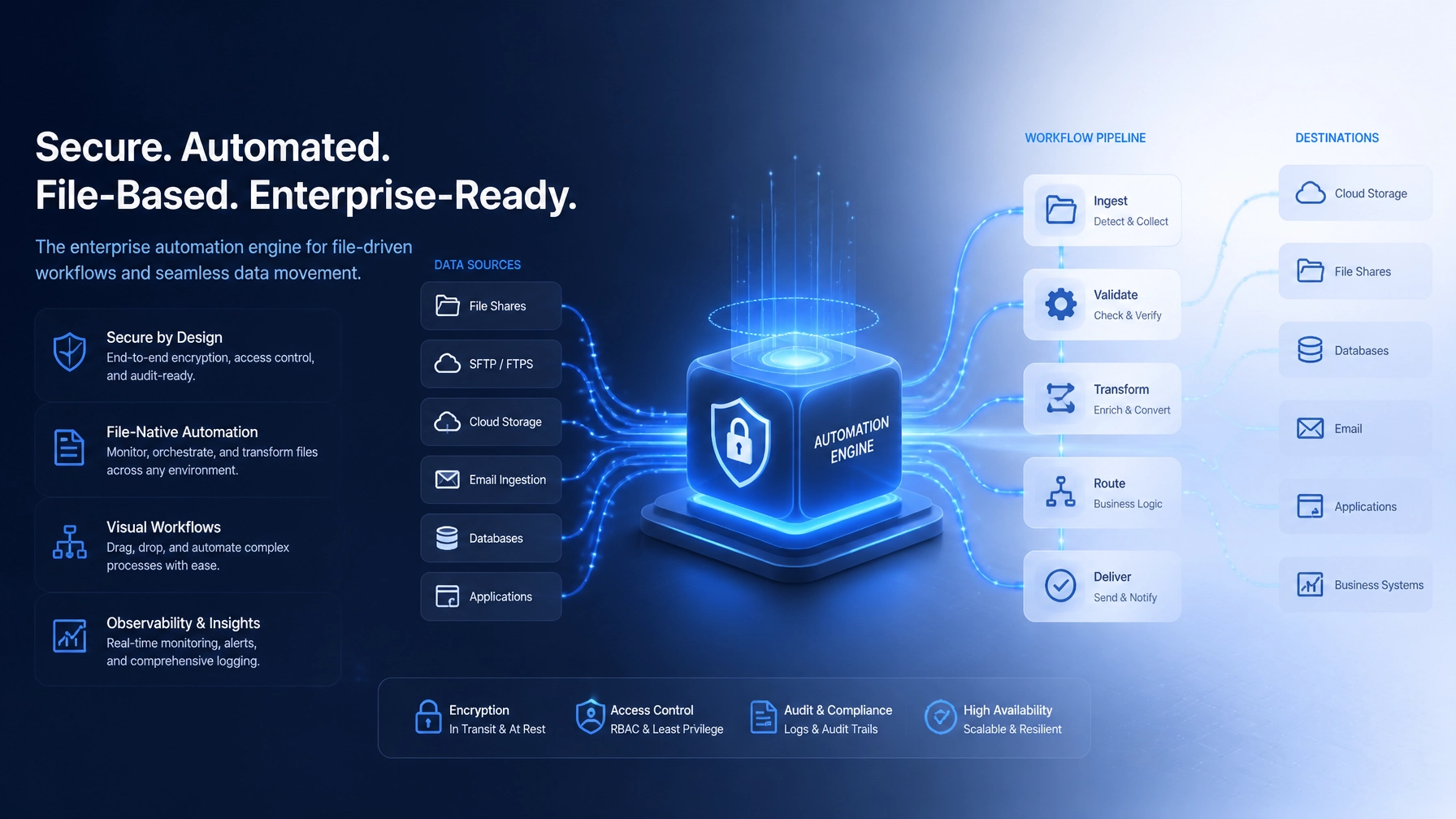
    • FTP Inform shows how secure file ingestion, validation, transformation, workflow orchestration, and auditability can replace fragmented enterprise tools in debt collection operations. Review the FTP Inform case study.

    These systems serve different industries, but the principles remain consistent: understand the operating model, structure the data correctly, integrate the systems that matter, automate repeatable decisions, and preserve governance.

    That is the difference between adding another software subscription and investing in a custom AI-powered business system.

    When custom development becomes the strategic choice

    Standard SaaS is often appropriate when a workflow is simple, stable, and shared across the market. Custom software development becomes more valuable when a business needs to:

    • Manage multiple tenants, brands, locations, or partner organizations
    • Encode proprietary workflows into software
    • Connect systems that do not integrate natively
    • Control data ownership and permissions at a granular level
    • Create a differentiated customer or operator experience
    • Launch a white-label or recurring-revenue platform
    • Scale execution without increasing administrative headcount at the same rate

    For these organizations, custom web application development is not about building technology for its own sake. It is about creating leverage.

    Pure Technology Consulting brings this perspective to custom software, AI consulting services, digital transformation consulting, and business process automation consulting engagements. We help growth-minded organizations move from manual processes and disconnected applications toward scalable technology foundations.

    If your business is evaluating a proprietary SaaS platform, an AI workflow automation initiative, or a complex internal application, book a discovery call with our team. You can also contact Pure Technology Consulting at +1 (803) 921-0969 to discuss your operating model, technical roadmap, and automation priorities.

    Amin Said, Founder of Pure Technology Consulting LLC
    https://puretechconsult.com
  • Case Study: Telephony Integration and Call Attribution for a High-Volume Debt Collection Agency

    Case Study: Telephony Integration and Call Attribution for a High-Volume Debt Collection Agency

    For a high-volume debt collection agency, every call contains operational intelligence. It can indicate a right-party contact, a promise-to-pay, a dispute, a callback request, or a compliance-sensitive interaction. When that information remains trapped inside a dialer or call center platform, the agency loses visibility into the workflows that follow.

    Amin Said, Founder of Pure Technology Consulting, led a custom integration initiative designed to connect telephony events with account records, campaigns, agent activity, and downstream business processes. The objective was not simply to add click-to-call functionality. It was to create a reliable operating layer for call attribution and outcome-based automation.

    This case study shows how custom web application development can connect a complex telephony environment to the systems a collection agency depends on every day.

    The operational challenge: calls were happening faster than the system could interpret them

    The agency managed a large volume of outbound and inbound activity across multiple campaigns, account portfolios, teams, and phone numbers. Its telephony platform could place and receive calls, but the surrounding operational systems lacked a complete picture of what happened during each interaction.

    Information was distributed across several places:

    • The dialer held call identifiers, timestamps, dispositions, recordings, and agent activity.
    • The collections platform held account balances, portfolio assignments, and account status.
    • Spreadsheets and manual notes tracked callbacks, promises-to-pay, and exceptions.
    • Reporting systems lacked consistent relationships between campaigns, phone numbers, agents, and recovery outcomes.

    This created several forms of operational drag. Managers could see call volume, but not always the business context behind it. Staff members manually re-entered call results. Follow-up tasks depended on individual discipline rather than system-driven rules. Reporting teams spent time reconciling records instead of analyzing performance.

    The agency did not need another isolated dashboard. It needed a unified data model that could interpret every call as an event connected to the appropriate account, campaign, agent, and next action.

    The solution: a custom integration layer between telephony and operations

    Pure Technology Consulting approached the project as an integration and orchestration problem. The telephony provider remained responsible for call delivery, while the custom application became the system responsible for interpreting events and coordinating workflows.

    The architecture included three connected layers:

    1. Telephony infrastructure for inbound routing, outbound campaigns, call recording, and agent activity.
    2. A custom collections data model for accounts, portfolios, campaigns, contacts, dispositions, and compliance attributes.
    3. An event-driven automation layer for receiving call updates, resolving relationships, and initiating the next workflow.

    This approach allowed the agency to preserve its existing telephony capabilities while adding the operational intelligence it needed around them.

    The integration was designed to receive API events and webhooks for relevant call milestones, including:

    • Call initiation
    • Ringing and connection
    • Answer or no-answer status
    • Call completion
    • Call duration
    • Inbound or outbound direction
    • Agent assignment
    • Campaign or list assignment
    • Recording availability
    • Final disposition

    Instead of treating each event as a disconnected log entry, the system mapped it to a canonical call record. That record could then be related to the correct debtor account, client portfolio, campaign, agent, and workflow history.

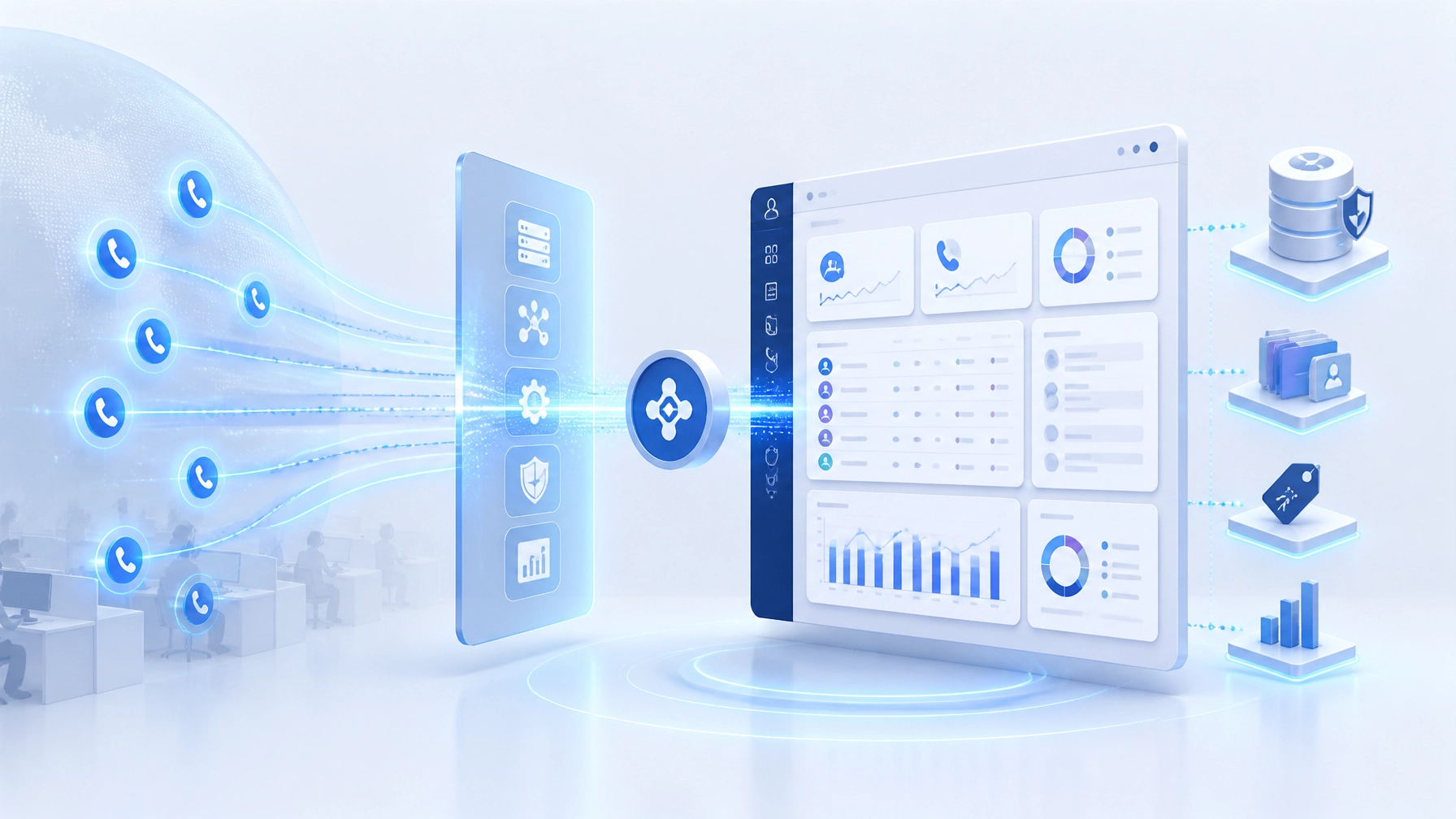
    Enterprise illustration of call events connecting through an API integration layer into account and campaign records

    Designing reliable call attribution

    Call attribution means more than knowing that a call occurred. It means understanding which business entity should receive credit, responsibility, and follow-up for that interaction.

    For this engagement, the attribution model centered on several identifiers:

    • Account ID: The internal record associated with the consumer or account.
    • Portfolio or client ID: The creditor, client group, or portfolio responsible for the account.
    • Campaign ID: The recovery strategy, aging segment, or outreach list involved.
    • Agent ID: The employee, team, or automated assistant responsible for the interaction.
    • Call ID: The unique identifier generated by the telephony system.
    • Phone number and DID: The originating number, destination number, or campaign-specific line.
    • Disposition code: The standardized result of the call.

    The system used these identifiers to resolve relationships as call data entered the platform. For example, an outbound call could be associated with a specific campaign and agent before it began, while the final disposition and recording metadata were attached after the interaction ended.

    Inbound calls required a different path. Caller ID and phone-number matching could identify a likely account, allowing the application to present relevant information to the agent or route the call according to account status. When a number matched multiple records or lacked sufficient confidence, the system could route the interaction for review rather than making an unsafe assumption.

    This structure created a unified interaction timeline. Voice calls, follow-up messages, payment links, disputes, and scheduled callbacks could be viewed as related events instead of separate activities across disconnected applications.

    Standardizing dispositions so workflows can act on outcomes

    One of the most important design decisions was replacing inconsistent free-text notes with structured disposition categories.

    A disposition should do more than describe what happened. It should help the system determine what should happen next.

    Typical outcome categories included:

    • Promise-to-pay
    • Payment completed
    • Broken promise
    • Dispute raised
    • Right-party contact
    • No right-party contact
    • Wrong number
    • Callback requested
    • Hardship discussion
    • No answer
    • Opt-out or do-not-call request

    Each category could include additional structured fields. A promise-to-pay might require a due date and amount. A dispute might require a case type and escalation status. A callback might include a preferred time window.

    This made the data more useful for both operations and reporting. Managers could compare outcomes across campaigns. Supervisors could identify where agents required support. Automated workflows could act on structured information without trying to interpret ambiguous notes.

    Outcome-based automation for the next best action

    Once call attribution and disposition data were reliable, the agency could introduce rules-based workflow automation around the events that occurred during calls.

    A promise-to-pay, for example, could trigger a confirmation message, create a due-date reminder, and schedule a follow-up task. A dispute could open a case, suspend inappropriate outreach, and route the record to a specialized team. A no-answer outcome could return the account to a campaign according to defined pacing rules rather than simply adding another manual task to an employee’s queue.

    Modern illustration of a workflow engine branching call outcomes into reminders, payment links, callbacks, and dispute cases

    The resulting workflows could include:

    • Automated callback scheduling
    • SMS or email payment-link delivery
    • Promise-to-pay reminders
    • Escalation to a senior recovery specialist
    • Campaign reassignment
    • Dispute case creation
    • Account status updates
    • Manager notifications for exceptions
    • Follow-up tasks based on defined time windows

    This is where ai workflow automation can become valuable, provided it is applied within clear controls. AI can help summarize calls, classify interaction themes, suggest a disposition, or identify the next best action. However, sensitive decisions should remain governed by explicit business rules, human review, and compliance requirements.

    The goal is not to introduce AI for its own sake. The goal is to reduce repetitive work while improving consistency, traceability, and decision quality.

    Compliance and auditability built into the architecture

    Debt collection technology must be designed around governance from the beginning. Compliance cannot be treated as a reporting feature added after deployment.

    The custom system was structured to preserve an auditable history of important events, including call attempts, contact outcomes, consent attributes, opt-out requests, disposition changes, workflow actions, and recording references.

    Operational safeguards can include:

    • Dialing-window validation
    • Contact-frequency controls
    • Do-not-call and opt-out suppression
    • Consent and phone-number status tracking
    • Role-based access controls
    • Recording-retention policies
    • Immutable event logs
    • Approval requirements for sensitive workflow actions

    These controls support the agency’s internal governance model and help operational teams investigate disputes or exceptions. They also provide a foundation for aligning system behavior with applicable regulatory requirements, including guidance published by the Consumer Financial Protection Bureau.

    Secure compliance governance illustration with audit trails, encrypted data paths, and controlled telephony access

    The exact compliance configuration must reflect the agency’s legal obligations, client agreements, jurisdictions, and operating policies. Custom software makes it possible to express those requirements directly in workflows rather than relying exclusively on manual checklists.

    The business impact: moving from call volume to operational intelligence

    The value of this build was not limited to faster dialing. It came from connecting call activity to the rest of the operating model.

    With a reliable attribution layer, the agency could work toward:

    • Less manual re-entry of call results
    • More consistent follow-up execution
    • Faster visibility into campaign performance
    • Better separation of agent, portfolio, and campaign outcomes
    • More complete audit trails
    • Fewer disconnected records across telephony and collections systems
    • A scalable foundation for future AI-assisted workflows

    The architecture also created a path for more advanced reporting. Leaders could evaluate right-party contact rates, promise-to-pay outcomes, kept promises, callback completion, campaign performance, and agent activity using data tied to a consistent model.

    That distinction matters. A call center report tells you how many calls occurred. An integrated operational system helps explain what those calls produced.

    Proven engineering discipline across complex systems

    This telephony and call-attribution build is part of a broader body of work at Pure Technology Consulting.

    • FTP Inform demonstrates secure file ingestion, validation, portfolio processing, and workflow orchestration for national debt collection operations.
    • EHRIO Pro applies matching engines, 70-question intakes, and HIPAA-adjacent workflows to healthcare operations.
    • ChainHQ demonstrates location-aware architecture, centralized reporting, and granular operational permissions.
    • AI Local Boost shows how governed automation can support multiple tenants, brands, users, and locations.

    The industries differ, but the engineering discipline remains consistent: understand the operating model, establish a dependable data foundation, integrate systems at the event level, automate repeatable decisions, and preserve governance throughout the process.

    When to consider a custom telephony integration

    A custom build may be appropriate when a collection agency or multi-location service business:

    • Relies on several systems that do not share data reliably
    • Needs call outcomes connected to account-level workflows
    • Has complex campaign, agent, or portfolio attribution requirements
    • Uses manual spreadsheets to manage follow-up activity
    • Needs stronger auditability and operational controls
    • Wants to introduce AI without surrendering human oversight
    • Is scaling beyond what generic integrations can support

    This type of project is best approached through structured business process automation consulting: first mapping the workflows, data relationships, compliance constraints, and measurable outcomes; then defining an architecture that can support the organization’s next stage of growth.

    If your agency is losing operational value between the dialer, CRM, collections platform, and reporting layer, book a discovery call with Pure Technology Consulting. We can help scope the integration strategy, workflow roadmap, and custom application requirements.

    You can also contact our team directly at +1 (803) 921-0969.

    Amin Said, Founder of Pure Technology Consulting LLC
    https://puretechconsult.com
    Phone: +1 (803) 921-0969

  • AI Consulting Services: What High-Ticket Enterprises Should Expect from a Custom Development Partner

    AI Consulting Services: What High-Ticket Enterprises Should Expect from a Custom Development Partner

    By Amin Said, Founder of Pure Technology Consulting LLC

    High-ticket enterprises do not need another disconnected AI experiment. They need a technology partner capable of translating strategic priorities into reliable operating systems that improve decision-making, reduce operational friction, and create room for sustainable growth.

    That distinction matters. AI consulting services are often presented as a collection of tools, pilots, or model recommendations. For an enterprise, the real opportunity is broader: redesigning how information moves through the organization, how decisions are supported, and how repetitive work is executed.

    The right custom development partner should bring together strategy, workflow design, software engineering, integration, governance, and long-term technical stewardship. The goal is not simply to deploy AI. It is to build an operating model that uses technology as leverage.

    Strategy should come before software development

    A credible partner begins with business context rather than a preferred technology stack.

    Before recommending a chatbot, AI agent, or new platform, the partner should understand:

    • Which processes directly affect revenue, customer experience, or compliance.
    • Where employees spend time on repetitive, low-value administrative work.
    • Which systems hold critical data and whether that data can be trusted.
    • Where decisions depend on proprietary rules, institutional knowledge, or complex exceptions.
    • What the organization needs to accomplish over the next 12 to 24 months.

    This is the foundation of effective digital transformation consulting. A transformation roadmap should connect technology initiatives to measurable business outcomes. It should identify which workflows to modernize first, which systems to integrate, and which capabilities should remain human-led.

    A strategy engagement should produce practical deliverables, including:

    • A current-state systems and workflow assessment.
    • A prioritized list of automation and AI use cases.
    • A target-state architecture.
    • A data and integration plan.
    • A governance framework.
    • A phased delivery roadmap with success metrics.

    The purpose is to make investment decisions clearer before significant development begins. A partner that moves directly from an introductory conversation to a technology recommendation may be selling a tool rather than solving an operating problem.

    Strategic enterprise technology roadmap flowing into a modular software architecture with governance checkpoints

    Workflow automation is the first source of leverage

    AI creates the most value when it is embedded inside a well-designed workflow.

    Many enterprises begin with a narrow question: “Where can we add AI?” A better question is: “Which process is limiting our ability to scale, and how should that process work in its ideal future state?”

    That shift moves the conversation from novelty to leverage.

    A strong business process automation consulting engagement typically examines:

    1. Inputs: How information enters the organization through forms, email, files, calls, portals, or third-party systems.
    2. Decision points: Which rules, approvals, classifications, or prioritization steps determine what happens next.
    3. Handoffs: Where work moves between departments, applications, locations, or external partners.
    4. Exceptions: What happens when information is incomplete, inconsistent, urgent, or outside standard policy.
    5. Outputs: Which actions, notifications, records, reports, or customer communications are produced.

    Once those elements are mapped, AI can be applied where it is most useful. It may summarize information, classify records, identify missing data, recommend an action, draft communications, or route work to the right person.

    The objective is not to remove human judgment from every process. It is to reserve human attention for decisions that require context, accountability, and expertise while allowing software to manage predictable coordination work.

    Effective AI workflow automation should include:

    • Event-driven triggers where appropriate.
    • Clear rules for automated actions.
    • Human review for high-impact or uncertain decisions.
    • Exception queues instead of silent failures.
    • Audit trails that show what the system did and why.
    • Performance reporting tied to cycle time, error rates, throughput, or revenue impact.

    Automation that cannot be monitored is not transformation. It is an additional operational risk.

    AI-powered business systems require a strong data foundation

    An AI system is only as useful as the business context available to it.

    If customer, operational, financial, or clinical data is distributed across disconnected applications, the first priority may not be an advanced model. It may be creating a reliable data layer that allows the right information to move securely and consistently.

    A custom development partner should be able to address:

    • API and system integration.
    • Data normalization and canonical data models.
    • Document and file ingestion.
    • Role-based access controls.
    • Secure storage and transmission.
    • Retrieval systems for internal knowledge.
    • Model evaluation and monitoring.
    • Versioning for prompts, workflows, and business rules.

    For example, an AI system that helps prioritize leads must be connected to relevant customer history, qualification criteria, service availability, and sales outcomes. A document-processing system must understand validation rules, exception handling, and downstream approvals. A reporting assistant must be able to distinguish current, authoritative data from outdated records.

    This is why AI consulting services should not be separated from application architecture. The most valuable systems are not isolated AI features. They are integrated business capabilities that support intake, routing, communication, reporting, and decision-making in one governed environment.

    When custom web application development beats SaaS

    Off-the-shelf SaaS remains the right choice for many standard business functions. Enterprises should not commission custom software simply to recreate email, generic project management, or basic accounting tools.

    Custom software becomes strategically valuable when the workflow itself is part of the company’s differentiation.

    A custom web application may be the better choice when:

    • The business relies on proprietary decision logic.
    • Multiple departments must work from a shared operational record.
    • Existing tools require extensive workarounds or manual data entry.
    • The organization needs specialized AI capabilities that vendors do not support.
    • Compliance requirements demand tailored permissions and auditability.
    • The software will become a core asset used across locations or business units.
    • Per-user licensing and customization costs are increasing with growth.

    The decision should be based on total cost of ownership and strategic value: not only the initial subscription price.

    Evaluation area Off-the-shelf SaaS Custom web application
    Initial deployment Usually faster for standardized processes Requires discovery, architecture, and development
    Workflow fit The organization adapts to the vendor’s model The system is designed around the organization’s operating model
    Integrations Dependent on available APIs and vendor priorities Designed for required systems and data flows
    Differentiation Limited to configurable features Can encode proprietary processes and intelligence
    Long-term control Subject to pricing, product, and roadmap changes Greater control over functionality, data flows, and evolution
    Best use Commodity capabilities Strategic workflows and complex operating models

    The right answer is often hybrid. Use SaaS where the function is standardized and non-differentiating. Build custom applications where operational complexity, proprietary data, or business logic creates a meaningful advantage.

    A serious partner should explain this tradeoff honestly. If every problem is presented as a custom-build opportunity, the recommendation is probably not sufficiently strategic.

    Premium editorial comparison of a tailored enterprise application fitting unique workflows beside rigid disconnected SaaS blocks

    Evaluate the partner’s proof of engineering capability

    High-ticket enterprises should look beyond polished presentations. Ask how the partner has handled complexity in real systems.

    Pure Technology Consulting has developed proprietary platforms that serve as proof-of-concept for this kind of engineering capability. AI Local Boost demonstrates large-scale automation around Google Business Profile workflows. ChainHQ reflects the challenges of coordinating multi-location operations and reporting. EHRIO Pro demonstrates complex healthcare intake and matching logic, including detailed questionnaires and sensitive workflow requirements. FTP Inform illustrates secure file ingestion, validation, transformation, and downstream orchestration for financial operations.

    These builds are not substitutes for a client-specific discovery process. They demonstrate that scalable systems can be designed around complex workflows, integrations, data models, and operational controls rather than assembled from disconnected features.

    When evaluating a custom development partner, ask:

    • Can the team explain the architecture in business terms?
    • How are security, permissions, and auditability designed?
    • What happens when an integration fails?
    • How are AI outputs evaluated and reviewed?
    • Who owns the code, data model, and documentation?
    • What does ongoing support look like after launch?
    • How will the system evolve as the business changes?

    The best partner should be able to discuss both the vision and the failure modes.

    Expect a phased, premium engagement model

    Custom development for a high-ticket enterprise should be scoped as a strategic investment, not treated like a small software purchase.

    A practical engagement often includes:

    1. Discovery and readiness assessment
      Understand the operating model, systems, data, stakeholders, and constraints.

    2. Roadmap and solution architecture
      Define the target state, priorities, integrations, governance, and delivery sequence.

    3. Focused implementation
      Build and validate one high-value workflow or business capability.

    4. Expansion and optimization
      Extend the platform, add automation opportunities, and improve reporting.

    5. Ongoing technical partnership
      Monitor performance, maintain integrations, and adapt the system to new requirements.

    Meaningful custom work is usually a premium scoped offering, often beginning at $10,000 or more for a defined initial engagement and expanding based on the number of workflows, integrations, users, compliance requirements, and operational locations involved.

    The commercial structure should reflect the complexity of the outcome. Clear scope, decision rights, milestones, documentation, and success metrics protect both the enterprise and the development partner.

    AI workflow automation architecture connecting enterprise systems to approved actions, dashboards, and human oversight

    The strategic question is not whether to use AI

    The more important question is whether your organization is building the systems required to use AI responsibly and profitably.

    Enterprises that approach transformation as a sequence of disconnected tools may accumulate software without gaining operational clarity. Enterprises that begin with strategy, redesign workflows, strengthen their data foundation, and invest selectively in custom applications can create a more durable advantage.

    The right AI consulting partner will help you determine what to automate, what to integrate, what to build, and what to leave alone. They will connect technical decisions to business outcomes and create an architecture that can mature with the organization.

    Pure Technology Consulting helps high-ticket enterprises move from operational complexity to governed, scalable technology. To discuss your transformation roadmap or request a workflow assessment, schedule a discovery consultation or visit https://puretechconsult.com.

    Contact: +1 (803) 921-0969

    Amin Said, Founder of Pure Technology Consulting LLC
    https://puretechconsult.com

  • Case Study: AI Local Boost : Building White-Label Automation Infrastructure That Scales

    Case Study: AI Local Boost : Building White-Label Automation Infrastructure That Scales

    Amin Said, Founder of Pure Technology Consulting LLC

    AI Local Boost was engineered to solve a problem that becomes increasingly complex as a local business portfolio grows: how to manage hundreds of Google Business Profiles, locations, brands, users, and automated workflows without creating a fragmented operational system.

    The answer was not another scheduling dashboard or a collection of disconnected marketing tools. It was a scalable, multi-tenant SaaS architecture designed to support partner configurations, white-label deployments, granular access controls, strict data isolation, and governed AI automation.

    For Pure Technology Consulting, AI Local Boost serves as a proof-of-concept for the type of high-value systems we build for organizations that need more than off-the-shelf software can provide. The platform demonstrates how custom web application development and enterprise automation consulting can turn a repetitive operational function into reusable infrastructure.

    The business challenge: scaling local visibility without scaling administrative overhead

    For a single location, managing a Google Business Profile can be straightforward. Teams can publish updates, respond to reviews, add media, and monitor performance manually.

    The model changes when an organization operates dozens or hundreds of locations. A multi-location brand may need to coordinate:

    • Location-specific profile content and offers
    • Review monitoring and response workflows
    • Local media publishing
    • Brand and compliance standards
    • Access for corporate, regional, and local teams
    • CRM, POS, scheduling, and communication integrations
    • Reporting across individual locations and the overall portfolio

    At that scale, manual management creates inconsistent execution and limited visibility. A centralized team becomes a bottleneck, while local teams may lack the authority or context to manage their profiles effectively.

    AI Local Boost was designed around a different operating model: one shared technology foundation capable of serving multiple organizations, partner brands, and locations while preserving control over each tenant’s data, users, branding, and automation policies.

    Minimalistic digital illustration of an AI content engine

    The architecture strategy: treat white-label as infrastructure, not decoration

    White-label SaaS is often reduced to a logo swap and a custom color palette. That approach is insufficient for a serious partner or enterprise deployment.

    A true white-label system must separate the underlying platform from the experience presented to each organization. It must allow a partner to operate within its own branded environment while ensuring that the platform owner maintains centralized governance, support, billing, configuration, and security controls.

    For AI Local Boost, the architecture was organized around several core principles:

    A shared platform with tenant-aware data modeling

    The platform uses a multi-tenant operating model: a common application foundation serves multiple organizations, but each record, workflow, integration, and user session is scoped to the appropriate tenant.

    This creates a balance between efficiency and isolation. Engineering teams can maintain a unified codebase, while customers and partners interact only with the data and locations they are authorized to access.

    Tenant-aware modeling also supports more complex organizational structures, including:

    • Platform administrators overseeing the complete environment
    • White-label partners managing their own client portfolios
    • Client administrators controlling brand and workflow settings
    • Regional managers overseeing groups of locations
    • Location-level users managing day-to-day activity

    This structure allows the system to scale without creating a separate application instance for every customer or location.

    Role-based access designed around operating responsibility

    Role-based access control is not simply a security feature. It is an operating model expressed through software.

    AI Local Boost was designed so that each user sees the controls, workflows, and reporting appropriate to their responsibility. A corporate administrator may need portfolio-wide performance visibility. A regional manager may need access to ten locations. A local operator may need to review posts and approve responses for only one profile.

    Granular permissions help prevent two common problems:

    1. Giving every user more access than they need
    2. Creating operational friction by restricting users from the tasks they are responsible for

    The result is a more governed system in which local flexibility exists within clear organizational boundaries.

    Data isolation and governance across hundreds of locations

    A platform that automates local SEO activity must manage more than content. It must protect business data, credentials, brand standards, workflow rules, and location-level performance information.

    AI Local Boost was built with data isolation as a foundational architectural concern. Location records, user permissions, business profiles, content settings, and integration credentials are associated with the correct tenant and operating scope.

    That design supports several governance requirements:

    • A partner cannot access another partner’s client data
    • A client can manage its own locations without reaching platform-level administration
    • Location users cannot modify corporate-wide settings without authorization
    • Integration credentials remain associated with the correct organization
    • Activity can be traced through audit and workflow records
    • Central teams can apply global standards without eliminating local controls

    For high-ticket clients, this distinction is essential. The goal is not simply to automate more actions. The goal is to automate those actions within a controlled environment that leadership can understand and govern.

    AI workflow automation with deliberate control points

    The AI layer was designed to operate as an orchestration system rather than an unbounded content generator.

    AI Local Boost can evaluate the context of a business, location, audience, and campaign before generating or recommending content. The platform can support workflows for Google posts, media, review responses, and multi-channel distribution while applying tenant-specific instructions and brand standards.

    The architecture supports a governed workflow pattern:

    1. Collect context from the tenant’s business information, location data, service details, and brand guidelines.
    2. Generate or recommend an action using configured AI instructions and approved workflow templates.
    3. Apply validation rules for tone, content, timing, and required information.
    4. Route the action for approval, scheduled publication, or automated execution based on tenant policy.
    5. Record the result for reporting, auditability, and future optimization.

    This suggest-and-approve model is especially important for review management. AI can analyze sentiment and draft a context-aware response, while the business can decide whether the response requires human approval or qualifies for an automated rule.

    The objective is not to remove human judgment from every workflow. It is to place human judgment where it adds value and automate repetitive execution where the rules are clear.

    Professional business dashboard for multi-location management

    White-label configuration that supports partners and enterprise teams

    The white-label layer was designed to support more than a branded interface. It provides a controlled configuration framework for partners and organizations operating multiple client accounts.

    Typical configuration areas include:

    • Custom branding and visual identity
    • Tenant-specific language and response tone
    • Custom domain or branded portal behavior
    • User and role administration
    • Location hierarchy and portfolio organization
    • Workflow templates and approval policies
    • Usage controls and cost governance
    • Reporting views for partners, clients, and locations

    This structure allows a partner to present a cohesive software experience to its customers without building an entire SaaS platform from scratch. At the same time, the underlying infrastructure remains centralized enough to support consistent maintenance, security, upgrades, and observability.

    For businesses considering a SaaS white-label model, this is the difference between reselling a tool and owning a scalable operating platform.

    Integration architecture turns local SEO into an operational system

    Local visibility does not exist in isolation. Profile activity often depends on events that occur elsewhere in the business: a completed purchase, a patient visit, a new lead, or a customer interaction.

    AI Local Boost was designed to connect local SEO workflows with business systems such as CRMs, POS platforms, scheduling tools, email, SMS, and social channels. These integrations allow operational events to trigger appropriate actions, including review requests, follow-ups, content distribution, and reporting updates.

    The platform’s integration strategy reflects a broader PTC principle: automation is most valuable when it connects systems around the actual operating model of the business.

    Rather than asking teams to copy data from one application into another, a custom orchestration layer can establish reliable relationships between events, rules, approvals, and outcomes.

    Abstract data visualization representing scale and connectivity

    Proof of capability across complex industries

    AI Local Boost is one part of Pure Technology Consulting’s broader proof-of-work portfolio.

    In healthcare, EHRIO Pro demonstrates how custom systems can coordinate 70-question intakes, provider matching, scheduling logic, and HIPAA-adjacent workflows.

    For multi-location operations, ChainHQ shows how unified, location-aware architecture can eliminate data silos while preserving local operational control.

    In financial operations, FTP Inform illustrates how secure file ingestion, validation, workflow orchestration, and auditability can replace fragmented enterprise tooling.

    These systems address different industries, but the engineering principles are consistent: model the business accurately, isolate data appropriately, automate repeatable decisions, and provide governance at every level.

    When a custom SaaS platform is the right strategic investment

    A custom platform is not automatically the right answer for every organization. Standard SaaS can be effective when workflows are simple, stable, and shared across the market.

    Custom development becomes strategically valuable when a business needs to:

    • Support multiple tenants, brands, or partner organizations
    • Encode proprietary workflows into software
    • Integrate systems that do not work together natively
    • Control data ownership and access at a granular level
    • Create differentiated customer or operator experiences
    • Build a new recurring-revenue software offering
    • Scale operations without adding administrative headcount linearly

    AI Local Boost demonstrates how those requirements can be addressed through a purpose-built system rather than a growing collection of workarounds.

    Build infrastructure for the operating model you are becoming

    The most important architectural decision is rarely the technology stack itself. It is the decision to build around the organization’s future operating model.

    AI Local Boost was designed for a world in which one platform may support multiple partners, hundreds of locations, many user roles, and thousands of governed workflow events. That forward-looking approach creates flexibility without sacrificing control.

    Pure Technology Consulting brings this same perspective to custom web applications, SaaS product development, enterprise automation, and AI workflow automation engagements. We help organizations move from disconnected tools and manual processes to technology foundations that support durable growth.

    If your organization is evaluating a white-label SaaS opportunity, a complex internal automation system, or a custom application that must scale across teams and locations, book a discovery call with Pure Technology Consulting.

    You can also contact our team directly at +1 (803) 921-0969 to discuss your workflow, architecture, and technology roadmap.

    Amin Said, Founder of Pure Technology Consulting LLC
    https://puretechconsult.com

  • Business Process Automation Consulting: A Decision Framework for High-Ticket Enterprises

    Business Process Automation Consulting: A Decision Framework for High-Ticket Enterprises

    High-ticket enterprises rarely lose growth because of one inefficient task. They lose momentum when critical workflows become fragmented across departments, software platforms, spreadsheets, and individual decision-makers.

    A sales opportunity may begin in a CRM, move through email approvals, depend on documents stored in shared drives, and eventually require manual updates in finance, operations, and customer service systems. Each handoff creates delay, duplication, and risk.

    This is where business process automation consulting becomes a strategic discipline rather than a technology project.

    At Pure Technology Consulting, Amin Said, Founder of Pure Technology Consulting LLC, works with growth-focused organizations to design custom web applications, AI-powered workflows, and integrated operating systems around the way the business actually functions. The objective is not to add more software. It is to create a more scalable, measurable, and resilient model for execution.

    This decision framework helps executives determine:

    • Which processes should be automated first
    • When traditional workflow automation is sufficient
    • When AI consulting services are appropriate
    • When a broader digital transformation program is required
    • How to build governance into automation from the beginning

    Start with the business outcome, not the technology

    Business process automation is often introduced through a technology conversation: Which platform should we buy? Can an AI agent handle this task? Should we deploy RPA?

    Those questions are premature if the organization has not defined the business result.

    According to IBM’s overview of business process automation, BPA connects multiple systems and activities to streamline complex processes. It can combine workflow orchestration, APIs, robotic process automation, artificial intelligence, and cloud platforms.

    For enterprise leadership, the more important question is:

    Which value chain is limiting growth, margin, customer experience, or operational control?

    Common high-value workflows include:

    • Lead-to-opportunity
    • Opportunity-to-contract
    • Contract-to-delivery
    • Customer onboarding
    • Quote-to-cash
    • Claims or case management
    • Compliance review
    • Delivery-to-renewal

    The strongest automation initiatives have a clear business thesis. They may aim to increase throughput without adding proportional headcount, reduce errors in a compliance-sensitive process, shorten customer onboarding, or improve leadership visibility across multiple locations.

    If the desired outcome cannot be connected to a measurable business priority, the initiative may be tool adoption rather than transformation.

    Prioritize the workflows with the greatest operating leverage

    Once the strategic outcome is clear, create a portfolio of processes rather than selecting one task in isolation.

    Document how work is actually performed today, including:

    • Triggers and inputs
    • Systems involved
    • Handoffs between teams
    • Approval points
    • Exceptions and escalations
    • Manual data entry
    • Final outputs
    • Process owners

    The documented process should reflect reality, not the idealized version found in an operations manual. Workarounds, inbox approvals, spreadsheets, and tribal knowledge are often where the highest-value automation opportunities are found.

    A practical prioritization model evaluates each process across five dimensions:

    1. Business impact: Does the process influence revenue, margin, customer retention, or compliance?
    2. Volume: How frequently does the process run?
    3. Repeatability: Are the steps and decision rules consistent?
    4. Error and rework: How often do mistakes create downstream cost?
    5. Dependency risk: Does the process rely on one executive, specialist, or employee?

    High-volume, repeatable processes are often strong candidates for workflow automation. Lower-volume processes may still deserve priority when a failure carries significant financial, regulatory, or reputational consequences.

    An executive decision framework prioritizing high-impact business workflows for automation

    Decide whether you need BPA, AI, or broader transformation

    Not every automation challenge requires artificial intelligence. Not every AI opportunity can be solved with a simple workflow tool.

    The right path depends on the nature of the process and the maturity of the underlying systems.

    Choose business process automation when the workflow is structured

    Traditional BPA or RPA is often appropriate when:

    • Inputs are structured
    • Rules are clear
    • The process runs frequently
    • Exceptions are limited
    • The same systems are used repeatedly
    • Outcomes can be validated objectively

    Examples include routing an application, updating records across systems, generating standard documents, triggering notifications, or reconciling predictable transactions.

    RPA is a narrower form of automation focused on repetitive, rules-based interactions. Broader BPA connects tasks and systems across an end-to-end workflow.

    Add AI when the process requires interpretation

    AI consulting services become more relevant when workflows involve unstructured data, language, classification, prediction, or contextual judgment.

    Examples include:

    • Reviewing contracts or intake documents
    • Classifying inbound requests
    • Summarizing customer or patient histories
    • Extracting information from emails and attachments
    • Recommending next actions
    • Detecting anomalies
    • Routing complex cases based on multiple variables

    AI should not be treated as an isolated assistant placed on top of a broken process. It is most valuable when integrated into a governed workflow with defined data sources, decision boundaries, human review points, and auditability.

    Research from EY and Automation Anywhere describes the evolution from task-based RPA toward agentic process automation, where AI reasoning can interpret context, coordinate steps, and handle more complex exceptions. The strategic implication is not that every process should become autonomous. It is that enterprises need a deliberate way to combine deterministic automation, AI, and human judgment.

    Pursue digital transformation when the operating model itself must change

    A broader digital transformation program may be necessary when:

    • Core systems cannot exchange reliable data
    • Multiple departments maintain conflicting records
    • Legacy platforms constrain the customer journey
    • The organization is expanding across locations
    • Business processes require significant redesign
    • Governance, security, or reporting capabilities are inadequate

    In these situations, automating the existing process may simply make an inefficient model run faster. The organization may need a new integration architecture, a unified data model, a custom application, or a redesigned operating model.

    Simplify and standardize before building

    A reliable automation roadmap follows a simple sequence:

    Understand → Simplify → Standardize → Automate → Govern

    This sequence matters because software cannot resolve unclear ownership, redundant approvals, inconsistent data, or conflicting policies on its own.

    Before implementation, executives should ask:

    • Which steps create value?
    • Which approvals are necessary?
    • Where does information change format?
    • Who owns each decision?
    • What qualifies as an exception?
    • Which data source is authoritative?
    • What should remain human-led?

    The goal is not to eliminate human involvement indiscriminately. High-value enterprises often need human judgment for sensitive decisions, relationship management, or unusual scenarios. The goal is to reserve human attention for the moments where it creates the most value.

    Typical consulting deliverables may include:

    • Current-state process maps
    • Future-state workflow designs
    • Automation opportunity scoring
    • Systems and integration architecture
    • Data and security requirements
    • AI readiness assessment
    • Custom application roadmap
    • Governance and measurement plan

    Build a phased roadmap with measurable checkpoints

    High-ticket automation programs should be ambitious in direction and disciplined in execution.

    A practical engagement usually moves through five phases:

    1. Discover

    Interview stakeholders, review systems, and identify the workflows creating the greatest operational drag.

    2. Map

    Document the current process, including the exceptions that are often invisible in formal procedures.

    3. Redesign

    Remove unnecessary steps, clarify ownership, standardize data, and define the appropriate balance between automation and human review.

    4. Build and integrate

    Develop the required workflow engine, custom web application, AI capability, dashboards, and system integrations.

    5. Adopt and optimize

    Train users, monitor performance, manage exceptions, and improve the system as business requirements evolve.

    The first implementation should generally focus on one or two high-impact workflows. This creates a controlled environment for validating assumptions, measuring operational outcomes, and refining governance before expanding the roadmap.

    Useful measures may include:

    • Cycle time
    • Error and rework rate
    • Manual touches per transaction
    • SLA performance
    • Hours reclaimed from administrative work
    • Revenue leakage
    • Exception volume
    • Customer response time

    These metrics create a clearer investment case than generic claims about efficiency.

    Use proven architecture as a foundation for custom systems

    Pure Technology Consulting brings experience from multiple high-stakes operating environments into bespoke client engagements.

    The company’s proprietary builds serve as proof-of-concept examples of that capability:

    • EHRIO Pro demonstrates how a custom healthcare workflow can coordinate detailed, 70-question intakes, matching logic, scheduling, and secure data movement. Learn more in the healthcare automation architecture article.
    • ChainHQ demonstrates a location-aware architecture for organizations managing multiple branches, teams, or operating units. Its model is discussed in the multi-location architecture case study.
    • AI Local Boost demonstrates how automated agents can manage structured digital visibility workflows, including Google Business Profile operations, while applying organization-specific logic.
    • FTP Inform demonstrates the value of centralized reporting, accountability, and file-based automation in complex operational environments.

    These systems are not presented as off-the-shelf replacements for every enterprise. They illustrate the engineering principles required to build scalable platforms: orchestration, secure integrations, role-based access, location-aware data, reporting, and controlled automation.

    Govern automation as an operating capability

    Automation becomes more valuable: and more consequential: as it scales.

    Every automated or AI-enabled workflow should have:

    • A clearly accountable business owner
    • Defined decision boundaries
    • Approved data sources
    • Role-based access controls
    • Exception and escalation procedures
    • Audit logs
    • Performance monitoring
    • A change-management process
    • Human review for high-risk decisions

    Governance is not a barrier to innovation. It is what allows leaders to expand automation with confidence.

    For AI-enabled workflows, organizations should also monitor the quality of outputs, the consistency of decisions, the handling of sensitive data, and the conditions under which a human must intervene.

    The objective is a system that is not only efficient, but understandable, maintainable, and aligned with the organization’s risk posture.

    The next step is a workflow audit, not a software demo

    The most important automation decision is rarely which tool to purchase. It is where the organization should focus its limited investment, attention, and change capacity.

    A structured assessment can identify whether your next initiative should be:

    • A focused workflow automation project
    • An AI-enabled process redesign
    • A custom web application
    • A systems integration program
    • A broader digital transformation roadmap

    Pure Technology Consulting partners with leaders who view technology as operating infrastructure: not another subscription. The process begins with understanding your business model, mapping the workflows that constrain growth, and defining a practical roadmap toward measurable leverage.

    Book a discovery consultation or explore Pure Technology Consulting to discuss your automation strategy.

    Contact: +1 (803) 921-0969


    Amin Said, Founder of Pure Technology Consulting LLC
    https://puretechconsult.com

  • Case Study: How EHRIO Pro Turned Healthcare Intake Into a Scalable Matching Engine

    Case Study: How EHRIO Pro Turned Healthcare Intake Into a Scalable Matching Engine

    Amin Said, Founder of Pure Technology Consulting LLC
    https://puretechconsult.com

    Healthcare intake is often treated as a form-building exercise. In practice, it is the first step in a much larger operating system.

    Every answer a patient provides can influence eligibility, provider fit, scheduling, communication, documentation, and staff workload. When that information is captured inconsistently or routed manually, growth introduces friction. More inquiries create more triage work. More providers create more matching complexity. More locations create more opportunities for data to fall between systems.

    EHRIO Pro was designed to address that challenge.

    The project demonstrates how Pure Technology Consulting can engineer a complex, healthcare-focused web application that turns structured intake into a scalable patient-to-provider matching engine. Rather than treating intake as a static questionnaire, the system uses adaptive data collection, configurable business rules, workflow automation, and human review points to support a more consistent patient access model.

    This is not a product pitch. It is a proof of capability: an example of how PTC approaches high-stakes operational software for healthcare organizations and other industries where fragmented processes limit growth.

    The business problem: intake was disconnected from operations

    A healthcare practice may receive new-patient inquiries through a website, phone call, referral, email, or advertising campaign. The information collected through each channel is often different.

    A front-desk team may then need to determine:

    • Whether the patient’s needs align with the services offered
    • Which provider has the appropriate specialty or experience
    • Whether the provider accepts the patient’s insurance
    • Whether the patient is located in an eligible state or service area
    • Whether the provider has availability at the patient’s preferred times
    • Whether the patient prefers virtual or in-person care
    • Whether additional clinical or administrative review is required

    In a small practice, staff may manage this through experience and informal notes. That approach becomes difficult to govern as the organization grows.

    The operational risk is not limited to slower response times. Manual intake can create inconsistent data, duplicate work, avoidable scheduling errors, poor provider fit, and limited visibility into where prospective patients are lost.

    The strategic requirement was clear: build an intake process that could collect better information and use it immediately.

    Designing intake as a data product

    The foundation of EHRIO Pro is a 70-question intelligent intake. The important design decision was not simply the number of questions. It was the way the questions were organized and used.

    A static form presents every user with the same fields. An intelligent intake uses conditional logic to create a more relevant path. A patient does not necessarily see all 70 questions. Instead, responses determine which questions appear next.

    For example:

    • A preference for telehealth can trigger location and jurisdiction questions.
    • An insurance response can determine which coverage details are required.
    • A behavioral health response can route the patient toward additional screening or clinical review.
    • A request for medication management can influence the required provider type.
    • A language or communication preference can become part of the matching profile.

    This approach produces two benefits. First, the patient experience becomes more focused. Second, the organization receives structured information that can support downstream decisions.

    The intake was designed to capture several categories of data:

    • Identity and contact information
    • Service needs and presenting concerns
    • Insurance or self-pay status
    • Location and jurisdiction
    • Visit modality and scheduling preferences
    • Provider preferences
    • Consent and communication permissions
    • Referral source and prior treatment context

    The goal is not to automate clinical judgment. The goal is to create a reliable administrative and operational foundation around the clinical team.

    Adaptive healthcare intake represented by branching question paths converging into a structured patient profile

    Building the patient-to-provider matching engine

    Once intake data is structured, it can become part of a decision system.

    EHRIO Pro models providers using configurable attributes such as:

    • Licensure and eligible jurisdictions
    • Specialties and conditions served
    • Age groups supported
    • Accepted insurance plans
    • Locations and telehealth availability
    • Treatment modalities
    • Languages and relevant provider preferences
    • Appointment availability
    • Practice-specific assignment rules

    The matching engine evaluates each patient against those provider profiles.

    The architecture separates hard filters from weighted preferences.

    Hard filters protect operational fit

    Hard filters represent criteria that must be satisfied before a provider can be considered. These may include:

    • State or jurisdiction eligibility
    • Service or provider type
    • Insurance acceptance
    • Visit modality
    • Location requirements
    • Age-range restrictions

    If a provider fails a required condition, that provider should not be presented as an eligible match simply because other attributes appear favorable.

    Weighted factors improve the recommendation

    After hard filters are applied, the engine can rank the remaining providers using weighted factors. These may include:

    • Clinical specialty alignment
    • Schedule overlap
    • Language preference
    • Provider preference
    • Distance or location fit
    • Treatment approach
    • Availability within the desired time window

    This makes the matching logic more useful than a simple keyword search. It also creates an opportunity for the organization to tune the operating model over time.

    A practice can adjust weighting, add new provider attributes, or introduce new routing rules without rebuilding the entire application. That configurability is an important distinction between a custom workflow system and a collection of disconnected forms.

    Patient-to-provider matching engine visualized as transparent weighted connections between an anonymized patient profile and eligible provider nodes

    Making the system explainable for staff

    Automation is most effective when staff can understand and supervise it.

    For that reason, a matching engine should not only produce a result. It should provide context for the result.

    A staff member may need to see that a provider was surfaced because of:

    • A matching specialty
    • Accepted insurance
    • Shared location or jurisdiction
    • Compatible availability
    • Requested visit modality
    • Language or preference alignment

    This supports trust, quality control, and continuous improvement. It also gives the organization a way to review exceptions rather than forcing staff to repeat every routine decision manually.

    EHRIO Pro’s approach uses confidence and exception handling as part of the workflow design. High-confidence administrative matches can continue toward scheduling. Ambiguous or incomplete cases can be routed to a manual review queue. Cases that require clinical judgment can be escalated to the appropriate licensed professional.

    That balance matters. The objective is not to remove people from the process. It is to reserve human attention for the decisions that genuinely require it.

    Orchestrating HIPAA-adjacent workflow automation

    The matching engine is only one part of the architecture. Its value increases when it connects to the workflows that follow intake.

    EHRIO Pro was designed around administrative automation that can include:

    • Data validation and normalization
    • Insurance and eligibility workflow triggers
    • Staff work queues
    • Scheduling recommendations
    • Consent-aware patient communication
    • Structured intake packets
    • EHR documentation workflows
    • Role-based access
    • Audit logging
    • Reporting and operational visibility

    These capabilities create a connected path from inquiry to appointment rather than leaving staff to move information between separate tools.

    The phrase “HIPAA-adjacent” is important. Administrative workflows that touch protected health information must be designed with appropriate security, access, data handling, and compliance requirements. Software controls alone do not establish compliance, and every deployment requires organization-specific legal, operational, and security review.

    The engineering responsibility is to provide a sound foundation: clear permissions, secure data handling, traceable activity, consent management, and minimum-necessary access patterns. The operational responsibility is to configure policies and processes appropriately for the organization.

    Secure healthcare workflow orchestration connecting intake validation, eligibility review, work queues, scheduling, communication, and structured documentation

    The result: intake became an operating capability

    The central transformation was conceptual and technical.

    Before the system, intake was primarily a data collection step. After the system was designed, intake became an operational capability that could:

    • Collect consistent information
    • Apply business rules
    • Recommend appropriate providers
    • Route exceptions to staff
    • Support scheduling
    • Create structured downstream documentation
    • Produce data for reporting and optimization

    That shift creates leverage. A growing practice does not need to increase manual triage work at the same rate as inquiry volume. New providers can be added to a structured profile model. New locations can be represented through configurable rules. New workflow requirements can be incorporated without replacing the entire system.

    The broader lesson applies beyond healthcare: when a business process contains repeatable decisions, structured data, and predictable handoffs, it may be a candidate for custom automation.

    What this case study demonstrates about custom development

    EHRIO Pro illustrates several capabilities required for complex, high-value software engagements:

    1. Domain modeling: Translating healthcare intake, provider profiles, scheduling constraints, and organizational rules into a flexible data model.
    2. Decision-engine development: Combining required eligibility rules with weighted recommendations and explainable outputs.
    3. Workflow orchestration: Connecting intake to review queues, scheduling, communication, and documentation.
    4. Security-aware architecture: Designing permissions, auditability, consent tracking, and secure handling into the workflow.
    5. Scalable product thinking: Building configurable systems that can support solo practitioners, single-location clinics, and multi-location organizations.
    6. Human-in-the-loop automation: Automating routine paths while preserving review for uncertain, sensitive, or clinically significant cases.

    These are the same engineering principles PTC brings to custom web applications, SaaS platforms, CRM systems, and AI-powered automation programs.

    The right question is not whether a business needs “an app.” The better question is whether its operating model has reached the point where a purpose-built system can create measurable leverage.

    When a custom matching engine makes sense

    A custom build may be appropriate when:

    • Staff rely on tribal knowledge to route work
    • Existing software cannot represent the organization’s rules
    • Multiple systems must share structured data
    • Provider, location, or eligibility complexity is increasing
    • Reporting requires manual spreadsheet work
    • The organization needs control over its workflow and data model
    • Automation must be introduced without removing human oversight

    For a healthcare organization evaluating this path, the engagement should begin with discovery: mapping the current intake process, identifying decision points, documenting integrations, reviewing compliance requirements, and defining measurable outcomes.

    Pure Technology Consulting brings proven healthcare capabilities: including intelligent intake, matching engines, and HIPAA-adjacent workflow design: into a broader custom software strategy. The goal is to build technology around the way the organization actually operates, not force the organization to work around generic software.

    If your team is evaluating a complex intake, routing, or workflow challenge, book a discovery call with Pure Technology Consulting to scope the operating model and identify the right technical roadmap.


    Amin Said, Founder of Pure Technology Consulting LLC
    https://puretechconsult.com
    +1 (803) 921-0969

  • Bespoke AI Solutions for High-Ticket Enterprises: A Roadmap from Strategy to AI-Powered Business Systems

    Bespoke AI Solutions for High-Ticket Enterprises: A Roadmap from Strategy to AI-Powered Business Systems

    By Amin Said, Founder of Pure Technology Consulting LLC

    For high-ticket enterprises, artificial intelligence is no longer an isolated technology initiative. It is becoming part of the operating model: the way organizations manage information, make decisions, serve customers, and scale execution.

    The strategic question is not whether a company should “use AI.” The more valuable question is where bespoke AI solutions can create measurable operating leverage without introducing unnecessary complexity, security exposure, or disconnected experiments.

    That distinction matters. Generic tools may support individual tasks, but they rarely understand the full context of a company’s workflows, systems, data, rules, and customer commitments. High-value transformation requires a more deliberate path: strategy first, process clarity second, and custom engineering where the opportunity justifies it.

    At Pure Technology Consulting, we help growth-focused organizations move from manual operations and disconnected software toward AI-powered business systems designed around the way they actually work.

    Why enterprise AI requires an operating strategy

    Many organizations begin with a narrow AI project: a chatbot, an automated email sequence, or a document summarization tool. These can be useful, but they do not automatically create transformation.

    The greatest value usually comes when AI is connected to the broader business process. An intake form can trigger qualification, routing, scheduling, documentation, and follow-up. A customer interaction can update multiple systems at once. A leadership dashboard can combine operational data with recommendations and exception alerts.

    This is the difference between adding AI features and building an AI-powered business system.

    A strategic AI initiative should answer four questions:

    • Which workflows consume the most staff time or create the greatest operational risk?
    • Where are decisions delayed because data is fragmented?
    • Which processes depend on repetitive human judgment that can be supported by AI?
    • What controls are required for security, compliance, approvals, and accountability?

    The answers create a foundation for focused investment. Instead of purchasing a collection of disconnected tools, leadership can build a roadmap that connects technology decisions to business outcomes.

    Executive AI strategy roadmap moving from discovery and process mapping to custom architecture and measurable operations

    The roadmap from strategy to business systems

    1. Begin with business process discovery

    Effective AI consulting services begin with understanding the operation before recommending a platform or model.

    A discovery process should document how work moves through the organization, including:

    • Intake channels and information requirements
    • Manual approvals and handoffs
    • CRM, EHR, ERP, accounting, scheduling, or telephony systems
    • Exceptions that require escalation
    • Reporting obligations and leadership decision points
    • Data quality, ownership, and access requirements

    This is where business process automation consulting creates value early. The goal is not to automate every task. It is to identify the points where automation can improve throughput, reduce errors, shorten cycle times, or give leaders a more reliable view of performance.

    A workflow audit may reveal that the largest opportunity is not a new AI model. It may be better data synchronization, a unified internal portal, or a rules engine that removes repetitive reconciliation.

    2. Prioritize use cases by business impact

    Once workflows are mapped, use cases can be evaluated according to value, feasibility, and risk.

    High-priority candidates often include:

    • High-volume document or form processing
    • Lead qualification and routing
    • Scheduling and resource assignment
    • Customer or patient communication
    • Multi-location reporting
    • Compliance checks and audit logging
    • Internal knowledge retrieval
    • Forecasting and decision support
    • Repetitive data entry between disconnected systems

    The best first use case is usually specific enough to measure and important enough to matter. A focused deployment creates evidence for the next phase of the roadmap.

    For high-ticket enterprises, this prioritization is especially important because custom development should be treated as a premium, scoped engagement. A serious build may begin at $10,000 or more depending on integrations, security requirements, workflow complexity, and the number of stakeholders involved. The investment should therefore be tied to a defined operating problem: not to experimentation for its own sake.

    3. Design the operating model before the interface

    An AI system is more than a user interface. It is a coordinated combination of data, business rules, integrations, automation, permissions, and human oversight.

    Before development begins, the organization should define:

    • What decisions AI can make independently
    • What actions require human approval
    • How exceptions are routed
    • Which systems remain the source of truth
    • How records are logged and reviewed
    • How users receive explanations or recommendations
    • How performance will be measured after launch

    This operating model prevents a common failure: building an impressive demonstration that does not fit the realities of daily work.

    Custom web application development becomes valuable when the system must reflect specialized processes. A bespoke application can combine dashboards, role-based workflows, AI assistance, approvals, notifications, and integrations into one coherent experience rather than forcing employees to move between multiple disconnected platforms.

    4. Build the automation layer around real systems

    AI workflow automation works best when it is connected to the systems where work already occurs.

    That may involve APIs, secure file transfers, webhooks, databases, communication platforms, payment systems, scheduling tools, or legacy applications. The objective is to create reliable movement of information across the business.

    A well-designed automation layer can:

    1. Receive a new request, file, form, or customer event.
    2. Validate and normalize the data.
    3. Apply business rules and AI-assisted classification.
    4. Route the work to the appropriate team or system.
    5. Trigger notifications, approvals, or follow-up.
    6. Record the outcome for reporting and auditability.

    This is the practical role of business automation consulting. AI should not operate as an isolated assistant. It should participate in a governed workflow with clear inputs, actions, and outcomes.

    AI workflow automation connecting documents, CRM records, approvals, alerts, and analytics through a central orchestration layer

    Where bespoke AI solutions create the most leverage

    Different industries require different operating logic. A healthcare intake workflow, a legal document process, a debt agency’s telephony environment, and a multi-location service business cannot be optimized with the same template.

    Pure Technology Consulting’s proprietary builds provide proof of this broader engineering capability:

    • EHRIO Pro demonstrates how complex healthcare workflows can incorporate matching engines, detailed 70-question intakes, smart scheduling, and HIPAA-adjacent operational controls.
    • ChainHQ demonstrates how a multi-location architecture can unify inventory, events, transactions, permissions, and reporting across distributed operations.
    • FTP Inform demonstrates how file-based workflows can be transformed through secure ingestion, schema validation, data normalization, exception handling, and downstream orchestration.
    • AI Local Boost demonstrates how AI and API integrations can support large-scale local visibility workflows across Google Business Profiles and related marketing channels.

    These platforms should be understood as proof-of-concept examples of what a capable software and automation partner can build: not as substitutes for a custom engagement when an enterprise has unique requirements.

    The same principles can be applied to legal and accounting operations. PTC brings proven capabilities from healthcare, field operations, fintech and debt management, and local SEO into new verticals so clients are not starting from scratch.

    Governance is part of the architecture

    Enterprise AI must be designed for trust as well as efficiency.

    Governance should address data access, privacy, security, model behavior, approval thresholds, audit trails, and ongoing monitoring. In regulated or high-stakes environments, human oversight is not a temporary limitation. It is an essential design feature.

    A governed AI-powered business system should make it possible to understand:

    • What information influenced an output
    • Which rule or model produced a recommendation
    • Who approved or changed an action
    • What happened when the system encountered an exception
    • How system performance is reviewed over time

    This approach allows organizations to adopt AI with confidence. It also makes future expansion easier because the operating principles are established before the system reaches a larger scale.

    Governed enterprise AI system with secure data controls, audit trails, integrations, and human approval checkpoints

    How to measure transformation after launch

    A custom AI initiative should be measured against the business process it was designed to improve.

    Useful measures may include:

    • Time from intake to first action
    • Manual touches per transaction
    • Error and exception rates
    • Staff hours spent on reconciliation
    • Response and resolution times
    • Revenue leakage caused by process gaps
    • Data completeness and reporting speed
    • Adoption by internal teams
    • Compliance or audit preparation time

    The right measurement window depends on the workflow and baseline. Some improvements may be visible within weeks, while broader productivity and revenue effects require several months of operational data.

    The goal is not to produce an impressive AI output. The goal is to create a more capable business: one that can process more work, respond more consistently, make better decisions, and grow without adding administrative complexity at the same rate.

    The next step is a focused transformation roadmap

    Bespoke AI solutions are most effective when they are approached as an executive transformation program rather than a collection of technical experiments.

    The path forward is straightforward:

    1. Audit the operating model.
    2. Identify the highest-value workflow constraints.
    3. Prioritize use cases by impact and risk.
    4. Define governance and integration requirements.
    5. Scope a focused custom build.
    6. Measure results and expand deliberately.

    For organizations with complex workflows, disconnected systems, or ambitious growth plans, the right technology partner should be able to advise, architect, build, implement, and support the solution over time.

    If your business is ready to evaluate where AI workflow automation or a custom AI-powered system could create measurable leverage, book a discovery call with Pure Technology Consulting. We can help translate operational complexity into a practical technology roadmap.

    Amin Said, Founder of Pure Technology Consulting LLC
    https://puretechconsult.com
    +1 (803) 921-0969

  • How Custom Web Applications Turn Operational Complexity into Competitive Advantage: PTC Case Studies

    How Custom Web Applications Turn Operational Complexity into Competitive Advantage: PTC Case Studies

    Amin Said

    Operational complexity is not automatically a disadvantage. In many organizations, complexity exists because the business has developed specialized processes, valuable customer data, multiple locations, or differentiated service models.

    The problem begins when those processes remain trapped in spreadsheets, disconnected SaaS tools, email threads, and manual workarounds.

    At that point, complexity stops creating value and starts creating drag.

    Custom web applications provide a strategic path forward. Instead of forcing an organization to adapt to generic software, a custom application can encode the company’s operating model into a scalable digital system. Workflows become repeatable. Data becomes visible. Decisions become faster. Proprietary processes become technology-enabled advantages that competitors cannot simply purchase from the same software marketplace.

    At Pure Technology Consulting, we design and deploy custom web applications and automation systems for growth-focused organizations across healthcare, local services, professional services, e-commerce, field operations, and financial services.

    Our proprietary platforms: AI Local Boost, ChainHQ, EHRIO Pro, and FTP Inform: serve as proof-of-concept examples of the architecture, automation, and integration principles we bring to high-ticket custom engagements.

    The strategic case for custom web application development

    Off-the-shelf software is effective when an organization’s workflows are relatively standard. A general CRM, scheduling platform, or accounting system may provide a strong foundation for common business functions.

    However, established companies often operate at the edges of those standard workflows.

    They may need to:

    • Coordinate operations across dozens or hundreds of locations.
    • Match customers or patients to providers using multiple decision variables.
    • Ingest files from external partners with inconsistent schemas.
    • Connect marketing, operations, billing, telephony, and reporting systems.
    • Enforce different permissions for executives, managers, specialists, and local teams.
    • Preserve compliance records and audit trails across complex processes.

    When a business reaches this level of operational maturity, adding more disconnected tools can increase technical debt. Teams spend time transferring data between systems instead of acting on it. Managers create manual reports because leadership lacks a unified view. Employees develop workarounds that only a few people understand.

    Custom applications address the underlying operating model rather than treating each symptom separately.

    The objective is not to automate everything indiscriminately. It is to identify the workflows where software can create measurable leverage, then build an architecture that supports governance, integration, scalability, and continuous improvement.

    Case study one: AI Local Boost and the challenge of location-scale visibility

    Enterprise-scale local search automation platform managing business profiles across many locations

    For multi-location businesses, Google Business Profiles are operational assets as well as marketing channels. Each profile represents a local point of visibility, customer interaction, review activity, and lead generation.

    Managing several locations manually is demanding. Managing hundreds introduces a different class of problem.

    A large network may need consistent posts, media updates, review monitoring, response workflows, and location-specific content. Those activities must remain aligned with brand standards while still reflecting local audiences and business conditions.

    PTC developed AI Local Boost as a demonstration of how a custom web application can coordinate this complexity through a centralized automation engine.

    Architecture and automation principles

    The platform is designed around several core principles:

    • Centralized management: Teams can coordinate many local profiles through a unified operational interface.
    • Location-aware content: Automation can account for the industry, location, audience, and local context of each profile.
    • AI-assisted governance: Incoming reviews can be analyzed for sentiment and used to generate context-aware response drafts.
    • Event-driven integrations: Customer events from CRMs, point-of-sale systems, and other applications can trigger review requests or downstream actions.
    • Human oversight where appropriate: High-confidence tasks may be automated, while sensitive or lower-confidence actions can follow a suggest-and-approve workflow.

    The referenced AI Local Boost case study describes an architecture designed to manage more than 500 locations without requiring a proportional increase in manual administration.

    The strategic value extends beyond local search. A system like this turns a fragmented marketing responsibility into a governed operating process. Leadership gains visibility. Local teams receive consistent support. The organization can scale its digital presence without scaling administrative effort at the same rate.

    Case study two: ChainHQ and the architecture of multi-location operations

    Unified enterprise data platform connecting multiple locations, data pipelines, integrations, and executive dashboards

    Multi-location growth creates a data architecture challenge. A business may have different branches, clinics, storefronts, regional offices, pop-ups, or warehouses. Each location generates operational data, but leadership still needs a unified view.

    Traditional approaches often produce one of two outcomes:

    1. Separate software instances create isolated data silos.
    2. A rigid global platform forces every location into the same workflow, even when local variations are operationally necessary.

    ChainHQ demonstrates a third approach: a unified, location-aware architecture.

    Architecture and automation principles

    The platform concept is built around:

    • Scoped entities: Shared records can be associated with both a tenant and a location, giving headquarters visibility while preserving local data boundaries.
    • Hierarchical inventory modeling: Inventory can be tracked across warehouses, regional hubs, storefronts, and other operational layers.
    • Role-based access control: Executives, regional leaders, managers, and local employees receive interfaces and permissions appropriate to their responsibilities.
    • Event-driven workflows: Inventory thresholds, transfers, reconciliation events, and other operational triggers can initiate automated actions.
    • Unified reporting: Leaders can compare performance across locations without waiting for manual spreadsheet consolidation.

    The ChainHQ case study illustrates how a custom system can centralize governance without eliminating local flexibility.

    This is particularly valuable for permanent jewelry brands, healthcare groups, franchise operators, and other businesses where growth depends on replicating a strong operating model across locations.

    The competitive advantage comes from visibility and consistency. Leaders can see where inventory is moving, how locations are performing, and which processes require intervention. Local teams can work within workflows that reflect their day-to-day responsibilities. Expansion becomes an architectural capability rather than a recurring software crisis.

    Case study three: EHRIO Pro and specialized healthcare workflows

    Secure healthcare workflow automation interface representing patient intake, matching, and data synchronization

    Healthcare practices often use multiple systems for scheduling, intake, patient records, billing, communications, and follow-up. Each system may perform its individual function well, yet the overall patient journey can remain fragmented.

    A growing physical therapy group, chiropractic practice, behavioral health organization, or specialty clinic may need to coordinate detailed intake requirements, insurance information, provider availability, clinical specialties, and location constraints.

    EHRIO Pro demonstrates how custom engineering can connect these requirements into one operational workflow.

    Architecture and automation principles

    The platform’s proof-of-concept architecture includes:

    • Dynamic intake journeys: A detailed intake process can adapt based on a patient’s answers instead of presenting every user with the same static form.
    • Matching engines: Patient information can be evaluated against provider specialization, location, scheduling availability, and insurance considerations.
    • Secure data synchronization: Status changes and appointment milestones can move between the custom application and existing healthcare systems through encrypted integration pipelines.
    • Role-based workflows: Front-desk staff, providers, administrators, and leadership can work from views designed for their responsibilities.
    • Operational status automation: Intake completion, eligibility checks, and follow-up requirements can trigger next steps without relying on manual reminders.

    The EHRIO Pro case study shows why custom development can be appropriate when a practice’s patient journey is itself a competitive differentiator.

    In regulated environments, architecture must be designed with security, permissions, auditability, and data-handling requirements in mind. The goal is not simply to digitize a paper form. It is to create a dependable operating layer that reduces re-entry, improves coordination, and gives staff more capacity for patient-facing work.

    Case study four: FTP Inform and file-driven enterprise automation

    Secure file-based automation engine connecting data sources with validation, transformation, routing, and business systems

    Many organizations still depend on files as a critical part of their operating model. Debt collection agencies, financial service organizations, logistics companies, and enterprise vendors may receive large volumes of CSV, Excel, fixed-width, or other structured files from external partners.

    The challenge is rarely file transfer alone. The real complexity lies in validating, transforming, routing, reconciling, and auditing the data after it arrives.

    PTC developed FTP Inform to demonstrate how a custom file-based automation engine can replace fragmented enterprise tooling with a coordinated system.

    Architecture and automation principles

    FTP Inform is structured around:

    • Secure SFTP ingestion: Incoming files are detected and processed through controlled, isolated endpoints.
    • Schema validation: Records are checked against client-specific rules before entering downstream workflows.
    • Exception handling: Invalid or incomplete records are quarantined for review rather than silently contaminating operational data.
    • Canonical data modeling: Validated information is normalized into a common internal structure.
    • Rules-based orchestration: Business logic can segment accounts, route work, and trigger actions based on defined criteria.
    • Audit-ready observability: Processing events, errors, status changes, and downstream actions can be logged for governance and review.

    According to the FTP Inform case study, the system consolidated three enterprise tools, reduced cycle time by 40 percent, and reduced manual intervention by more than 75 percent in the described deployment.

    The strategic lesson is broader than debt collection. When file-driven work is central to revenue delivery, custom software can turn an unreliable batch process into a dependable operational pipeline.

    A practical roadmap for turning complexity into leverage

    A successful custom web application begins with business strategy, not technology selection.

    Before development begins, leadership should identify:

    1. The highest-cost friction points: Where do delays, errors, duplicate work, or missed handoffs affect revenue and service quality?
    2. The data intersections: Which systems need to share information, and where is staff manually transferring data today?
    3. The proprietary logic: Which matching rules, approval paths, routing decisions, or service processes differentiate the business?
    4. The governance requirements: What permissions, audit trails, compliance controls, and approval workflows must be built into the system?
    5. The future operating model: Will the application need to support new locations, business units, customer segments, integrations, or licensing models?

    Typical deliverables may include workflow maps, a technical architecture roadmap, integration specifications, role-based interfaces, automation rules, dashboards, security controls, and a phased deployment plan.

    For organizations with complex operations, a custom build is often a premium, scoped investment: frequently beginning at $10,000 or more depending on integrations, compliance requirements, user roles, and workflow depth. The decision should be based on measurable operational leverage and long-term strategic value, not on the lowest initial software cost.

    Build the system your growth requires

    AI Local Boost, ChainHQ, EHRIO Pro, and FTP Inform represent different industries and different operational challenges. Their common foundation is the same: purpose-built architecture designed around how a business actually works.

    Custom web applications can unify fragmented data, automate high-value workflows, preserve institutional knowledge, and make differentiated processes scalable. They can help an organization move from reactive administration to a more intentional operating model.

    Pure Technology Consulting brings proven capabilities from healthcare, field operations, fintech, debt management, and local SEO into custom engagements for legal, accounting, professional services, and other growth-focused organizations.

    If disconnected systems or manual processes are limiting your next stage of growth, contact PTC at +1 (803) 921-0969 or book a discovery call to scope a practical technology roadmap.

    Amin Said, Founder of Pure Technology Consulting LLC
    https://puretechconsult.com
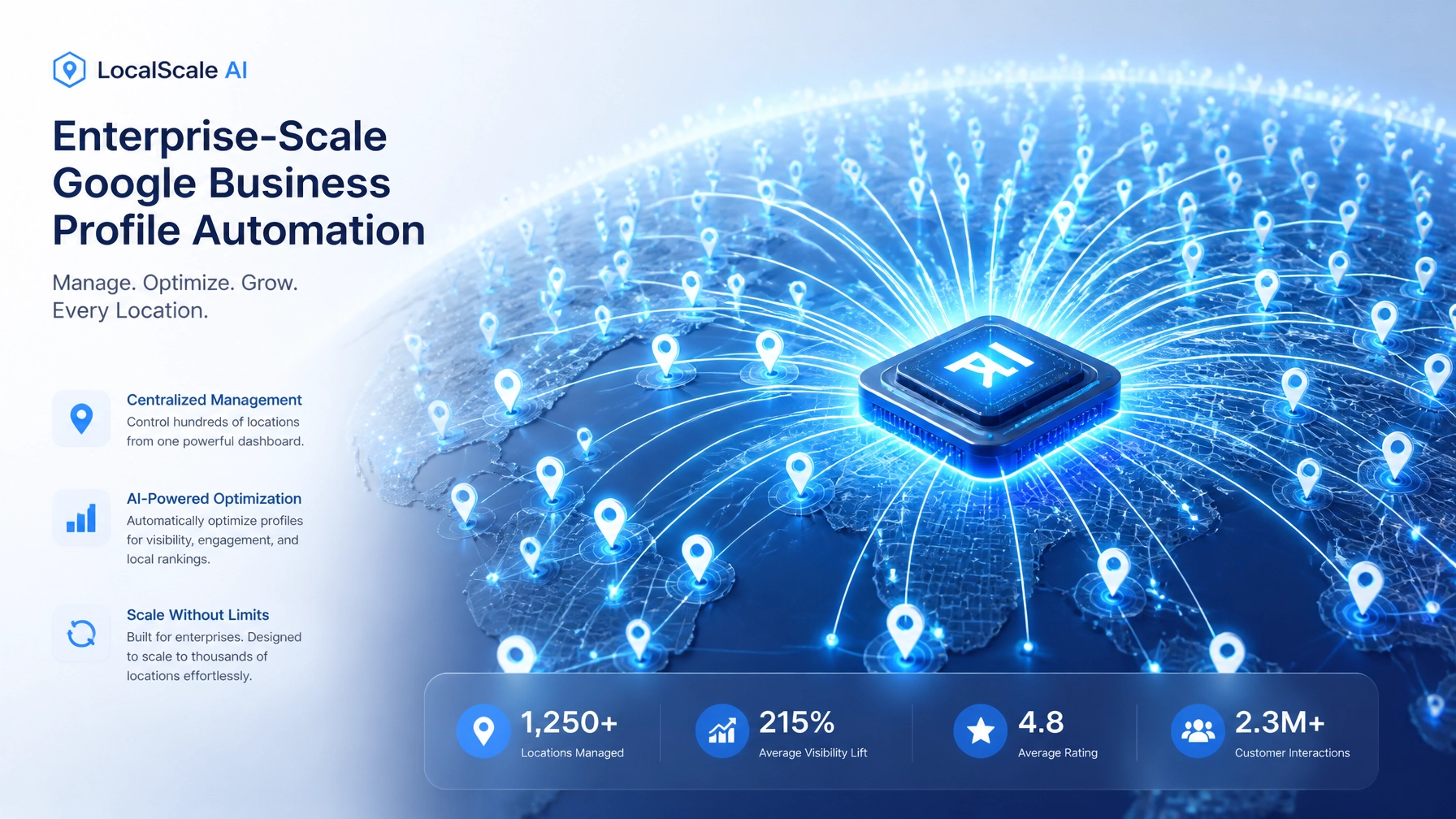
  • Digital Transformation for High-Ticket Enterprises: A Roadmap from Strategy to AI-Powered Operations

    Digital Transformation for High-Ticket Enterprises: A Roadmap from Strategy to AI-Powered Operations

    Digital transformation is no longer primarily an IT initiative. For growth-focused enterprises, it is an operating model decision.

    When revenue reaches $500K, $5M, or beyond, operational complexity begins to compound. More locations create more data. More customers create more intake and service activity. More employees create more approvals, handoffs, and reporting requirements. If the underlying systems do not evolve with the business, growth begins to produce drag instead of leverage.

    The leaders making the most progress are not replacing every tool at once. They are identifying where the business is losing time, visibility, margin, and control, then building a deliberate roadmap toward AI-powered operations.

    The business case for transformation is operational leverage

    A high-ticket business can appear successful while relying on fragile manual infrastructure behind the scenes.

    A sales opportunity may move from a CRM into a spreadsheet. A patient may complete an intake form that staff manually re-enter into an EHR. A scheduled service may require separate updates in a calendar, billing system, and dispatch platform. A multi-location operator may wait days for consolidated reporting because each branch uses a different process.

    These are not isolated inconveniences. They are symptoms of an operating model that has outgrown its software.

    Disconnected CRM, EHR, scheduling, billing, and spreadsheet systems converging into a unified operating layer

    Common sources of operational drag include:

    • Manual data entry between CRM, EHR, scheduling, billing, and accounting systems
    • Inconsistent processes across locations, departments, or service teams
    • Reporting that depends on spreadsheet consolidation
    • Approval workflows managed through email and informal follow-up
    • Customer and patient information distributed across disconnected platforms
    • Repetitive administrative work that depends on a small number of experienced employees
    • Limited visibility into bottlenecks, exceptions, and revenue leakage

    Off-the-shelf SaaS remains valuable for standardized capabilities. CRM, accounting, scheduling, and communication tools can provide a strong foundation. The challenge appears when a company’s competitive advantage depends on processes those platforms were not designed to support.

    At that point, adding another subscription may only increase fragmentation. The strategic answer may be a custom web application, an integration layer, or a bespoke automation system designed around the business’s actual operating model.

    Strategy comes before software

    Digital transformation consulting should begin with business outcomes, not a list of preferred technologies.

    Before selecting a platform or discussing artificial intelligence, executive teams should clarify what the transformation must accomplish. Depending on the business, the first priority may be reducing sales-cycle time, improving patient intake, accelerating account onboarding, increasing location-level visibility, or reducing the cost of service delivery.

    A useful strategy starts with four questions:

    1. Where is growth creating the most operational friction?
    2. Which workflows affect revenue, customer experience, compliance, or margin?
    3. What information must be available in real time for leaders to make better decisions?
    4. Where does existing SaaS support the operating model, and where does it impose limitations?

    This assessment creates a distinction between foundational systems and differentiating systems.

    Standard capabilities can often remain within configurable SaaS tools. Differentiating capabilities may justify custom software development. These can include specialized intake and matching engines, multi-location operating layers, proprietary pricing logic, client portals, complex assignment workflows, and AI-powered decision support.

    The goal is not to build everything from scratch. It is to build selectively where technology can create durable operational advantage.

    The executive roadmap: assess, prioritize, build, and measure

    A transformation roadmap should be ambitious enough to support long-term growth and disciplined enough to produce measurable progress.

    Executive digital transformation roadmap showing assessment, prioritization, phased development, and measurement

    1. Assess the current operating model

    Begin by mapping the workflows that move value through the organization.

    For a healthcare group, that may include marketing, intake, eligibility, provider matching, scheduling, clinical documentation, billing, and follow-up. For a professional services firm, it may include lead qualification, scoping, proposal development, approvals, project delivery, invoicing, and renewal.

    Document:

    • Systems involved in each workflow
    • Manual handoffs and duplicate entry points
    • Data ownership and quality issues
    • Approval and exception paths
    • Security, privacy, and compliance requirements
    • Delays that affect revenue or customer experience

    This process often reveals that the biggest problem is not a missing feature. It is the absence of a reliable flow of information between existing systems.

    2. Prioritize the highest-value opportunities

    Not every manual task deserves automation. Prioritize workflows based on business impact, frequency, complexity, and implementation risk.

    A strong first initiative usually has three characteristics:

    • It occurs often enough to create measurable operational cost
    • It affects a high-value customer, employee, or revenue process
    • Its success can be measured within a defined period

    Examples include automated intake routing, AI-assisted proposal generation, lead qualification, account assignment, file validation, review management, or billing reconciliation.

    Leaders should define a baseline before development begins. Relevant measures may include cycle time, administrative hours, error rates, missed appointments, conversion rates, response time, or days sales outstanding.

    3. Build in phases around a target architecture

    High-value custom systems should not begin as an unbounded, multi-year technology project.

    Instead, define a target architecture and deliver it in controlled phases:

    • Phase one: workflow foundation : establish data models, integrations, user roles, and core process logic.
    • Phase two: operational application : provide the interfaces, dashboards, portals, and automations teams need to execute consistently.
    • Phase three: intelligence layer : introduce AI for classification, recommendations, document processing, forecasting, and exception handling.
    • Phase four: scale and governance : expand across locations or departments while strengthening permissions, audit trails, monitoring, and support.

    This phased approach allows the organization to validate assumptions early while building toward a coherent system rather than a collection of disconnected pilots.

    4. Measure adoption and business impact

    A system creates value only when people use it and the business operates differently because of it.

    Measure both operational and financial outcomes. Did intake processing become faster? Did staff reduce duplicate entry? Did leadership gain real-time visibility? Did exceptions reach the right person earlier? Did customer response times improve?

    AI workflow automation should also include human governance. High-impact decisions may require review and approval, while low-risk, high-volume actions can operate automatically. The right balance depends on the process, data quality, and compliance environment.

    Where custom software beats another SaaS subscription

    The strongest case for custom web application development appears when the workflow itself is strategic.

    A configurable SaaS product may support scheduling, but not a provider-matching model based on insurance, geography, specialization, and availability. A CRM may store leads, but not coordinate a complex intake journey across departments. An accounting platform may record transactions, but not reconcile data from a specialized operational workflow.

    Custom systems can provide:

    • A unified data model: teams work from consistent records rather than competing spreadsheets.
    • Workflow alignment: the application reflects the organization’s actual process and decision logic.
    • Integration control: APIs connect CRM, EHR, scheduling, billing, telephony, and reporting systems.
    • Role-based experiences: each user sees the information and actions relevant to their responsibilities.
    • Embedded governance: permissions, approvals, audit trails, and exception routing become part of the operating system.
    • Scalability: new locations, services, and business units can be added without multiplying manual work.

    This is the distinction between buying software and engineering an AI-powered business system.

    Proof: capabilities proven across complex operating environments

    Pure Technology Consulting brings custom development and automation experience from several demanding domains. These proprietary builds are not presented as one-size-fits-all products. They serve as proof-of-concept examples of the architecture, integration, and workflow expertise PTC brings to high-ticket custom engagements.

    Unified multi-location business architecture developed for scalable operations

    ChainHQ demonstrates how a location-aware operating layer can unify multi-location data, inventory, permissions, and reporting. Its architecture addresses the problems that emerge when each branch operates through isolated tools and local workarounds. Read the ChainHQ architecture case study.

    EHRIO Pro demonstrates how a healthcare workflow can coordinate detailed, 70-question intakes, provider matching, scheduling, and secure data synchronization. The broader lesson applies to any business with complex qualification and routing requirements. Explore the EHRIO Pro build.

    AI Local Boost demonstrates bespoke AI solutions for high-volume, multi-location reputation and local visibility workflows. It shows how AI orchestration, API integrations, approval logic, and content operations can work together at scale. Review the AI Local Boost case study.

    FTP Inform demonstrates enterprise automation consulting for file-based financial operations. Its secure ingestion, schema validation, exception handling, and downstream orchestration replaced fragmented tooling with a unified automation engine. See how FTP Inform was engineered.

    Together, these builds reflect PTC’s approach to business automation consulting: understand the operating environment, model the data, connect the systems, automate the repeatable work, and preserve human oversight where judgment matters.

    AI-powered business systems coordinating secure integrations, workflows, governance, and performance analytics

    The same capabilities can support legal and accounting firms, multi-location service businesses, healthcare organizations, e-commerce operators, and professional services companies. These organizations do not need to start from scratch conceptually. Proven patterns from healthcare, field operations, fintech, debt management, and local SEO can inform a tailored roadmap for their own environment.

    The next step is a scoped transformation roadmap

    Digital transformation becomes practical when it is connected to a specific workflow, measurable business outcome, and realistic implementation sequence.

    If your organization is managing growth through spreadsheets, disconnected systems, manual approvals, or repetitive administrative work, a workflow audit can clarify where custom development and automation will create the greatest leverage. The right answer may be a targeted integration, a new internal application, an AI-assisted workflow, or a broader operating layer built in phases.

    Book a discovery call with Pure Technology Consulting to discuss your systems, constraints, and transformation priorities. The conversation is focused on scoping the opportunity and identifying a practical next step, with no obligation.

    Amin Said, Founder of Pure Technology Consulting LLC
    https://puretechconsult.com
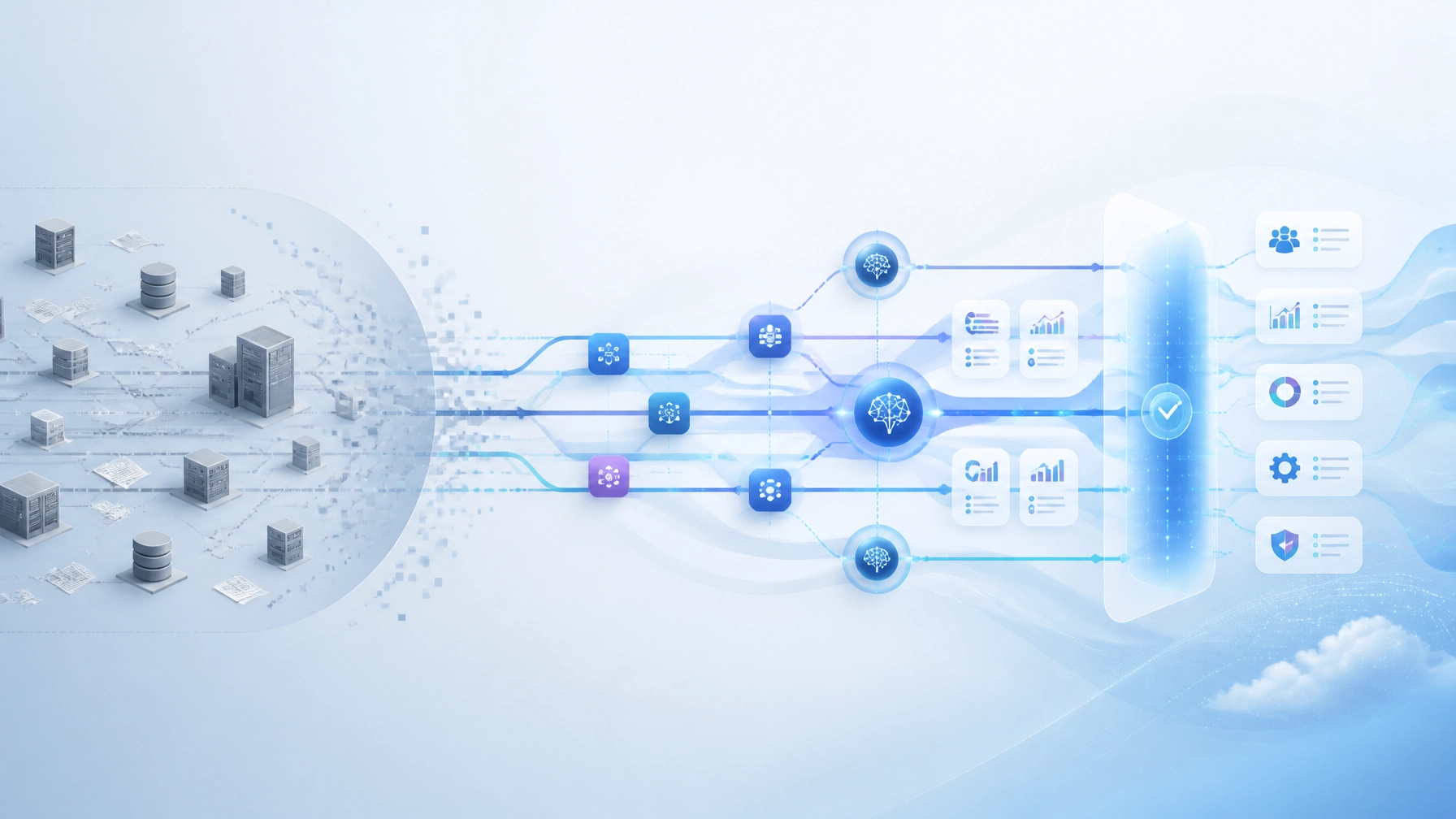
    Phone: +1 (803) 921-0969

  • Case Study: Engineering a Unified Operating Layer for Multi-Location Growth with ChainHQ

    Case Study: Engineering a Unified Operating Layer for Multi-Location Growth with ChainHQ

    Amin Said

    Multi-location growth creates a strategic challenge that is easy to underestimate: every new location adds revenue potential, but it also adds another layer of inventory, staffing, events, reporting, customer data, and operational coordination.

    When those activities are managed through disconnected tools, growth can increase complexity faster than it increases enterprise value.

    This case study examines how Pure Technology Consulting engineered ChainHQ as a proof of concept for a unified operating layer serving a growing permanent jewelry business. The platform demonstrates how custom web application development, intelligent workflow design, and enterprise automation consulting can transform fragmented operations into a scalable digital foundation.

    The broader lesson applies to multi-location retailers, healthcare groups, specialty clinics, franchises, and service businesses: the right technology strategy is not always another software subscription. Sometimes, the highest-leverage investment is a bespoke system built around the way the business actually operates.

    The business challenge: growth without operational visibility

    The client was expanding across multiple retail locations, pop-up events, trunk shows, and wholesale partnerships. The commercial opportunity was clear, but the operating model had not evolved at the same pace.

    Core information was distributed across spreadsheets, point-of-sale systems, manual processes, and separate reporting tools. This created several operational constraints:

    • Inventory visibility varied by location and event.
    • Leadership lacked a consistent view of revenue, cost of goods sold, and margin.
    • Event performance was difficult to compare across partners and markets.
    • Inventory transfers and post-event reconciliation required significant manual effort.
    • Adding locations or events introduced new workarounds instead of a repeatable launch process.

    These were not isolated software problems. They were operating-model problems caused by disconnected data and workflows.

    A location could perform well commercially while creating hidden administrative costs. An event could generate revenue without giving leadership a clear view of true margin. Inventory could exist somewhere in the network but remain unavailable to the location that needed it.

    The business needed more than a dashboard. It needed an operating layer that connected planning, execution, financial visibility, and decision-making.

    The strategic response: design around the operating model

    Pure Technology Consulting approached ChainHQ as a unified, location-aware ecosystem rather than a collection of independent storefront accounts.

    The objective was to create a system that could support local execution while preserving centralized governance. Headquarters needed a comprehensive view of the business. Local teams needed focused workflows relevant to their responsibilities. Both groups needed to work from consistent data.

    The platform was designed around four connected objectives:

    1. Establish a single source of truth for products, materials, locations, events, customers, transactions, revenue, and costs.
    2. Standardize the workflows that repeat across locations and events.
    3. Make expansion more repeatable without requiring administrative headcount to grow at the same rate.
    4. Give leadership reliable operating data for decisions about inventory, staffing, partners, and growth.

    This is a defining principle of effective digital transformation consulting: technology should reinforce the organization’s strategy, not simply digitize existing disconnection.

    Centralized data core connecting headquarters, regional hubs, storefronts, and pop-up events

    The architecture: one system with location-aware intelligence

    The ChainHQ architecture was built around a centralized data core with scoped entities.

    Instead of maintaining a separate database or isolated software instance for every location, the system uses shared business records with location and tenant context. In practical terms, each transaction, inventory movement, event, and staff activity can be associated with the appropriate business unit while remaining available for consolidated reporting.

    This model supports two important requirements at the same time:

    • Centralized visibility: Leadership can evaluate the full network, compare locations, and review performance across events and markets.
    • Operational control: Local managers and staff interact with the records and workflows relevant to their assigned location or role.

    The architecture also allows an organization to preserve local flexibility without permitting every location to create its own version of the operating process.

    A hierarchical inventory model

    Inventory was modeled across multiple operational levels, including central inventory, location inventory, and event-specific allocations.

    That structure creates a clear record of:

    • What is available centrally.
    • What is assigned to a location.
    • What is reserved for an upcoming event.
    • What is in transit.
    • What was sold or returned.
    • What requires replenishment.

    This is more than inventory tracking. It is a business control system. When inventory data is connected to events, transactions, and cost structures, leadership can understand not only what was sold, but where and under what operating conditions.

    Role-based access and governance

    Enterprise scalability requires more than a strong database. It also requires appropriate governance.

    ChainHQ was structured around role-based access so that executives, regional leaders, location managers, and frontline staff could work within interfaces appropriate to their responsibilities.

    This reduces unnecessary complexity for frontline users while protecting sensitive information and preserving consistent operating standards. Governance can be applied to inventory allocations, discounts, approvals, reporting, and location-level permissions without removing the autonomy required for daily execution.

    The automation approach: connect the work, not just the tools

    Architecture creates the foundation, but automation creates leverage.

    The ChainHQ approach focused on connecting the sequence of work from planning through reconciliation. That meant identifying where manual handoffs created delay, inconsistency, or duplicate data entry.

    Key workflow areas included:

    Event planning and setup

    Teams can define event details, assign locations and staff, establish expected performance indicators, and allocate the appropriate inventory.

    Over time, historical event data can support more informed planning. Similar event types, locations, partners, and product patterns can become inputs for future decisions.

    Inventory allocation and replenishment

    Inventory movement between central stock, locations, and events is recorded as an operational event rather than a spreadsheet update.

    Thresholds and velocity signals can support alerts and replenishment workflows. This gives the business a path toward AI workflow automation, where systems can identify patterns and recommend or initiate next actions under defined governance rules.

    Transaction and customer data capture

    Sales can be associated with the relevant location, event, staff member, product, and cost basis. Customer information can be made available across the appropriate operating context, supporting a more consistent brand experience when customers interact with different locations or event teams.

    Reconciliation and reporting

    After an event, the system can compare allocated inventory with sold and returned inventory, then connect the resulting activity to revenue, COGS, and margin reporting.

    This reduces dependence on manual consolidation and gives leadership a clearer operating picture without waiting for separate teams to assemble reports.

    AI workflow automation coordinating event planning, inventory allocation, transactions, reconciliation, and executive reporting

    Outcomes: a more predictable foundation for expansion

    Because client-specific financial metrics are confidential, this case study does not present unsupported percentage claims. The meaningful outcomes were structural and operational.

    ChainHQ created:

    • A consolidated view of inventory, sales, events, and locations.
    • More consistent workflows across the operating network.
    • Greater clarity into event-level and location-level performance.
    • A repeatable foundation for opening locations and adding events.
    • Less dependence on spreadsheet reconciliation and manual reporting.
    • A stronger basis for future automation and AI-assisted decision support.

    The most important shift was from reactive administration to managed operating visibility.

    Leaders could evaluate which events and partners justified further investment. Teams could identify inventory risks earlier. New locations could be introduced through standardized templates and processes rather than assembled from scratch.

    That is the strategic value of a custom system. It does not simply replace a collection of tools. It gives the organization a shared operating language.

    Why a bespoke AI-powered business system can be the better fit

    Not every business process requires custom software. Standard tools remain appropriate for common functions such as email, payroll, document storage, and basic scheduling.

    A bespoke system becomes more compelling when the process has one or more of the following characteristics:

    • It directly influences revenue, margin, or customer experience.
    • It contains proprietary business logic.
    • It requires data to move across several departments or locations.
    • It must coordinate people, inventory, events, communications, and reporting.
    • Existing tools force teams to maintain manual workarounds.
    • The business expects continued expansion or increasing process complexity.

    An AI-powered business system is particularly valuable when AI has access to structured, governed business data. Without that foundation, AI is often added as a disconnected assistant. With the foundation, AI can support practical use cases such as demand forecasting, event recommendations, exception detection, customer communication, report generation, and workflow routing.

    The objective is not to automate every decision. It is to automate the right decisions while keeping human oversight where judgment, compliance, or customer sensitivity requires it.

    This is where bespoke AI solutions and enterprise automation consulting intersect. The work begins with process design and data architecture, then adds intelligence where it can produce measurable operational leverage.

    Lessons for leaders planning multi-location growth

    The ChainHQ case offers several principles for executives evaluating their technology roadmap.

    1. Start with the operating model

    Before selecting a platform, document how work moves through the business. Identify the systems, people, approvals, and handoffs involved in each critical process.

    2. Treat manual data transfers as strategic signals

    Every time staff copy information from one system to another, the organization has an opportunity to improve data quality, reduce cycle time, or create automation.

    3. Separate local flexibility from system fragmentation

    Locations may require different schedules, partners, or customer interactions. That does not mean every location should operate on a separate data model.

    4. Build governance into the application

    Security, roles, permissions, approvals, and auditability should be part of the architecture rather than afterthoughts.

    5. Measure operational leverage

    Evaluate cycle time, reconciliation effort, data accuracy, throughput, exception rates, and the time leadership spends assembling information. These measures reveal the value of the system more clearly than software adoption alone.

    Executive digital transformation roadmap showing governance, scalable operations, and connected multi-location growth

    The broader opportunity

    ChainHQ illustrates how a custom software development agency can turn a complex operating environment into a scalable digital system.

    The same engineering principles can apply to healthcare intake and matching, professional-services workflows, field operations, debt-agency telephony, local SEO management, and other high-value processes. Pure Technology Consulting brings proven capabilities from platforms such as EHRIO, AI Local Boost, and FTP Inform into private custom engagements rather than asking clients to start from an empty blueprint.

    For growth-focused organizations, the decision is not simply whether to buy another tool. The more important question is whether the current technology stack reflects the business the organization is becoming.

    If disconnected systems are limiting visibility, increasing administrative overhead, or making expansion harder to manage, a structured workflow audit can identify where custom web application development and business automation consulting would create the greatest impact.

    Book a discovery call to discuss your operating model, automation priorities, and potential roadmap. You can also explore Pure Technology Consulting at https://puretechconsult.com.

    Contact: +1 (803) 921-0969

    Amin Said, Founder of Pure Technology Consulting LLC
    https://puretechconsult.com