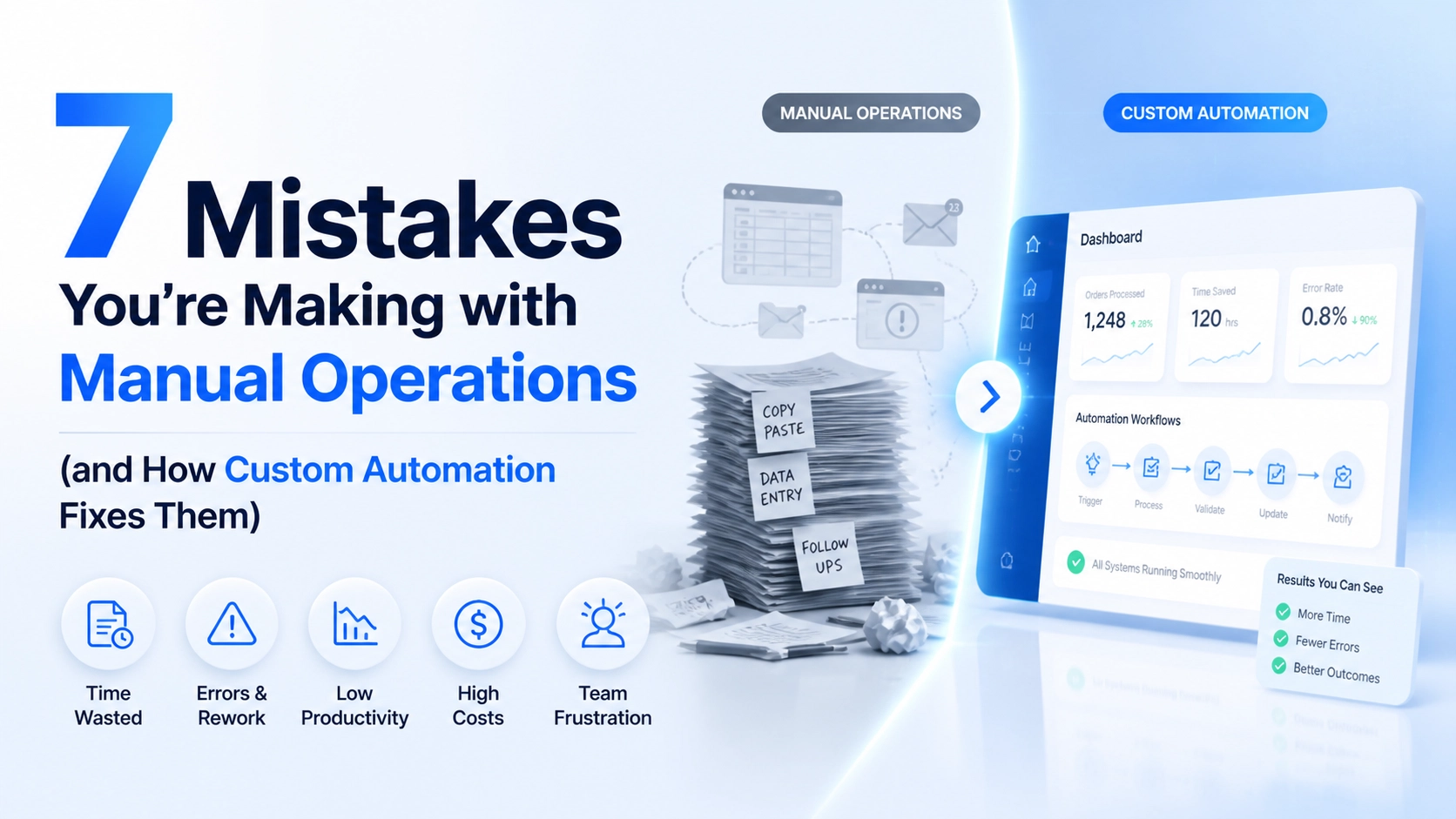
In the modern enterprise, the most dangerous phrase a leader can hear is, "This is the way we’ve always done it." For many high-growth companies, manual operations are not just a nuisance; they are a silent tax on every department, from finance to operations. As we navigate 2026, the gap between organizations that rely on human-intensive workflows and those that leverage bespoke automation is widening into a chasm.
At Pure Technology Consulting, we view custom software not as an expense, but as a strategic lever. When you move beyond off-the-shelf SaaS and invest in custom web applications tailored to your specific business logic, you aren’t just saving time: you are reclaiming your organization’s capacity to innovate.
Here are the seven most common mistakes businesses make with manual operations and the roadmap for how custom automation transforms these liabilities into competitive advantages.
1. The "Fat Finger" Tax: Manual Data Entry Errors
The most obvious mistake in manual operations is the reliance on human data entry. Even the most diligent team members have an error rate of roughly 1% to 4%. In a high-volume environment: whether you are managing legal intakes or financial reconciliations: that small percentage compounds into massive compliance risks and financial leakage.
Custom automation replaces manual entry with intelligent data capture and validation. By building bespoke interfaces that sanitize data at the point of origin, we eliminate the downstream "clean-up" phase that plagues so many accounting and legal firms.
2. Fragmented Communication and Information Silos
Many organizations operate as a collection of "islands." Sales has their data, operations has theirs, and the two rarely speak the same language. This leads to manual status checks, endless "just following up" emails, and a total lack of real-time visibility.
Take ChainHQ as a prime example of how we solve this. Originally designed to handle complex coordination, ChainHQ demonstrates our ability to build centralized ecosystems where every stakeholder sees exactly what they need to see, exactly when they need to see it. Instead of manual updates, the system triggers actions based on logic, ensuring that no project stalls due to a communication breakdown.

3. Relying on "Memory-Based" Compliance
In highly regulated industries like healthcare or legal services, manual operations often rely on the institutional memory of key staff. If a senior partner or operations manager leaves, the "know-how" of compliance leaves with them. This is a significant operational risk that creates a glass ceiling for scaling.
We address this through rigorous digital transformation. For instance, our work with EHRIO Pro serves as a proof of concept for how complex, 70-question intake forms and matching engines can be automated. By embedding compliance rules directly into the software architecture, we ensure that every action meets regulatory standards (like HIPAA-adjacent workflows) without requiring a human to cross-check a manual every five minutes.
4. Lack of Real-Time Field Accountability
For companies with field operations or door-to-door sales teams, manual reporting is often delayed by 24 to 48 hours. By the time a manager identifies a performance dip or a geographic inefficiency, the opportunity to pivot has passed.
Our experience building D2D Tracking solutions highlights the power of GPS logging and real-time rep accountability. When you automate the tracking of field movements and outcomes, you move from reactive management to proactive strategy. You no longer have to ask "Where was the team today?" because the data is already on your dashboard, verified and visualized.
5. The "Spreadsheet Hell" Reporting Model
If your month-end reporting requires an analyst to export three CSV files, perform a VLOOKUP, and manually format a slide deck, you are making a critical mistake. Manual reporting is not only slow; it is historical. It tells you what happened last month, not what is happening right now.
Bespoke web apps allow for the creation of live executive dashboards. We integrate directly with your various data sources: telephony for fintech, CRMs for sales, or proprietary databases: to provide a single source of truth. This allows CFOs and CEOs to make decisions based on live data, reducing the "reporting lag" from weeks to seconds.

6. Neglecting Local Presence and Reputation Maintenance
For multi-location businesses, manually managing a Google Business Profile or responding to local reviews is a full-time job that often falls through the cracks. This manual oversight leads to a "ghost town" online presence, which directly impacts local SEO and lead generation.
We developed AI Local Boost (AILB) to demonstrate how AI-powered automation can handle high-frequency, local-level tasks. By automating Google Business Profile updates and review interactions, we show our clients how custom-built AI can maintain a premium brand image at scale. It’s not about replacing the human touch; it’s about using AI to ensure that the human touch is applied where it matters most, while the routine maintenance is handled by the machine.
7. Insecure and Inefficient File Management
In the age of cyber-threats, the manual handling of sensitive files: via email attachments or unsecured shared drives: is a catastrophe waiting to happen. Furthermore, knowing when a file has been accessed or moved is often a manual tracking nightmare.
FTP Inform is our answer to this specific operational drag. It provides a window into the flow of information, offering automated notifications and logging for file transfers. When we build custom automation for high-ticket clients, we integrate these types of "intelligence layers" into their workflows. It ensures that data isn't just moving; it’s being monitored and governed.
The Pure Technology Approach: From Manual to Visionary
Strategic automation is not about buying more software; it is about building the right software. Most businesses are "SaaS-poor": they pay for dozens of subscriptions that don't talk to each other, creating more manual work to bridge the gaps.
Pure Technology Consulting specializes in building those bridges. Whether it’s integrating debt agency telephony with custom call attribution or developing a sophisticated healthcare matching engine, our goal is to eliminate the "operational drag" that prevents your company from reaching its next $10M or $100M milestone.
We don't just write code; we architect operating models. We look at your manual bottlenecks: the places where your team feels the most friction: and we engineer bespoke solutions that turn those bottlenecks into high-speed conduits for growth.
Request a Workflow Audit
If your operations are still held together by spreadsheets, manual emails, and "hope," it is time for a strategic pivot. Moving to custom automation is a high-ticket investment that pays dividends in scalability, security, and peace of mind.
Ready to see how custom software can transform your operating model?
Book a discovery call with our team today: https://puretechconsult.com/schedule
Pure Technology Consulting LLC
1234 Tech Way, Suite 100
Contact: +1 (803) 921-0969
https://puretechconsult.com
Amin Said, Founder of Pure Technology Consulting LLC
https://puretechconsult.com
Leave a Reply