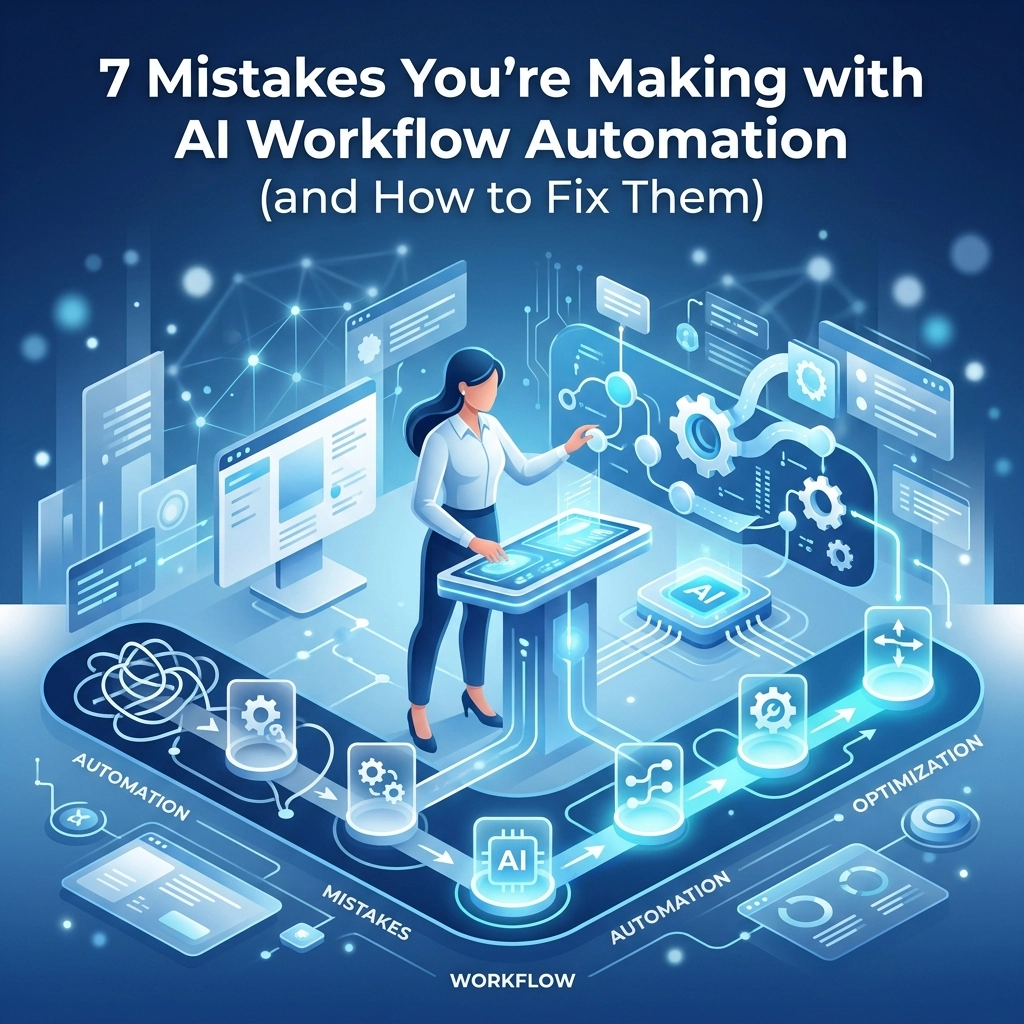
As we navigate the business landscape of 2026, the question for most executives is no longer "Should we automate?" but "Why isn't our automation working as promised?"
At Pure Technology Consulting, we’ve seen a massive shift in how firms approach digital transformation. The initial hype of 2023 and 2024 has matured into a pragmatic need for systems that actually move the needle on the P&L. Yet, many organizations are still falling into the same traps, treating AI automation as a "plug-and-play" miracle rather than a strategic operating model.
If your automation initiatives are stalling, or if you’re seeing "silent failures" in your workflows, you’re likely making one of these seven common mistakes. Here is how to diagnose the drag and fix it for good.
1. Automating the "Chaos Loop" (Broken Processes)
The single most expensive mistake a CFO can oversee is the automation of an inefficient, manual process. If your current workflow is redundant, relies on messy spreadsheets, or involves three different people "checking" the same data point, automating it simply accelerates the chaos.
The Fix: Before you write a single line of code or deploy an AI agent, you must perform a workflow audit. At Pure Technology Consulting, we advocate for the "Simplify, then Amplify" approach. We look at the bespoke requirements of your operation first. For example, when we work with healthcare or legal firms, we often utilize frameworks similar to our EHRIO Pro platform. It’s designed to handle complex, 70-question intakes and HIPAA-adjacent workflows by creating a structured matching engine first. By ensuring the logic is sound at the intake level, the automation that follows is clean, compliant, and actually reduces cycle time rather than just creating more digital noise.

2. The "SaaS Squeeze": Choosing Tools Over Strategy
Many firms try to patch together ten different "No-Code" SaaS subscriptions to build an AI workflow. This leads to what we call the "SaaS Squeeze": where your data is siloed across various platforms, and you’re paying thousands in monthly seat licenses for tools that don't talk to each other.
The Fix: Transition from a "tool-first" mindset to a "platform-first" mindset. Instead of trying to bend a generic CRM to fit your unique field operations, consider a custom-built web application. We’ve demonstrated this capability through proprietary projects like our D2D Tracking systems, where we integrated GPS logging and rep accountability into a single, cohesive interface. When your software is bespoke, the automation is baked into the architecture, not "bolted on" with fragile third-party integrations.
3. Ignoring the "Garbage In, Garbage Out" Reality
AI is only as visionary as the data it feeds on. We see many companies attempting to launch AI-driven customer service or predictive analytics while their underlying database is a graveyard of duplicates and inconsistent formatting. According to industry standards, bad data costs businesses trillions in wasted operational drag.
The Fix: Implement strict data governance at the point of entry. This is where a consultative approach beats a software-only approach. We help clients build validation rules that act as gatekeepers. Think of how we use AI Local Boost for Google Business Profile automation. The success of that tool isn't just in the "posting": it’s in the structured way it handles local SEO data to ensure the AI isn't hallucinating information about your business locations. Clean data leads to clean automation.

4. The "Set-and-Forget" Fallacy
Automation is often sold as a way to "fire your problems." In reality, automated workflows are living systems. APIs change, data schemas evolve, and AI models can "drift" over time. A silent failure in an automated billing cycle can go unnoticed for months, resulting in massive revenue leakage.
The Fix: You need a monitoring and notification layer that keeps the humans in the loop when exceptions occur. This is why we developed FTP Inform. In complex enterprise environments, data transfers (FTP/SFTP) are often the backbone of the business, yet they are rarely monitored effectively. FTP Inform provides that missing visibility: alerting stakeholders the moment a file transfer fails or data isn't where it should be. High-ticket automation requires high-level oversight.
5. Neglecting the User Experience (Internal and External)
If your automated workflow makes life harder for your employees or creates a "robotic" and frustrating experience for your clients, it will fail. We see this often in debt agency telephony integrations or call attribution setups. If the AI doesn't feel human or the dashboard is too complex for a staff member to use, they will find manual workarounds.
The Fix: Design for the "Human-in-the-Loop." Your custom web apps should be intuitive. When we build fintech or debt collection solutions, we focus on the UI/UX of the telephony integration. The goal is to empower the user with AI-driven insights in real-time, not to replace the human element entirely. The automation should be the "wind at the back" of your team, not a wall they have to climb over.

6. Scaling Too Fast Without Governance
It’s tempting to see one successful automation and try to apply it to every department overnight. However, scaling without a centralized strategy leads to "Shadow IT," where different departments are running different (and often conflicting) automations.
The Fix: Centralize your automation roadmap. This is a primary focus of our work with ChainHQ, where we manage complex supply chain and operations workflows. By having a central "headquarters" for your chains of command and data flow, you ensure that as you scale from one department to ten, the integrity of your operating model remains intact. You need a partner who understands how to bridge the gap between "cool tech" and "enterprise-grade infrastructure."
7. Measuring Vanity Metrics Over ROI
Processing 10,000 invoices an hour is a great stat, but if 20% of them have errors that require manual correction, you haven't actually saved money: you've just moved the bottleneck. Many firms measure "activity" instead of "impact."
The Fix: Focus on high-level KPIs: Cycle Time Reduction, Error Rate improvement, and Throughput. At Pure Technology Consulting, we help our clients define these benchmarks before we build. Whether it’s a custom matching engine for a legal firm or a local SEO boost for a franchise, the goal is always a measurable increase in operational leverage.
Moving Toward a Visionary Future
AI workflow automation is the most powerful lever available to the modern executive, but it requires a surgeon’s precision, not a sledgehammer. At Pure Technology Consulting, we specialize in building the bespoke web applications and high-level automations that turn these "mistakes" into competitive advantages.
We don't just sell software; we build the digital infrastructure that allows your company to scale without the traditional overhead. From HIPAA-adjacent healthcare workflows to complex fintech integrations, we bring proven capabilities to the table to ensure your transformation is both inspirational and, more importantly, profitable.
Ready to audit your workflows and stop the operational drag?
Let’s move past the "off-the-shelf" limitations and build something that fits your business perfectly. Reach out to our team to discuss your custom software and automation needs.
Contact Us:
Phone: +1 (803) 921-0969
Schedule a Discovery Call: https://puretechconsult.com/schedule
Amin Said, Founder of Pure Technology Consulting LLC
https://puretechconsult.com
Leave a Reply