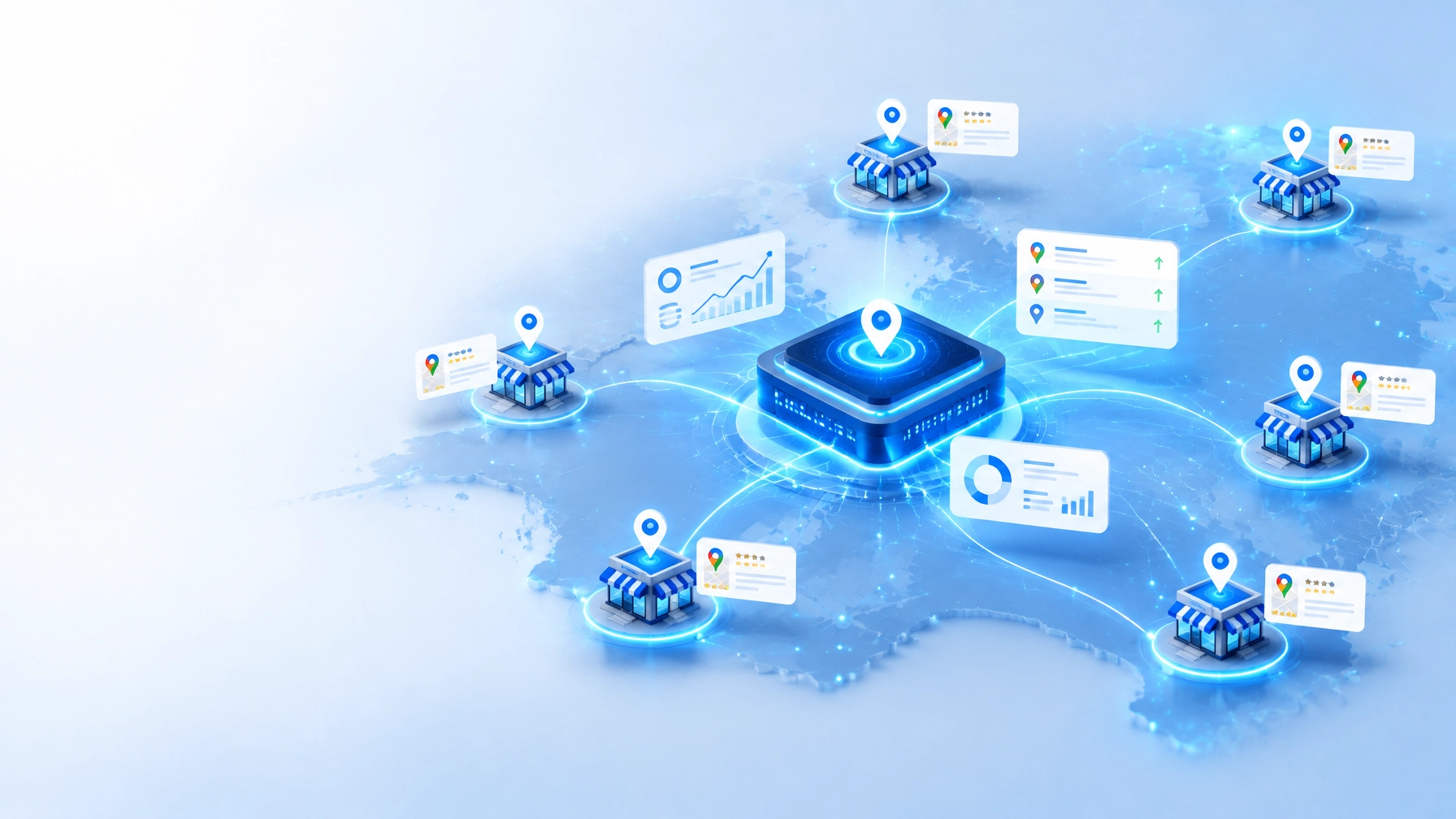
Amin Said, Founder of Pure Technology Consulting LLC, approached this engagement from a product strategy perspective: the franchise group did not simply need another local SEO tool. It needed a technology asset it could offer to its franchisees as a recurring-revenue service.
The group had the market access, franchise relationships, and operational knowledge. What it did not have was an internal engineering team capable of building a secure, multi-tenant SaaS platform, integrating location data, managing Google Business Profile connections, and supporting a branded customer experience.
Pure Technology Consulting used AI Local Boost as the proof-of-concept foundation for that opportunity. The result was not a generic marketing dashboard. It was a white-label infrastructure model designed to help a franchise organization launch, manage, and eventually license its own local search visibility platform.
The client and commercial terms are presented without identifying details. The architecture and delivery model reflect the type of white-label SaaS engagement PTC is equipped to design and deploy.
The business opportunity: turn operational capability into recurring software revenue
Franchise groups often manage a complex relationship between corporate leadership, regional operators, local managers, and external vendors.
Each location needs accurate business information, consistent messaging, timely updates, and visibility into performance. Corporate teams need governance and reporting. Franchisees need practical tools that help them manage their own locations without exposing data belonging to other operators.
That creates an opportunity beyond internal efficiency.
A franchise group can package its local visibility processes into a software service and make that capability available to franchisees through a recurring subscription or technology fee. The platform becomes part of the group’s operating model while creating an additional revenue channel.
The challenge is that this product requires more than a branded login screen. It needs:
- Tenant isolation across franchise groups and locations
- Secure connections to Google Business Profile accounts
- Role-based access for corporate and local users
- Centralized location data management
- Automated publishing workflows
- Reporting at both network and location level
- A supportable infrastructure that can grow with the franchise system
This is where a white-label development partnership becomes more valuable than assembling disconnected tools.
Why AI Local Boost was the right proof of concept
PTC had already engineered AI Local Boost to demonstrate how local visibility workflows could be coordinated through custom software. That existing capability included structured location data, multi-location controls, publishing workflows, reporting, and white-label configuration.
For this engagement, the emphasis shifted.
The earlier question was: How can a multi-location business govern and automate local SEO activity at scale?
The franchise licensing question was different: How can a franchise group own the customer experience, provision access to franchisees, and operate local SEO software as a branded SaaS product?
That distinction changed the architecture and the commercial design.
The platform needed to behave like a product ecosystem rather than an internal automation tool. PTC focused on tenant structure, account provisioning, permissions, configuration, integrations, and reporting portability.
This is consistent with PTC’s broader custom web application development approach: start with the operating model, then build the technology around the organization’s commercial and workflow requirements.
The architecture: one platform, multiple controlled environments

Multi-tenant tenancy with isolated business data
The platform was structured around a hierarchy that separated the franchise organization from the locations it managed.
A typical model included:
- Platform layer: The underlying PTC infrastructure and shared services
- Franchise group tenant: The corporate organization operating the branded platform
- Franchisee accounts: Individual operators or regional business units
- Location records: The stores, clinics, offices, or service areas connected to each account
- User roles: Corporate administrators, regional managers, franchisees, and location-level users
This structure allows the same platform to support many locations without mixing data between accounts.
Tenant-aware design also makes it possible to configure branding, permissions, reporting views, and workflow rules at the appropriate level. A corporate user can see the network overview. A franchisee can see assigned locations. A local manager can work within the boundaries of one location.
The architecture is designed so those boundaries are enforced by the application and database model, not merely by hiding menu items.
Per-location Google Business Profile connections
Each location requires a controlled relationship with its Google Business Profile data.
The integration path was designed to associate a location inside the platform with the appropriate Google account, Business Profile account, and location resource. This allows the platform to manage authorized location data while preserving an auditable connection between the franchise record and the external profile.
Google’s Business Profile APIs support programmatic management of account and location data, but access requires eligibility, OAuth authorization, a Google Cloud project, and compliance with usage policies. API rate limits and account permissions also need to be considered during implementation.
For that reason, the integration was treated as a product capability rather than a one-time connection. The system needs to handle:
- Authorization and token management
- Location matching and connection status
- Permission changes and disconnected accounts
- API failures and retry behavior
- Publishing history
- Exceptions requiring human review
A resilient integration layer protects the franchise group from turning every Google-side change into a support ticket.
Role-based access that matches franchise operations
A white-label franchise platform must recognize that not every user should have the same level of control.
The access model was designed around practical responsibilities:
- Corporate administrators manage brand standards, templates, users, and network-wide reporting.
- Regional managers oversee assigned groups of locations and review exceptions.
- Franchisees access their own locations and approved workflows.
- Location managers maintain location-specific information within defined limits.
- Support or agency users can assist with operations without automatically receiving unrestricted access.
This approach creates a balance between central consistency and local ownership.
Corporate teams can publish approved location data or templates across a group. Local operators can contribute relevant information without changing high-impact fields that should remain governed centrally. The system can also create approval steps for sensitive edits, such as address changes, categories, or core business information.
The result is a more useful operating model than either extreme: complete corporate control or unrestricted local editing.
Automated location data publishing

The platform established a central source of truth for location data. That record could include:
- Business name and address
- Phone number and website
- Hours of operation
- Categories and services
- Service areas
- Location-specific descriptions
- Approved photos and media
- Publishing status and synchronization history
When a change is approved, the platform can send it through a publishing workflow rather than relying on staff to update each location manually.
This workflow includes validation, permission checks, queue management, and status tracking. If an external API rejects an update or becomes temporarily unavailable, the platform can record the failure, retry when appropriate, and surface the exception to an operator.
That operational detail is important. Automation is not simply the ability to send data. It is the ability to know what was sent, whether it succeeded, what failed, and who needs to act next.
Reporting designed for two audiences
The reporting model had to serve both the franchise group and the franchisees using the platform.
At the corporate level, dashboards could organize information such as:
- Location connection status
- Profile completeness
- Publishing activity
- Review and response trends
- Local visibility indicators
- Location-level exceptions
- Network performance by region or franchise group
At the franchisee level, the interface could provide a narrower view focused on the locations they were authorized to manage.
This dual reporting model supports the commercial purpose of the platform. Corporate leadership can demonstrate value across the network, while franchisees receive actionable information about their own businesses.
The white-label layer also extends to presentation. Branding, colors, support information, report exports, and customer-facing language can be configured for the franchise group rather than exposing the underlying technology partner.
White-label SaaS is therefore not only a visual customization exercise. It is a combination of tenant-aware infrastructure, product configuration, permission design, reporting, support workflows, and commercial ownership.
The integration and deployment path

For a platform of this type, PTC recommends a phased deployment rather than attempting to activate every feature and location simultaneously.
An illustrative delivery plan looks like this:
Phase one: discovery and operating model
The first stage maps the franchise group’s account structure, user roles, location records, approval rules, reporting needs, and commercial packaging.
The objective is to define what the platform must do before deciding how the interface should look.
Phase two: architecture and integration design
The next stage establishes tenancy, data models, authentication, role-based access, Google Business Profile authorization, publishing workflows, and reporting requirements.
At this point, the team also confirms API eligibility, access requirements, and integration constraints.
Phase three: branded product configuration
The platform is configured around the franchise group’s identity, terminology, onboarding flow, support model, and customer-facing reporting.
This is where an internal capability becomes a licensable product experience.
Phase four: pilot deployment
A limited set of locations is connected first. The pilot validates data mapping, permissions, publishing behavior, reporting accuracy, and support procedures before broader rollout.
Phase five: network expansion and optimization
Once the pilot is stable, additional franchisees and locations can be onboarded through repeatable provisioning workflows. New features, directory integrations, and reporting improvements can then be prioritized based on actual usage.
For a focused first release, a practical implementation may take approximately 6–10 weeks after scope, access, and brand requirements are confirmed. A larger deployment involving additional directories, complex billing, advanced analytics, or extensive migration will require a broader roadmap.
What this proves about PTC’s licensing capability
This engagement demonstrates that PTC can do more than build a custom internal application.
The same engineering foundation can be adapted into:
- A branded SaaS product for a franchise system
- A licensed platform for an industry vendor
- A white-label operational tool for a consulting firm
- A recurring-revenue technology layer for an established service business
AI Local Boost serves as proof that PTC can design and operate complex multi-location software. The white-label engagement extends that proof into product strategy, tenant architecture, integration management, permissions, reporting, and commercial deployment.
It also reflects a broader PTC capability: bringing proven systems thinking into new industries without forcing clients to start from a blank page. The company’s experience spans healthcare intake workflows, field operations, debt agency telephony, local SEO automation, and custom business platforms.
When white-label custom development is the right move
A white-label build makes sense when the platform itself is part of the organization’s competitive advantage.
It may be the right strategy when a business wants to:
- Create recurring software revenue
- Own the customer relationship and product experience
- Support workflows that generic tools cannot model
- Combine multiple systems under one branded interface
- Control permissions and data by account or location
- Add proprietary reporting and automation
- Expand without building a full internal engineering department
The investment is typically a scoped, five-figure custom software engagement or larger, depending on integrations, migration, billing, security, and rollout requirements. The relevant question is not only the build cost. It is whether the platform can create operating leverage, retention, differentiation, and new revenue over time.
If your organization is evaluating a white-label SaaS product, book a discovery call with Pure Technology Consulting. We can help define the tenancy model, integration roadmap, deployment phases, and technical scope before development begins.
+1 (803) 921-0969
Amin Said, Founder of Pure Technology Consulting LLC
https://puretechconsult.com
Leave a Reply