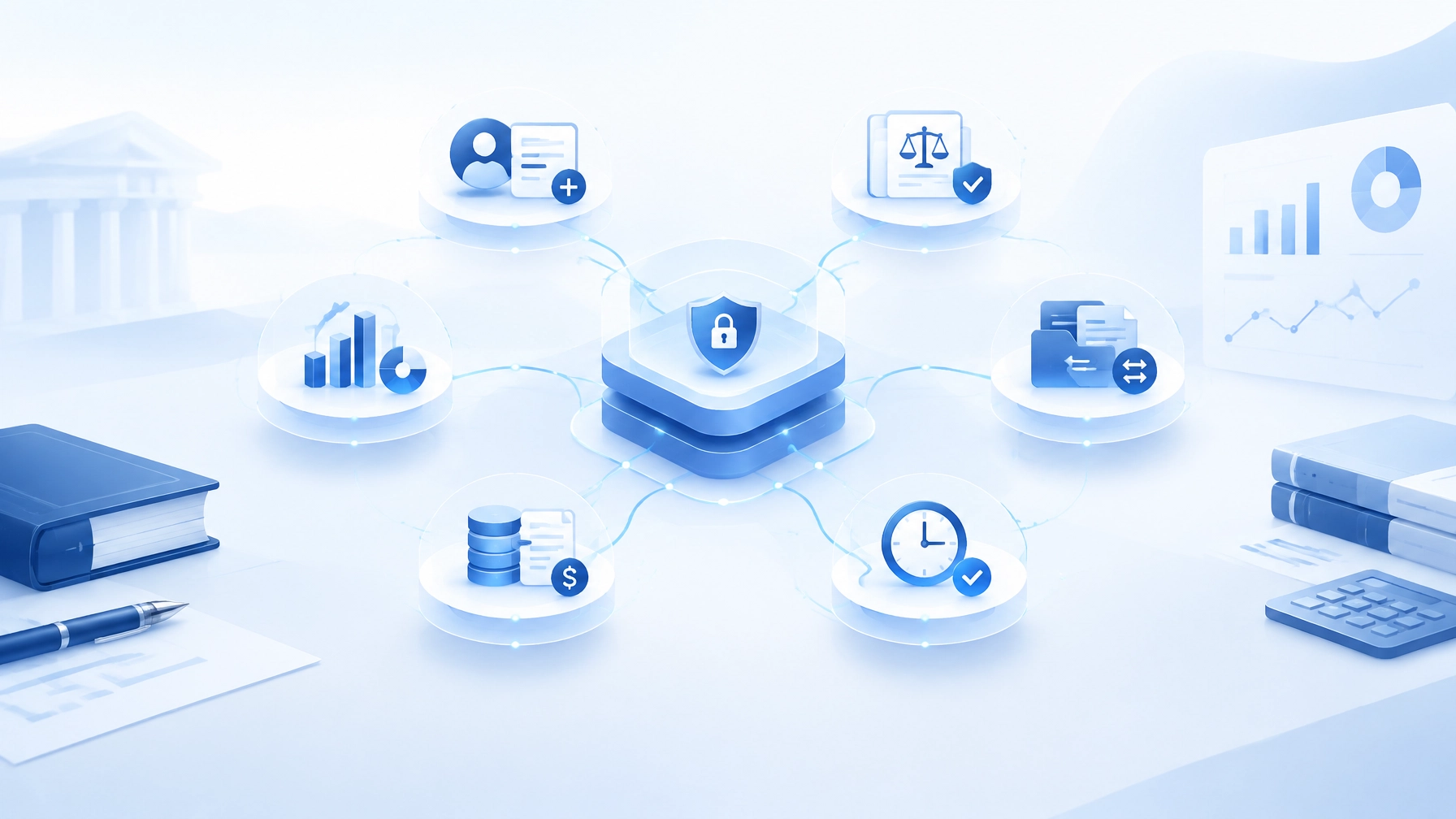
For law firms, accounting practices, and other professional services organizations, digital transformation is no longer defined by adding another software subscription. It is defined by how effectively the firm connects its people, data, decisions, and client experience.
Partners and managing directors often see the same operational pattern: strong professionals supported by fragmented systems. Intake arrives through email, websites, phone calls, and referrals. Conflict checks depend on manual searches. Matter or engagement setup requires repeated data entry. Time capture happens after the fact. Billing teams reconcile information across platforms. Client documents move through inboxes and shared folders without a consistent operating model.
These issues are not simply administrative inconveniences. They affect responsiveness, realization, utilization, risk management, and the firm’s capacity to grow without adding proportional overhead.
Pure Technology Consulting approaches this challenge through digital transformation consulting and business process automation consulting. The objective is not to force a law or accounting firm into a generic technology model. It is to adapt proven architectures from adjacent industries to the firm’s specific workflows, governance requirements, and growth strategy.
Transformation begins with the operating model
The most effective automation initiatives start with the way work actually moves through the organization.
A professional services firm may use a CRM, practice management platform, document management system, accounting software, timekeeping application, and communication tools. Each system may function adequately on its own. The operational drag appears in the handoffs between them.
A prospective client submits information, but the data does not automatically become a structured intake record. A conflict check may require searching multiple databases. Once a matter or engagement is approved, staff may recreate information in several systems. Time entries, billing rules, expenses, and payment data may not align cleanly enough to support timely reporting.
A transformation roadmap should therefore answer practical questions:
- Where does a client, matter, or engagement first enter the firm?
- Which decisions require partner or manager approval?
- Which data should become the authoritative record?
- What exceptions require human judgment?
- Which systems need to exchange information?
- How should the firm measure cycle time, utilization, realization, and profitability?
The answers create the foundation for automation. Technology follows the operating model rather than defining it.
Proven architecture from adjacent industries
Pure Technology Consulting is not approaching legal and accounting automation as a blank-page exercise. Our work across healthcare, field operations, fintech, debt management, and local search has required many of the same architectural disciplines professional services firms need.

Healthcare: structured intake and matching logic
Our Thrive and EHRIO work demonstrates how a complex intake journey can be converted into structured, actionable data. A workflow may include approximately 70 questions, conditional paths, matching logic, scheduling requirements, document collection, and HIPAA-adjacent controls.
The important capability is not the healthcare interface itself. It is the architecture behind it:
- Structured data capture instead of unsearchable email or PDFs
- Rules-based routing and matching
- Role-based review queues
- Exception handling
- Integration with downstream systems
- Activity history and audit-oriented records
For a law firm, the equivalent may be a guided client intake that captures matter type, jurisdiction, parties, referral source, urgency, conflicts information, and required documents before routing the opportunity to the appropriate practice group.
For an accounting practice, the same pattern may support tax, audit, advisory, or bookkeeping intake, with different questions and approval paths based on service line and client profile.
Operations and field work: accountability across distributed activity
D2D Tracking demonstrates another relevant capability: connecting activity to accountability through GPS-verified rep workflows.
Professional services firms may not need GPS logging, but they do need visibility into distributed work. Partners, associates, managers, and administrative teams often operate across offices, matters, engagements, and client accounts. A custom system can define ownership, record status changes, surface bottlenecks, and show where work is accumulating.
The shared principle is operational visibility. Leadership should not have to wait for a monthly report to discover that a client onboarding process is stalled or that a matter setup queue is creating downstream billing delays.
Fintech and debt: telephony integrations and attribution
Debt agency systems have required integrations between telephony, call records, attribution logic, follow-up workflows, and reporting.
That experience translates to professional services in several ways. Firms may want to associate inbound communications with a client or prospect, record the responsible team, preserve a history of interactions, and trigger next steps based on the outcome of a call.
The architecture must preserve context across systems. A phone call should not become an isolated event. It should contribute to the client record, business-development workflow, service request, or engagement timeline.
Local SEO: multi-entity governance at scale
AI Local Boost was engineered as a proof-of-concept for managing Google Business Profile workflows across multiple business entities and locations. It demonstrates tenant-aware data structures, role-based permissions, approvals, scheduled activity, error handling, dashboards, and change history.
The platform is not presented as a product for law or accounting firms to purchase. It is evidence of PTC’s ability to design complex, scalable systems where central governance must coexist with local or departmental control.
That same architecture can support multiple offices, practice groups, client portfolios, entities, or service lines within a professional services environment.
The shared architecture behind effective automation
Across these proof-of-work examples, the same technical pattern appears repeatedly.

Multi-entity data governance
A firm must be able to distinguish among clients, prospects, matters, engagements, offices, departments, service lines, and responsible professionals. Data models should support those relationships without forcing teams to maintain duplicate records in spreadsheets.
Role-based workflow
Not every user should see or approve the same information. Partners, associates, billing teams, intake coordinators, and administrators may require different permissions and queues.
Audit trails
Important actions should be traceable. A governed system can record who reviewed an intake, approved a matter, changed a billing status, uploaded a document, or modified a workflow decision.
Integration layers
Automation should connect existing systems where practical rather than replacing every platform at once. APIs, webhooks, scheduled synchronization, and controlled data exchange can reduce duplicate entry while preserving the firm’s investment in core software.
Operational dashboards
Leadership needs more than activity counts. Dashboards should help answer whether matters are being opened on time, whether onboarding is stalled, whether time is being captured accurately, whether invoices require repeated correction, and where utilization or realization is changing.
Where professional services firms can apply automation
A focused transformation initiative may begin with one high-value workflow and expand from there.
Client intake and conflict checks
A guided intake system can collect structured information, identify missing fields, check client and party records, and route exceptions for human review. The goal is not to automate professional judgment. It is to make the relevant information available earlier and reduce avoidable administrative work.
Matter and engagement setup
Once work is approved, a workflow can create the appropriate records, assign ownership, generate task lists, request documents, and notify relevant teams. This reduces the gap between winning work and being ready to deliver it.
Time capture and billing reconciliation
Custom workflow logic can connect time entries, rates, expenses, budgets, billing rules, and invoice status. Instead of discovering inconsistencies at month-end, teams can surface exceptions earlier and direct them to the right reviewer.
Utilization and profitability reporting
A reporting layer can unify operational and financial data to show utilization, realization, matter or engagement performance, write-offs, cycle times, and workload distribution. The value is not another dashboard. It is a more reliable basis for management decisions.
Client onboarding and document exchange
A secure client portal or workflow can organize questionnaires, documents, approvals, deadlines, and communications in one experience. Clients receive clearer next steps, while internal teams gain visibility into incomplete requests and outstanding dependencies.
A practical roadmap for transformation

A responsible engagement typically moves through four stages:
- Assess: Map current workflows, systems, data ownership, handoffs, and bottlenecks.
- Prioritize: Select a process where operational impact is meaningful and scope can be governed.
- Pilot: Build and test the workflow with representative users, integrations, permissions, and reporting.
- Scale: Expand across practice groups, offices, or service lines after the operating model has been validated.
This staged approach avoids two common mistakes: purchasing technology before defining the process, and attempting a firmwide transformation without learning from a controlled implementation.
The right starting point may be an intake and conflict workflow, a matter-opening process, or billing reconciliation. The decision should be based on the firm’s baseline: cycle time, staff touches, error frequency, revenue leakage, and leadership visibility.
When custom development is the right investment
Off-the-shelf software remains valuable when a firm’s needs align with the product’s workflow. Custom web application development becomes more compelling when the firm’s operating model is distinctive, its systems are disconnected, or its growth depends on a process that generic tools cannot adequately support.
A bespoke system may be appropriate when the firm needs to:
- Integrate several existing platforms
- Preserve firm-specific approval and governance rules
- Support multiple entities, offices, or service lines
- Build a secure client-facing experience
- Create reporting around its own economic model
- Automate repeatable work while retaining professional review
- Establish a scalable foundation for future AI-powered business systems
AI should be applied selectively. AI workflow automation can classify submissions, summarize documents, identify missing information, draft communications, or recommend routing. But high-impact decisions should remain governed by permissions, review steps, transparent rules, and auditability.
Bring proven capability into your firm
Digital transformation in professional services is not about chasing every new technology trend. It is about creating an operating model in which skilled people spend more time on judgment, client service, and growth, and less time moving information between disconnected systems.
Pure Technology Consulting brings proven capabilities from healthcare, field operations, fintech, debt, and local SEO into legal and accounting environments. The architectures are adapted to the firm’s requirements, not copied without context.
If your firm is evaluating intake automation, conflict checks, matter or engagement setup, billing reconciliation, client onboarding, or utilization reporting, request a workflow discovery consultation or call +1 (803) 921-0969. We can help define the current-state process, identify the highest-value opportunity, and shape a practical roadmap for a custom system.
Amin Said, Founder of Pure Technology Consulting LLC
https://puretechconsult.com
Leave a Reply