Amin Said
Founder of Pure Technology Consulting LLC
AI pilots often demonstrate what is technically possible. Far fewer become dependable systems that support revenue, operations, and decision-making at scale.
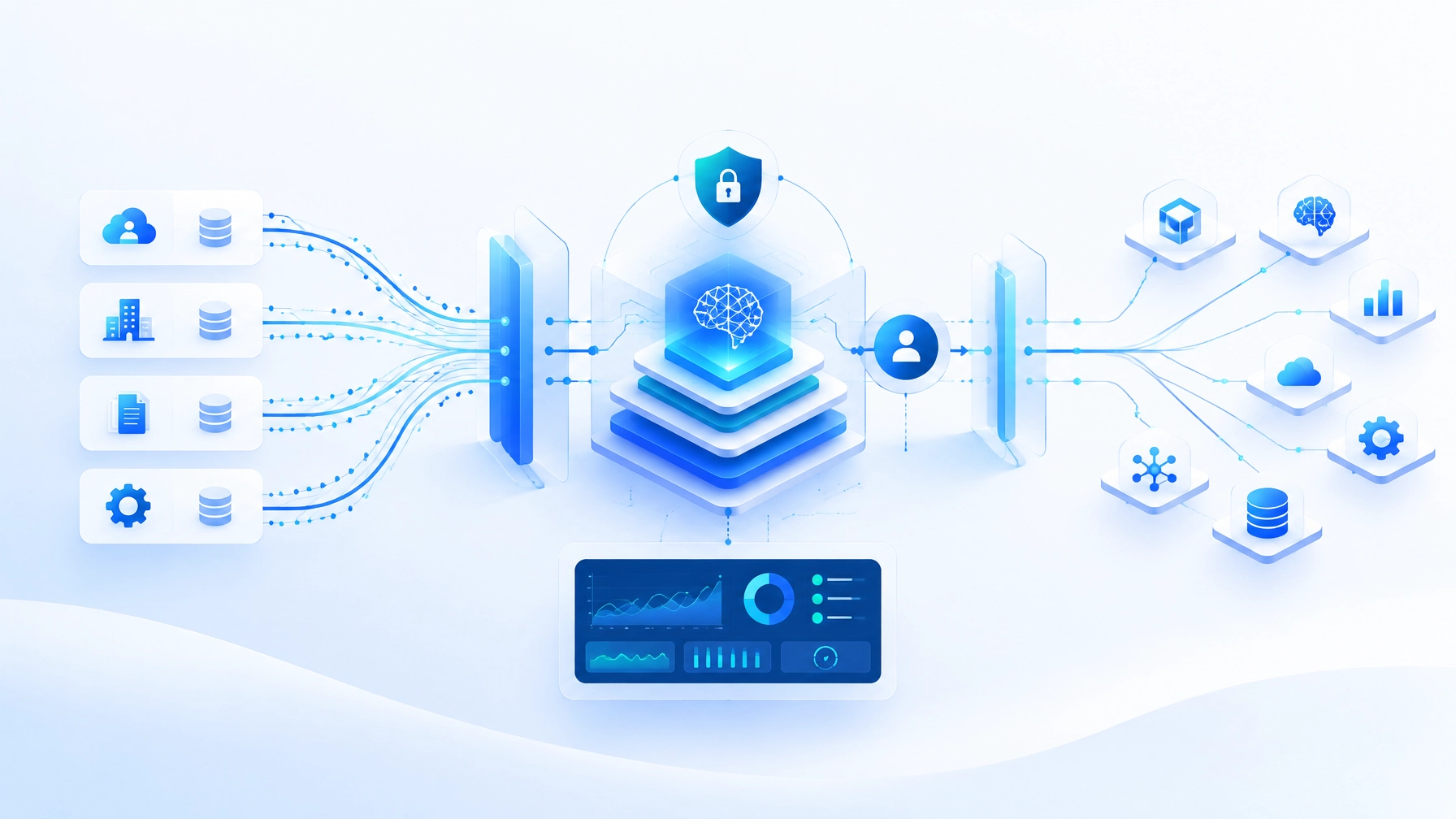
The difference is rarely the model alone. It is the architecture surrounding the model: who owns the data, how systems connect, where humans remain accountable, and how performance is evaluated after deployment.
For executives evaluating bespoke AI solutions, these decisions should be made before development begins. A compelling demonstration can be built quickly. A reliable AI-powered business system requires a more deliberate operating model.
Scalable AI begins with the operating model
The strongest AI initiatives start with a workflow, not a model.
Before selecting a platform or language model, leadership should understand:
- Which process is creating measurable operational drag
- Where decisions are being delayed or repeated
- Which systems contain the required data
- What outcomes define success
- Which actions can be automated safely
- Where human approval must remain part of the process
This approach prevents a common failure pattern: building an impressive AI feature that does not fit the way the organization actually operates.
For example, a multi-location healthcare group may not need an isolated chatbot. It may need a governed intake and routing system that connects inquiries, structured forms, provider matching, scheduling, communications, and reporting.
A debt collection agency may not need a generic AI assistant. It may need telephony integrations, call attribution, compliance workflows, prioritization logic, and dashboards that connect conversations to operational outcomes.
The architecture should follow the business process.
1. Data ownership is the foundation

AI automation is only as reliable as the information it can access and trust. That makes data ownership one of the earliest strategic decisions in a custom build.
Executives should establish:
- Which data the organization owns and has permission to process
- Where the data is stored
- How data moves between systems
- Which users and services can access it
- How data quality is validated
- How records are retained, corrected, or deleted
- Whether model outputs and workflow history remain under company control
Data is often fragmented across CRMs, EHRs, spreadsheets, scheduling platforms, phone systems, document repositories, and legacy applications. A bespoke AI system must create a controlled foundation across those sources rather than introduce another disconnected silo.
This may include a centralized data model, event logs, validation services, access controls, and audit-oriented records. The goal is not to move every piece of information into one place. It is to establish clear ownership and reliable pathways for the information required by each workflow.
A custom development partner should address these questions during discovery, not after a prototype has already created new dependencies.
2. Integration boundaries determine resilience
AI should rarely sit directly inside every business system. It is usually more effective to treat AI capabilities as governed services with clearly defined boundaries.
That means deciding:
- Which systems can provide information to the AI workflow
- Which systems can receive recommendations or completed actions
- Which actions are synchronous and require an immediate response
- Which tasks can run asynchronously in the background
- Where APIs, queues, or middleware are required
- How failures are logged, retried, and escalated
Clear boundaries make the system easier to maintain. If a model changes, the CRM or scheduling platform should not require a complete redesign. If an external API becomes unavailable, the workflow should have a controlled fallback rather than silently losing work.
This is especially important for multi-location businesses and high-ticket enterprises. Different locations, departments, or clients may require different permissions, rules, branding, and approval paths. The architecture must support those variations without duplicating the entire system.
Pure Technology Consulting’s custom web development services are designed around this type of integration-first thinking: scalable applications, secure data flows, and operating systems that connect existing tools rather than replace everything indiscriminately.
3. Human-in-the-loop checkpoints create control

Automation should reduce unnecessary effort without hiding important decisions.
A practical human-in-the-loop design separates work into three categories:
- Routine actions that can proceed automatically under defined rules
- Reviewable recommendations that require employee approval
- High-risk or ambiguous cases that must be escalated
For example, an AI workflow may categorize an incoming request, extract information from a document, or draft a response automatically. A staff member may still need to approve a financial action, change a patient-routing decision, publish a sensitive customer response, or authorize a compliance-related communication.
The checkpoint must be built into the existing workflow. Employees should be able to review, correct, approve, or reject an output without switching between multiple disconnected portals.
Human feedback also becomes valuable operational data. Corrections can reveal recurring model weaknesses, unclear business rules, or gaps in the source data. Over time, the system can improve because the organization is capturing how decisions are actually made.
This is the difference between automation that removes visibility and automation that increases organizational capacity.
4. Evaluation and monitoring must continue after launch
A pilot can appear successful because it works on a small sample of curated inputs. Production systems face incomplete records, unusual requests, shifting customer behavior, new regulations, integration failures, and changing business priorities.
Scalable ai workflow automation requires continuous evaluation.
Before launch, teams should define:
- The business KPI the system is expected to influence
- The acceptable error rate for each workflow
- Quality thresholds for model outputs
- Expected response times and system availability
- Conditions that require human review
- The process for reporting incorrect or harmful outputs
After launch, monitoring should cover more than uptime. Leadership may need visibility into:
- Workflow completion rates
- Exception and escalation volume
- Time saved per transaction
- Data-quality failures
- Model confidence and output quality
- Integration errors
- Changes in input patterns
- Drift in performance over time

A responsible system also needs fallback logic. When confidence is low, an integration fails, or a policy condition is triggered, the workflow should move to a known state. It should not invent an answer or continue silently.
Monitoring turns AI from a one-time implementation into a managed operating capability.
What should you automate first?
The best starting point is usually a workflow that is repetitive, measurable, and important enough to justify improvement, but structured enough to govern.
Strong early candidates often include:
- Intake and qualification
- Document classification and data extraction
- Appointment or assignment routing
- Customer follow-up and status notifications
- Review and approval queues
- Reporting and exception management
- Data synchronization between established systems
Avoid starting with the most ambiguous or highest-risk decision in the organization. Instead, choose a process where the baseline is visible and improvement can be measured.
Useful initial metrics may include cycle time, number of staff touches, completion rate, manual data-entry volume, exception frequency, and time from inquiry to next action.
The first release should establish a foundation for expansion. A narrowly scoped workflow can later become part of a broader AI-powered business system.
Where does a bespoke build beat off-the-shelf SaaS?

Off-the-shelf SaaS is often appropriate when the business can adopt a standardized process without significant compromise. It becomes less effective when the workflow itself is a source of differentiation or operational complexity.
A custom or bespoke build may be the better strategy when you need to:
- Coordinate multiple systems with different data structures
- Support unique approval, compliance, or routing rules
- Manage complex relationships across locations, departments, or accounts
- Create a branded partner or white-label experience
- Preserve ownership of data, workflows, and application logic
- Connect AI actions to operational events
- Build reporting around your own performance model
- Scale without increasing manual administration proportionally
Pure Technology Consulting’s proprietary platforms provide proof-of-concept examples of this capability. AI Local Boost demonstrates multi-location workflow orchestration and Google Business Profile automation. ChainHQ reflects the challenges of centralized operations across distributed entities. EHRIO Pro demonstrates structured intake, matching logic, and HIPAA-adjacent workflow design. FTP Inform represents the value of purpose-built information and operational systems.
These platforms are not being presented as standalone products to purchase. They illustrate how PTC approaches complex architecture: understand the operating model, define the boundaries, and build the system around the organization’s actual requirements.
The same principles apply when bringing proven capabilities into legal, accounting, healthcare, field operations, debt management, and other professional environments. Clients do not have to begin from a blank page, but the final system should still be designed around their data, stakeholders, and governance requirements.
Bespoke AI solutions require a deliberate roadmap
Custom AI development is not simply a decision to use a more advanced model. It is a decision to create a technology layer that can participate safely and measurably in the business.
That requires alignment across:
- Business process design
- Data ownership and governance
- Integration architecture
- Human accountability
- Security and access control
- Evaluation and monitoring
- Long-term application management
At Pure Technology Consulting, these engagements are positioned as premium, scoped custom builds, often $10,000 or more depending on the workflow, integrations, security requirements, and deployment scope. The investment is justified when the system can reduce operational drag, improve decision consistency, create new capacity, or support a differentiated operating model.
If your organization is evaluating an AI pilot, the next question should not only be whether the prototype works. Ask whether the architecture can support the business six months, two years, and ten times the current volume from now.
To discuss a custom AI roadmap, book a discovery call or contact Pure Technology Consulting at +1 (803) 921-0969. We can help identify what to automate first, define the governance model, and scope an AI-powered business system built for durable growth.
Amin Said, Founder of Pure Technology Consulting LLC
https://puretechconsult.com
Leave a Reply