Amin Said here: a multi-channel commerce business can generate substantial revenue while still operating with fragmented systems.
One team may manage Amazon listings, another may update eBay prices, and a third may maintain the company’s own storefront. Inventory decisions may depend on spreadsheets. Margin calculations may happen after an order is completed, when the opportunity to correct pricing has already passed.
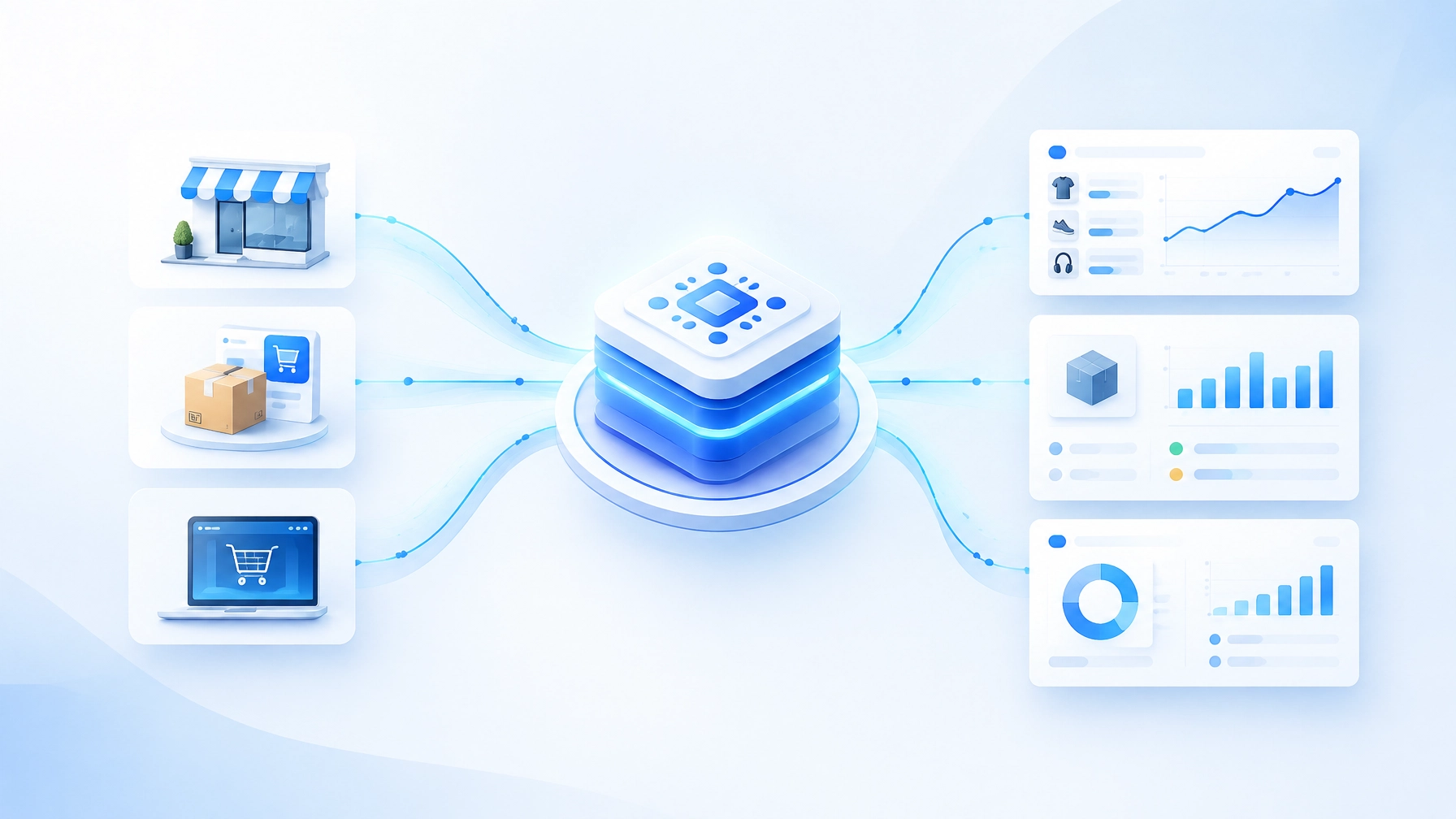
This case study examines a high-ticket custom web application development engagement for an e-commerce operator selling through Amazon, eBay, and its own storefront. The objective was not to build another generic reporting dashboard. It was to create a governed commerce intelligence engine that connected pricing, inventory, order data, channel fees, and contribution margin in one operating system.
The result was a bespoke architecture designed around the company’s actual commercial rules rather than the limitations of disconnected seller tools.
The business context: revenue was growing faster than operational visibility
The operator had established demand across multiple sales channels. Each channel contributed revenue, customer data, fees, fulfillment requirements, and pricing considerations.
The challenge was that the business did not have one reliable view of what each sale was actually worth.
A product could appear profitable at the listing level while becoming unprofitable after accounting for:
- Marketplace referral fees
- Fulfillment and shipping costs
- Payment processing
- Product acquisition cost
- Packaging and handling
- Promotions and discounts
- Returns, refunds, and adjustments
- Channel-specific pricing differences
Inventory created a related problem. Stock needed to be allocated across channels without creating overselling risk, while pricing decisions needed to account for availability, demand, fees, and target margin.
The organization had enough data to make decisions, but that data was distributed across seller portals, spreadsheets, exports, accounting records, and internal workflows. Staff became the integration layer.
That operating model can work at a smaller scale. As channel volume increases, it creates decision latency, duplicate entry, reconciliation work, and inconsistent commercial judgment.
The operating constraints the system had to address
The application needed to coordinate several different realities at once.
Amazon, eBay, and the company’s own storefront each have their own APIs, identifiers, order states, fee structures, rate limits, and synchronization behavior. A SKU may be represented differently across systems. An order may be created in one channel while inventory is being reserved in another.
The system therefore had to support:
- A normalized product and SKU model
- Channel-specific listings and identifiers
- Inventory quantities by location or fulfillment source
- Price rules that could vary by channel
- Cost and fee calculations at the order level
- Returns, cancellations, and adjustments
- Synchronization monitoring and retry handling
- User permissions and approval workflows
- Historical records for pricing and inventory decisions
The most important constraint was governance. A pricing engine should not quietly publish an unexpected price across thousands of listings. An inventory service should not overwrite a trusted quantity without recording the source and time of the change.
The application needed to automate routine work while preserving visibility and control.

The architecture: one commerce intelligence layer between channels and decisions
The core design placed a centralized commerce engine between the external sales channels and the internal operating team.
Rather than allowing each channel to become its own source of truth, the platform created a normalized internal model for:
- Products and variants
- SKUs and channel listings
- Inventory positions
- Orders and order lines
- Costs and fee schedules
- Pricing rules
- Margin calculations
- Exceptions and approvals
The channel integration layer was responsible for communicating with Amazon, eBay, and the branded storefront. It handled channel-specific requirements while presenting consistent data to the core application.
This separation was important. Channel-specific complexity could remain inside the connectors instead of spreading throughout the application. If a new marketplace or fulfillment system were added later, the core pricing and margin logic would not need to be rebuilt from scratch.
The web application then gave operators a unified environment for reviewing commercial conditions, approving changes, investigating exceptions, and understanding performance at the SKU and channel level.
This approach reflects the broader principles used in Pure Technology Consulting’s custom web development services: scalable architecture, secure integrations, modern web interfaces, and business logic designed around the client’s operating model.
Pricing intelligence built around actual commercial economics
A basic repricing tool changes a price according to a narrow rule. A custom pricing engine can account for the complete economics of a sale.
The application was designed to support pricing logic based on variables such as:
- Product cost
- Channel fees
- Fulfillment expense
- Shipping and packaging
- Target contribution margin
- Inventory availability
- Promotional rules
- Minimum and maximum price thresholds
- Channel-specific commercial strategy
The important distinction is between a calculated recommendation and an uncontrolled automated change.
A pricing recommendation could be evaluated against guardrails before publication. For example, the system could identify a price that would meet a target margin but require approval if the change exceeded a defined threshold. It could also flag SKUs where the available price range could not satisfy the desired margin.

This created a more useful management conversation. Instead of asking, “What did we sell?” leadership could ask:
- Which products are profitable by channel?
- Which fees are eroding contribution margin?
- Where is inventory tied up in slow-moving products?
- Which price changes require review?
- Which listings should be paused, adjusted, or prioritized?
- How do returns and fulfillment costs change the economics?
The system was designed to make those questions answerable from the same underlying data model.
Inventory orchestration with controlled synchronization
Inventory accuracy is not simply a matter of copying a quantity from one system to another. It requires rules about reservations, timing, fulfillment sources, safety buffers, cancellations, returns, and channel priority.
The custom application treated inventory as a governed operational service.
A typical flow could include:
- A sale is received from one channel.
- The order is normalized and validated.
- Available inventory is reserved against the correct SKU.
- Channel quantities are recalculated according to allocation rules.
- Updates are sent to the other connected channels.
- Failures or delays are recorded for review.
- Cancellations, returns, and adjustments are reconciled.
The application also needed to distinguish between a successful synchronization and a merely attempted synchronization. That meant recording status, timestamps, source data, response details, and retry state.
This is where custom development creates leverage. The system does not just move data; it establishes ownership, sequence, exception handling, and accountability.

Governance and guardrails for a high-volume operating environment
Automation is valuable only when the business can trust it.
The platform included governance concepts that allowed the operator to scale automation without surrendering control. These included:
- Role-based permissions for pricing and inventory actions
- Approval thresholds for material changes
- Audit records for user and system activity
- Reconciliation workflows for conflicting data
- Error queues for failed integrations
- Retry logic for temporary channel or network failures
- Historical snapshots for price and margin review
- Separation between recommendations and published changes
These controls are especially important when a system influences revenue, customer experience, and inventory commitments.
An AI-powered business system could later assist with anomaly detection, price recommendations, or demand signals. However, those capabilities should operate within the same governance model. AI can help identify patterns and recommend actions, but commercial rules, approval boundaries, and traceability still matter.
Measuring operational leverage without inventing performance claims
A responsible case study should distinguish between system capability and measured business outcomes.
For this type of engagement, the most relevant performance measures would include:
- Time required to update prices across channels
- Percentage of price changes completed without manual re-entry
- Inventory synchronization failure rate
- Time required to reconcile channel orders
- Number of spreadsheet-based workflows retired
- Margin visibility by SKU and channel
- Frequency of unprofitable sales
- Stock-out and overselling incidents
- Staff hours spent on exception handling
- Time from order completion to reliable margin reporting
These metrics create a baseline for evaluating the platform after deployment. The objective is not to claim a universal result for every e-commerce operator. It is to build an environment where operational improvement can be observed, governed, and refined.
The value of the system comes from reducing the distance between commercial activity and commercial understanding.
What this proves about Pure Technology Consulting
This commerce build is one example of a broader capability: designing complex software around the decisions that make a business unique.
Pure Technology Consulting has developed proof-of-work across several demanding operating environments, including:
- Healthcare workflows involving EHRIO and Thrive matching engines, approximately 70-question intakes, and HIPAA-adjacent process design
- Field operations involving D2D representative accountability and GPS-logged activity
- Fintech and debt operations involving telephony integration and call attribution
- Local SEO operations involving AI Local Boost and Google Business Profile automation
Those platforms are not presented as standalone products for this engagement. They demonstrate the ability to build and manage systems that combine structured data, integrations, business rules, user workflows, and operational reporting.
For a multi-channel commerce operator, a comparable custom web application development engagement is typically scoped as a premium initiative, often $10k or more depending on channel complexity, data volume, integration requirements, security controls, and the number of workflows being replaced.

What a similar engagement could look like for another operator
The right starting point is not a predetermined feature list. It is a clear assessment of where fragmented systems are creating commercial risk or operational drag.
A similar engagement may include:
- A unified product and SKU data model
- Amazon, eBay, and storefront integrations
- Centralized inventory and allocation rules
- Channel-aware pricing and margin calculations
- Order and return normalization
- Approval workflows for sensitive changes
- Reconciliation and exception management
- Executive views of margin, inventory, and channel health
- A roadmap for AI-assisted recommendations and anomaly detection
The architecture should be sized to the operator’s current needs while preserving a path for additional channels, fulfillment partners, brands, or business units.
That is the strategic advantage of bespoke development: the system can be shaped around the operating model instead of forcing the operating model into a generic tool.
Build the commerce intelligence layer your growth requires
Multi-channel commerce creates scale, but it also multiplies operational complexity. When pricing, inventory, and margin decisions remain distributed across disconnected tools, growth can become harder to govern.
A custom system brings those decisions into one trusted operating layer.
If your commerce business is outgrowing spreadsheets, seller portals, and disconnected integrations, Pure Technology Consulting can help define the architecture for a scalable solution. Schedule a consultation or visit https://puretechconsult.com to discuss a custom web application or business process automation consulting engagement.
For project inquiries, call +1 (803) 921-0969.
Amin Said, Founder of Pure Technology Consulting LLC
https://puretechconsult.com
Leave a Reply