
Digital transformation is no longer primarily an IT initiative. For growth-focused enterprises, it is an operating model decision.
When revenue reaches $500K, $5M, or beyond, operational complexity begins to compound. More locations create more data. More customers create more intake and service activity. More employees create more approvals, handoffs, and reporting requirements. If the underlying systems do not evolve with the business, growth begins to produce drag instead of leverage.
The leaders making the most progress are not replacing every tool at once. They are identifying where the business is losing time, visibility, margin, and control, then building a deliberate roadmap toward AI-powered operations.
The business case for transformation is operational leverage
A high-ticket business can appear successful while relying on fragile manual infrastructure behind the scenes.
A sales opportunity may move from a CRM into a spreadsheet. A patient may complete an intake form that staff manually re-enter into an EHR. A scheduled service may require separate updates in a calendar, billing system, and dispatch platform. A multi-location operator may wait days for consolidated reporting because each branch uses a different process.
These are not isolated inconveniences. They are symptoms of an operating model that has outgrown its software.

Common sources of operational drag include:
- Manual data entry between CRM, EHR, scheduling, billing, and accounting systems
- Inconsistent processes across locations, departments, or service teams
- Reporting that depends on spreadsheet consolidation
- Approval workflows managed through email and informal follow-up
- Customer and patient information distributed across disconnected platforms
- Repetitive administrative work that depends on a small number of experienced employees
- Limited visibility into bottlenecks, exceptions, and revenue leakage
Off-the-shelf SaaS remains valuable for standardized capabilities. CRM, accounting, scheduling, and communication tools can provide a strong foundation. The challenge appears when a company’s competitive advantage depends on processes those platforms were not designed to support.
At that point, adding another subscription may only increase fragmentation. The strategic answer may be a custom web application, an integration layer, or a bespoke automation system designed around the business’s actual operating model.
Strategy comes before software
Digital transformation consulting should begin with business outcomes, not a list of preferred technologies.
Before selecting a platform or discussing artificial intelligence, executive teams should clarify what the transformation must accomplish. Depending on the business, the first priority may be reducing sales-cycle time, improving patient intake, accelerating account onboarding, increasing location-level visibility, or reducing the cost of service delivery.
A useful strategy starts with four questions:
- Where is growth creating the most operational friction?
- Which workflows affect revenue, customer experience, compliance, or margin?
- What information must be available in real time for leaders to make better decisions?
- Where does existing SaaS support the operating model, and where does it impose limitations?
This assessment creates a distinction between foundational systems and differentiating systems.
Standard capabilities can often remain within configurable SaaS tools. Differentiating capabilities may justify custom software development. These can include specialized intake and matching engines, multi-location operating layers, proprietary pricing logic, client portals, complex assignment workflows, and AI-powered decision support.
The goal is not to build everything from scratch. It is to build selectively where technology can create durable operational advantage.
The executive roadmap: assess, prioritize, build, and measure
A transformation roadmap should be ambitious enough to support long-term growth and disciplined enough to produce measurable progress.

1. Assess the current operating model
Begin by mapping the workflows that move value through the organization.
For a healthcare group, that may include marketing, intake, eligibility, provider matching, scheduling, clinical documentation, billing, and follow-up. For a professional services firm, it may include lead qualification, scoping, proposal development, approvals, project delivery, invoicing, and renewal.
Document:
- Systems involved in each workflow
- Manual handoffs and duplicate entry points
- Data ownership and quality issues
- Approval and exception paths
- Security, privacy, and compliance requirements
- Delays that affect revenue or customer experience
This process often reveals that the biggest problem is not a missing feature. It is the absence of a reliable flow of information between existing systems.
2. Prioritize the highest-value opportunities
Not every manual task deserves automation. Prioritize workflows based on business impact, frequency, complexity, and implementation risk.
A strong first initiative usually has three characteristics:
- It occurs often enough to create measurable operational cost
- It affects a high-value customer, employee, or revenue process
- Its success can be measured within a defined period
Examples include automated intake routing, AI-assisted proposal generation, lead qualification, account assignment, file validation, review management, or billing reconciliation.
Leaders should define a baseline before development begins. Relevant measures may include cycle time, administrative hours, error rates, missed appointments, conversion rates, response time, or days sales outstanding.
3. Build in phases around a target architecture
High-value custom systems should not begin as an unbounded, multi-year technology project.
Instead, define a target architecture and deliver it in controlled phases:
- Phase one: workflow foundation : establish data models, integrations, user roles, and core process logic.
- Phase two: operational application : provide the interfaces, dashboards, portals, and automations teams need to execute consistently.
- Phase three: intelligence layer : introduce AI for classification, recommendations, document processing, forecasting, and exception handling.
- Phase four: scale and governance : expand across locations or departments while strengthening permissions, audit trails, monitoring, and support.
This phased approach allows the organization to validate assumptions early while building toward a coherent system rather than a collection of disconnected pilots.
4. Measure adoption and business impact
A system creates value only when people use it and the business operates differently because of it.
Measure both operational and financial outcomes. Did intake processing become faster? Did staff reduce duplicate entry? Did leadership gain real-time visibility? Did exceptions reach the right person earlier? Did customer response times improve?
AI workflow automation should also include human governance. High-impact decisions may require review and approval, while low-risk, high-volume actions can operate automatically. The right balance depends on the process, data quality, and compliance environment.
Where custom software beats another SaaS subscription
The strongest case for custom web application development appears when the workflow itself is strategic.
A configurable SaaS product may support scheduling, but not a provider-matching model based on insurance, geography, specialization, and availability. A CRM may store leads, but not coordinate a complex intake journey across departments. An accounting platform may record transactions, but not reconcile data from a specialized operational workflow.
Custom systems can provide:
- A unified data model: teams work from consistent records rather than competing spreadsheets.
- Workflow alignment: the application reflects the organization’s actual process and decision logic.
- Integration control: APIs connect CRM, EHR, scheduling, billing, telephony, and reporting systems.
- Role-based experiences: each user sees the information and actions relevant to their responsibilities.
- Embedded governance: permissions, approvals, audit trails, and exception routing become part of the operating system.
- Scalability: new locations, services, and business units can be added without multiplying manual work.
This is the distinction between buying software and engineering an AI-powered business system.
Proof: capabilities proven across complex operating environments
Pure Technology Consulting brings custom development and automation experience from several demanding domains. These proprietary builds are not presented as one-size-fits-all products. They serve as proof-of-concept examples of the architecture, integration, and workflow expertise PTC brings to high-ticket custom engagements.
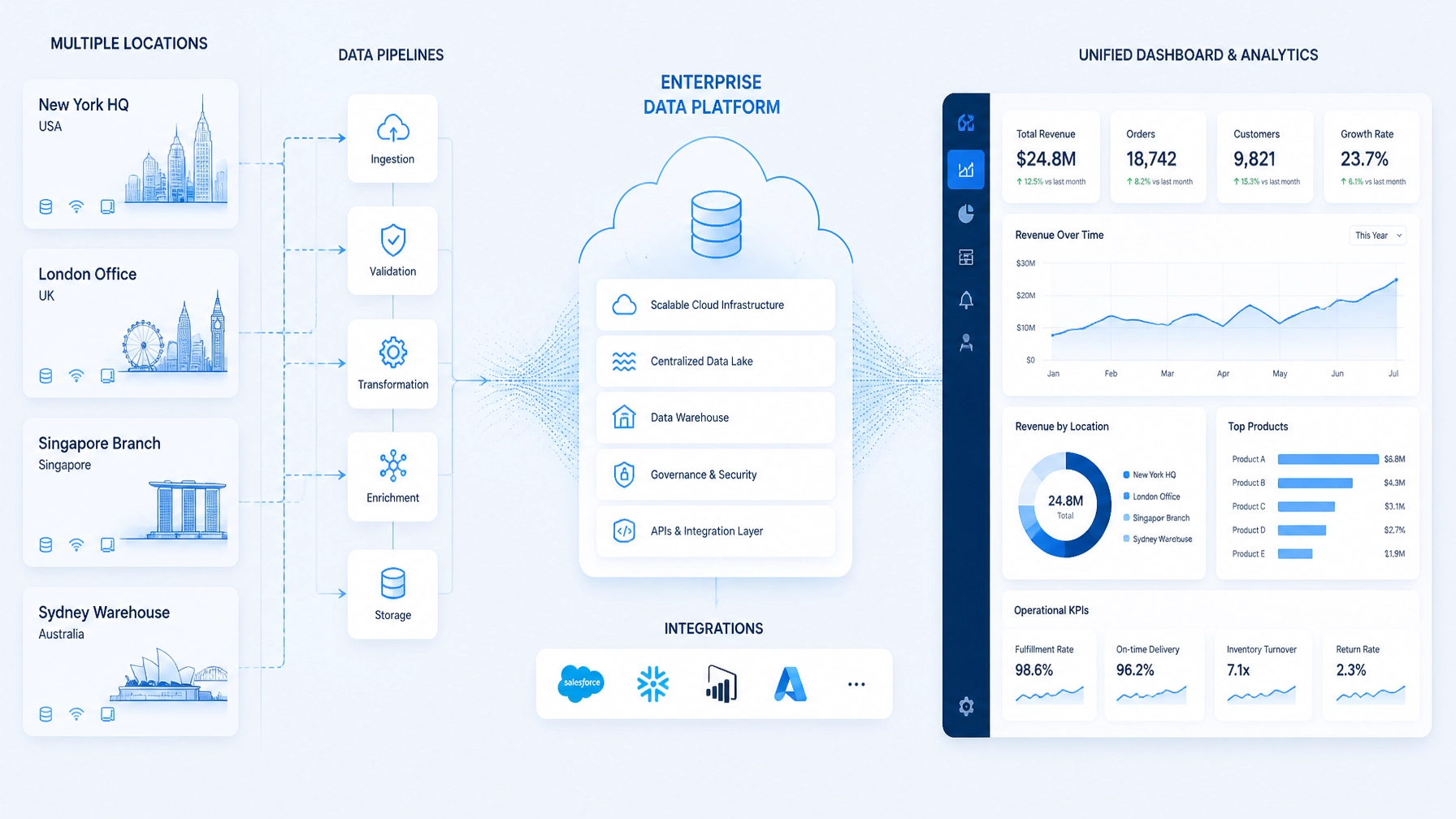
ChainHQ demonstrates how a location-aware operating layer can unify multi-location data, inventory, permissions, and reporting. Its architecture addresses the problems that emerge when each branch operates through isolated tools and local workarounds. Read the ChainHQ architecture case study.
EHRIO Pro demonstrates how a healthcare workflow can coordinate detailed, 70-question intakes, provider matching, scheduling, and secure data synchronization. The broader lesson applies to any business with complex qualification and routing requirements. Explore the EHRIO Pro build.
AI Local Boost demonstrates bespoke AI solutions for high-volume, multi-location reputation and local visibility workflows. It shows how AI orchestration, API integrations, approval logic, and content operations can work together at scale. Review the AI Local Boost case study.
FTP Inform demonstrates enterprise automation consulting for file-based financial operations. Its secure ingestion, schema validation, exception handling, and downstream orchestration replaced fragmented tooling with a unified automation engine. See how FTP Inform was engineered.
Together, these builds reflect PTC’s approach to business automation consulting: understand the operating environment, model the data, connect the systems, automate the repeatable work, and preserve human oversight where judgment matters.

The same capabilities can support legal and accounting firms, multi-location service businesses, healthcare organizations, e-commerce operators, and professional services companies. These organizations do not need to start from scratch conceptually. Proven patterns from healthcare, field operations, fintech, debt management, and local SEO can inform a tailored roadmap for their own environment.
The next step is a scoped transformation roadmap
Digital transformation becomes practical when it is connected to a specific workflow, measurable business outcome, and realistic implementation sequence.
If your organization is managing growth through spreadsheets, disconnected systems, manual approvals, or repetitive administrative work, a workflow audit can clarify where custom development and automation will create the greatest leverage. The right answer may be a targeted integration, a new internal application, an AI-assisted workflow, or a broader operating layer built in phases.
Book a discovery call with Pure Technology Consulting to discuss your systems, constraints, and transformation priorities. The conversation is focused on scoping the opportunity and identifying a practical next step, with no obligation.
Amin Said, Founder of Pure Technology Consulting LLC
https://puretechconsult.com
Phone: +1 (803) 921-0969
Leave a Reply