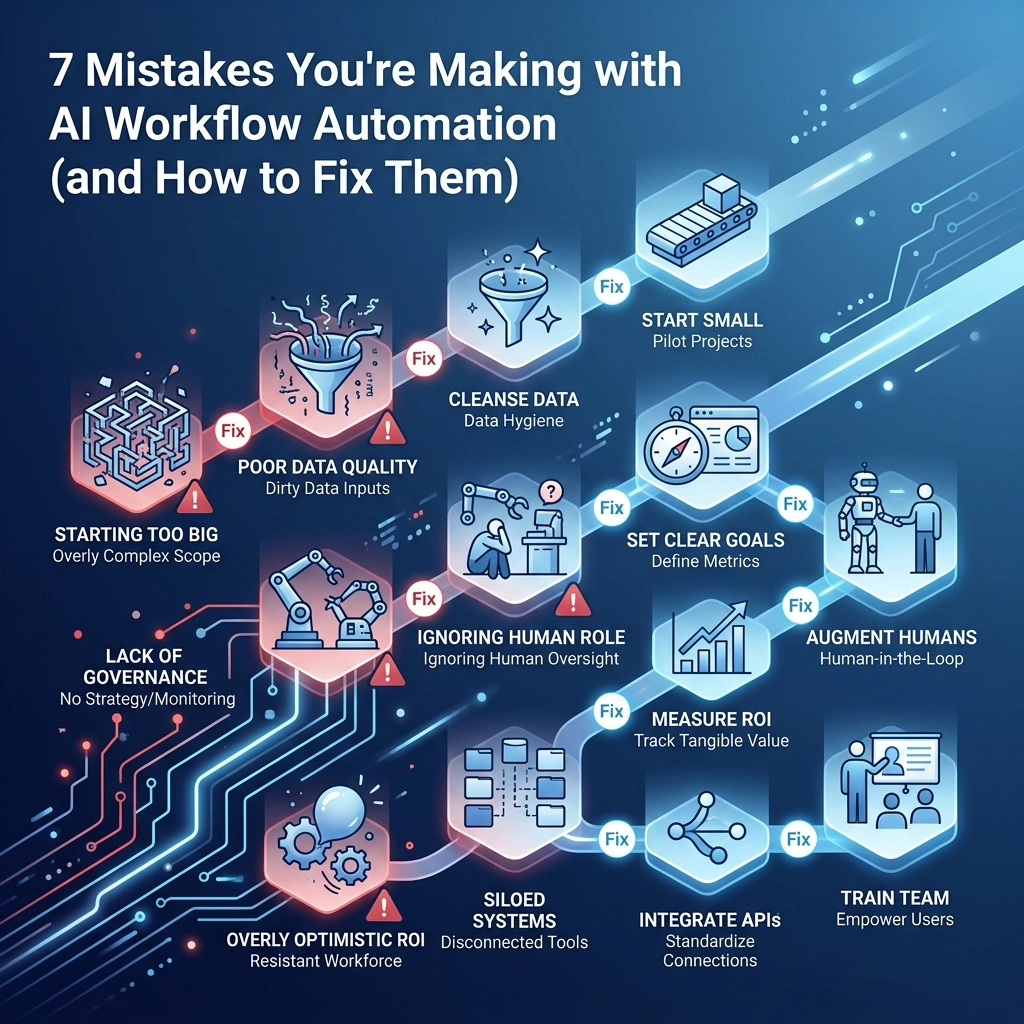
The promise of AI workflow automation is seductive: a world where your business operates with surgical precision, costs plummet, and your team focuses purely on high-level strategy. At Pure Technology Consulting, we’ve seen this transformation firsthand. However, we’ve also seen the "automated chaos" that occurs when executives treat AI as a magic wand rather than a strategic architectural shift.
The difference between a high-performing custom automation and a failed experiment usually comes down to a few fundamental architectural choices. If you’re looking to scale your operations: whether in legal, accounting, or enterprise field services: avoiding these seven common pitfalls is the key to unlocking true operational leverage.
1. Automating a Broken (or Unknown) Process
The most expensive mistake you can make is "AI-ifying" a messy manual workflow. If a process is chaotic when handled by humans, adding AI only makes it chaotic at the speed of light. We often see teams attempt to automate onboarding or billing without actually mapping out every branch and exception.
The Fix: You must map the real process, not the ideal one. Before we write a single line of code for a custom web app, we shadow users and record sessions to understand the "happy path" and the weird edge cases. Simplify the workflow first. Remove redundant approvals and standardize inputs.
At Pure Technology Consulting, when we build custom integrations, we often look at how data moves through tools like FTP Inform. Our proprietary FTP Inform platform isn’t just a file transfer utility; it’s a masterclass in how we approach data transparency. By ensuring the "where" and "when" of data movement is visible and structured, we eliminate the ambiguity that kills most automation projects before they start.
2. Chasing “Cool AI” Instead of Clear Business Outcomes
It’s easy to get distracted by multi-agent systems and fancy LLM interfaces. But technical completeness doesn't equal business value. If your automation doesn’t move a specific metric: like reducing Tier 2 ticket response time from 8 hours to 2 hours: it’s just a shiny toy.
The Fix: Define one sharp outcome per workflow. At our firm, we don't just "add AI" to your stack; we architect solutions that address operational drag. Whether it's a custom CRM integration or a bespoke field service portal, every feature must justify its existence against a business target. If it doesn’t move the needle on revenue or cycle time, it doesn’t belong in the build.

3. Treating LLMs as Deterministic APIs
A common technical error is assuming an LLM will always return the exact same response or valid JSON. Unlike traditional software, AI is probabilistic. If your downstream systems (billing, scheduling, or reporting) expect a perfect, rigid input and the AI gives them a slightly creative variation, the whole system crashes.
The Fix: Design for stochastic output. You need a "guardrail layer" between the AI and your core systems. This is where custom software development shines over off-the-shelf "no-code" tools. We build validation engines that check required fields, normalize types, and auto-repair model outputs before they touch your production database.
Take our work with EHRIO Pro as an example. In the healthcare space, matching engines and patient intake forms (often involving 70+ complex questions) require absolute precision. We use the logic honed in EHRIO Pro to demonstrate how bespoke matching algorithms can coexist with flexible AI inputs, ensuring HIPAA-adjacent workflows remain compliant and accurate.
4. Ignoring Data Quality and Context
AI is only as smart as the context you provide. If your CRM data is full of duplicates or your product analytics aren't integrated, the AI will make decisions based on hallucinations or outdated information.
The Fix: Clean and standardize your data first. You need a single source of truth for each entity: be it a client, an order, or a legal case. Good automation is "boringly strict" about data entry. We often recommend using structured forms and dropdowns upstream to prevent the AI from having to guess what a user meant.
5. Picking the Wrong Tooling (or Overbuilding In-House)
We see two extremes: companies using a consumer-grade toy for mission-critical flows, or engineering teams trying to build a custom orchestration platform from scratch before they’ve even validated the use case.
The Fix: Match the platform to the team and the risk. For high-ticket, complex operations, you need an orchestrator that offers robust versioning and observability.
This is where our proprietary asset, ChainHQ, comes into play. We developed ChainHQ as a demonstration of high-level orchestration. It shows our ability to build systems that handle multi-chain logic and complex integrations across disparate SaaS tools. When you engage us for a custom $10k+ build, we aren't starting from zero; we're bringing the architectural rigor of ChainHQ to your specific business problem.

6. Defaulting to Full Automation When Users Need Guidance
There is a psychological barrier to AI. If a system starts "touching production" without human oversight, your team will stop using it out of fear. The "black box" approach kills adoption.
The Fix: Move through three stages: Explain, Guide, and Execute.
- Explain: Tell the user exactly what the workflow is about to do.
- Guide: Walk the user through the task interactively: the AI suggests, the human clicks.
- Execute: Only move to full automation once the risk is low and the pattern is proven.
In our Local SEO work via AI Local Boost (AILB), we demonstrate this balance. AILB automates Google Business Profile management at scale, but it’s designed to provide the high-level strategy and execution that local businesses need without stripping away the human touch that defines a brand's voice. It’s an example of how we scale high-volume tasks while maintaining quality control.
7. Scaling Too Fast Without Governance
A few wins in automation often lead to "shadow automations": where every department starts building its own flows in a vacuum. Suddenly, a change in your CRM breaks six different workflows that no one even knew existed.
The Fix: Establish lightweight governance early. You don't need a massive committee, but you do need a central registry of all active workflows, their owners, and their dependencies.
At Pure Technology Consulting, we treat every automation project as a long-term asset. We provide the architecture, the logging, and the runbooks needed to ensure that as you scale, your complexity decreases rather than increases.
Building the Future of Your Operations
The shift to AI-powered automation isn't just about software; it's about reimagining how your business functions at its core. Whether we are leveraging our experience in Fintech telephony integrations or field service GPS logging, our goal is to build bespoke web applications that fit your operations like a glove.
If you’re ready to move past the "trial and error" phase of AI and want to build a robust, scalable operating model, let’s talk. My assistant, Emily, can help you schedule a discovery call to audit your current workflows and map out a visionary roadmap for your business.

We don't just build apps; we build the future of your company’s efficiency.
Amin Said, Founder of Pure Technology Consulting LLC
https://puretechconsult.com
+1 (803) 921-0969
Leave a Reply