If you’re running a chiropractic practice, a physical therapy clinic, or a wellness center in 2026, you’ve likely noticed a frustrating paradox. You have more digital tools than ever before, yet your staff is still bogged down by "admin drag." Your Electronic Health Record (EHR) system, which was supposed to be the backbone of your digital transformation, has instead become a digital filing cabinet: a place where data goes to rest, rather than a system that drives your business forward.
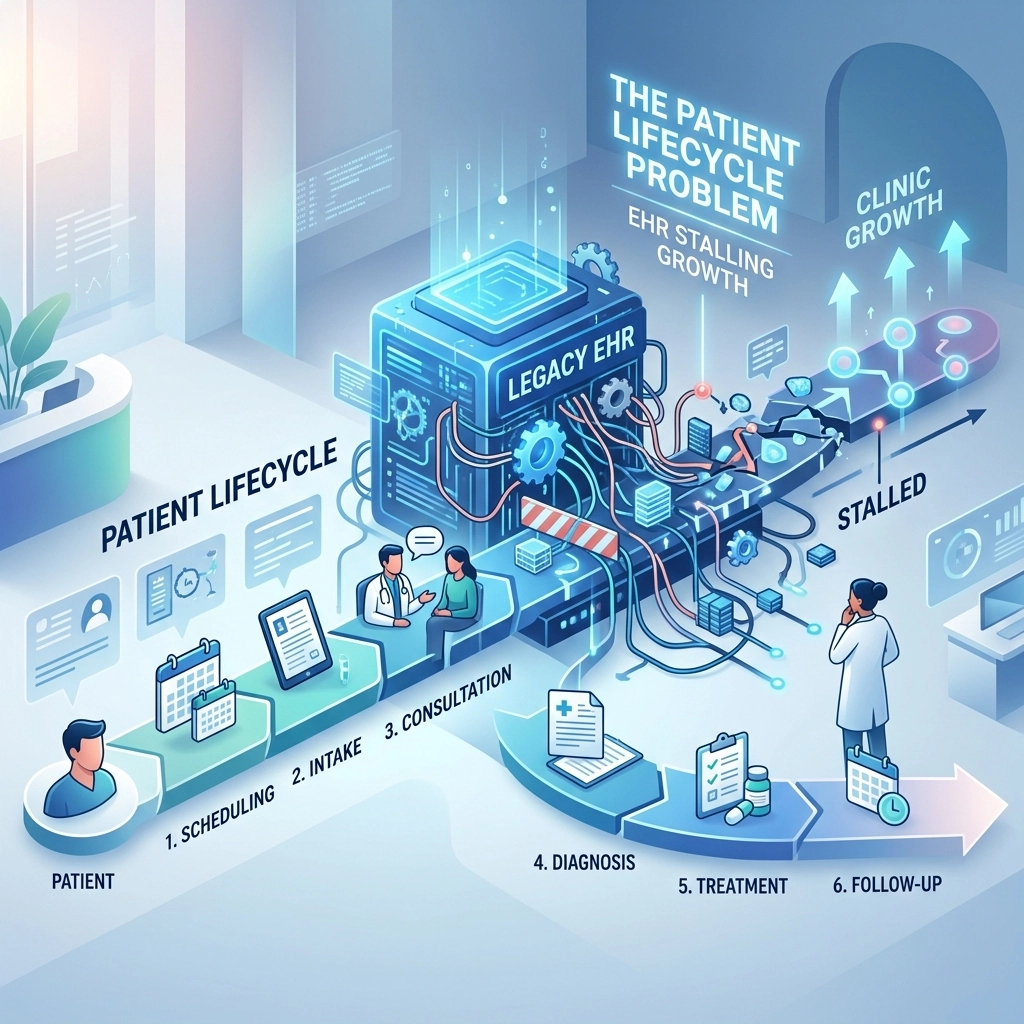
At Pure Technology Consulting, we’ve spent years deconstructing the workflows of high-growth clinics. What we’ve found is that the biggest bottleneck isn't a lack of clinical skill; it’s the Patient Lifecycle Problem.
In 2026, the market has shifted. Patients expect a seamless, "Amazon-like" experience from their healthcare providers. If your EHR only stores charts and schedules appointments, you aren't just behind the curve: you’re actively stalling your growth.
The "Standard EHR" Trap: Why Storage Isn't Strategy
The traditional EHR model was built for a different era of healthcare. These systems were designed primarily for two things: compliance and billing. They were built to satisfy insurance requirements and store patient history. While necessary, these functions are purely reactive.
When we talk about healthcare automation, we’re looking at the difference between a database and a growth engine. A standard EHR requires a human to trigger almost every action. A human has to call the patient to confirm the appointment. A human has to hand over the 70-question intake form on a clipboard. A human has to follow up when a patient misses a session.
This manual intervention creates friction. Friction leads to "no-shows," dropped leads, and a staff that is too busy with data entry to provide high-touch care. In 2026, the clinics that are scaling at 30-50% year-over-year have moved beyond simple record-keeping. They have automated the entire patient lifecycle.

Understanding the Patient Lifecycle Problem
To solve the growth plateau, we have to look at the lifecycle of a patient as a continuous loop, not a series of disconnected events. The "Problem" occurs when there are gaps in this loop that require manual labor to bridge.
- The Intake Gap: Most clinics lose potential patients during the onboarding phase. If a patient has to wait until they are in your waiting room to fill out a 70-question history, you’ve already lost the opportunity to build rapport.
- The Scheduling Gap: If your scheduling system isn't integrated with your marketing and follow-up workflows, you’re leaving your calendar to chance.
- The Retention Gap: This is where most clinics bleed revenue. Patients finish their initial treatment plan and "disappear" because there is no automated system to nurture that relationship long-term.
Standard EHRs don't solve these gaps; they just record that they happened.
Enter EHRIO Pro: Moving to Full Lifecycle Automation
At Pure Technology Consulting, we don’t just build software; we engineer operating models. Our work with EHRIO Pro is a testament to what happens when you treat patient management as a bespoke automation challenge rather than a SaaS subscription.
EHRIO Pro was designed to solve the Patient Lifecycle Problem by removing the human bottleneck from the administrative process. Here’s how we approach ai workflow automation within the clinic environment:
1. The 70-Question Automated Intake
We’ve implemented complex matching engines and deep-dive intake systems that allow patients to provide their history long before they step foot in the clinic. By moving the 70-question intake to a smart, automated digital workflow, the data is already categorized and analyzed by the time the provider sees the patient. This isn't just "digital forms": this is intelligent data mapping that prepares the clinician for the visit.
2. Autonomous Scheduling & Re-Engagement
Why should your front desk spend four hours a day on the phone? EHRIO Pro uses healthcare automation to handle scheduling, reminders, and: most importantly: re-engagement. If a patient misses a milestone in their treatment plan, the system triggers a personalized follow-up based on their specific care path.
3. Integrated Decision Support
In 2026, small business automation is about more than just moving data; it’s about making data useful. By integrating automated workflows, clinic owners can see real-time dashboards of patient health outcomes versus clinic profitability.

The Shift: From Admin-Heavy to Patient-Centric
The most successful clinics we consult for have one thing in common: their staff doesn't feel like "data entry clerks."
When you solve the Patient Lifecycle Problem with custom-built automation, you see an immediate shift in your clinic’s culture.
- Front Desk Staff become Patient Experience Coordinators. They focus on the person in front of them, not the software on their screen.
- Providers spend more time on clinical outcomes and less time navigating clunky EHR interfaces.
- Patients feel "seen" because the communication they receive is timely, relevant, and automated to fit their needs.
This is the "Visionary" approach to healthcare. It’s about using technology to make the practice more human, not less. By leveraging our experience in complex web applications: from fintech telephony integrations to GPS-logged field operations: we bring a level of technical governance to clinics that standard "off-the-shelf" EHRs simply cannot match.
Why Custom Beats SaaS in 2026
Many clinic owners ask, "Why not just buy another subscription?" The answer lies in your growth strategy. When you rely on a generic SaaS EHR, you are limited by their roadmap. You are one of ten thousand users.
When we engage in bespoke development and high-level automation consulting, we are building a proprietary asset for your business. Whether it’s HIPAA-adjacent workflows or custom matching engines, we ensure your tech stack fits your operations: not the other way around.
In 2026, the "connected ecosystem" is no longer optional. As CMS-aligned networks become the standard, your ability to integrate and automate will define your clinic's valuation.

Where to Automate First: A Roadmap for Clinic Owners
If you feel your EHR is stalling your growth, you don't necessarily need to rip and replace everything tomorrow. You need a strategy. Here is what we recommend to our high-ticket consulting clients:
- Audit Your Intake: Count how many manual hours your staff spends on data entry for new patients. This is your first target for automation.
- Map Your Patient Journey: Identify the "drop-off points." Is it after the first visit? After the insurance verification? Use ai workflow automation to bridge these gaps.
- Look Beyond Healthcare: Some of the best automation ideas come from other industries. We’ve taken rep accountability models from the field service industry and applied them to clinic provider tracking with massive success.
Final Thoughts: The Strategic Choice
The Patient Lifecycle Problem is an operational drag that most clinic owners accept as the "cost of doing business." But in the competitive landscape of 2026, it is a cost you can no longer afford.
Standard EHRs are stalling your growth because they focus on the past (the record). You need a system that focuses on the future (the patient journey). Whether you are looking for a workflow audit or a full-scale bespoke automation build, the goal is the same: to move your clinic from admin-heavy to patient-centric.
At Pure Technology Consulting, we specialize in building these scalable, complex web applications. We’ve done it for legal firms, accounting practices, and fintech agencies, and we’ve perfected it for healthcare with EHRIO Pro.
If you’re ready to stop fighting your software and start growing your practice, let’s talk about a roadmap that actually fits your vision.
Ready to audit your clinic’s workflow?
Book a discovery call with our team to see how we can automate your patient lifecycle and unlock your clinic’s true potential.
Amin Said, Founder of Pure Technology Consulting LLC
https://puretechconsult.com
+1 (803) 921-0969
Leave a Reply