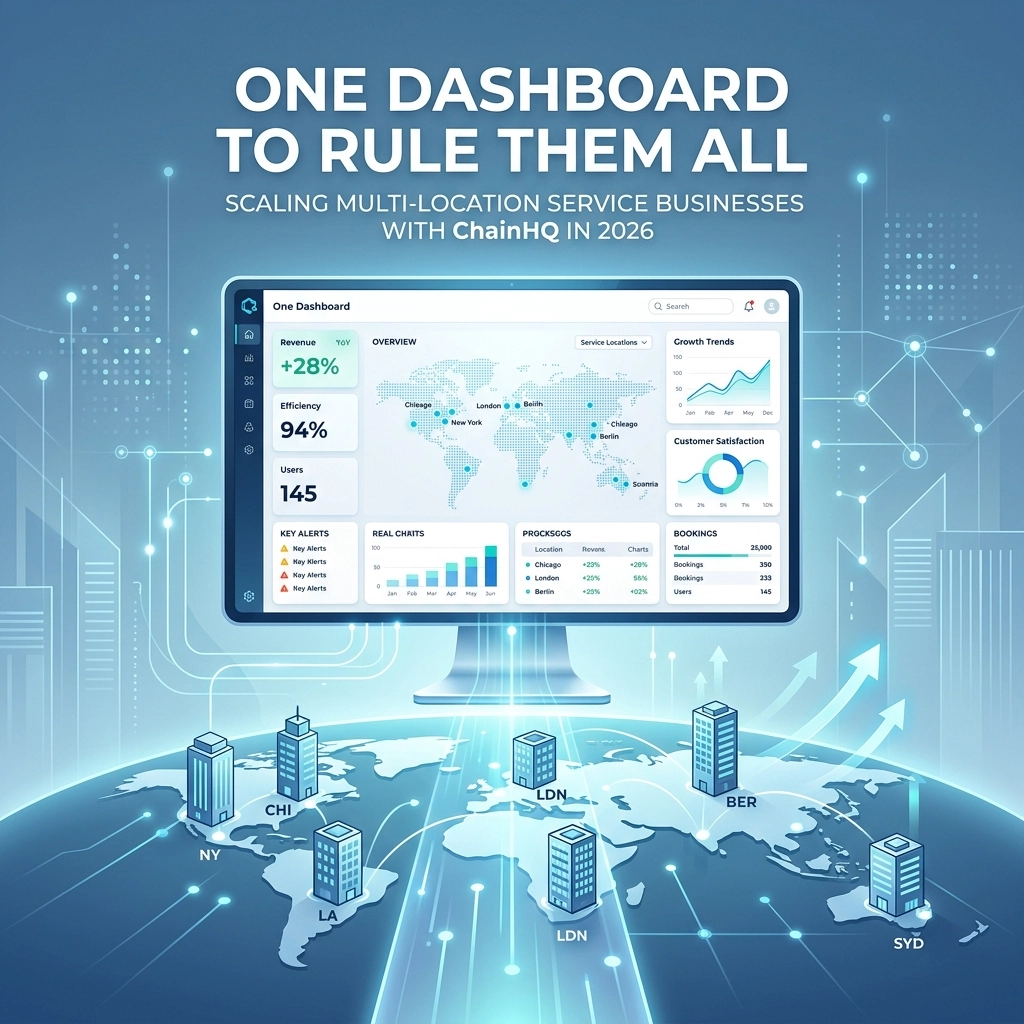
For the modern service operator, growth is a double-edged sword. On one hand, expanding from three locations to thirty represents a triumph of market fit and demand. On the other, it often introduces a level of operational complexity that threatens to erode the very margins that made the business successful in the first place.
By 2026, the gap between "growing" and "scaling" has widened. Growing simply means getting bigger; scaling means getting better as you get bigger. The primary obstacle to scaling in the multi-location service sector isn't a lack of hard work, it is the fragmentation of data and the "growth tax" of redundant manual reporting.
At Pure Technology Consulting, we approach this challenge not as a software problem, but as a strategic architecture problem. Through our work on bespoke systems like ChainHQ, we have demonstrated that the path to high-level scale lies in centralizing operations through a unified operational dashboard.
The Cost of the Fragmented Enterprise
In many multi-location businesses, each site operates as a digital island. One location might use a specific CRM, another relies on legacy spreadsheets, and a third has its own localized way of tracking field technician productivity. When leadership requires a bird's-eye view of the organization’s health, the process is agonizing.
Managers spend hours, if not days, pulling reports from disparate systems, cleaning the data in Excel, and trying to reconcile conflicting metrics. By the time the "Monthly Operations Report" reaches the CEO’s desk, the data is already two weeks old. This is the definition of operational drag.
The consequences are tangible:
- Inconsistent Customer Experience: Service standards vary wildly between locations because there is no central mechanism for monitoring performance in real-time.
- Wasted Labor: High-value managers are relegated to data entry and manual reporting instead of high-level strategy and team development.
- Missed Opportunities: Without real-time visibility, leadership cannot pivot resources toward high-performing locations or provide early intervention for struggling ones.

Scaling with ChainHQ: A Blueprint for Unified Visibility
ChainHQ serves as a powerful proof-of-concept for what we build at Pure Technology Consulting. It is designed specifically for multi-location operators who have outgrown "off-the-shelf" solutions and require a tailored operating model.
The philosophy behind ChainHQ is simple: One version of the truth.
By integrating with existing point-of-sale systems, field service management tools, and accounting software, ChainHQ aggregates data into a single, high-fidelity dashboard. This isn't just a collection of charts; it is a live command center.
Centralizing Operations Across Geographies
When we consult with multi-site operators, the first goal is to eliminate the "local blind spot." A unified dashboard allows executives to drill down from a national level to a specific region, city, or individual service bay in seconds. Whether you are managing five locations or five hundred, the transparency remains absolute.
Eliminating Data Silos
Data silos occur when information is trapped within a specific department or software tool. Through business process automation consulting, we map out these silos and build the bridges necessary to make data flow. ChainHQ acts as the bridge, ensuring that the marketing data from one location correlates with the labor costs at another, providing a true picture of ROI that manual reporting simply cannot achieve.
The Strategic Role of Business Process Automation Consulting
A dashboard is only as good as the workflows that feed it. This is where many businesses falter, they buy a "visualization tool" but fail to address the broken processes underneath.
Scaling in 2026 requires a deep dive into ai workflow automation. It is no longer enough to just see the data; the system must act on it. At Pure Technology Consulting, we look at how custom-built logic can handle the heavy lifting of multi-location management.
For example, if a service location in Atlanta sees a 20% spike in cancellations, an automated workflow can immediately trigger an alert to the regional manager, pull the recorded calls for those cancellations using AI-driven sentiment analysis, and schedule a review meeting, all before a human has even looked at the morning report.
This level of automation turns a passive dashboard into a proactive management partner.

Where Custom Software Beats the "One-Size-Fits-All" SaaS
The market is flooded with SaaS products promising to manage your business. However, as service companies move into the mid-market and enterprise levels, these generic tools often become a hindrance. They force your unique business processes into their rigid templates.
Custom development allows for:
- Bespoke Integration: We don't ask you to change your tech stack. We build the integrations that make your current tools work together.
- Scalability Without "Per-User" Penalties: Many SaaS platforms punish growth with exponential licensing fees. A custom build like ChainHQ is an asset you own, designed to scale with you.
- Data Sovereignty: In an era of increasing data privacy regulations, owning your infrastructure ensures you have total control over your customer and operational data.
Our experience in healthcare (EHRIO Pro), field operations (D2D Tracking), and fintech allows us to bring high-level compliance and governance standards to the service sector. We aren't just building an app; we are building a proprietary operating system for your brand.
Transitioning from Reactive to Predictive
The ultimate goal of scaling with a unified dashboard is to move from reactive management to predictive strategy. When your data is centralized and your workflows are automated, you can begin to see patterns that were previously invisible.
You can predict seasonal labor shortages across specific regions. You can identify which service packages have the highest lifetime value in urban versus suburban markets. You can automate your supply chain so that inventory arrives exactly when it’s needed, reducing capital tied up in sitting stock.

A Roadmap for Transformation
Building a unified operational dashboard like ChainHQ is a journey, not a transaction. It begins with a thorough audit of your current "operational drag", identifying where manual reporting is slowing you down and where data silos are costing you money.
At Pure Technology Consulting, we specialize in building these high-stakes, custom web applications for businesses that are ready to move to the next level of maturity. We focus on the architecture, the integration, and the long-term scalability of your digital assets.
If your multi-location business is currently struggling with the "growth tax" of manual reporting and disconnected systems, it may be time to move toward a unified operating model.
Next Steps for Your Operation
Scaling is a strategic choice. To understand how bespoke automation and a unified dashboard can transform your specific service business, we invite you to begin a dialogue with our advisory team.
Consultation and Scoping:
We offer a deep-dive workflow audit to identify the specific integrations and automations that will provide the highest leverage for your organization. This is a consultative process designed to create a clear roadmap for your digital transformation.
To schedule a discovery call and explore how we can build your version of a unified command center, please visit our scheduling page:
https://puretechconsult.com/schedule
You can also learn more about our approach to custom development and view our portfolio of work at our main site:
https://www.puretechconsult.com
Scaling your business doesn't have to mean losing your mind. With the right architecture, you can gain the visibility you need to lead with confidence.
Amin Said, Founder of Pure Technology Consulting LLC
https://puretechconsult.com
Phone: +1 (803) 921-0969
Leave a Reply