By Amin Said, Founder of Pure Technology Consulting LLC
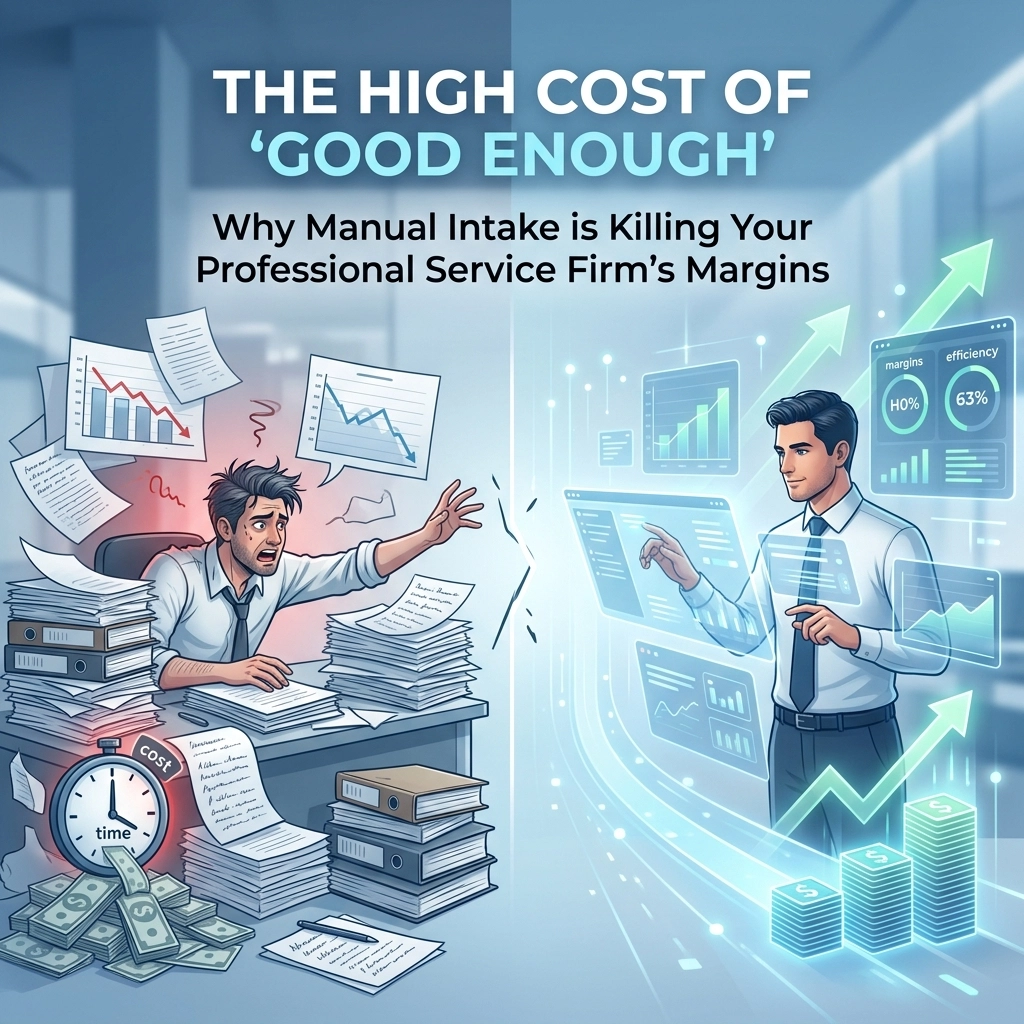
In the world of professional services: whether you’re running a law firm, an accounting practice, or a high-ticket consultancy: there is a silent killer lurking in your operations. It’s not your competition, and it’s not the economy. It’s the phrase "good enough."
Usually, this phrase is applied to your intake process. You know the one: a prospective client calls in, a junior staff member scribbles notes on a legal pad or a Word doc, an email chain starts that involves three different departments, and eventually, someone remembers to follow up with a proposal.
It feels functional. It feels like "the way things are done." But if you look at your margins, "good enough" is costing you a fortune.
At Pure Technology Consulting, we’ve seen this play out across dozens of industries. What looks like a simple administrative task is actually a massive leak in your revenue bucket. Between lost billable hours, data entry errors, and missed conversion opportunities, manual intake is likely the single biggest drag on your firm's profitability.
The Billable Hour Trap: Why Your Best People are Doing $20/hr Work
The most immediate cost of manual intake is the direct drain on your highest-value resources.
In a typical professional services firm, senior partners or specialized consultants often find themselves bogged down in the administrative weeds. Research shows that senior professionals billing between $400 and $600 per hour regularly spend 10 to 15 hours every month on manual intake and documentation.
Let’s do the math. For a firm with just five senior partners, that represents a lost billable opportunity cost of roughly $360,000 per year.
When your intake workflow isn't automated, your most expensive assets are essentially acting as data entry clerks. Every minute a partner spends chasing a signed retainer or manually typing client details into a CRM is a minute they aren't solving high-level problems or bringing in new business.

The "Telephone Game" of Manual Data Entry
Manual intake is rarely a one-step process. Data is captured in a phone call, moved to an email, copied into a spreadsheet, and eventually (hopefully) keyed into your project management system.
Every time a human moves data from Point A to Point B, the risk of error increases exponentially. These aren't just "typos." In professional services, a data entry error can lead to:
- Invalid Pricing Calculations: A missed decimal point or a misunderstood requirement can result in underquoting a project by thousands of dollars.
- Compliance Failures: Missing a key conflict-of-interest check or a regulatory requirement during intake can lead to malpractice risks and massive liability exposure.
- The Re-Work Tax: When the wrong information is captured at the start, the entire project is built on a shaky foundation. Your team ends up doing the work twice: once incorrectly, and once to fix the mistakes.
Firms that transition to bespoke, automated intake systems typically see an 80-90% reduction in proposal and intake errors. By building custom internal systems that validate data at the point of entry, you ensure that the "source of truth" is established on day one.
Margin Erosion Through Pricing Inconsistency
One of the hidden benefits of a sophisticated, automated intake system is the ability to enforce pricing governance.
When intake is manual, pricing becomes "vibe-based." A staff member might use an outdated rate sheet, or they might fail to account for the complexity of a specific integration. We’ve seen mid-sized firms discover that their manual processes were undervaluing complex engagements by an average of 23%.
Without a centralized reporting dashboard and an automated workflow, leadership has zero visibility into why certain projects are less profitable than others. You can't fix what you can't see.
A custom-built intake engine doesn't just collect names and phone numbers; it applies logic. It looks at the scope, compares it against historical data, and ensures that your margins are protected before the contract is even sent.

The Scalability Wall: Why You Can’t "Brute Force" Growth
Many founders believe they can scale their firm simply by hiring more administrative staff to handle the manual workload. This is a trap.
Manual intake doesn't scale linearly; it scales inefficiently. As your client volume grows, the complexity of managing those manual handoffs grows even faster. Eventually, you reach a "scalability wall" where your overhead grows faster than your revenue. Your margins begin to shrink even as your firm gets "bigger."
True scale requires an operating model where doubling your client volume doesn't require doubling your headcount. This is where custom software development becomes a strategic lever.
Instead of hiring another admin, you invest in a custom internal system that handles the heavy lifting. We’ve implemented these types of high-level automations in complex environments: from 70-question medical intakes for healthcare clients like Thrive and EHRIO to GPS-logged rep accountability systems in field operations. These aren't off-the-shelf SaaS products; they are bespoke engines designed to fit the specific "DNA" of the business.
Speed as a Competitive Advantage
In 2026, the firm that responds first usually wins.
Clients expect a seamless, digital experience. If your intake process involves mailing physical forms or waiting four days for a manual follow-up, you are losing business to more agile competitors.
A streamlined, automated intake process allows you to:
- Capture leads instantly through custom web apps.
- Automate conflict checks and background screening.
- Generate proposals and contracts in minutes, not days.
- Integrate directly with your CRM to ensure no lead falls through the cracks.
This isn't just about "efficiency." It's about conversion. Firms with automated quote-to-contract processes see conversion rates that are 15-25% higher than their manual counterparts.

Moving Beyond "Good Enough"
If you’re still relying on manual intake, you’re essentially paying a "manual tax" on every single hour your firm bills. That tax is eating your margins, frustrating your staff, and limiting your ability to scale.
The path forward isn't to find a better spreadsheet. The path forward is a strategic roadmap that replaces manual bottlenecks with custom automation and integrated systems.
At Pure Technology Consulting, we don't just build apps; we build the infrastructure for growth. We’ve helped firms in legal, accounting, healthcare, and fintech transition from "good enough" to "best-in-class" by building bespoke systems that fit their specific workflows like a glove.
Ready to Audit Your Intake Workflow?
If you suspect your manual processes are holding you back, it's time for a professional assessment. We help firms identify where their margins are leaking and build the custom tools needed to plug those holes.
Don’t let "good enough" be the reason your firm plateaus.
Book a discovery call with our team today to explore how custom automation can transform your operating model.
Pure Technology Consulting
+1 (803) 921-0969
https://puretechconsult.com
Amin Said, Founder of Pure Technology Consulting LLC
https://puretechconsult.com
Leave a Reply