Amin Said, Founder of Pure Technology Consulting LLC
https://puretechconsult.com
For a multi-location service business, local SEO is not simply a marketing task. It is an operating discipline: business information must stay accurate, reviews need timely attention, local content must reflect each community, and leadership needs to understand what is happening across the portfolio.
Spreadsheets and agency retasks can support an early stage of growth. But as locations multiply, the work becomes harder to coordinate and its impact harder to see. A custom local SEO platform can create a consistent operating layer, automating repeatable tasks while keeping people responsible for decisions that affect customers and the brand.
Why manual local SEO becomes difficult to scale
A spreadsheet can record profile details, review status, content calendars, and owners. It cannot reliably coordinate the work across teams or ensure that every update is current. As locations are added, common problems start to compound:
- Business hours, phone numbers, or services drift out of date across listings.
- Google Business Profiles receive inconsistent updates, or updates are missed.
- Review responses wait in inboxes or are handled differently by each location.
- Teams cannot easily see which actions were completed, by whom, or when.
- Reporting shows general activity but does not help operators understand location-level performance or what may be contributing to calls.
An agency can provide valuable strategy and execution, but one-off requests and recurring manual checks may leave a gap between recommendation and day-to-day operations. Local managers, central marketing teams, and external partners may each have part of the picture without a shared workflow.
The issue is not that people are incapable of managing the work. It is that coordination does not scale cleanly when the process depends on scattered documents, reminders, and repeated handoffs.

What a platform layer changes
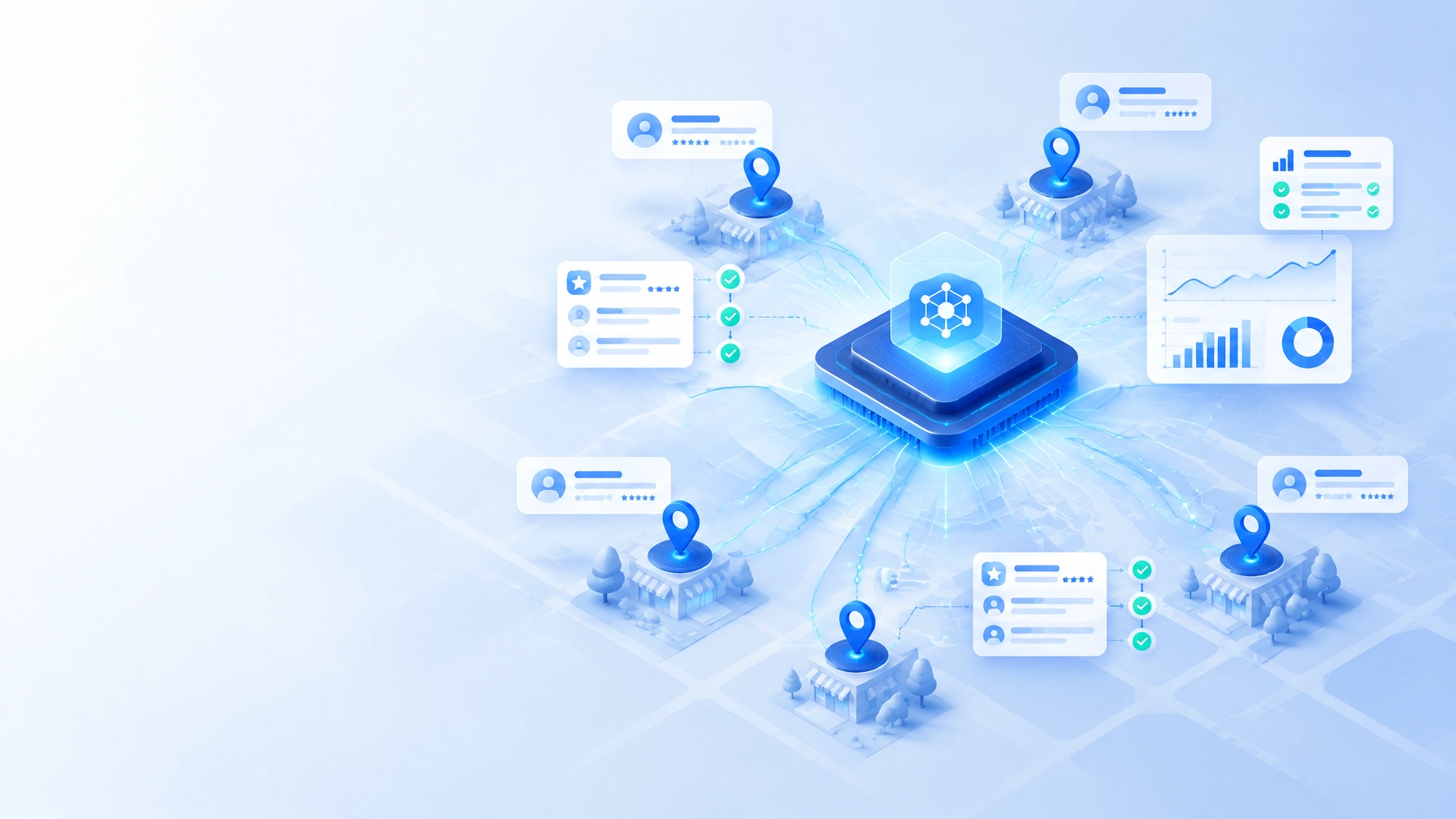
A purpose-built platform makes the location, not the spreadsheet row or individual task, the central unit of work. Each location has its own profile information, activity history, review queue, content schedule, permissions, and performance view. The business can manage common standards centrally while retaining the local context each branch needs.
This is the difference between adding another dashboard and building an operating system for visibility. The platform coordinates the work across existing tools and turns repeatable activities into governed workflows.
A practical system can support:
- Listing hygiene: Compare approved business information with profile data, flag inconsistencies, and route proposed updates for review.
- Review workflows: Bring review activity into a shared queue, help teams prioritize responses, and track approvals and completion.
- Location-level content: Plan and coordinate updates while preserving local details and brand standards.
- Reporting: Give corporate, regional, and location teams views appropriate to their responsibilities.
The goal is not to automate every marketing decision. It is to reduce avoidable coordination, make exceptions visible, and give operators a clearer view of the work.
How custom local SEO platform architecture works
A reliable platform is designed around the business’s organizational structure and the constraints of its external systems. That requires more than connecting an API to a user interface.
Locations are first-class data objects
Each location should have a durable record in the application, connected to its brand, region, authorized users, profile accounts, and local operating rules. This makes it possible to assign work, manage permissions, compare status, and preserve the history of changes without treating every branch as a variation of one generic account.
The data model should also distinguish between what the business intends to be true and what external platforms currently show. That separation helps teams identify drift without blindly overwriting changes made by an authorized person or the platform itself.
Integrations sit at the edge of the system
Google Business Profile and review APIs are external dependencies, not the application’s foundation. A provider layer handles authentication, data exchange, API limitations, errors, and changes in the integration. The rest of the platform can then organize workflows around the business’s needs rather than being tightly coupled to one provider.
Google’s Business Profile API policies specify that tools must be used for profiles a business owns or is authorized to manage. They also require appropriate user authorization for certain actions, including responding to reviews and making automated or programmatic changes. The architecture should account for those requirements from the beginning, including how users authorize access and how the business can end that access.
Approval queues manage operational risk
Not every action has the same consequence. A draft response to a routine review, a change to business hours, and an update to a business name should not necessarily follow the same path.
An approval queue can route work based on its type, location, sensitivity, and business rules. Low-risk tasks may be prepared automatically, while material profile changes or sensitive responses can require an authorized person’s review. The system should record the proposed change, the approver, the outcome, and any response from the external platform.

Scheduling and dashboards support a repeatable cadence
A scheduling engine can coordinate checks and approved publishing around each location’s needs. It should also handle failures gracefully: retrying temporary errors, flagging items that require attention, and avoiding silent failures.
Per-location dashboards make the system useful to more than central marketing. A regional manager may need a portfolio view of outstanding actions, while a location manager needs a focused queue. Leadership can review trends and exceptions without losing sight of local detail.
Audit trails connect those views to what actually happened: which account or automation initiated an action, whether it was approved, and what result was returned. This matters for operational accountability and for diagnosing errors.
Where AI helps, and where people remain responsible
AI can help teams manage repetitive work across a large set of locations. It may draft a response using brand guidance and review context, identify profile information that differs from an approved source, or prioritize locations that need attention based on defined signals.
These capabilities are most useful inside a governed workflow:
- The platform gathers relevant location and task context.
- AI prepares a draft or flags an exception.
- Business rules check the work and identify when review is required.
- An authorized person approves, edits, or declines the action.
- The platform records the decision and outcome.
This is ai workflow automation with human judgment in the loop, not a promise that an AI system can make every public-facing decision safely on its own. Human oversight helps preserve brand voice, account for unusual situations, and handle sensitive or ambiguous reviews.

Set realistic expectations and build for compliance
A local SEO platform can improve process consistency and make activity more visible. It cannot guarantee ranking positions, customer calls, or a specific rate of growth. Search results are influenced by factors outside an organization’s control, and a dashboard cannot establish that one action caused a change in calls.
Useful reporting should distinguish activity from outcomes. It can show whether profile information is current, how quickly reviews move through an approved response workflow, which locations have pending tasks, and what performance data is available. Where call attribution matters, the measurement approach should be explicit about the use of call tracking, campaign data, and any limitations.
Compliance belongs in the product design. Google’s API policies and business representation guidelines should inform authorization, account access, automation, and change management. A sound system uses consent and permission controls, does not imply Google endorsement, and makes it clear to clients what the platform changes on their behalf.
Who benefits from a custom platform?
A custom build may be appropriate when a multi-location operator has workflows that standard tools do not support well, a franchise group needs both brand governance and local flexibility, or an agency wants to productize its operating process for clients.
It may be a poor fit when a business has only a few locations, its workflows are already well served by existing software, or the team cannot yet define who owns approvals and profile data. In those cases, a process review or a lighter integration may be a better starting point.
At Pure Technology Consulting, AI Local Boost serves as a proof of concept for building multi-tenant local SEO automation infrastructure, not as a standalone product pitch. It demonstrates how custom web application development can bring location data, workflows, permissions, and reporting into a cohesive platform. The same engineering discipline supports enterprise automation consulting, business automation consulting, business process automation consulting, AI consulting services, and digital transformation consulting engagements.
From visibility tasks to operating capability
The strategic question is not simply how to publish more updates. It is how to create a dependable operating model for keeping every location accurate, responsive, and measurable as the business grows.
That model starts with clear ownership, a well-designed location data structure, compliant integrations, approval paths, and reporting tied to decisions. If you are evaluating a platform for your locations, or considering whether custom software can connect your current systems, request a discovery call with Pure Technology Consulting. Call +1 (803) 921-0969 to discuss your workflows, requirements, and technology roadmap.
Amin Said, Founder of Pure Technology Consulting LLC
https://puretechconsult.com
Leave a Reply