Amin Said, Founder of Pure Technology Consulting LLC
For a multi-location healthcare group, clinical intake is not simply a form submission. It is the first operational decision point in the patient journey.
The information collected during intake may determine eligibility, clinical service fit, provider specialty, appointment modality, location, urgency, insurance requirements, and the next action for staff. When those decisions remain distributed across forms, email, spreadsheets, calendars, and disconnected systems, administrative teams become the integration layer.
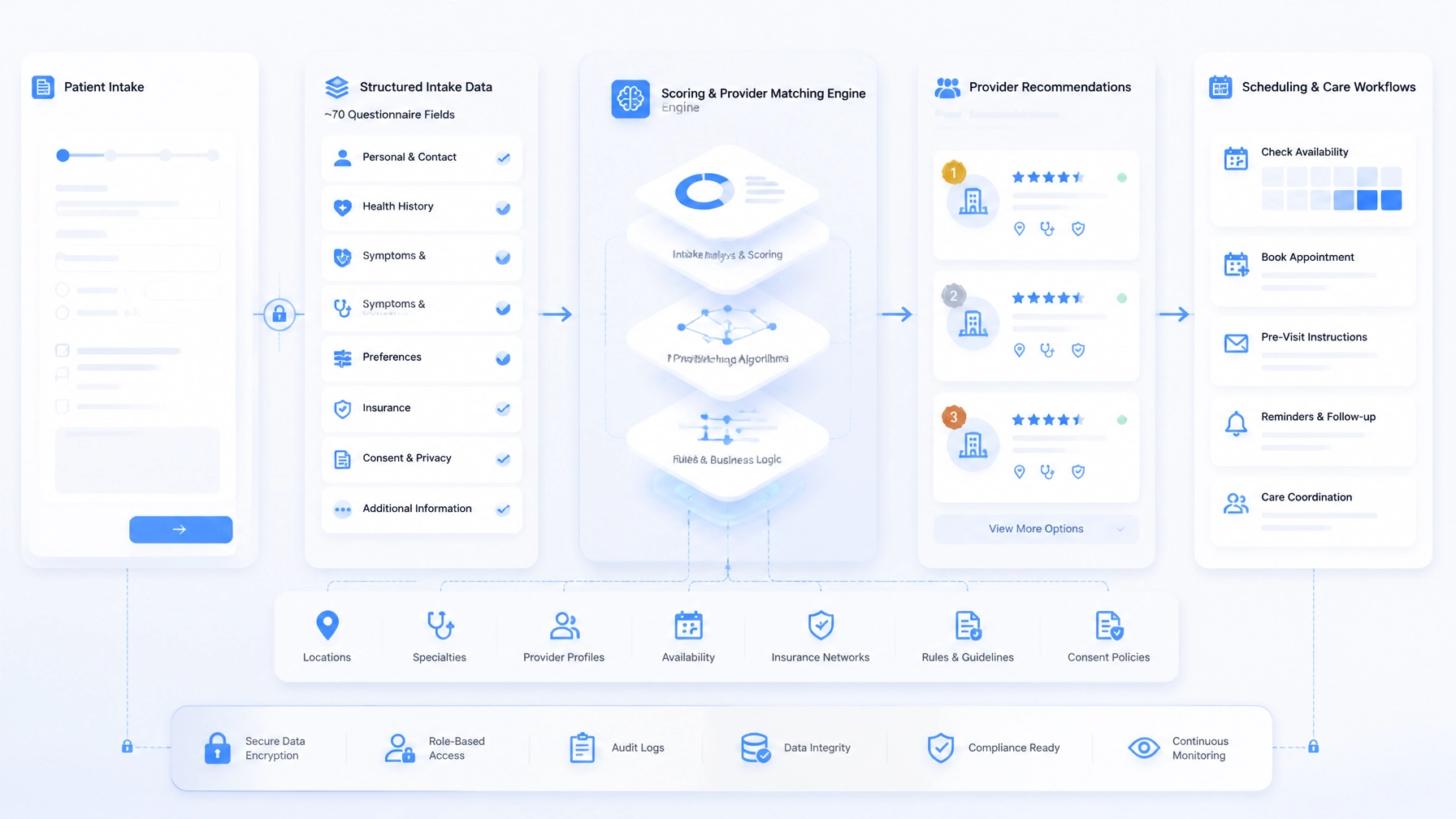
Pure Technology Consulting engineered EHRIO Pro as a proof of concept for a more reliable operating model. The platform demonstrates how a complex intake process can become structured data, how provider recommendations can be generated through configurable rules, and how multi-location healthcare operations can gain visibility without removing human accountability.
EHRIO Pro is not presented here as a standalone SaaS product for purchase. It is evidence of PTC’s ability to design and build complex, compliance-sensitive custom systems for high-ticket engagements, often scoped at $10,000 or more depending on workflow complexity, integrations, security requirements, and ongoing support.
The engineering decision: model intake as data, not a form
A conventional form stores answers. A clinical intake engine must make those answers useful to the rest of the organization.
EHRIO Pro was designed around a structured intake journey capable of supporting approximately 70 questions or data points. The objective was not to create a longer questionnaire. It was to capture the information required for downstream decisions without asking staff to reconstruct a patient’s situation manually.
The intake model can represent information such as:
- Presenting concerns, care needs, and relevant history
- Specialty or service-line requirements
- Insurance and eligibility details
- Location, travel, and telehealth preferences
- Provider preferences and communication requirements
- Referral information and supporting documents
- Consent and communication preferences
- Scheduling constraints and appointment requirements
- Acuity indicators requiring review or escalation
The workflow is adaptive rather than static. A response can determine which question appears next, which fields become required, and which routing conditions are evaluated. A patient requesting behavioral health services may follow a different path from a patient seeking physical therapy or chiropractic care.
This distinction is central to the architecture:
A form collects information. A structured intake engine creates information that other systems can validate, filter, score, route, report on, and audit.
That data model is one of the most valuable assets in a system like this. The user interface can change over time. It may become a patient portal, a mobile workflow, an embedded website experience, or an internal staff application. The underlying entities, relationships, validation rules, and decision logic remain useful regardless of the interface.

A rules-based matching engine configured for each practice
The matching engine was designed to answer a more useful question than “Who is available?”
The operational question is:
Which provider, location, and appointment format represent the best fit for this patient under the practice’s rules?
EHRIO Pro separates hard eligibility constraints from softer preferences. That distinction prevents an optional preference from creating a false no-match.
Hard constraints establish eligibility
Depending on the practice, hard filters may include:
- Required specialty or clinical service
- Provider qualifications and licensure
- Insurance participation or eligibility
- Geographic boundaries and service areas
- Age or program eligibility
- In-person or telehealth requirements
- Provider availability and new-patient capacity
- Location-specific operational restrictions
If a provider fails a required condition, that provider is removed from consideration.
Weighted preferences rank viable options
After eligible providers and locations are identified, the engine can rank options using configurable preferences such as:
- Preferred appointment window
- Telehealth versus in-person care
- Distance from the patient
- Language concordance
- Requested provider characteristics
- Continuity of care
- Current schedule utilization
- Appointment duration and capacity
This architecture allows each practice to define its own operating model. A behavioral health group may prioritize modality, language, acuity, and specialty. A physical therapy organization may emphasize service line, referral type, location, and schedule capacity. A multi-location wellness group may configure different rules for each site.
The logic is not intended to make an autonomous clinical diagnosis. Acuity should function as a safety and routing signal. High-risk, ambiguous, or incomplete cases should be escalated to qualified staff according to the practice’s policies.
The resulting output may be a ranked recommendation, a direct scheduling path, a priority queue, or a request for additional information.
Configuration matters more than hard-coded logic
Healthcare organizations change. Providers join and leave. New locations open. Insurance relationships evolve. Services are added. Scheduling policies are revised.
A system that requires a software release for every operational change quickly becomes expensive to maintain. EHRIO Pro was therefore designed around configurable entities and rules rather than a workflow hard-coded into one implementation.
The configurable layer can include:
- Intake questions and response types
- Required and optional fields
- Conditional question paths
- Provider specialties and capabilities
- Location service areas
- Insurance and eligibility matrices
- Modality and appointment rules
- Matching weights and scoring criteria
- Acuity thresholds and escalation paths
- Staff queues, notifications, and follow-up actions
Versioning is equally important. When a match is generated, the organization should be able to identify which intake configuration, provider data, and matching rule set were active at that time.
That makes change governable. If match acceptance, scheduling speed, or exception volume changes after a rule update, operators can investigate the reason instead of relying on memory or scattered notes.
Multi-location routing and schedule utilization
Multi-location healthcare groups need central governance without losing local operating context.
EHRIO Pro demonstrates a shared-platform model in which organization-wide standards can coexist with location-specific configuration.
Central governance may define:
- Common intake taxonomies
- Standard workflow statuses
- Organization-wide access policies
- Shared specialty and service definitions
- Consistent reporting structures
- Integration and exception-monitoring practices
Each location can then maintain its own:
- Providers and specialties
- Accepted payers
- Availability and appointment types
- Service boundaries
- Scheduling constraints
- Staff permissions
- Escalation procedures
This structure supports more deliberate schedule utilization. Instead of routing every case to the nearest location or first available provider, the engine can consider capacity, service fit, payer eligibility, modality, and the operational rules of each site.
A new location should not require a disconnected collection of forms, calendars, and spreadsheets. It should involve configuring a governed operating model within an architecture that already understands the organization’s core entities and workflow states.
HIPAA-adjacent handling and audit trails
Healthcare automation requires more than a login screen and a database. It requires deliberate decisions about access, data movement, retention, monitoring, and accountability.
EHRIO Pro demonstrates a HIPAA-adjacent architecture that can support controls such as:
- Role-based access for intake, clinical, administrative, and leadership users
- Location-aware permissions
- Separation between operational intake data and clinical records
- Controlled access to sensitive fields
- Consent and communication tracking
- Encryption in transit and at rest
- Audit logging for record access and workflow changes
- Controlled staff overrides
- Integration monitoring and error visibility
A production deployment would still require a client-specific security and compliance assessment. That assessment should consider the organization’s policies, business associate agreements, vendors, data classification, retention requirements, hosting environment, and applicable legal obligations.
Auditability is especially important in a matching workflow. Recording only the final provider assignment is not enough. A useful event history may include:
- Intake workflow and version
- Answers used in the decision
- Eligibility results
- Providers or locations excluded by hard constraints
- Matching scores and rationale
- Rule-set version
- Staff overrides and reviewer identity
- Workflow transitions
- Integration errors and synchronization status
This creates a defensible operational trail for quality improvement, troubleshooting, governance, and staff training.

What practice operators see in reporting
A sophisticated backend is only valuable if it improves operational visibility.
EHRIO Pro’s reporting model is designed around the questions practice operators and executives need to answer:
- How many inquiries started an intake?
- Where are patients abandoning the process?
- How long does it take to move from referral to scheduling?
- Which locations are receiving the greatest demand?
- Where are exceptions accumulating?
- How often are recommendations accepted or overridden?
- Which providers or sites have available capacity?
- How frequently does incomplete information delay scheduling?
- Which referral sources generate qualified demand?
- Which rules produce the greatest number of no-match outcomes?
The reporting layer can give managers a view of throughput, utilization, exception volume, intake completion, and routing outcomes by location or service line.
These measures should be compared with the organization’s own baseline. The value is not a generic promise of improvement. The value is the ability to observe how the operating model performs, identify bottlenecks, and refine the rules with evidence.

What EHRIO Pro proves about custom development
EHRIO Pro demonstrates a combination of capabilities that generic form tools rarely provide as one coherent system:
- Structured, conditional clinical intake
- Rules-based provider and location matching
- Specialty, modality, insurance, availability, and acuity-aware routing
- Multi-location configuration and governance
- Scheduling and capacity considerations
- Role- and location-aware access controls
- Audit-oriented workflow history
- Exception queues and human review
- Integration-ready architecture
- Operational dashboards and reporting
The broader lesson is product-agnostic: the data model and matching rules are the asset; the interface is replaceable.
That principle applies beyond healthcare. A legal intake system may use the same disciplines for conflict checks, matter classification, jurisdiction, attorney capacity, and document collection. An accounting workflow may apply them to client eligibility, service requirements, deadlines, staff expertise, and review queues.
PTC brings proven patterns from healthcare, field operations, fintech, debt operations, and local SEO automation into new custom engagements. Those patterns include:
- Healthcare: structured intake, matching engines, 70-question workflows, and HIPAA-adjacent controls
- Field operations: D2D Tracking with rep accountability and GPS logging
- Fintech and debt: telephony integrations and call attribution
- Local SEO: AI Local Boost automation for Google Business Profiles
The implementation changes by industry. The engineering discipline remains consistent: model the work correctly, make decisions traceable, connect systems deliberately, and preserve human oversight where judgment matters.
A premium engagement should begin with the operating model
A comparable custom healthcare engagement may include architecture, data modeling, workflow design, configurable matching logic, integrations, access controls, reporting, testing, rollout, and post-launch support.
That is why this work should be treated as a premium, scoped technology initiative rather than a form-building exercise. The right architecture depends on the organization’s locations, systems, payer relationships, service lines, workflow ownership, and compliance requirements.
For healthcare groups, the next step may be a workflow audit or a focused proof of concept for one location or service line. For legal and accounting firms, it may be an intake and routing system adapted from the same underlying principles.
If disconnected systems, manual triage, or limited schedule visibility are constraining growth, book a discovery consultation with Pure Technology Consulting. You can also review our custom web development capabilities and related work on complex intake automation.
Contact: +1 (803) 921-0969
Amin Said, Founder of Pure Technology Consulting LLC
https://puretechconsult.com
Leave a Reply