Amin Said
Digital transformation rarely fails because an organization lacks access to software. More often, it fails because the business has not agreed on how work should move before technology is asked to move it.
A leadership team may purchase a CRM, workflow platform, AI assistant, scheduling system, or integration tool with a clear objective: improve efficiency and create room for growth. Yet the new system often inherits the same unclear ownership, duplicated data, inconsistent decisions, and hidden workarounds that existed before implementation.
The result is faster activity without meaningful operational leverage.
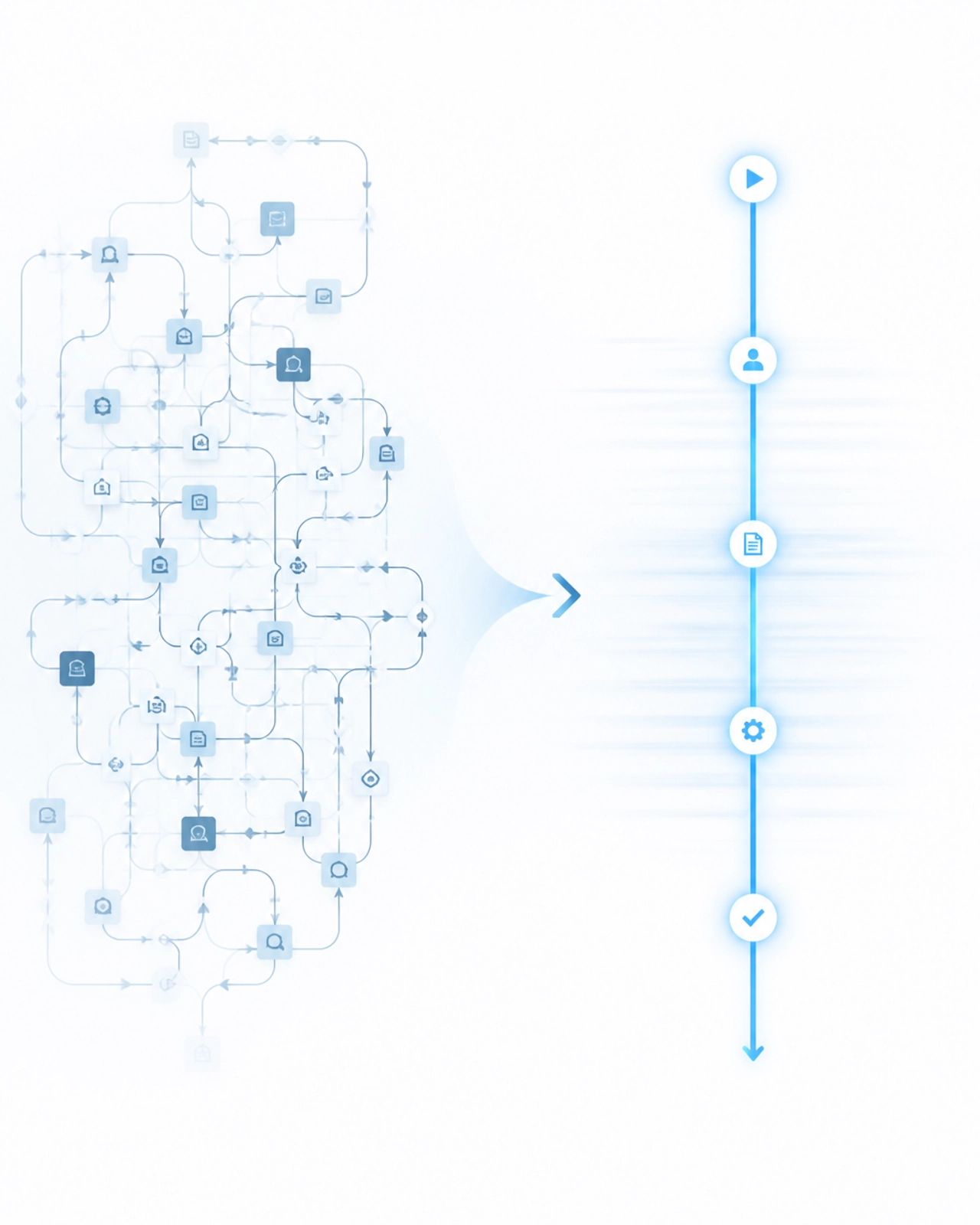
That is why effective business process automation consulting begins with an honest process map. Before selecting software, writing integrations, or introducing AI workflow automation, leaders need to understand how work actually enters the organization, how decisions are made, where information changes hands, and what happens when the normal path breaks.
The process map is not administrative preparation. It is the strategic foundation of the automation program.
A process map reveals the operating model beneath the tools
A process is more than a sequence of software screens. It is the interaction between people, decisions, information, systems, rules, and exceptions.
Consider a high-ticket service business managing a new client or patient. The visible process may appear simple:
- A prospect submits an inquiry.
- The team reviews the information.
- Someone schedules a consultation.
- Staff members prepare for service delivery.
- Billing and follow-up begin.
The actual process may be much more complex. A coordinator may copy information from an email into a CRM, check availability in a separate system, request missing documents by phone, consult a manager about eligibility, and update a spreadsheet because the primary platform does not support a critical business rule.
If those steps are not documented, software decisions are based on an incomplete version of reality.
An honest map captures:
- Where the process begins and what outcome it should produce
- Which roles own each stage
- What information is required to advance
- Which decisions are rules-based and which require judgment
- Where data is entered, transformed, duplicated, or lost
- What exceptions occur and how staff handle them
- Which systems support the workflow
- How performance, risk, and quality are measured
This perspective is central to serious digital transformation consulting. The goal is not simply to digitize existing activity. It is to understand the operating model well enough to improve it.

Why tool-first automation creates expensive compromises
A tool-first approach starts with a platform and asks the business to fit around it. That may be appropriate for a straightforward, standardized workflow. It becomes risky when the process is a source of differentiation or includes substantial operational complexity.
Common symptoms include:
- Employees maintaining shadow spreadsheets beside the official system
- Staff manually reconciling records between platforms
- Managers approving work through email because system permissions are unclear
- AI outputs being reviewed inconsistently
- Exceptions disappearing into inboxes or chat threads
- Teams optimizing one department while creating delays for another
- Reporting that measures activity but not process health
In these environments, automation can preserve inefficiency while making it less visible. A workflow may move more quickly, but the organization still receives incomplete data, applies inconsistent judgment, or struggles to explain why a decision was made.
This is particularly consequential for healthcare, legal, accounting, financial operations, field services, and other high-value environments. The cost of a poorly designed workflow is not limited to wasted time. It may include missed revenue, compliance exposure, client dissatisfaction, rework, and loss of management confidence.
The better sequence is straightforward:
Map the current process, redesign the target process, then select the technology that can support it.
What an honest process map should make visible
A useful process map is not a decorative flowchart. It is a decision-making instrument.
1. The actual path of work
Document how work moves today, including the steps that are not officially documented. Interviews with staff are important because employees often compensate for system limitations through manual workarounds.
The question is not, “How is this process supposed to work?”
It is, “What happens from the moment a request arrives until the business considers it complete?”
2. Ownership and decision rights
Every stage should have a clear owner. If multiple people are involved, the map should distinguish between responsibility, approval, consultation, and notification.
Ambiguous ownership is one of the most common reasons automation stalls. A system can route a task, but it cannot resolve an unresolved decision about who is accountable for the outcome.
3. Data movement
The map should show where information originates, where it is stored, and where it must be reused. This exposes duplicate entry, conflicting records, missing fields, and weak system boundaries.
It also provides the foundation for a durable data model and integration architecture. Without this view, teams often automate individual steps while leaving the underlying data fragmentation untouched.
4. Exceptions and judgment
The normal path is only part of the process. A mature map documents what happens when information is incomplete, a customer does not meet standard criteria, a schedule changes, or a system cannot make a confident recommendation.
These exceptions determine where AI can assist, where rules should govern, and where a person must remain responsible.

AI compounds the quality of the process beneath it
AI workflow automation is most valuable when it operates inside a well-defined process. It can classify information, identify missing details, summarize records, recommend assignments, draft communications, and surface unusual patterns.
However, AI does not eliminate the need for process design. It increases the importance of it.
If the underlying workflow is inconsistent, AI may produce inconsistent recommendations. If the data model is unclear, the system may act on incomplete context. If approval boundaries are undefined, employees may either over-trust the system or ignore it entirely.
A process map gives AI a structured environment in which to operate. It clarifies:
- Which inputs the system can trust
- Which decisions can be automated
- What confidence threshold requires human review
- Which actions the system may take
- How recommendations should be recorded
- What happens when the system cannot determine the next step
This is the difference between adding an AI feature and designing a governed AI operating capability.
In enterprise automation consulting, the objective is not to maximize the number of automated actions. It is to create a reliable division of work between people, rules, integrations, and intelligent systems.
When the process map points toward custom software
A process map does not automatically lead to a custom application. Sometimes it confirms that an existing platform is sufficient. In other cases, it shows that the business needs an orchestration layer connecting several systems.
Custom web application development becomes a stronger option when the organization needs to:
- Coordinate complex intake, qualification, and assignment logic
- Connect CRM, scheduling, billing, communication, and reporting systems
- Support multiple locations, teams, or user roles
- Apply specialized approval and escalation rules
- Provide a secure portal for clients, partners, or staff
- Maintain a detailed audit trail
- Create dashboards based on operational rather than vanity metrics
- Build a workflow that reflects a competitive service model
Pure Technology Consulting’s proprietary platforms illustrate these patterns without serving as one-size-fits-all products.
ChainHQ demonstrates how location, capacity, availability, and business rules can be coordinated through a custom assignment workflow. AI Local Boost reflects the need for multi-location automation, governance, approvals, and reporting. EHRIO Pro demonstrates how structured intake and matching logic can support complex healthcare workflows.
The common lesson is not that every company needs the same platform. It is that valuable software begins with a precise understanding of the process it must support.
What should come from a process-first automation engagement?
A strong consulting engagement should produce more than a recommendation to “implement AI.” It should create a practical roadmap that stakeholders can use to make investment decisions.
Typical deliverables include:
- Current-state process maps
- Future-state workflow designs
- Systems and integration inventory
- Data and ownership requirements
- Automation opportunity backlog
- Human-versus-automation decision boundaries
- Exception and escalation rules
- Security and governance requirements
- KPI definitions and measurement baselines
- Technical architecture recommendations
- Pilot scope and implementation roadmap
The roadmap should also explain what not to automate yet. A process may be strategically important but not ready because data is incomplete, ownership is unclear, or the workflow changes too frequently.
That discipline protects the organization from expensive experimentation and keeps the focus on measurable business outcomes.
Relevant measures may include cycle time, manual touches per transaction, error and rework rates, exception volume, response time, throughput, and staff capacity returned to higher-value work. The right metric depends on the process, but the principle remains consistent: define the baseline before changing the system.

The process map is where transformation becomes practical
The future of business automation will not be determined by the number of tools an organization adopts. It will be determined by whether those tools reinforce a coherent way of working.
A process map creates that coherence. It gives leadership a shared view of the business, gives technical teams a clear implementation target, and gives employees a voice in how the future workflow should operate.
For growth-focused service businesses, this is where transformation becomes tangible. A counseling center can clarify how intake, matching, scheduling, and follow-up should connect. A law or accounting firm can define how inquiries become qualified matters. A field operation can establish how assignments, GPS activity, accountability, and reporting should work together. A debt agency can map the relationship between telephony, attribution, records, and collections activity.
The technology comes after the clarity.
Pure Technology Consulting helps organizations turn that clarity into custom web applications, integrated systems, and governed AI workflow automation. Explore the company’s custom web development capabilities, or schedule a discovery call to discuss a process that is limiting growth.
For direct inquiries, call +1 (803) 921-0969.
Amin Said, Founder of Pure Technology Consulting LLC
https://puretechconsult.com
Leave a Reply