Author: admin

  • Are Manual Processes Dead? Why Business Process Automation Consulting is the New Standard

    Are Manual Processes Dead? Why Business Process Automation Consulting is the New Standard

    For decades, "manual" was a synonym for "thorough." In law firms, accounting practices, and healthcare organizations, the human touch was the gold standard for accuracy and trust. But as we move deeper into 2026, the landscape has shifted. Today, manual processes are increasingly seen as a liability: a bottleneck that introduces risk, drains morale, and hemorrhages capital.

    At Pure Technology Consulting, we’ve watched this transition unfold across multiple industries. We are no longer asking if a business should automate; we are asking how fast they can transition to an automated operating model before their competitors leave them in the dust. The "New Standard" isn't just about buying a piece of software; it’s about strategic automation consulting that re-architects how work actually happens.

    The Invisible Tax of Manual Work

    The data is becoming impossible to ignore. Research shows that manual data entry errors cost an average of $4.70 per instance. When you multiply that by thousands of entries across a fiscal year, the "invisible tax" on your operations becomes a significant line item. In the United States alone, poor data quality: largely driven by manual handling: contributes to a staggering $75 billion loss annually.

    But the cost isn't just financial. It’s a talent drain. Over 40% of workers spend at least a quarter of their week on repetitive, low-value tasks. In high-stakes fields like legal and accounting, having a senior associate or a CPA spend hours on manual reconciliation or data migration isn't just inefficient; it’s a recipe for burnout. These professionals want to solve complex problems, not copy-paste data between spreadsheets.

    Professional transitioning from chaotic manual paperwork to organized automated digital workflows.

    Why Software Alone Isn’t the Solution

    Many executives make the mistake of thinking automation is a product you buy off the shelf. They subscribe to a dozen SaaS tools, only to find their team is now doing "manual work 2.0": manually moving data between those very tools.

    This is where Business Process Automation Consulting differentiates itself. It’s not about the tool; it’s about the architecture. When we engage with a client for a custom web app or a complex automation roadmap, we look at the entire lifecycle of a data point.

    • Where does it originate?
    • Who needs to validate it?
    • What compliance frameworks (like HIPAA or SOC2) govern it?
    • Where does it need to end up to trigger the next stage of the workflow?

    We don't just "add AI." We build bespoke systems that act as the central nervous system for a business.

    Authority Anchors: Proven Capabilities in High-Stakes Sectors

    At Pure Technology Consulting, we don’t start from scratch. We bring proven frameworks from highly regulated industries and apply them to the legal and accounting sectors. Our proprietary solutions serve as proof-of-concept for what’s possible with custom development.

    For instance, our work in healthcare with EHRIO Pro involved building complex matching engines and 70-question intake forms that manage HIPAA-adjacent workflows with surgical precision. We’ve taken that same logic of "complex data validation" and applied it to legal intake and accounting audits. If we can handle the life-and-death accuracy required in healthcare tech, we can certainly handle the rigorous documentation required in a law firm.

    Similarly, our experience with FTP Inform showcases our ability to handle secure, automated data transmission and monitoring at scale. In an era where data breaches are a constant threat, having an automated, monitored pipeline for sensitive files is no longer a luxury: it’s a foundational requirement for any modern enterprise.

    Secure interconnected data network illustrating bespoke software architecture and automated business processes.

    The Roadmap to Automation: A Consultative Approach

    When we sit down with a CEO or a Managing Partner, we aren't looking to sell a subscription. We are looking to build a multi-year asset. Our engagements, often starting at $10k+ for scoped consulting and bespoke builds, follow a rigorous strategic roadmap:

    1. Workflow Audit: We identify the "friction points" where manual work is causing delays or errors.
    2. Gap Analysis: We look at your current tech stack and identify where data is "falling through the cracks."
    3. Bespoke Architecture: Instead of forcing your business to fit into a SaaS box, we build a custom web application or integration layer that fits your specific operations.
    4. AI Integration: We leverage AI not as a chatbot, but as a processing engine: using it for document summarization, predictive analytics, and automated categorization.
    5. Governance & Scaling: We ensure the system is compliant, secure, and ready to grow with your firm.

    Case Study: From Debt Telephony to Legal Ops

    Our background in Fintech and debt agency telephony integrations has taught us the value of "call attribution" and automated logging. We’ve taken those lessons in rep accountability and GPS logging: originally developed for field operations like D2D Tracking: and moved them into professional service environments.

    Imagine a legal practice where every client interaction, every document update, and every filing deadline is tracked and logged automatically without a single minute of manual entry from the attorney. That’s the level of operational leverage we provide. It’s about moving from a reactive "catch-up" mode to a proactive, visionary stance.

    The AI Local Boost: Automating Growth

    Automation isn't just for back-office operations; it’s for market positioning too. Our AI Local Boost product demonstrates how we use Google Business Profile automation to ensure our clients maintain a dominant local presence without manual intervention. By automating the "growth" side of the business, leaders can focus on the "delivery" side, knowing their pipeline is being managed by intelligent systems.

    Digital pathway to the horizon symbolizing scalable business growth and strategic AI-powered automation.

    Is Manual Work Truly Dead?

    While a human will always be needed for final decision-making and high-level strategy, the era of the "manual workflow" is effectively over for any business that wants to remain competitive. AI-powered automation achieves 99% accuracy compared to the 85-95% average for human work. It doesn't sleep, it doesn't get bored, and it doesn't make "copy-paste" errors after a long day.

    The companies that thrive in the next five years will be those that view automation as a core pillar of their strategy, not an IT afterthought. They will be the ones who invest in custom solutions that provide a unique competitive advantage, rather than relying on the same generic tools as everyone else.

    Your Path Forward

    Transitioning away from manual processes can feel daunting. There are legacy systems to consider, team cultures to navigate, and data security risks to mitigate. That’s why we don't just deliver code; we deliver a strategy.

    If you are ready to eliminate the operational drag of manual processes and build a scalable, automated future, let’s start a conversation. My assistant, Emily, can help coordinate a discovery call where we can audit your current workflows and identify the highest-impact opportunities for bespoke automation.

    We aren't just building apps; we’re building the future of how your business operates.

    Ready to see what custom automation can do for your firm?
    Book a discovery call with our team or call us directly at +1 (803) 921-0969.

    Amin Said, Founder of Pure Technology Consulting LLC
    https://puretechconsult.com
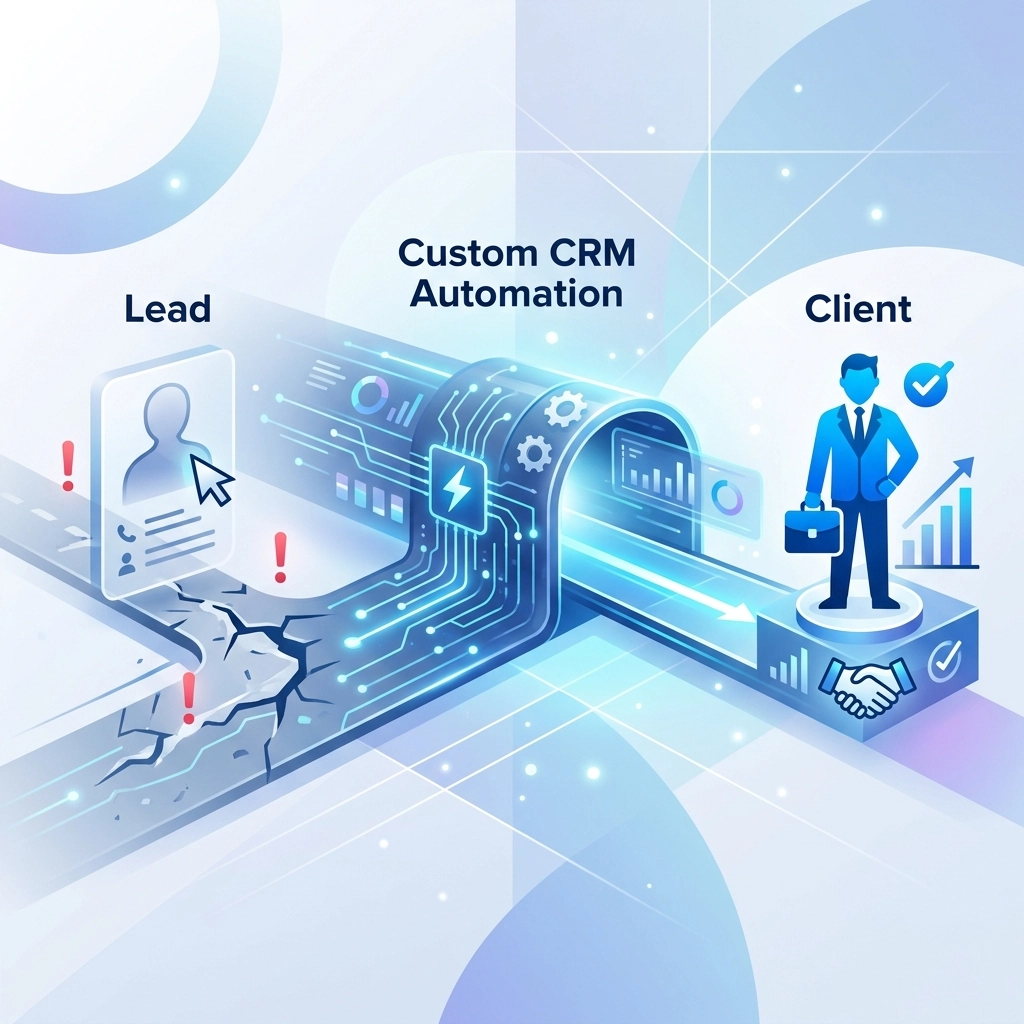
  • The Frictionless Lead: Why Custom CRM Automation is the Difference Between a Lead and a Client in 2026

    The Frictionless Lead: Why Custom CRM Automation is the Difference Between a Lead and a Client in 2026

    It’s April 2026, and the digital landscape has shifted again. If your business is still operating on the "we’ll get back to you in 24 hours" model, you’re not just behind: you’re likely invisible to your best prospects.

    In my years leading Pure Technology Consulting, I’ve seen the same pattern repeat across industries: a mid-sized company spends thousands on high-tier marketing, drives quality traffic to a landing page, and then lets those leads die a slow death in a disconnected spreadsheet or a rigid, off-the-shelf CRM that no one actually enjoys using.

    The gap between a "lead" and a "client" has never been thinner, yet the friction standing in the way has never been more costly. In 2026, the winner isn't necessarily the company with the biggest ad budget; it’s the one with the most frictionless intake ecosystem. This is where custom CRM automation moves from a "nice-to-have" luxury to a fundamental operating requirement.

    The High Cost of Disconnected Systems

    Most mid-sized businesses today are suffering from what I call "The Fragmented Stack." You have a CRM for data storage, a separate tool for scheduling, another for billing, and perhaps a third-party app for initial lead capture.

    When these systems don't talk to each other, friction is the immediate byproduct. A prospect fills out a form, waits four hours for a manual email, replies with their availability, waits another six hours for a calendar link, and by the time the first appointment is actually booked, the "buying heat" has cooled.

    This operational drag does more than just annoy prospects; it kills your conversion rates. When data is siloed, your sales team spends 40% of their day on administrative data entry rather than relationship-building. They are chasing missing info instead of closing deals. This is exactly why business process automation consulting has become our most requested service: because businesses are realizing that their "software" is actually a bottleneck.

    Blue blocks aligning to represent business process automation consulting solving disconnected data silos.

    Architecting the Bridge: From Lead Capture to First Appointment

    The most critical moment in the customer journey is the seconds immediately following a lead capture. In 2026, the standard is no longer a "Thank You" page; it is an immediate, automated transition into the next stage of the funnel.

    Custom CRM automation allows us to build a bridge that feels human but operates with machine precision. Imagine this workflow:

    1. Instant Enrichment: A lead submits a form. Before your team even sees the notification, the system has already performed a data sweep, appending company size, industry, and firmographic details.
    2. Smart Routing: The lead isn't just dumped into a general inbox. It’s scored and routed to the specific consultant or account executive best suited for that industry.
    3. The Frictionless Calendar: Instead of the back-and-forth email dance, the lead is immediately presented with an integrated scheduling interface tailored to their specific needs.

    By the time a human on your team picks up the phone, the lead is already qualified, enriched, and booked. This isn't just about speed; it’s about governance. It ensures that no lead falls through the cracks, regardless of how busy the office gets.

    Why Off-The-Shelf Hits a Ceiling

    I often talk to CEOs who are frustrated that their $200/month SaaS subscription isn't solving their problems. The reality is that "standard" CRMs are built for the average user. But your business isn't average. Your workflows in legal, accounting, or specialized field services have nuances that a template cannot capture.

    Generic platforms often lead to "workarounds": the manual steps your team takes to force the software to do what they actually need. These workarounds are where the friction lives.

    Our approach at Pure Technology Consulting is to build bespoke solutions or heavily customized integrations that fit your operations like a glove. Whether it’s integrating complex telephony for call attribution in fintech or building 70-question intake engines for HIPAA-adjacent healthcare workflows (similar to our work with Thrive and EHRIO), the goal is the same: eliminate the manual touchpoints that don't add value.

    A digital conduit illustrating data integration services and CRM automation for a frictionless lead journey.

    The Revenue Impact: Beyond the Spreadsheet

    The data in 2026 is clear: companies that prioritize custom automation see a massive delta in their bottom line. We aren't just talking about saving a few hours of manual labor: we’re talking about a fundamental shift in pipeline velocity.

    Research indicates that AI-driven automation in the intake process can lead to a 45% increase in qualified leads and a 20% reduction in time-to-first-contact. When you double your conversion rate through structured crm automation, you effectively double your marketing ROI without spending an extra cent on ads.

    For a mid-sized firm, that 10% to 20% jump in conversion isn't just incremental growth; it’s the difference between scaling and stagnating. Our data integration services focus on ensuring that every piece of data collected during the intake process flows seamlessly into your billing and project management systems, creating a "single source of truth" that executives can actually use to make decisions.

    Proven Capabilities: Bringing Sophistication to High-Stakes Industries

    We’ve spent years refining these capabilities in high-pressure environments before pivoting our focus to the legal and accounting sectors. We know what it takes to manage accountability and data integrity at scale.

    • In Healthcare: We’ve built matching engines and complex intake workflows that handle sensitive data while maintaining high conversion.
    • In Field Ops: Our work on GPS logging and rep accountability for D2D Tracking proves that we can automate the most "human" elements of a sales process.
    • In Fintech: We’ve integrated telephony and call attribution for debt agencies where every second of a lead's attention is worth thousands of dollars.

    When we bring this level of engineering to a mid-sized law firm or an accounting practice, the results are transformative. We aren't just installing a CRM; we are architecting a revenue engine.

    The 2026 Strategy: Audit, Integrate, Scale

    If you feel like your current systems are holding you back, the answer isn't to buy more software. The answer is to evaluate your strategy.

    We recommend a three-step roadmap for any business looking to remove friction:

    1. The Workflow Audit: Identify exactly where leads are stalling. Is it between the form and the call? Is it during the qualification phase?
    2. Custom Integration: Use data integration services to connect your siloed apps. If your scheduler doesn't update your CRM in real-time, you have a leak.
    3. Automated Governance: Set up triggers that recalculate lead scores and re-engage dormant prospects without human intervention.

    Your Move: Transitioning from Lead to Client

    The difference between a lead and a client in 2026 is the absence of friction. Every hurdle you place in front of a prospect: a slow response, a manual form, a confusing scheduling process: is an invitation for them to call your competitor.

    At Pure Technology Consulting, we specialize in building the custom web applications and automation frameworks that make your business the easiest choice for your clients. We don't just provide tools; we provide the strategic roadmap to operational excellence.

    If you’re ready to see what a frictionless intake process looks like for your firm, let’s talk. My assistant, Emily, can help you find a time on my calendar for a high-level discovery call. We can dive into your current stack, identify the bottlenecks, and map out a custom solution that positions you as the leader in your market.

    You can schedule a consultation here or view some of our video walkthroughs to see our work in action.

    The future of your business is automated. Let’s make sure it’s built to win.

    Amin Said, Founder of Pure Technology Consulting LLC
    https://puretechconsult.com

    +1 (803) 921-0969

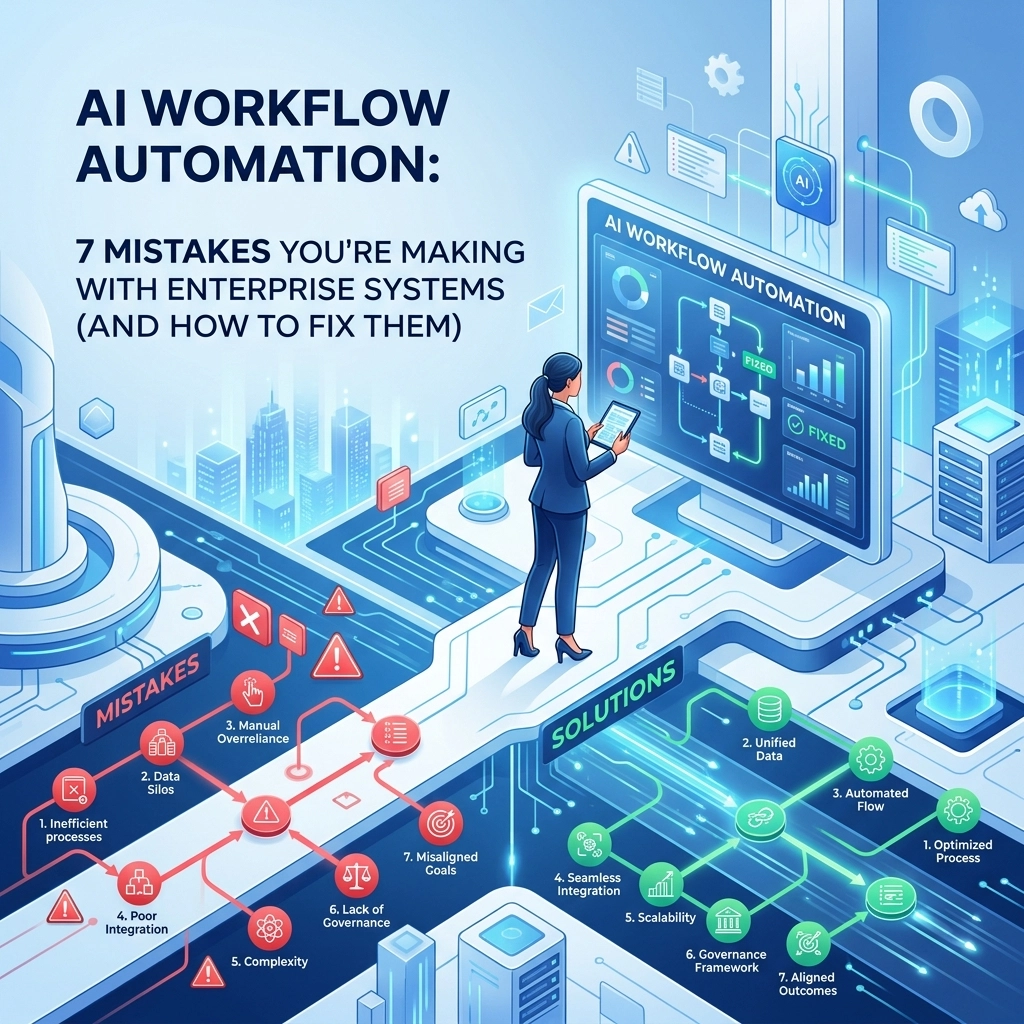
  • AI Workflow Automation: 7 Mistakes You’re Making with Enterprise Systems (And How to Fix Them)

    AI Workflow Automation: 7 Mistakes You’re Making with Enterprise Systems (And How to Fix Them)

    The promise of AI in 2026 isn't just about "doing things faster": it’s about doing things that were previously impossible. We’ve moved past the novelty of simple chatbots and into the era of the autonomous enterprise. However, as I sit down with executives across the legal, accounting, and healthcare sectors, I see a recurring pattern: organizations are throwing sophisticated AI at archaic workflows and wondering why the ROI isn’t hitting the bottom line.

    Automation is a force multiplier. If you multiply a zero, you still get zero. If you multiply a mess, you get a monumental, automated disaster.

    At Pure Technology Consulting, we don’t just build "apps"; we architect operating models. Whether we are deploying high-level matching engines like we did with EHRIO Pro or securing sensitive data transfers, the strategy precedes the software. If you want to move from "tinkering with AI" to "dominating with AI," you need to stop making these seven critical mistakes.


    1. The "Faster Chaos" Trap: Automating Broken Processes

    The most frequent error I see is the rush to automate a workflow that is fundamentally flawed. If your current manual intake process for a law firm is redundant and prone to human error, applying an AI agent to it will only generate errors at the speed of light.

    Research shows that automating inefficient workflows without fixing the underlying logic is the fastest way to frustrate your team and your clients. Enterprises often skip the "process discovery" phase because it feels slow.

    The Fix: Before a single line of code is written, map your workflow. We take this approach with every bespoke project, such as our work in the healthcare space with EHRIO Pro. By mapping the 70-question intake and matching engines first, we ensure the AI is optimizing a streamlined path, not paving a cow path. Look for redundant steps and eliminate them before you automate them.

    2. The $3.1 Trillion Data Trust Deficit

    Bad data costs U.S. businesses trillions annually. In the enterprise world, AI is only as visionary as the data feeding it. If your CRM is a graveyard of duplicate entries and your ERP is siloed, your AI-powered insights will be hallucinations at best and liabilities at worst.

    Many organizations expect AI to "clean" the data automatically. While AI can help, it requires a robust governance framework to be effective.

    The Fix: Implement data validation rules at the point of entry. Think of how we handle fintech integrations for debt agencies: every call attribution and data point is validated against a central source of truth. When we build custom web applications, we prioritize data integrity through master data management (MDM) practices. If you don't trust your data, you can't trust your automation.

    Conceptual art showing data integrity and MDM practices organizing messy enterprise information.

    3. Rebuilding the Wheel in Every Department

    I often see large firms where the accounting department is building one AI tool for document processing, while the legal team is building a nearly identical one for contract review: using two different platforms. This fragmentation leads to "Shadow AI," where data is trapped in department-level silos.

    When workflows aren't standardized across the enterprise, you lose the ability to scale horizontally. You end up paying for the same development work twice, and your systems can’t talk to each other.

    The Fix: Create a shared infrastructure. This is why we developed ChainHQ. It serves as a proof-of-concept for how an enterprise can unify disparate data flows into a single, coherent stream. By using a centralized "brain" for your automations, you ensure that a win in one department can be scaled across the entire organization without starting from scratch.

    4. Neglecting the "Security-First" Architecture

    In high-stakes industries like legal and finance, a "good enough" security posture is a ticking time bomb. Many off-the-shelf AI tools and quick-fix automations don't meet the rigorous compliance standards (like HIPAA-adjacent workflows) required for enterprise-grade operations.

    Ignoring security during the development phase leads to massive technical debt and regulatory risk. If your automated workflow handles sensitive client files without end-to-end encryption or role-based access control, you aren't innovating: you're gambling.

    The Fix: Security must be baked into the architecture, not bolted on. When we consult on custom builds, we lean on the principles behind FTP Inform. It’s our benchmark for how enterprise data should be moved: securely, transparently, and with full audit trails. Every automated trigger should have a corresponding security check.

    5. Designing for the "Now" and Ignoring the "Next"

    Scalability is the silent killer of enterprise AI. A script that works for 100 entries might fail spectacularly when asked to handle 100,000. Many businesses build "brittle" automations that are hard-coded to specific software versions or data volumes.

    As your business grows, your AI must scale horizontally across systems. If your automation can't handle the addition of new cloud applications or emerging tools, it will become a legacy anchor within 18 months.

    The Fix: Build with an API-first mindset. For example, our D2D Tracking system for field operations was built to handle GPS logging and rep accountability at scale. It’s a testament to building systems that can handle high-velocity data without breaking. When you build custom software, ensure it’s modular so you can swap out parts as the technology evolves.

    Modular bridge illustrating scalable AI architecture and flexible enterprise software development.

    6. The "Out-of-the-Loop" Syndrome (Automation Bias)

    There is a dangerous tendency to trust AI blindly once it’s deployed. This is known as automation bias. Over time, "operator drift" occurs: the human team stops monitoring the outputs, assuming the machine is always right. But systems change, data environments evolve, and AI models can drift.

    Without human-in-the-loop (HITL) checkpoints, hidden flaws can stay buried for months, causing compounding damage to your reputation or bottom line.

    The Fix: Establish regular audit intervals. Automation should augment your experts, not replace their judgment. In our legal and accounting pivots, we emphasize that AI handles the heavy lifting of data retrieval and synthesis, but the final strategic decision remains with the professional. High-level automation is a partnership between human intuition and machine precision.

    7. Fragmented Architectures and Legacy Friction

    The final mistake is trying to run a 2026 AI strategy on a 2015 architecture. Legacy ERPs, spreadsheets, and fragmented cloud silos create "data gravity" that slows down AI agents. Real-time automation requires real-time data access. If your AI has to wait for a nightly batch process to sync, it’s already obsolete.

    The Fix: Modernize the middleware. You don't always have to rip and replace your legacy systems, but you do need a modern data platform to bridge the gap. We see this often in local SEO and visibility automation. With AI Local Boost, we demonstrate how complex, fragmented data from Google Business Profiles can be unified and automated for maximum impact. The goal is to create a seamless flow from your legacy core to your modern AI frontend.


    Moving Toward Bespoke Excellence

    The common thread in all these mistakes is the attempt to use "cookie-cutter" solutions for complex, high-ticket problems. In the enterprise world, the most successful AI implementations are those that are custom-tailored to the specific friction points of the business.

    At Pure Technology Consulting, we specialize in building these bespoke engines. We don’t just look at the code; we look at the culture, the compliance requirements, and the long-term vision of your company. Whether it's a matching engine for a healthcare provider or a secure telephony integration for a debt agency, our approach is always the same: Strategy first. Scalability always.

    If you’re ready to move beyond basic automation and build a custom web application that truly fits your operations, let's talk. My assistant, Emily, can help you schedule a discovery call to audit your current workflows and identify where custom development can provide your biggest competitive advantage.

    Stop automating your mistakes. Start architecting your future.

    Amin Said, Founder of Pure Technology Consulting LLC
    https://puretechconsult.com

    Phone: +1 (803) 921-0969
    Request a workflow audit or schedule a call here

  • The White-Label Revolution: How ChainHQ Powers SaaS Expansion for Consulting Agencies in 2026

    The White-Label Revolution: How ChainHQ Powers SaaS Expansion for Consulting Agencies in 2026

    The landscape of professional services has shifted. In 2026, the traditional consulting model: trading hours for dollars: is no longer the ceiling; it is the floor. Modern agencies are no longer just advisors; they are technology partners. We are seeing a massive transition where high-level digital transformation consulting is becoming inextricably linked with software delivery.

    The challenge for most agencies, however, has always been the technical barrier. Building a proprietary software platform from scratch requires a massive capital injection, a dedicated engineering team, and months (if not years) of development cycles. This is where the white-label revolution, led by platforms like ChainHQ, is redefining what it means to be a "consultant."

    At Pure Technology Consulting, we have seen this evolution firsthand. We are moving toward a future where consulting agencies can deploy sophisticated, custom-branded software solutions as a standard part of their engagement. This isn't just about adding a new revenue stream; it’s about becoming the essential operating system for your clients' businesses.

    The Shift from Advisor to Infrastructure Provider

    For years, consulting was about the "handover." You provided the strategy, the roadmap, and perhaps a few spreadsheets, and then you wished the client luck with implementation. In 2026, that gap is where value is lost.

    Agencies are now realizing that the most sustainable way to scale is through recurring revenue models built on software. By offering a SaaS product development path that is already 90% built, agencies can focus on the final 10%: the custom strategy and branding that makes the solution unique to their niche.

    Whether you are a franchise consultant looking to provide a unified dashboard for a hundred locations or a specialized industry vendor needing a backend that automates complex workflows, the requirement is the same: you need a technical backbone that is reliable, scalable, and entirely under your brand.

    Holographic software interface over a blueprint illustrating digital transformation and SaaS product development.

    Why ChainHQ is the Technical Backbone for 2026

    ChainHQ was designed to bridge the gap between "bespoke custom software" and "off-the-shelf SaaS." It acts as the automated backend engine that allows consulting agencies to deploy software environments at scale without hiring a single internal developer.

    1. Rapid Software Deployment

    In the current market, speed is a competitive advantage. If a consulting firm identifies a bottleneck in a client’s operation, the ability to deploy an automated solution in days: rather than months: changes the dynamic of the relationship. ChainHQ provides the underlying architecture, from database management to API integrations, allowing the agency to focus on the user interface and the specific business logic that solves the client's problem.

    2. Automating the Backend for Vendors and Franchises

    One of the most powerful applications we have seen for ChainHQ is within the franchise and large vendor space. These organizations often struggle with fragmented data and manual reporting. By using ChainHQ to automate the backend, these groups can centralize their data, automate their billing cycles, and provide real-time reporting to all stakeholders. This is ai automation services at its most practical level: taking high-friction manual tasks and turning them into a background process.

    3. Custom Branding and the White-Label Edge

    Your brand is your most valuable asset. When you provide software to a client, they shouldn't see a third-party logo. They should see your brand. ChainHQ’s white-labeling capabilities ensure that every touchpoint: from the login screen to the automated email reports: is consistent with your agency’s identity. This builds trust and positions your firm as a technology leader, not just a middleman for other people's software.

    Enabling Recurring Revenue Without Dev Costs

    The primary deterrent for agencies entering the software space has always been the "Dev Trap." Building software is expensive, but maintaining it is often where agencies go to die. Bug fixes, server maintenance, security patches, and feature updates can quickly eat through any profit margin.

    By leveraging a white-label engine like ChainHQ, consulting firms offload the heavy lifting of infrastructure maintenance. You gain the benefits of a proprietary software product: high margins, recurring monthly revenue (MRR), and increased company valuation: without the overhead of a 20-person engineering department.

    This model allows for a more focused approach to digital transformation consulting. Instead of worrying about server uptime, you can worry about how the software is improving your client’s bottom line. It changes the conversation from "What can we build?" to "What can we solve?"

    Digital backbone of glowing data connections representing automated backend systems for SaaS expansion.

    Proven Capabilities: The Pure Technology Standard

    At Pure Technology Consulting, we don’t just talk about these frameworks; we build them. Our work across various sectors serves as a roadmap for what is possible when you combine deep industry expertise with high-level automation.

    For instance, in the healthcare sector, our work with matching engines and HIPAA-adjacent workflows demonstrates our ability to handle complex data environments. In the field operations space, our GPS logging and rep accountability tools show how software can enforce operational discipline. These aren't just "apps"; they are the delivery layers for professional expertise.

    When we talk about ChainHQ powering your agency, we are talking about bringing that same level of technical rigor to your brand. Whether it’s a debt agency needing telephony integration or a local service business requiring automated SEO management, the underlying philosophy is the same: leverage proven technology to deliver a bespoke experience.

    Building Your Roadmap to SaaS Expansion

    Transitioning from a pure service model to a software-enabled model requires a strategic approach. It is not something you "bolt on" overnight. It requires a clear understanding of your clients' most persistent pain points.

    What to Automate First?
    Look for the processes your team or your clients repeat manually every single week. Is it reporting? Is it lead routing? Is it compliance tracking? These are the prime candidates for your first white-labeled SaaS offering.

    Integration and Governance
    A common mistake is building in a silo. Your software must play well with the existing tools your clients use. This is where our expertise in ai automation services comes into play: ensuring that your new platform integrates seamlessly with existing CRMs, ERPs, and communication tools.

    Scoping the Opportunity
    Most of our bespoke automation engagements for high-ticket clients begin with a thorough audit of the current workflow. We identify the "operational drag" and design a roadmap that moves the client from their current state to an automated, software-driven future.

    Modern digital roadmap illustrating the path toward automated software solutions for consulting agencies.

    The Future is Collaborative

    The "White-Label Revolution" isn't about replacing consultants with robots. It’s about empowering consultants to be more effective. By providing the tools that clients use every day to run their businesses, you move from being an "expense" on their P&L to an "asset."

    In 2026, the most successful consulting agencies will be those that own their own technology stack. They will be the ones who can offer a unified brand experience, a robust technical backbone, and a clear path to digital maturity.

    If you are looking to expand your agency’s capabilities and move into the world of SaaS without the traditional risks of software development, it’s time to look at the infrastructure you’re building on. ChainHQ is that foundation.

    We invite you to explore how these capabilities can be tailored to your specific industry. At Pure Technology Consulting, we specialize in building the complex, scalable web applications that high-ticket clients demand.

    To discuss your roadmap and how we can help you deploy a white-labeled solution that scales, let’s start a conversation.

    Ready to explore the technical backbone of your agency’s future?
    Book a discovery call or Request a workflow audit.

    Amin Said, Founder of Pure Technology Consulting LLC
    https://puretechconsult.com
    +1 (803) 921-0969

  • Stop Wasting Time on Manual Workflows: Try These 7 AI Workflow Automation Hacks

    Stop Wasting Time on Manual Workflows: Try These 7 AI Workflow Automation Hacks

    In the modern enterprise landscape, the most expensive resource is not hardware, office space, or even specialized software: it is human attention. Despite the digital revolution, many executive teams find their highest-paid talent bogged down by "operational drag": the repetitive, manual tasks that bridge the gaps between disconnected systems.

    At Pure Technology Consulting, we view automation not as a cost-cutting measure, but as a strategic reallocation of human capital. When you remove the friction of manual data entry, scheduling, and repetitive content creation, you empower your team to focus on high-value initiatives that drive growth.

    The following seven AI workflow automation hacks represent the entry point into a broader digital transformation. These are the strategies we use to move our clients from reactive operations to a predictive, high-leverage operating model.

    1. Transform Institutional Knowledge into Modular Content

    Most organizations "leak" value every time they record a video or host a webinar. The insights remain trapped in a 60-minute file that no one has the time to revisit. AI video tools like Descript or OpusClip allow you to treat video as a database.

    By automatically extracting highlights, generating captions, and reformatting clips for LinkedIn or internal training portals, you turn a single hour of effort into a month of authoritative content. This isn't just about social media; it’s about internal training and stakeholder alignment.

    AI-powered automation deconstructing a film strip into modular content pieces for digital marketing.

    2. Implement "Invisible" Meeting Intelligence

    Note-taking is a relic of the manual era. When an executive is focused on writing down what was said, they aren't fully present to lead the conversation.

    Using AI transcription and summarization engines like Fireflies or Otter.ai allows for the automatic generation of action items, sentiment analysis, and highlight reels. This data should then be fed directly into your project management system. Imagine a world where a meeting concludes and the relevant tasks are already assigned in your CRM without a single keystroke.

    3. Leverage Local Visibility Automation (The AI Local Boost Model)

    Many businesses struggle with the manual upkeep of their digital footprint. Responding to reviews, updating business hours, and posting local updates can consume hours of a marketing manager’s week.

    At Pure Technology Consulting, we developed AI Local Boost to demonstrate how custom automation can handle these high-frequency, low-complexity tasks. By automating Google Business Profile updates and review management, we provide a blueprint for how local authority can be maintained at scale. For our clients, this serves as a case study in "set and forget" local SEO, ensuring that the business remains visible while the team focuses on closing leads.

    Digital map markers and signal pulses over a city representing automated local SEO and business visibility.

    4. Scalable Executive Communication

    The bottleneck in many professional service firms: particularly in legal and accounting: is the partners' inbox. Drafting personalized follow-ups, reports, and status updates is essential for client retention but devastating for productivity.

    AI-powered communication frameworks can draft these documents based on a few bullet points of context. By integrating these tools with your internal data, you can generate reports that maintain your professional voice while reducing the drafting time by 80%.

    5. High-Security Data Integration (The FTP Inform Approach)

    One of the greatest manual hurdles is the secure transfer and processing of sensitive data. In sectors like fintech or debt management, moving data between legacy systems and modern web apps often involves manual file uploads and downloads.

    We built FTP Inform to address this specific operational drag. It serves as a prime example of how bespoke software can monitor secure file transfers and trigger automated workflows the moment data arrives. This eliminates the "waiting game" and ensures that your data pipelines are always moving at the speed of your business, not the speed of your manual check-ins.

    High-speed light trails through a digital conduit symbolizing secure automated data integration and pipelines.

    6. Predictive Task Prioritization and Governance

    Most teams manage their day based on the "loudest" notification, not the most strategic task. AI automation tools like Motion or ClickUp AI are moving toward predictive scheduling: prioritizing tasks based on deadlines, stakeholder importance, and even the "energy levels" or historical performance of the team.

    This level of governance ensures that the roadmap remains the priority. When you automate the prioritization process, you remove the "decision fatigue" that often plagues high-performing teams by 2 PM.

    7. Complex Intake and Workflow Orchestration (The EHRIO Pro Standard)

    The most sophisticated hack is moving from simple "if-this-then-that" rules to complex, multi-stage workflow orchestration. This is where off-the-shelf SaaS often fails and where bespoke development shines.

    Take our work with EHRIO Pro in the healthcare sector. We developed 70-question intake engines that handle HIPAA-adjacent workflows, matching patient data against complex criteria in real-time. This level of automation doesn't just save time; it ensures compliance and precision that manual entry could never guarantee. It’s a testament to how Pure Technology Consulting approaches high-ticket automation: we don't just fix a step; we re-architect the entire journey.

    Interconnected data networks on floating glass layers representing complex AI workflow orchestration and architecture.

    From "Hacks" to Bespoke Systems

    While these seven hacks can provide immediate relief, the true visionary path lies in custom web applications and bespoke automation. Off-the-shelf tools are excellent for general productivity, but they rarely fit the unique contours of a $10M+ enterprise.

    At Pure Technology Consulting, we specialize in bridging the gap between generic SaaS and the specific operational needs of sectors like Legal, Accounting, and Healthcare. Whether it’s GPS logging for field accountability or telephony integrations for debt agencies, we bring proven capabilities to the table.

    Our approach starts with a discovery phase where we audit your current workflows, identify the points of highest friction, and build a roadmap for a custom solution that grows with your business. We don't just implement software; we build the digital infrastructure that defines your competitive advantage.

    Start Your Transformation

    If you are ready to stop managing manual workflows and start leading a streamlined, automated organization, the next step is a strategic evaluation.

    Stop wasting time on the "how" of manual labor and start focusing on the "why" of your business growth. Our team is ready to help you navigate the transition from fragmented tools to a unified, AI-powered operating system.

    Ready to audit your workflow?
    Contact our team today to discuss a custom automation roadmap.
    Phone: +1 (803) 921-0969
    Discovery Call: https://puretechconsult.com/schedule

    Amin Said, Founder of Pure Technology Consulting LLC
    https://puretechconsult.com

  • Visibility as a Service: Why FTP Inform is the Decision Engine Professional Firms Need in 2026

    Visibility as a Service: Why FTP Inform is the Decision Engine Professional Firms Need in 2026

    It is Wednesday, April 1, 2026. If you are leading a professional services firm or a debt agency today, you aren’t suffering from a lack of data. In fact, you are likely drowning in it. Your CRM tracks leads, your telephony system logs calls, your accounting software monitors cash flow, and your project management tools track hours.

    The problem isn't the volume of information; it’s the "reporting lag." By the time your team compiles last month's performance into a spreadsheet, the insights are already stale. You are performing an autopsy on your business operations when you should be performing live surgery.

    At Pure Technology Consulting, we’ve seen this "operational drag" cripple even the most ambitious firms. This is why we’ve pivoted the conversation from simple "analytics" to Visibility as a Service (VaaS). Central to this shift is FTP Inform, our proprietary framework and decision engine designed to bridge the gap between raw data and decisive action.

    The Ghost in the Machine: Why Reporting Lag is Killing Your Growth

    Most professional firms: especially those in high-volume sectors like debt collection or legal services: operate in silos. The marketing department sees one version of the truth, while the operations team sees another.

    When data lives in disparate systems, the only way to get a "birds-eye view" is through manual intervention. This usually involves a senior staff member spending hours exporting CSV files, cleaning data in Excel, and building pivot tables.

    This manual approach introduces three critical risks:

    1. Human Error: One broken formula can lead to a disastrous strategic decision.
    2. Resource Drain: You are paying high-level talent to be data entry clerks.
    3. The Lag: Decisions made on data that is 14 days old are inherently reactive.

    In 2026, reactivity is a luxury you can no longer afford. The market moves too fast. To scale, you need a decision engine that operates in real-time.

    Streamlined data integration services organizing chaotic business silos into a clear decision engine.

    Enter FTP Inform: More Than Just a Dashboard

    When we provide business process automation consulting, we often encounter clients who ask for "better reports." We tell them they don't need reports; they need a decision engine.

    FTP Inform is the manifestation of that philosophy. It isn't a static tool you buy off the shelf; it is a bespoke visibility layer we build into your existing infrastructure. It acts as the "nervous system" of your firm, pulling data from every touchpoint: telephony, CRM, financial legacy systems: and translating it into a unified operational language.

    Bridging the Gap Between Data and Action

    Visibility as a Service is about more than just seeing what happened; it’s about knowing what to do next. For example, in a debt agency environment, knowing you had 5,000 calls yesterday is a metric. Knowing that 20% of those calls dropped because of a specific routing bottleneck in your telephony integration is an insight.

    FTP Inform provides that insight instantly. By leveraging data integration services, we ensure that your software doesn't just store information: it communicates it. We move your firm away from "I think we're doing well" to "The data shows exactly where we need to pivot."

    The Strategic Shift: From Spreadsheets to Automated Workflows

    The era of the "Master Spreadsheet" is over. For professional services firms, the spreadsheet has become a bottleneck that prevents true digital transformation.

    Through business automation consulting, we help firms replace these manual checkpoints with automated triggers. Imagine a workflow where:

    • An intake form is completed by a prospect.
    • Data is instantly cross-referenced against your current caseload capacity.
    • A "Matching Engine" (similar to what we built for healthcare clients) assigns the lead to the best-fit representative.
    • Management receives a real-time notification if the lead isn't contacted within 15 minutes.

    This isn't science fiction; it’s the standard for operational excellence in 2026. By removing the manual reporting step, you free your team to focus on high-value billable work rather than administrative overhead.

    Central business automation consulting engine connecting data points for real-time operational excellence.

    Proven Capability: Bringing "Battle-Tested" Tech to Professional Services

    At Pure Technology Consulting, we don’t believe in starting from scratch. Our work with FTP Inform is built on a foundation of complex, high-stakes environments. We’ve taken the rigors of healthcare data management and the high-volume demands of fintech and applied them to the professional services sector.

    • Healthcare Heritage: We developed matching engines and 70-question intake systems for HIPAA-adjacent workflows. This taught us how to handle complex data with zero margin for error.
    • Fintech & Debt Collection: We’ve built deep telephony integrations that handle call attribution and GPS logging for field reps. We understand that in these industries, a millisecond of lag is lost revenue.
    • Operational Accountability: Using lessons from our field operations software, we ensure every action in your firm is logged, tracked, and visible.

    When you engage us for business process automation consulting, you aren't just getting code. You are getting a roadmap based on years of solving the "Visibility Problem" for high-ticket clients.

    Why 2026 is the Year of the Decision Engine

    The competitive landscape has shifted. Clients of professional firms: whether they are legal clients or creditors: expect transparency and speed. They want to know the status of their files in real-time. If you cannot provide that visibility internally, you certainly cannot provide it to your clients.

    FTP Inform allows you to offer "transparency as a product." When your internal operations are visible and automated, you can provide client portals and real-time updates that your competitors, still stuck in their spreadsheets, simply cannot match.

    The Roadmap to Implementation

    Transitioning to a Visibility as a Service model doesn't happen overnight, but it is a structured process:

    1. The Audit: We identify where your data silos live and where the manual "reporting lag" is most damaging.
    2. The Integration: Using our expertise in data integration services, we connect your disparate tools into a single source of truth.
    3. The Engine: We deploy the FTP Inform framework, customized to your specific KPIs and decision-making triggers.
    4. The Optimization: We continuously refine the automation to ensure it evolves with your business goals.

    Strategic business roadmap visualizing growth and optimized decision-making for modern professional firms.

    Conclusion: Lead with Vision, Not Just Data

    The difference between a firm that survives and a firm that leads in 2026 is the speed of their decision-making. If you are still waiting until Friday afternoon to see how your team performed on Monday, you are losing ground.

    Visibility is no longer a "nice to have" feature of your software: it is a service that must be integrated into the very fabric of your business. With FTP Inform and the strategic guidance of Pure Technology Consulting, you can finally close the gap between what you see and what you do.

    Stop looking back at where you’ve been. It’s time to see exactly where you are going.

    To learn more about how we can build your bespoke decision engine, explore our video walkthroughs or schedule a discovery call to discuss your firm's specific needs.

    Amin Said, Founder of Pure Technology Consulting LLC
    https://puretechconsult.com

    Phone: +1 (803) 921-0969

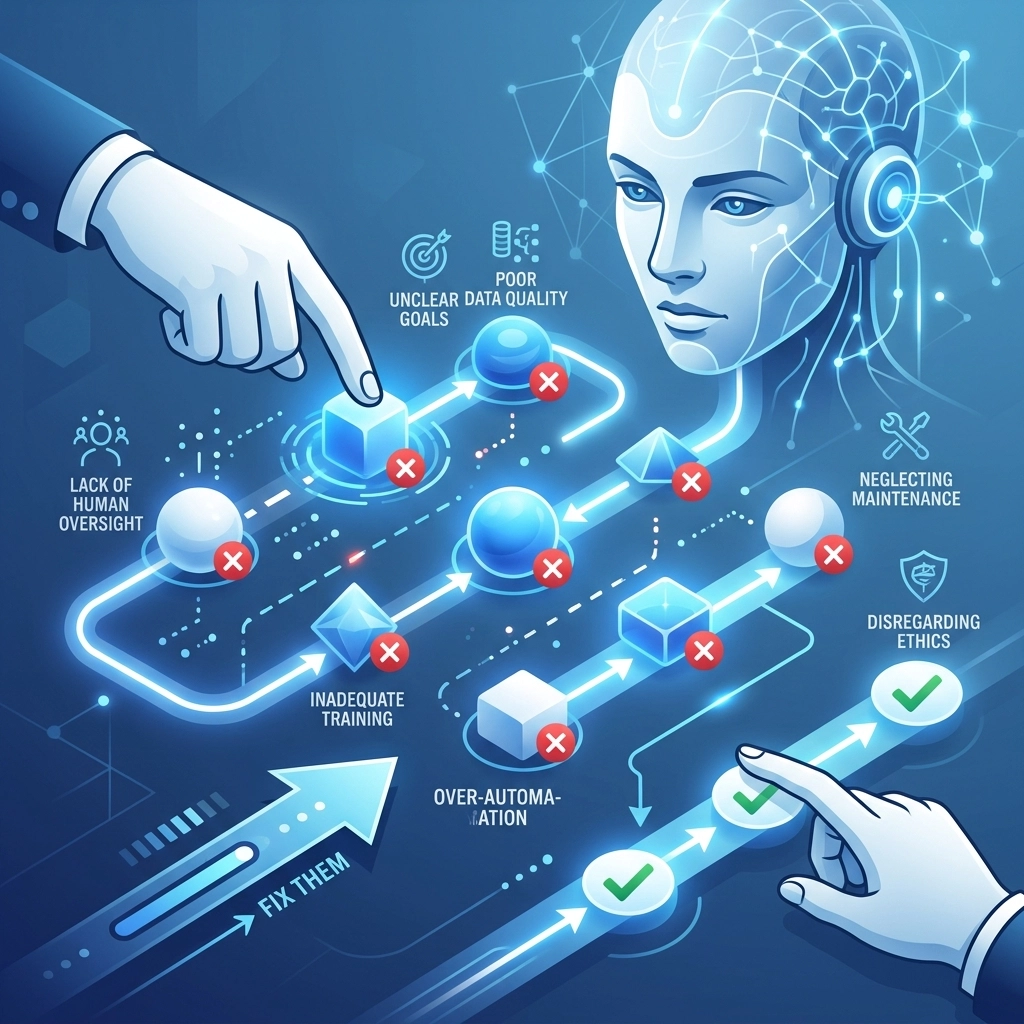
  • 7 Mistakes You’re Making with AI Workflow Automation (and How to Fix Them)

    7 Mistakes You’re Making with AI Workflow Automation (and How to Fix Them)

    In 2026, the novelty of "AI for the sake of AI" has finally evaporated. We are no longer in the era of simple experimentation; we are in the era of operational excellence. For modern enterprises, the question is no longer if they should automate, but how they can do so without creating a digital house of cards.

    At Pure Technology Consulting, we’ve spent years architecting high-stakes systems: from HIPAA-adjacent healthcare engines in EHRIO Pro to complex lead attribution for fintech. What we’ve discovered is that while the tools have become more accessible, the architectural pitfalls have become more dangerous. AI workflow automation promises exponential leverage, but without a visionary roadmap, it often delivers little more than expensive technical debt.

    If your automation efforts feel brittle, unpredictable, or prohibitively expensive, you are likely falling into one of these seven common traps. Here is how to navigate them.


    1. Using Enterprise-Grade Models for Simple Tasks

    The most frequent drain on an automation budget isn’t the development time: it’s the compute. We see organizations deploying "frontier" models like GPT-4 or Claude Opus to perform basic data extraction or simple classification tasks.

    Research indicates that compute costs can represent 70–80% of total AI expenses. Using a high-reasoning model for a task that a lightweight, specialized model could handle is like hiring a senior architect to hammer nails. It’s effective, but it’s an operational disaster.

    The Fix: Strategic Model Routing
    Implement a multi-tier model strategy. Use lightweight models for initial classification and routing. Only when a task triggers a specific "complexity flag" should it be escalated to a more expensive, high-reasoning model. Our proprietary orchestration layer, ChainHQ, was designed specifically for this purpose: ensuring that every token spent is tied to a specific business value, rather than wasted on "over-thinking" simple data points.

    Strategic AI model routing hub visualizing task complexity management in automated workflows.

    2. Poor Context Management and "Token Snowballing"

    When agents interact within a workflow, there is a tendency to pass the entire conversation history or massive background datasets through every single handoff. This is what we call "token snowballing." As the workflow progresses, the context window expands, and the costs explode. More importantly, the model’s focus begins to drift.

    The Fix: Context Compression and Explicit Schemas
    Treat prompts as versioned assets. Instead of passing raw data, implement summarization and compression steps between agents. Define explicit output schemas so that each agent returns only the structured data necessary for the next step. By keeping the context lean, you maintain both model accuracy and fiscal responsibility.

    3. Deploying Without Governance or Validation

    In the rush to achieve "digital transformation," many businesses skip the most critical step: the validation layer. Organizations with mature AI governance see a 68% success rate, while those without often hover around 32%. AI agents can produce technically correct but contextually catastrophic results. If your workflow doesn't have a "sanity check," those errors will compound as they move downstream.

    The Fix: The "Human-in-the-Loop" Hybrid
    Build validation into the DNA of your workflow. For high-ticket industries like legal or accounting, we implement automated data quality checks that flag anomalies before they reach a human reviewer. This is the approach we took with EHRIO Pro, where complex 70-question medical intakes are processed through a matching engine that prioritizes accuracy over raw speed, ensuring that high-stakes data is never left to chance.

    4. Inadequate Error Handling: The "Perfect Path" Fallacy

    Too many developers build automations assuming a "happy path": the idea that APIs will always respond, payloads will always be formatted correctly, and events will always arrive on time. In a production environment, this is a dangerous assumption. When an API times out or a field goes missing, a poorly designed workflow simply breaks, often leaving a trail of corrupted data in its wake.

    The Fix: "Guilty Until Proven Innocent" Inputs
    Every input must be validated and sanitized. Treat your automation as a series of defensive barriers. Implement comprehensive error handling that includes retries, back-off strategies, and fallback routes. At Pure Technology Consulting, we don’t just build for the success state; we architect for the failure state. This ensures that even if a third-party tool goes down, your core business operations remain intact.

    Secure AI automation architecture showing protective layers for resilient business workflow error handling.

    5. Ignoring Multi-Agent Coordination Complexity

    Single-agent automations are straightforward. However, as you scale toward complex web apps, you begin using multi-agent systems where agents pass tasks back and forth. Without a centralized "conductor," these systems can enter decision loops or duplicate work, leading to massive inefficiencies.

    The Fix: Centralized State Management
    Before writing a single line of code, design your multi-agent architecture. Use a centralized state management system to ensure agents share a "source of truth." This prevents agents from working in silos and ensures that the workflow moves toward a resolution rather than circling a problem. We’ve used this strategy to build custom GPS logging and rep accountability tools for field operations, where multiple data streams must be synchronized in real-time.

    6. Building "Monster Workflows"

    Enthusiasm is the enemy of reliability. It is tempting to build one massive, all-encompassing workflow that handles everything from lead capture to final billing. We call these "Monster Workflows." They are impressive to look at on a whiteboard but are a nightmare to maintain. When one small branch breaks, the entire system grinds to a halt.

    The Fix: Modular Micro-Automations
    Break your processes down into small, "boring," and reliable modules. Each module should do one thing exceptionally well. These modules can then be linked together. This modularity allows you to update specific parts of your tech stack: like your reporting engine or your SEO automation: without risking your entire operation.

    For instance, our AI Local Boost tool focuses specifically on Google Business Profile automation. By keeping the scope focused, we ensure the highest possible reliability for local SEO, which can then be integrated into a larger marketing ecosystem if needed.

    Scalable modular blocks representing specialized micro-automations for reliable AI workflow integration.

    7. Underestimating Total Implementation Costs

    The biggest mistake executives make is budgeting only for the "API fees." They assume that because an AI model is inexpensive, the automation is too. In reality, the AI is only about 10% of the solution. The remaining 90% is engineering: building the missing APIs, creating secure data pipelines, implementing permission logic, and establishing monitoring infrastructure.

    The Fix: Consultative Scoping and Monitoring
    Budget for the integration, not just the intelligence. A truly visionary automation strategy requires ongoing monitoring to track per-feature spend, error rates, and user satisfaction. We utilize tools like FTP Inform to provide our clients with secure, transparent data reporting. This allows leadership to see the actual ROI of their custom builds and adjust their roadmap based on production performance, not just theoretical potential.


    The Visionary Path Forward

    The transition from manual processes to AI-powered automation is the most significant competitive advantage of our decade. However, the winners won't be those who move the fastest, but those who build the most resilient foundations.

    At Pure Technology Consulting, we don't just "plug in" AI. We bring proven capabilities from healthcare, fintech, and field operations to help legal and accounting firms build bespoke web applications that fit their unique operations. We believe in high-leverage, custom software that acts as a force multiplier for your team.

    If you are ready to move past brittle automations and build a scalable, AI-driven operating model, we are here to guide that transformation. Our approach is consultative, professional, and focused on one thing: delivering premium, high-ticket solutions that stand the test of time.

    To discuss your roadmap or request a workflow audit, we invite you to take the next step toward operational excellence.

    Contact us today to schedule a discovery call.
    Phone: +1 (803) 921-0969
    Website: puretechconsult.com/schedule

    Amin Said, Founder of Pure Technology Consulting LLC
    https://puretechconsult.com
  • Beyond Search: How AI Local Boost Automates Dominance for Multi-Location Clinics in 2026

    Beyond Search: How AI Local Boost Automates Dominance for Multi-Location Clinics in 2026

    By April 2026, the landscape of local search has fundamentally transformed. For multi-location wellness clinics and chiropractic practices, the traditional "SEO checklist" is no longer a viable strategy: it’s an operational liability. The shift from keyword-based search to AI-driven discovery means that if your practice isn't visible within the large language models (LLMs) and automated local ecosystems, you don’t exist to the modern patient.

    At Pure Technology Consulting, we’ve watched this evolution closely. Managing local visibility for a single office is a task; managing it for 10, 20, or 50 locations is a complex data governance challenge. This is where AI Local Boost: our framework for automating local dominance: moves from a competitive advantage to a foundational requirement for digital transformation.

    The Multi-Location Wall: Why Manual SEO Fails at Scale

    Most multi-location wellness clinics suffer from what we call "The Referral Trap." You’ve built a successful brand on word-of-mouth, but your digital growth is inconsistent. One clinic ranks well, while another ten miles away is invisible.

    The manual effort required to maintain Name, Address, and Phone (NAP) consistency, respond to reviews across dozens of profiles, and post location-specific updates is staggering. When a marketing team tries to handle this manually for 10+ locations, three things happen:

    1. Content Dilution: Each location gets generic, "copy-paste" updates that search engines ignore.
    2. Data Decay: Holiday hours, practitioner changes, and new service offerings aren't updated in real-time across all platforms.
    3. Strategic Blindness: There is no centralized "source of truth," leading to fragmented brand authority.

    In 2026, AI assistants like Gemini, ChatGPT, and Perplexity are the primary filters through which patients find care. They don’t just look at who has the most keywords; they evaluate which clinic has the most consistent, semantically rich, and trusted data footprint.

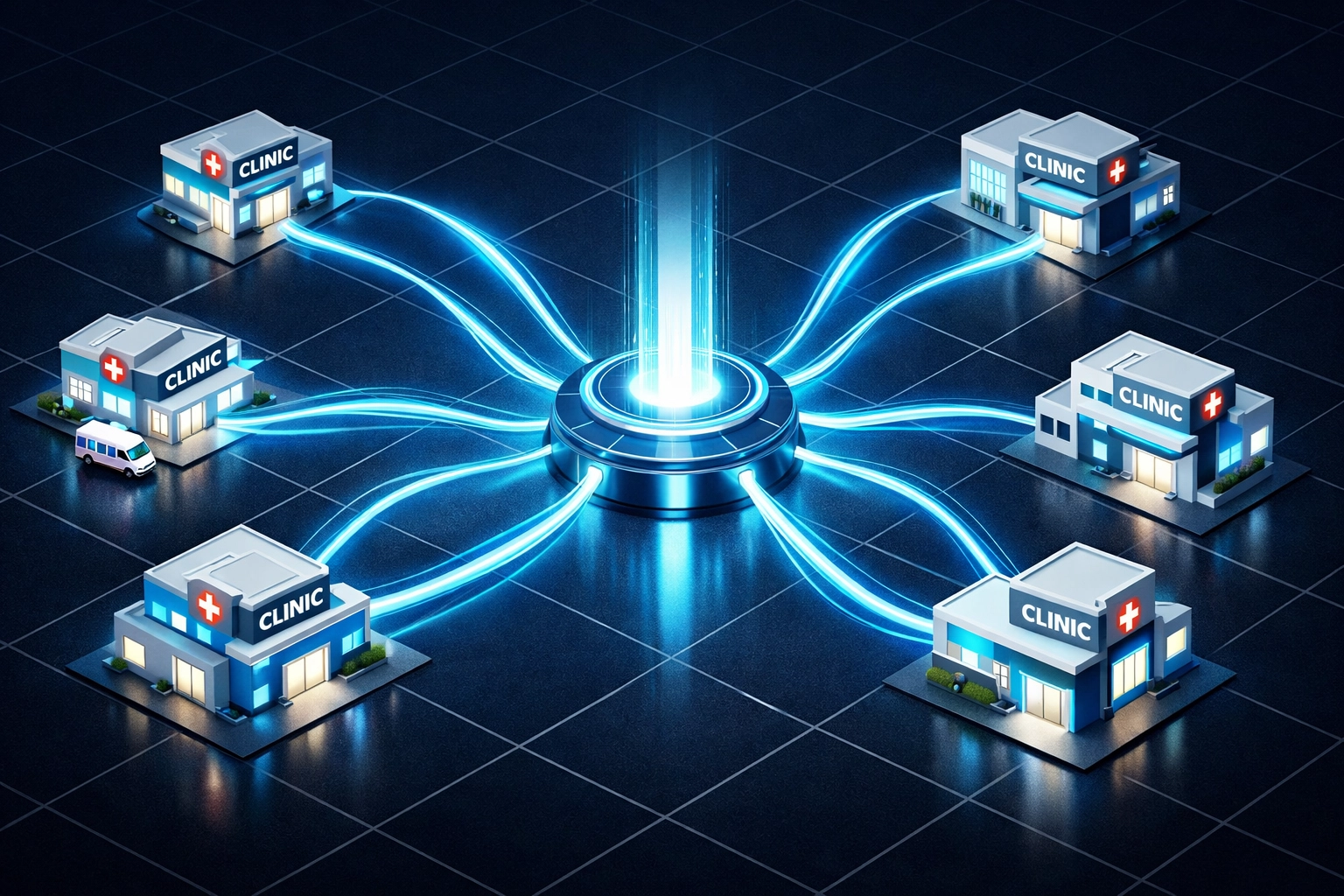
    A network of healthcare clinics connected by automated digital data streams for unified local SEO.

    AI Local Boost: The Architecture of Automated Dominance

    AI Local Boost isn't just a tool; it’s a sophisticated digital transformation consulting approach. It’s about building a custom automation layer that sits over your clinic's operational data. Here is how we approach the automation of local visibility at scale.

    1. Centralized Data Governance

    The cornerstone of dominance is a "Single Source of Truth." Instead of updating 15 different directories, we build systems where your clinic data (practitioners, specialties, hours, insurance accepted) is managed in one central dashboard. AI Local Boost then synchronizes this data across Google Business Profiles, Apple Maps, Bing, and healthcare-specific directories like Healthgrades.

    2. Semantic Hyper-Local Content

    Search engines in 2026 prioritize "neighborhood-intent." A patient doesn't just search for "Chiropractor"; they search for "Chiropractor near [Specific Neighborhood] that handles sports injuries and takes Blue Cross."

    Through AI automation, we generate unique, high-value content for every location. Rather than a generic "We treat back pain" post, the system generates location-specific updates: "Our Downtown clinic just upgraded its spinal decompression suite to serve the local athletic community." This provides the semantic signals AI models need to recommend your specific branch.

    3. Automated Reputation Management

    For a multi-location clinic, reviews are the lifeblood of trust. AI Local Boost automates the monitoring and initial response drafting for reviews across all locations. By using custom-trained models that understand your brand voice, we ensure that every patient feels heard, while your team only intervenes for high-priority issues.

    From Referral-Dependency to Predictable Growth

    Many wellness clinics feel stuck. They want to expand, but they aren't sure if a new location will "take." By implementing small business automation strategies, you remove the guesswork.

    When you have a proven, automated system for local visibility, opening a new location is no longer a marketing gamble. You simply plug the new address into the AI Local Boost framework. Within weeks, the system establishes the necessary local authority, syncs the listings, and begins generating the "answer-based" search results that drive appointments.

    Digital map showing multi-location clinic expansion through automated local search results and data insights.

    The AI-First Paradigm: Optimizing for LLMs

    We are currently in a transition where roughly 60% of new patients interact with an AI assistant before they ever visit your website. These AI models act as "healthcare concierges."

    If a patient asks, "Which wellness clinic near me has the shortest wait times for a consultation?" and your data isn't structured or accessible, you lose that patient to a competitor who has embraced digital transformation consulting.

    Our approach at Pure Technology Consulting is to treat your clinic’s information as a high-performance data feed. We use schema markup and structured data to ensure that when an AI "crawls" the web, it finds clear, unambiguous proof that your clinics are the top choice in their respective areas.

    Operational Leverage: Doing More with Less

    The most significant impact of AI Local Boost is the reduction in overhead. Traditional agencies might charge tens of thousands of dollars a month to "manage" 20 locations, often with lackluster results.

    By leveraging bespoke automation, our clients see:

    • 75% Lower Marketing Operational Costs: You don’t need a massive team to manage listings and content.
    • 10x Faster Deployment: New locations go from "hidden" to "dominant" in 4–6 weeks rather than 6–12 months.
    • Increased Clinic Efficiency: Your staff spends less time answering basic questions about hours and services because that information is accurately disseminated everywhere online.

    Why Pure Technology Consulting?

    We don't just provide a platform; we provide strategic advisory. Our background in complex healthcare integrations: such as our work with the Thrive/EHRIO matching engines and HIPAA-adjacent workflows: allows us to understand the nuances of clinic operations.

    We see local SEO not as a marketing task, but as a software and data problem. Whether it’s building 70-question intake flows or integrating GPS logging for rep accountability, our focus is always on building high-ticket custom web apps and bespoke automation that scales with your ambition.

    Bespoke AI automation hub representing centralized management for multi-location healthcare digital transformation.

    The Roadmap to 2026 Dominance

    If you are managing 10+ locations and still relying on manual SEO updates or a "hope and pray" referral strategy, the window of opportunity is closing. The clinics that dominate the next decade will be those that treat their digital presence as a programmable asset.

    What to automate first:

    1. Listing Synchronization: Ensure your NAP data is locked and synced.
    2. Location-Specific Pages: Move away from a single "Locations" page to individual, high-authority neighborhood hubs.
    3. Review Workflows: Implement a system that captures and responds to feedback instantly.

    Strategy Over Hype

    At Pure Technology Consulting, we prioritize executive-level strategy. We don't promise "instant" results through gimmicks. We offer a roadmap for digital transformation that turns your multi-location practice into a search-dominant powerhouse.

    If you’re ready to move beyond basic search and start automating your clinic's growth, it’s time for a discovery call. We’ll audit your current workflows and show you exactly where custom automation can eliminate operational drag and drive predictable patient acquisition.

    Ready to scale your clinic’s visibility?
    Book a discovery call with our team to discuss a custom automation roadmap for your multi-location business.


    Amin Said, Founder of Pure Technology Consulting LLC
    https://puretechconsult.com

    +1 (803) 921-0969

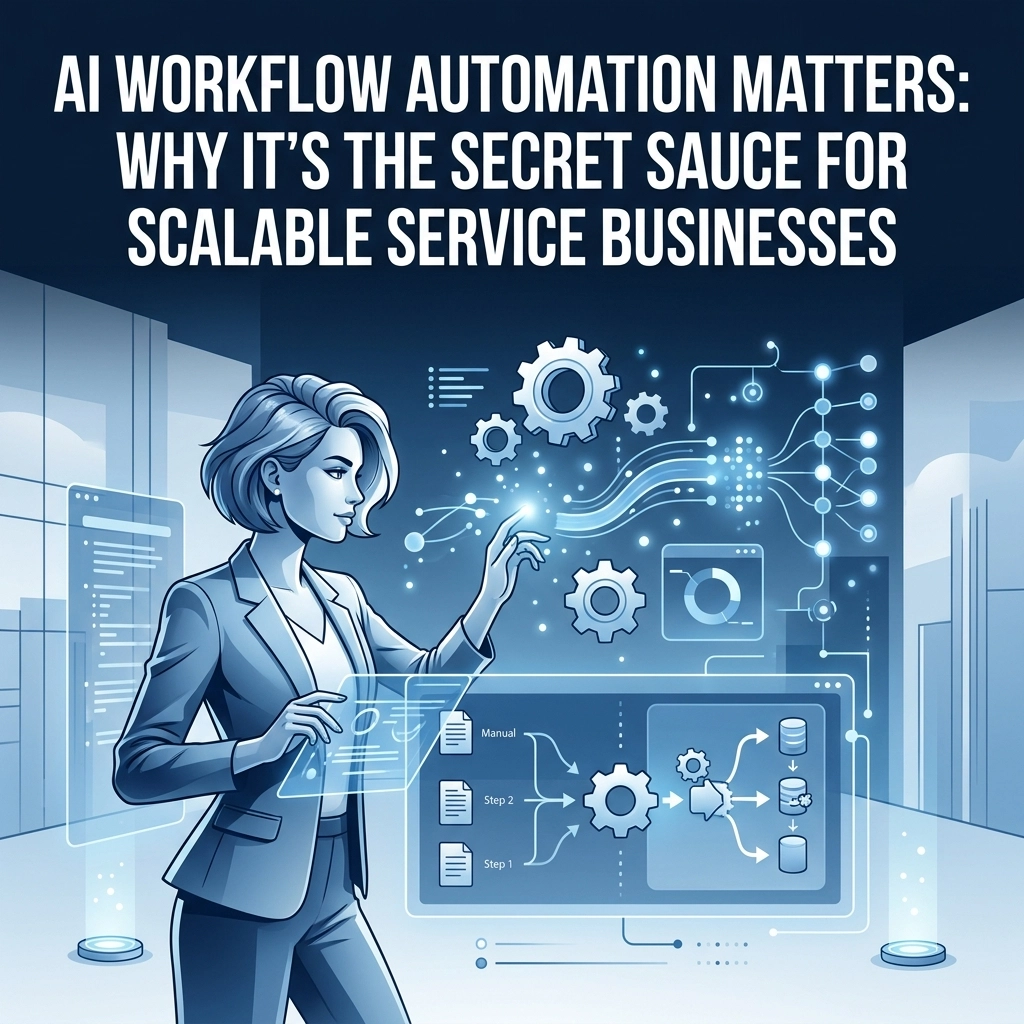
  • AI Workflow Automation Matters: Why It’s the Secret Sauce for Scalable Service Businesses

    AI Workflow Automation Matters: Why It’s the Secret Sauce for Scalable Service Businesses

    For most service-based businesses, growth is a double-edged sword. On one side, more clients mean more revenue. On the other, more clients traditionally mean more overhead, more staff, and a higher risk of operational fragmentation. This is the "linear growth trap", the moment your success starts to feel like a burden because your manual processes simply can’t keep up with the demand.

    To scale without breaking, you need more than just a larger team; you need a smarter operating model. At Pure Technology Consulting, we believe the true secret sauce for scalability in 2026 isn't just "software", it's AI Workflow Automation. By moving from manual coordination to intelligent, self-correcting systems, businesses can finally decouple their revenue growth from their headcount.

    The Invisible Ceiling of Manual Operations

    Every service business eventually hits an invisible ceiling. It’s the point where the CEO is spending 80% of their time managing people who are managing spreadsheets, rather than focusing on high-level strategy. This operational drag is caused by "data silos" and manual handoffs.

    When a lead comes in, does it automatically trigger a series of qualification steps? When a client signs a contract, does the project management tool automatically spin up a workspace with the correct templates? If the answer is "no" or "sometimes," you are leaving profit on the table and risking client churn.

    Research indicates that AI-powered automation can improve worker performance by nearly 40%. For a high-ticket service business, that’s the difference between scaling to an eight-figure valuation or remaining stuck in the mid-six-figure grind.

    Decoupling Growth from Headcount

    The traditional approach to scaling is to hire. Need more sales? Hire a BDR. Need more fulfillment? Hire a project manager.

    However, AI workflow automation allows you to handle growing workloads without proportional increases in labor costs. This is the "scalability advantage." An intelligent system can handle 100 client intakes as easily as it can handle one, with zero degradation in quality.

    At Pure Technology Consulting, we don’t just build "apps"; we build bespoke architectures that act as the digital nervous system of your company. Whether it's integrating complex telephony systems for a debt agency or building matching engines for healthcare providers, our focus is on creating leverage.

    Conceptual digital nervous system showing scalable automation architecture for high-ticket service businesses.

    Proven Architecture: From Healthcare to Legal and Accounting

    Our approach is built on years of experience in high-stakes industries where data integrity and compliance are non-negotiable. We are now bringing these proven capabilities into the legal and accounting sectors: industries that are historically ripe for transformation.

    Consider our work with EHRIO Pro. In the healthcare space, we developed complex matching engines and 70-question intake forms that handle HIPAA-adjacent workflows with precision. This same logic: taking high-volume, sensitive data and turning it into actionable outcomes: is the blueprint we use for law firms needing to automate discovery or accounting firms managing seasonal tax surges.

    Similarly, our proprietary tool FTP Inform serves as a prime example of how we handle the "plumbing" of a business. In professional services, the secure and automated transfer of documents is vital. FTP Inform ensures that data isn't just moved, but monitored and logged, providing the kind of governance that high-ticket clients expect.

    Strategic Intelligence: Beyond Simple "If-This-Then-That"

    Many business owners think of automation as simple Zapier integrations. While those have their place, visionary automation involves AI that learns and adapts.

    When we talk about workflow automation, we’re talking about systems that:

    • Anticipate needs: Recognizing patterns in client communication to flag high-risk accounts before they churn.
    • Self-correct: Identifying errors in data entry and correcting them based on historical records.
    • Analyze in real-time: Providing executives with live dashboards that show exactly where a bottleneck is occurring.

    This level of sophistication is what we’ve embedded into ChainHQ. It demonstrates our ability to build complex, multi-layered systems that manage supply chains or intricate service delivery pipelines. When a business outgrows off-the-shelf SaaS, they come to us to build a "ChainHQ-level" custom solution tailored to their specific "secret sauce."

    AI neural network sphere depicting intelligent automation for strategic service business scaling.

    Transforming Visibility with AI Local Boost

    Scalability isn't just about internal operations; it's about the consistent acquisition of new business. For service providers with a local or regional footprint, manual SEO and reputation management are often the first things to slip when the business gets busy.

    This is why we developed AI Local Boost. By automating Google Business Profile updates and local SEO workflows, we ensure our clients maintain market dominance without having to manually post updates or chase reviews. It is a testament to our philosophy: if a task is repetitive and data-driven, a human shouldn't be doing it. We use these proprietary SaaS assets as proof-of-concept for the custom, high-level automation we build for our consulting clients.

    Where Custom Software Beats SaaS

    Many executives ask, "Why should I build custom when I can just subscribe to five different SaaS tools?"

    The answer lies in the "Integration Tax." When you use five different tools, your team spends half their time moving data between them. Custom web apps: built bespoke for your operations: eliminate that friction. They are designed to fit your workflow, not the other way around.

    For a legal firm, this might mean a custom portal that integrates GPS logging (similar to our D2D Tracking capabilities) to verify service of process or field-based depositions. For an accounting firm, it might be a custom dashboard that pulls call attribution data from telephony integrations to see exactly which marketing campaigns are driving the highest-value clients.

    Bespoke software interface panels representing integrated data dashboards and custom workflow solutions.

    The Roadmap to a Scalable Future

    Transitioning to an AI-automated workflow doesn't happen overnight, but the strategic stakes of waiting are too high to ignore. The gap between businesses that use AI to scale and those that don't is widening.

    Our process typically involves:

    1. Workflow Audit: Identifying the manual tasks that are currently acting as "speed bumps" in your growth.
    2. Architecture Design: Mapping out a bespoke system that integrates your existing data with custom AI logic.
    3. Bespoke Development: Building the application or automation engine (often a $10k+ engagement) that serves as your competitive advantage.
    4. Governance & Integration: Ensuring the new system plays well with your existing tech stack and meets all compliance requirements.

    Closing the Loop

    In the visionary service business of 2026, the CEO is no longer a firefighter. They are the architect of a machine that produces results with clinical consistency.

    AI workflow automation is the secret sauce because it allows you to maintain the "human touch" where it matters: in strategy and client relationships: while delegating the "heavy lifting" to a system that never sleeps, never forgets, and never stops improving.

    If you are ready to stop trading your time for growth and start building a truly scalable enterprise, it’s time to move beyond standard software and into the realm of bespoke automation.

    Amin Said, Founder of Pure Technology Consulting LLC
    https://puretechconsult.com

    +1 (803) 921-0969

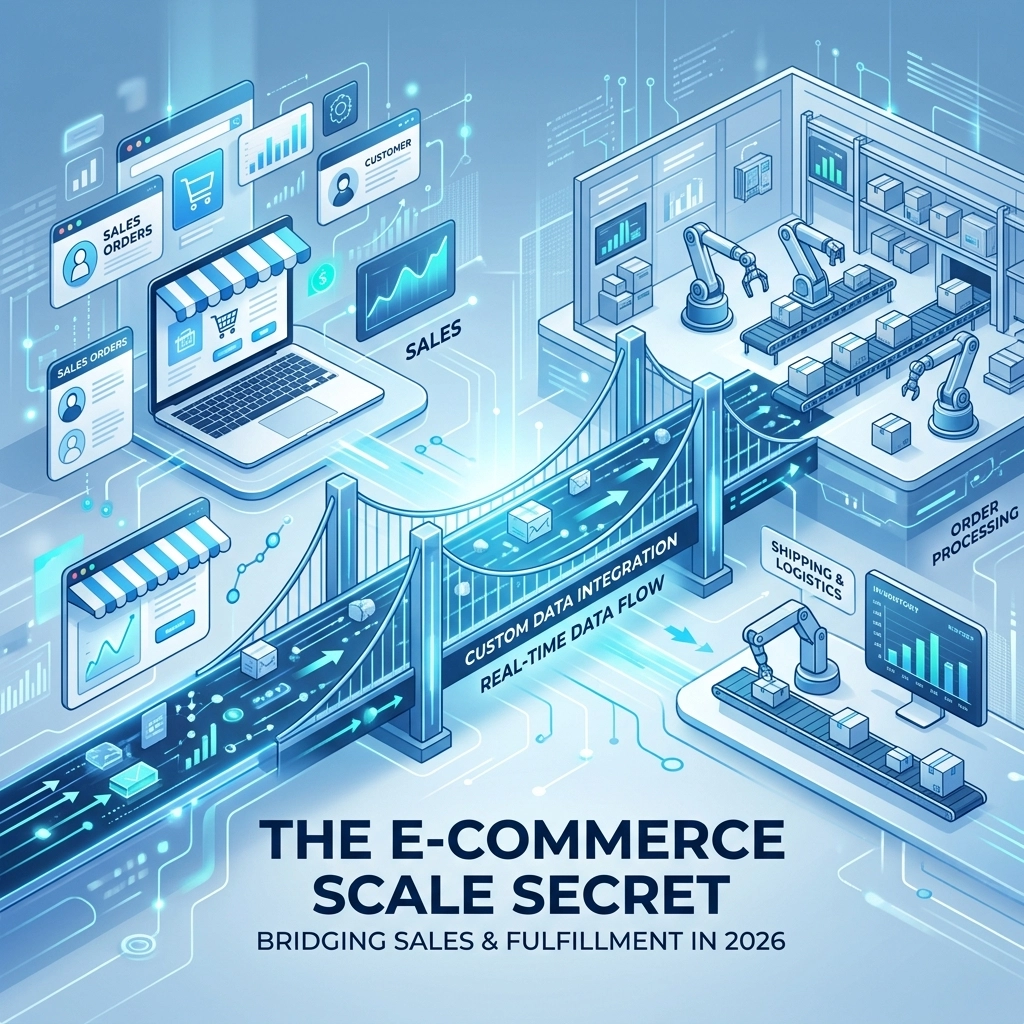
  • The E-commerce Scale Secret: How Custom Data Integration Bridges the Gap Between Sales and Fulfillment in 2026

    The E-commerce Scale Secret: How Custom Data Integration Bridges the Gap Between Sales and Fulfillment in 2026

    It’s Tuesday, March 31, 2026, and the e-commerce landscape looks radically different than it did even two years ago. If you’re running a high-growth brand on Amazon or eBay, you’ve likely realized that "more sales" is no longer your biggest challenge. In today’s market, the real battle is won or lost in the "gap", that chaotic space between a customer hitting the "Buy Now" button and the package arriving at their doorstep.

    For many founders, scaling up used to mean hiring more people to manage spreadsheets, manually update inventory, and reconcile shipping labels. But in 2026, labor is expensive, and human error is a luxury your margins can’t afford.

    The secret to scaling in this environment isn't more headcount; it’s custom data integration. At Pure Technology Consulting, we’re seeing a massive shift where the most successful brands are moving away from fragmented SaaS tools and toward a unified, automated operating model.

    The Hidden Cost of Manual Workflows in 2026

    If you’re still copy-pasting tracking numbers or manually checking if your Amazon stock matches your eBay listings, you’re operating with a "scaling tax."

    Every manual step in your workflow is a friction point. When your sales team is disconnected from your fulfillment team, data silos form. Sales might be booming on a specific SKU on eBay, but if your warehouse management system doesn't see that in real-time, you’re looking at overselling, stockouts, and those dreaded negative reviews that can tank your seller rating in 48 hours.

    The gap between sales and fulfillment is where profit goes to die. Through our digital transformation consulting, we’ve identified that mid-market e-commerce brands often lose between 15% and 20% of their potential efficiency purely due to data fragmentation.

    Digital representation of e-commerce data silos and inefficient manual workflows needing integration.

    Centralizing the Chaos: The Power of a Custom Dashboard

    Most e-commerce owners are drowning in tabs. You have the Amazon Seller Central tab, the eBay Seller Hub, your 3PL portal, and perhaps a basic accounting tool.

    The first step in a true data integration services engagement is centralizing this data. Imagine a single, visionary dashboard that doesn't just show you "sales," but shows you your entire ecosystem.

    Why a Custom Dashboard Beats "Off-the-Shelf"

    While there are plenty of $50/month apps that claim to sync your stores, they often lack the granularity required for complex operations. A custom-built dashboard from Pure Technology Consulting provides:

    • Real-time Inventory Orchestration: When an item sells on Amazon, your eBay listing is updated in milliseconds, not minutes.
    • Integrated Profitability Tracking: Most platforms show you revenue. A custom dashboard pulls in your COGS, shipping fees, and ad spend to show you real-time net profit per SKU.
    • Predictive Demand Forecasting: Using historical sales patterns, we can build logic that tells you exactly when to reorder stock before you even realize you’re low.

    This isn't just about looking at pretty charts; it's about executive-level governance of your business. It's about having the "single source of truth" that allows you to make strategic decisions in seconds.

    Automation: The Bridge Between Sales and Fulfillment

    In 2026, the brands that win are the ones that treat their operations like a software product. This is where business automation consulting becomes your most powerful weapon.

    When a sale is made on a marketplace, a series of invisible events should trigger immediately. In an un-integrated business, these events are manual. In a "Pure Tech" optimized business, they are event-driven.

    The Automated Workflow Journey

    1. The Trigger: A customer purchases a high-ticket item on eBay.
    2. The Sync: The custom integration immediately locks that inventory unit across all other channels.
    3. The Fulfillment Trigger: An API call is sent to your 3PL or warehouse system to generate a pick-list.
    4. The Communication: A personalized, branded email is sent to the customer, and the tracking number is automatically pushed back to the marketplace the moment the label is scanned.
    5. The Accounting: The transaction is logged in your finance system with the correct tax and fee breakdowns.

    By automating these "invisible" tasks, your team stops being "data movers" and starts being "growth drivers." We’ve seen teams reduce their manual data tasks by over 60%, allowing them to handle 3x the order volume without adding a single new employee.

    Modern visualization of automated data integration between e-commerce sales and fulfillment hubs.

    Scaling Without the Labor "Anchor"

    The traditional model of e-commerce scaling is linear: more orders = more customer service reps + more warehouse admins. That model is broken.

    The visionary approach, the one we advocate for at Pure Technology Consulting, is exponential scaling. By investing in custom web apps and bespoke integrations, you decouple your growth from your labor costs.

    Think of it this way: a custom integration doesn't take a lunch break, it doesn't make typos, and it doesn't need a raise. Whether you process 100 orders a day or 10,000, the infrastructure remains the same. This is how you achieve "operational leverage."

    Where Custom Software Beats SaaS

    Many clients ask us: "Why not just use a standard connector?"
    The answer lies in the edge cases. Every business has a unique way they bundle products, handle returns, or manage international shipping. Standard SaaS tools force you to change your business to fit their software. We build software to fit your business.

    Whether it's a custom matching engine for healthcare data or a GPS-logged accountability system for field ops, our background in building complex, high-ticket web applications means we know how to handle the data nuances that generic tools miss. We bring that same level of rigor to e-commerce fulfillment.

    The 2026 Strategic Roadmap

    If you’re looking to bridge the gap between your sales and fulfillment this year, your roadmap should look like this:

    • Audit Your Workflows: Identify every place where a human is currently moving data from one screen to another. That is your first target for automation.
    • Prioritize Integration Integrity: Ensure your sales channels (Amazon/eBay) are talking directly to your backend systems with zero latency.
    • Invest in Visibility: If you can’t see your real-time margins across all channels on one screen, you are flying blind.
    • Schedule a Strategy Session: Don't guess which tools will work. Request a workflow audit to see where custom code can replace manual drag.

    A sleek custom data dashboard interface for high-level e-commerce strategy and workflow auditing.

    Final Thoughts: The Future is Integrated

    The "secret" to scaling in 2026 isn't a secret at all, it’s architecture. It’s the realization that your data is your most valuable asset, but only if it’s moving freely between your sales platforms and your fulfillment centers.

    At Pure Technology Consulting, we don't just build apps; we build the digital nervous systems for high-growth brands. We help you bridge the gap so you can stop worrying about the "how" of fulfillment and start focusing on the "what's next" of your brand’s vision.

    If you’re ready to stop the manual grind and start scaling with precision, let’s talk. Our bespoke automation and integration engagements are designed for brands that have outgrown the "basic" tools and are ready for professional-grade infrastructure.

    To your growth,

    Amin Said, Founder of Pure Technology Consulting LLC
    Phone: +1 (803) 921-0969
    Website: https://puretechconsult.com

    Discovery: https://puretechconsult.com/schedule

    For any inquiries regarding this post or to book a consultation, please contact my assistant, Emily.