It’s Tuesday, March 24, 2026, and the landscape of service-based business has reached a definitive tipping point. For years, we’ve talked about "digital transformation" as a goal to be reached eventually. But as of this year, the grace period is officially over.
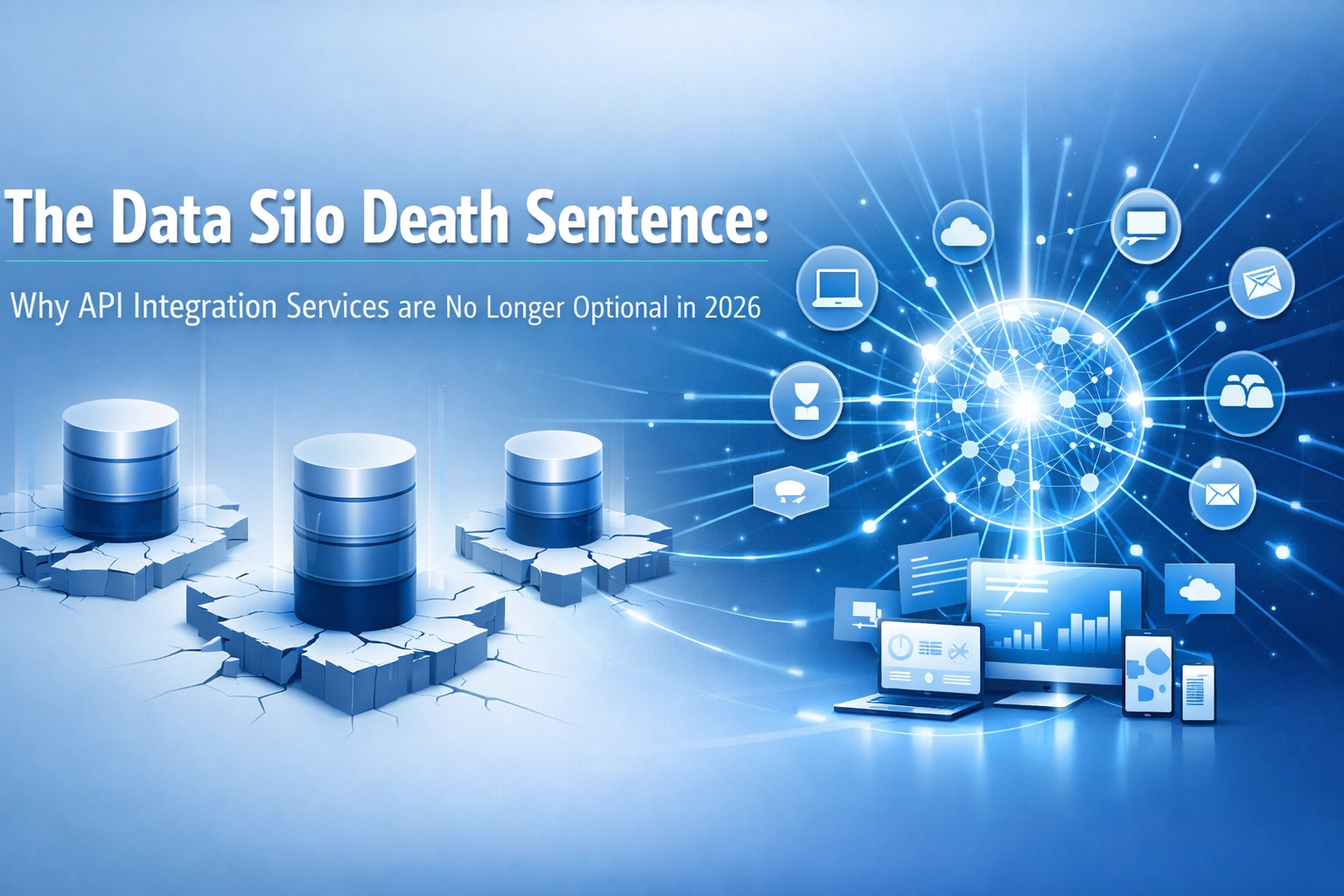
If your organization is still relying on manual CSV exports to move data between your CRM, your accounting software, and your field operations tools, you aren't just dealing with a minor inconvenience. You are facing what I call the "Data Silo Death Sentence." In a market that moves at the speed of AI-driven automation, a disconnected system is a slow-motion catastrophe for your margins, your compliance, and your ability to scale.
At Pure Technology Consulting, we’re seeing a massive shift. The conversation has moved from "Can we connect these tools?" to "How fast can we build a unified data backbone?" API integration services have evolved from a "nice-to-have" IT project into the most critical infrastructure investment a service business can make.
The Operational Drag of Disconnected Systems
For operationally constrained service businesses: especially those managing multiple locations: the biggest enemy isn't the competition; it’s the friction inside their own walls.
When your data lives in silos, your team spends 30% of their day acting as "human middleware." They are copying data from a lead form into a scheduling tool, then exporting a spreadsheet to upload into an invoicing system, and finally trying to reconcile it all in a dashboard that is, by definition, already out of date by the time it’s viewed.
This manual data handling creates three primary risks:
- Data Decay: Information loses value every minute it sits waiting to be moved.
- Integrity Erosion: Manual entry is the birthplace of the "typo that cost ten thousand dollars."
- Strategic Blindness: If your data isn't real-time, you are making 2026 decisions based on last week's reality.

Why 2026 is the Year of No Return
Why is this a "death sentence" now and not three years ago? The answer lies in the convergence of three powerful forces: Regulatory Mandates, the AI Explosion, and Ecosystem Connectivity.
1. The Regulatory Hammer
We are seeing a global shift toward mandatory interoperability. In the healthcare sector, the Fast Healthcare Interoperability Resources (FHIR) mandates are no longer suggestions: they are requirements. Patient data access requirements became firm in early 2026, with prior authorization APIs following closely behind.
It’s not just healthcare. The financial sector has seen a 50% increase in customer connections through FDX-aligned APIs in the last year. If your service business interacts with these industries: or if you simply want to maintain high-standard security: you can no longer afford to be an island. Being incompatible with modern digital infrastructure means being ineligible for the highest-tier contracts.
2. The AI Gap
By now, every CEO has heard that AI will "revolutionize their business." But here is the secret: AI is only as good as its access to data. If your data is trapped in isolated silos, your AI tools are essentially working with one eye closed. Custom internal systems powered by real-time API integration services allow AI to see the entire picture, enabling predictive scheduling, automated client communication, and anomaly detection that manual systems simply can’t match.
3. Ecosystem Connectivity
The old model was "App A talks to App B." The 2026 model is "The Ecosystem." You are no longer just managing your internal tools; you are connecting to partners, vendors, and regulatory bodies in real-time. Without a robust API strategy, you are effectively opting out of the modern economy.
From Manual Exports to Real-Time Automated Flows
The "backbone" of any scalable service business today is a custom integration layer. We often see businesses try to solve this with "off-the-shelf" automation tools. While those have their place for simple tasks, they often fall short when dealing with complex, multi-location operations that require specific business logic and high-security standards.
This is where bespoke data integration services become a game-changer. Instead of a fragile web of "zaps," we build a central nervous system for your business.
The Shift:
- The Old Way: Exporting a CSV from your field service software on Friday, cleaning it in Excel on Monday, and importing it into your accounting software on Tuesday.
- The New Way: A technician finishes a job in the field. The moment they hit "complete," the API triggers an invoice in the accounting system, updates the inventory levels in the warehouse, and sends a personalized "thank you" and review request to the client: all in less than two seconds.

API Integration as the Foundation for Custom Internal Systems
At Pure Technology Consulting, we don’t just "plug things in." We look at API integration as the foundation for high-leverage custom software. Whether it’s building a custom web development solution or a complex automation engine, the goal is always the same: Operational Leverage.
Consider our work in high-stakes industries:
- In Healthcare: We’ve built matching engines that handle complex intakes while maintaining HIPAA-adjacent workflows. Without deep API integration, these systems would be impossible to scale.
- In Fintech/Debt: We’ve integrated telephony systems with custom CRM platforms to provide real-time call attribution and rep accountability.
- In Multi-location Operations: We’ve developed GPS logging and rep accountability tools that ensure data flows from the "boots on the ground" directly to the executive dashboard without a single manual touchpoint.
When you treat integration as a service rather than a one-off task, you gain the ability to pivot. When a new tool comes out or a new regulation is passed, you don't have to rebuild your entire workflow; you simply update the integration point.
Security and Compliance in the Age of Interconnectivity
One of the biggest hesitations I hear from CEOs regarding API integration is security. "If everything is connected, isn't everything more vulnerable?"
In reality, the opposite is true. Disconnected systems often lead to "Shadow IT," where employees use unauthorized tools to bridge the gaps, or they store sensitive data in insecure Excel files on their desktops.
Modern API integration services actually improve security by:
- Centralizing Governance: You control who has access to what data through a single, secure gateway.
- Real-time Monitoring: We use behavioral analysis and telemetry to detect anomalies. If a system starts requesting an unusual amount of data, we can shut it down instantly.
- Encrypted Identity Context: Each data exchange is backed by modern identity protocols, ensuring that data only moves between trusted entities.

The Pure Technology Consulting Approach: Your Workflow Audit
If you’re feeling the "operational drag" of disconnected systems, the solution isn't to buy more software. The solution is to optimize the software you already have through a strategic integration roadmap.
We specialize in helping operationally constrained businesses break free from the "CSV trap." We don't just provide a service; we provide a vision for how your company should function in a world where data is your most valuable asset.
Our process starts with a deep dive into your current operating model. We identify the bottlenecks, the manual data entries, and the "silent killers" of your productivity. From there, we build a bespoke architecture that connects your systems into a unified, automated, and scalable engine.
Conclusion: Evolve or Become Obsolete
The "Data Silo Death Sentence" isn't a threat; it’s a reality of the 2026 market. Businesses that continue to operate with fragmented systems will find their margins squeezed by competitors who can move faster, serve clients better, and adapt to regulations instantly.
API and data integration services are no longer "IT projects." They are the core of your business strategy. If you are ready to stop managing spreadsheets and start managing a high-performance, integrated organization, it’s time to move.
Let’s look at your current workflows and see where we can inject some real-time intelligence. You can schedule a discovery call with our team to start your audit. We’ll look at your systems, your data flows, and your growth goals to build a roadmap that makes sense for your specific scale.
The future of your business is integrated. Don’t let your data be the thing that holds you back.
Amin Said, Founder of Pure Technology Consulting LLC
https://puretechconsult.com
+1 (803) 921-0969
Leave a Reply