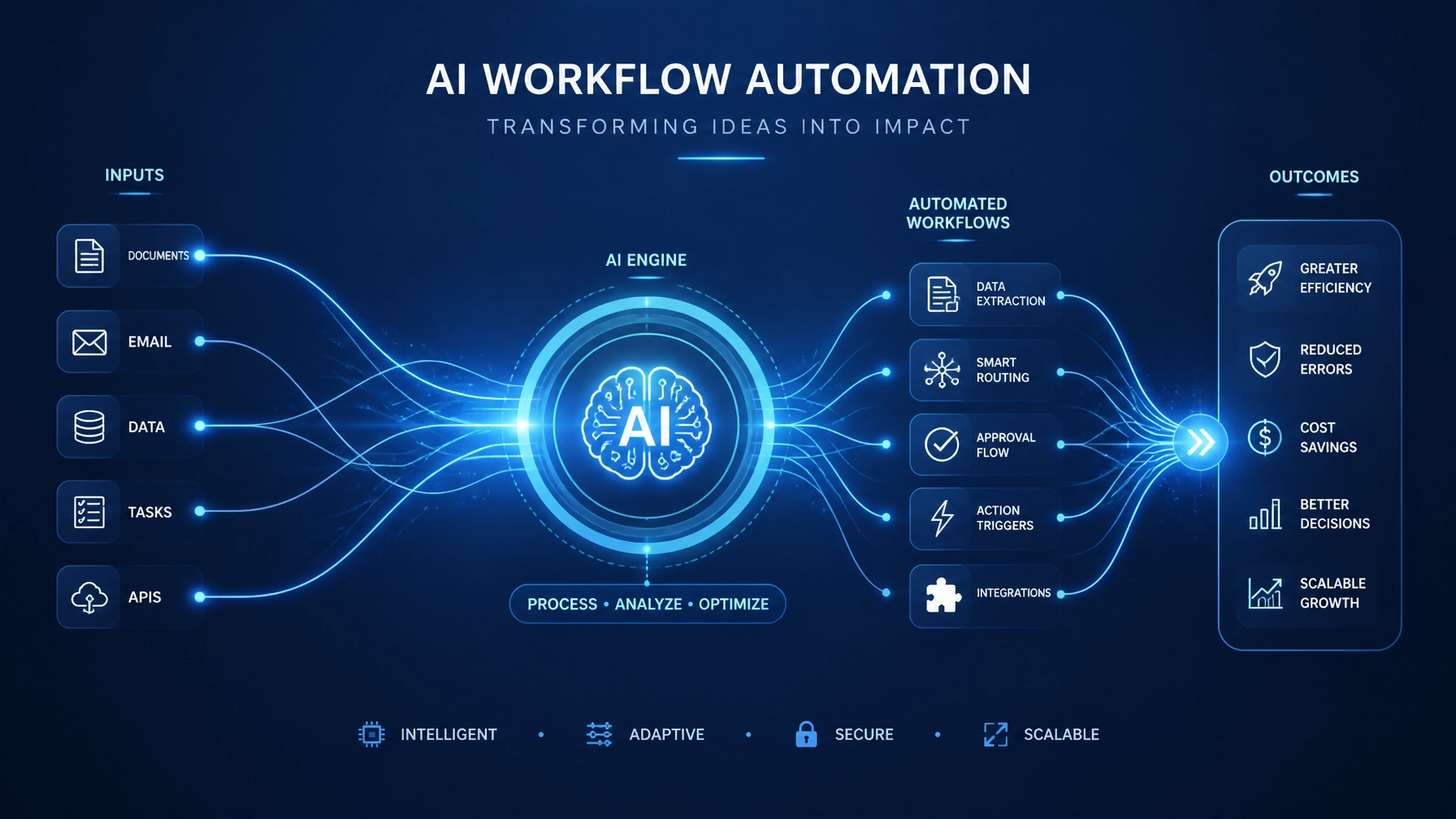
Manual data entry is the "hidden tax" on your business growth. It doesn’t just slow down your staff; it creates a ceiling on your ability to scale. Every hour a highly-paid employee spends retyping an invoice, updating a CRM field, or cross-referencing a spreadsheet is an hour they aren't spending on strategy, patient care, or closing deals.
At Pure Technology Consulting (PTC), we view automation not as a way to replace people, but as a way to liberate them. By 2026, the businesses that thrive will be those that have moved from "manual-first" to "automation-first" operating models.
If your team is still drowning in spreadsheets, here are seven AI-powered workflow hacks to reclaim your time and accuracy.
1. Transform Static Documents into Living Data
The most common source of manual entry is the PDF. Whether it’s a medical intake form, a vendor invoice, or a signed contract, the "human bridge": someone reading the page and typing the data: is a massive bottleneck.
Modern AI document processing has evolved past simple OCR (Optical Character Recognition). Today’s systems understand context. For example, our work with EHRIO Pro involves processing complex medical intakes where the AI doesn't just "see" text; it identifies patient history, matching symptoms to specific diagnostic codes automatically.
The Hack: Build a "Document-to-System" pipeline. Use an AI parser to extract fields from incoming emails or scans and push that data directly into your CRM or EHR. You only step in for the 2% of cases that require a human eye.

2. Automate Your Reputation and Local Visibility
For local service businesses: from physical therapy clinics to specialty retailers: managing Google Business Profiles often feels like a full-time job. Responding to reviews and updating photos manually is a repetitive task that often falls through the cracks.
We developed AI Local Boost to handle the heavy lifting of local SEO. By automating the intake of customer feedback and the generation of localized content, businesses can maintain a 5-star presence without ever logging into a dashboard.
The Hack: Use AI to monitor your local listings. When a new review lands, have a workflow draft a response based on your brand voice and update your local ranking reports automatically. This ensures consistency without the manual oversight.

3. Implement "Enter Once, Sync Everywhere" Architecture
One of the biggest time-wasters is data silos. You enter a customer's info in your CRM, then you enter it again in your billing software, and once more in your project management tool.
Bespoke web applications can bridge these gaps. Our platform, ChainHQ, was designed to solve this exact problem for multi-platform environments. It acts as the "connective tissue," ensuring that when a record changes in one location, the update ripples through the entire supply chain or service network.
The Hack: Identify your "Source of Truth" (usually your CRM). Use automation tools like Zapier, Make, or a custom API integration to ensure that any change in the Source of Truth automatically updates every other tool in your stack.

4. Move Field Data Entry to Real-Time Voice and GPS
For businesses with field reps or multi-location operations, waiting for "end-of-day reports" is a recipe for data loss and inaccuracy. Manual logging of visits or status updates is often the first thing reps skip when they’re busy.
We’ve seen incredible results by moving field data to automated logs. Using GPS-gated triggers: similar to our D2D Tracking solutions: you can log a representative's location and duration of visit automatically.
The Hack: Stop asking for manual logs. Use mobile-first automation that triggers based on location or allows for "Voice-to-Data" entry. A rep speaks their notes into an app, and AI parses those notes into structured CRM fields.
5. Automate File Intake with Intelligent Notifications
If your business relies on receiving large batches of data from vendors or partners, the manual "check and notify" process is a drain. You shouldn't have to refresh a folder to see if a file has arrived.
This is why we built FTP Inform. It turns passive file storage into active communication. When a file lands, the system not only alerts the right team member but can also trigger a secondary AI process to analyze the file content and provide a summary before a human even opens it.
The Hack: Set up "Active Listeners" on your data folders. When a vendor uploads a file, have an automated workflow ping your Slack or Teams channel with a summary of the data received and its validation status.
6. Use AI for Predictive Record Matching
In industries like debt collection or healthcare, data entry isn't just about typing; it's about matching. Does this new record belong to an existing patient? Is this payment tied to this specific account?
Manual matching is prone to "duplicate-itis," where your database becomes a mess of redundant records. AI excels at fuzzy matching: looking at multiple data points (name, address, partial ID) to determine the probability of a match with near-perfect accuracy.
The Hack: Before a new entry is created, run it through a matching algorithm. If the AI is 95% sure it’s an existing record, have it suggest an "Update" instead of a "New Entry." This keeps your data clean and your reporting accurate.
7. Automate Compliance and Audit Logs
Manual data entry often fails the most during the "boring" parts: compliance logging. Ensuring that every action is tracked for HIPAA, GDPR, or internal governance is usually a manual checkbox exercise.
Visionary leaders automate the audit trail. By building bespoke internal systems, every data movement is logged automatically at the database level. There is no "forgetting" to log an action because the system doesn't allow an action without a log.
The Hack: Replace manual "activity logs" with system-generated audit trails. Every time a record is accessed or changed, have the workflow create a non-editable log entry. This reduces liability and saves hundreds of hours during audit season.

Bespoke Web Apps That Fit Your Operations
The common thread among these hacks is a shift toward custom-fit technology. Off-the-shelf software often forces you into their manual workflows. Custom development: the kind we specialize in at Pure Technology Consulting: allows the software to bend to your business logic.
Whether it’s a HIPAA-adjacent workflow for a wellness clinic or a telephony integration for a professional services firm, the goal is always the same: Operational Leverage.
If you are ready to stop fighting your software and start scaling your operations, we can help you map out an automation roadmap. We don't just provide tools; we provide the strategy to ensure your technology is an investment, not a drag.
Ready to audit your workflows?
If your team is losing hours to manual data entry, it's time for a professional assessment. We help growth-focused businesses identify the bottlenecks that are holding them back.
Schedule a Discovery Call: Pure Tech Consulting Schedule
Phone: +1 (803) 921-0969
Amin Said, Founder of Pure Technology Consulting LLC
https://puretechconsult.com
Leave a Reply