PTC AI Insights

  • Digital Transformation Isn’t an Upgrade. It’s an Operating System for Growth.

    Digital Transformation Isn’t an Upgrade. It’s an Operating System for Growth.

    By Amin Said, Founder of Pure Technology Consulting LLC

    Digital transformation is often described as an upgrade: move to the cloud, add automation, replace outdated software, or introduce artificial intelligence.

    That framing is too narrow.

    For a growth-focused business, digital transformation is not about installing another tool. It is about redesigning the operating system of the company: the connected structure of workflows, data, roles, decision-making, and technology that determines how work gets done every day.

    When that operating system is designed well, growth becomes more repeatable. Teams spend less time reconciling information, leadership gains clearer visibility, and the organization can handle more volume without adding administrative complexity at the same rate.

    This is the strategic role of digital transformation consulting and AI workflow automation: not simply to modernize individual tasks, but to create a scalable operating model for the business.

    Growth exposes the weaknesses in your operating model

    Many businesses do not experience operational friction when they are small. A founder can personally review every lead. A manager can reconcile reports across several spreadsheets. A front-desk employee can re-enter information into multiple systems.

    As volume increases, those workarounds become structural constraints.

    Growth often exposes:

    • Manual data entry between CRM, scheduling, billing, and reporting systems
    • Inconsistent processes across locations or departments
    • Delayed reporting that prevents timely decisions
    • Workflows dependent on individual employees’ memory
    • AI tools operating without clear governance or reliable business data
    • Disconnected customer, operational, and financial information

    The problem is not always that a company lacks software. More often, it has too much software without a coherent architecture connecting everything together.

    A digital transformation strategy begins by examining how work actually moves through the organization. Which systems create the data? Who makes decisions? Where are approvals delayed? Which steps are repeated? What happens when information is incomplete or an exception occurs?

    Those answers form the blueprint for a better operating model.

    A modern operating system has five connected layers

    A scalable digital operating model should connect five essential layers.

    1. Workflow design

    Before automating a process, the process itself must be understood.

    A workflow audit documents the steps, owners, systems, handoffs, decision points, exceptions, and measurable outcomes involved in a business process. This prevents companies from automating unnecessary steps or accelerating a process that is already poorly designed.

    Typical opportunities include:

    • Lead intake and qualification
    • Patient or client onboarding
    • Scheduling and assignment
    • File ingestion and validation
    • Approvals and notifications
    • Reporting and reconciliation
    • Customer follow-up and retention

    The goal is not to automate everything. It is to prioritize workflows that are repetitive, high-volume, error-prone, or directly connected to revenue and service delivery.

    2. Data architecture

    Automation is only as reliable as the information flowing through it.

    When customer records, appointments, transactions, and operational events live in separate systems, employees become the integration layer. They copy, reconcile, verify, and interpret data manually.

    A stronger architecture creates a trusted source of operational truth. This may involve a centralized data model, secure APIs, event-driven workflows, or a custom orchestration layer that connects existing systems without forcing the company to abandon every tool it already uses.

    The result is not simply better reporting. It is better decision-making throughout the business.

    3. Custom applications and integrations

    Off-the-shelf software is valuable when a company’s workflows are standardized. Custom software becomes strategically important when the organization’s differentiation depends on specialized processes, complex rules, or coordination across multiple systems.

    A bespoke web application can provide:

    • A unified internal workspace
    • Custom intake and routing logic
    • Role-based dashboards
    • Secure integrations with existing platforms
    • Exception handling and approval workflows
    • Operational reporting tailored to leadership needs
    • Customer or partner portals

    The right question is not whether custom development is more advanced than SaaS. The right question is whether the business can continue growing while adapting its operating model to the limitations of generic software.
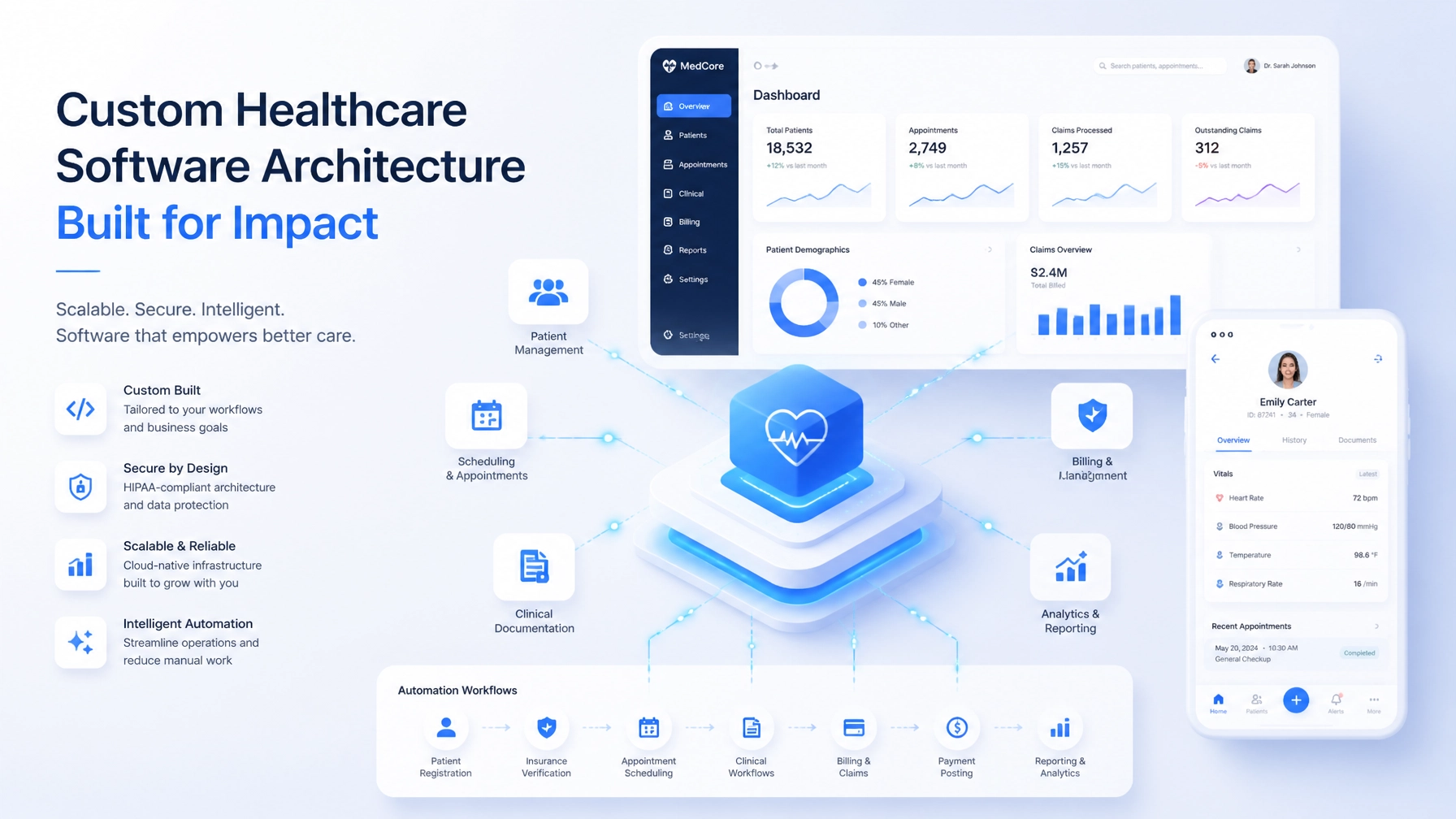
    Custom healthcare software architecture connecting intake, scheduling, billing, documentation, and analytics

    AI workflow automation should support decisions, not create more noise

    AI workflow automation is most valuable when it is connected to a defined process and governed by clear rules.

    For example, an AI-enabled workflow may:

    • Classify incoming requests
    • Extract structured information from documents
    • Summarize customer or patient history
    • Recommend routing or assignment
    • Draft communications for human approval
    • Identify missing information
    • Trigger follow-up sequences
    • Detect exceptions that require escalation

    The design principle is simple: use rules for deterministic tasks and AI for tasks that require interpretation, classification, or contextual support.

    Human oversight remains essential in high-stakes environments such as healthcare, legal services, accounting, and financial operations. A well-designed system defines where AI can act independently, where a human must review the result, and how every action is recorded.

    That combination of automation, visibility, and governance creates leverage without turning the organization into a collection of unmonitored AI experiments.

    Proven builds reveal what custom transformation makes possible

    At Pure Technology Consulting, proprietary platforms are not presented as generic products to purchase. They are proof-of-concept evidence of the engineering capabilities we bring to complex custom engagements.

    EHRIO Pro: orchestrating specialized healthcare workflows

    The architecture behind EHRIO Pro demonstrates how a custom system can coordinate detailed intake, provider matching, scheduling, documentation, billing, and reporting.

    The platform’s healthcare workflow model includes a dynamic 70-question intake process, matching logic, secure data synchronization, and role-based access patterns. These capabilities illustrate how technology can be designed around the specific operating model of a clinic rather than forcing staff to work across disconnected portals.

    The broader lesson applies beyond healthcare: when the process is specialized, the software should reflect the process.

    ChainHQ: turning multi-location complexity into a unified system

    ChainHQ provides a case study in location-aware architecture.

    Multi-location businesses often operate with isolated databases, local spreadsheets, and inconsistent reporting. A unified architecture can centralize core records while preserving location-level permissions and workflows.

    This approach supports:

    • Centralized executive visibility
    • Location-specific access controls
    • Shared customer and product records
    • Automated inventory and operational synchronization
    • Consistent governance with local flexibility

    The capability is relevant to clinics, franchise groups, field-service businesses, retailers, and professional service organizations operating across branches.
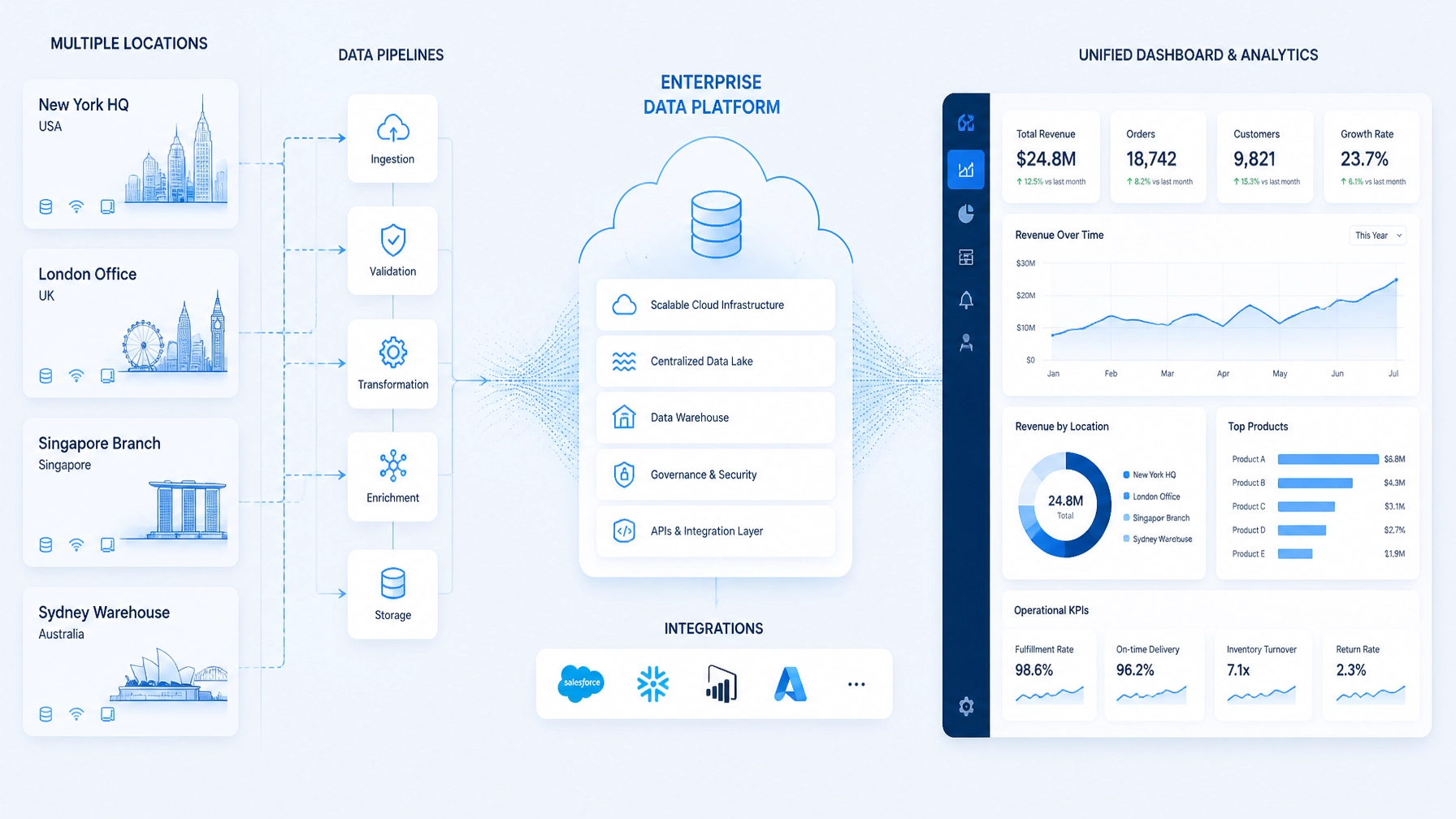
    Unified enterprise data platform connecting multiple locations, pipelines, integrations, and executive analytics

    FTP Inform: building automation around file-driven operations

    The FTP Inform case study demonstrates another form of transformation: replacing fragmented file-processing tools with a unified ingestion and orchestration engine.

    For a national debt collection agency, the system consolidated three enterprise tools into one custom platform. It automated secure file ingestion, schema validation, data transformation, exception handling, and downstream workflow routing.

    The documented result included a 40% reduction in cycle time and more than 75% less manual intervention. Those outcomes came from aligning the software architecture with the client’s actual operating model: not from adding a generic automation layer on top of disconnected systems.
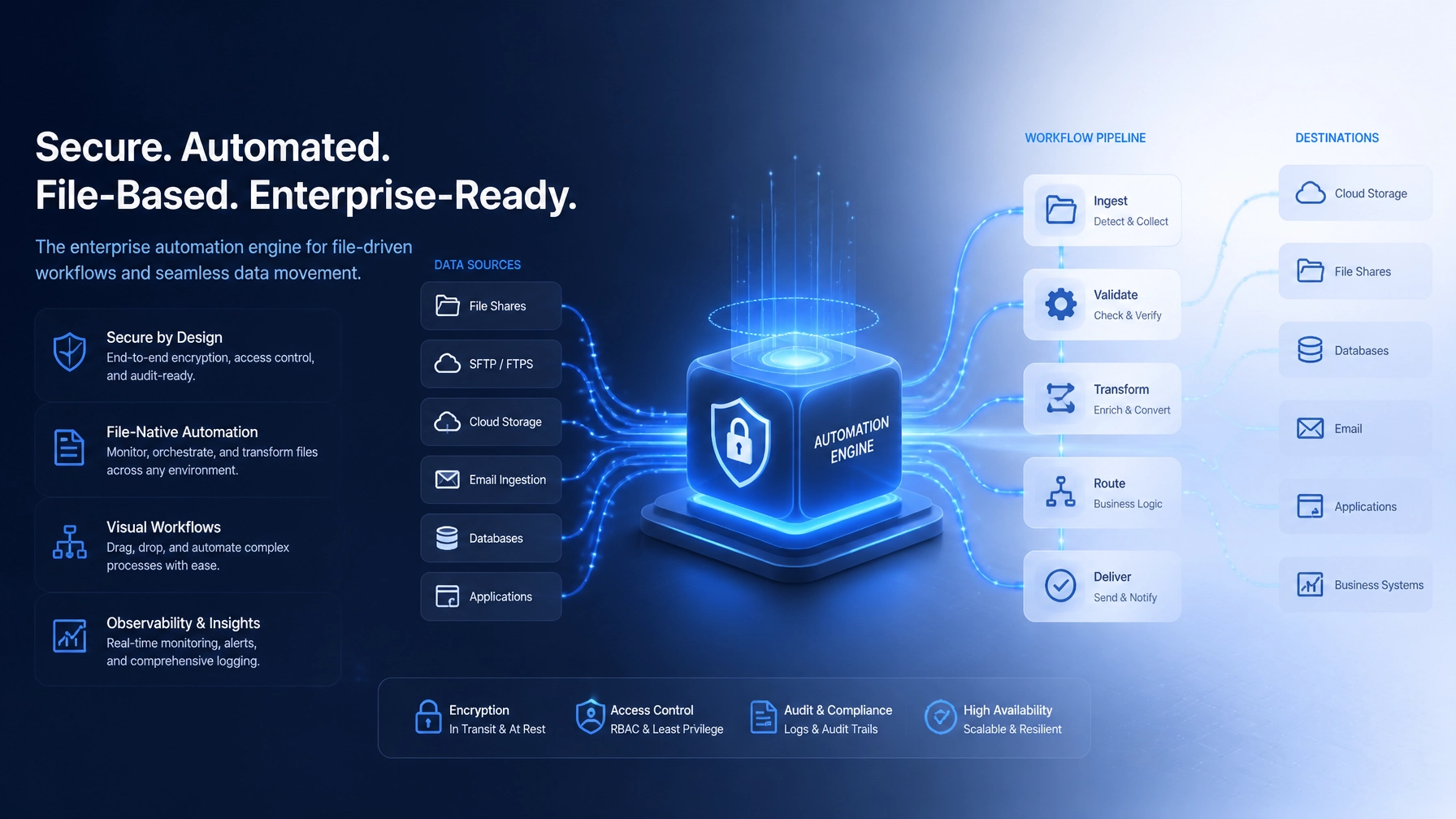
    Secure file-based automation engine connecting data sources, validation, transformation, routing, and business systems

    How to build a transformation roadmap that creates leverage

    A practical transformation roadmap should move through four stages.

    Assess the current operating model

    Map the workflows that affect revenue, service delivery, compliance, and administrative capacity. Measure cycle times, error rates, handoffs, and manual effort where possible.

    Prioritize the highest-value constraints

    Choose workflows where automation can produce a measurable operational impact. The best starting point is often a process that is repetitive, costly, visible to customers, or creating a bottleneck for growth.

    Design the target architecture

    Define the future workflow, data model, integrations, permissions, dashboards, and human review points before development begins. This is where digital transformation consulting creates value beyond software implementation.

    Build, measure, and scale

    Develop the custom components, connect the required systems, and launch with clear success criteria. Track metrics such as cycle time, error reduction, throughput, response time, and hours of manual work reclaimed.

    A transformation program should produce a system that improves over time. Governance, reporting, and continuous optimization are part of the operating system: not optional add-ons.

    The strategic shift: from operator to architect

    The purpose of digital transformation is not to remove people from the business. It is to remove unnecessary friction from the way people work.

    When routine coordination, data transfer, and reporting are automated, leadership can focus on operating the business at a higher level. Teams can spend more time on customer relationships, professional judgment, creative problem-solving, and growth initiatives.

    That is the difference between an upgrade and an operating system.

    An upgrade improves an existing tool. A redesigned operating system changes how the company creates value.

    If your business is growing faster than its internal processes can support, request a discovery consultation with Pure Technology Consulting. We can help map your workflows, identify the highest-value automation opportunities, and define a custom technology roadmap for the next stage of growth.

    Amin Said, Founder of Pure Technology Consulting LLC
    https://puretechconsult.com
    Phone: +1 (803) 921-0969
  • Scaling Local Visibility Through Engineering: How AI Local Boost Proves the Power of Custom Multi-Location Automation

    Scaling Local Visibility Through Engineering: How AI Local Boost Proves the Power of Custom Multi-Location Automation

    Amin Said, Founder and CEO of Pure Technology Consulting

    Local visibility is no longer a marketing task that can be separated from operations. For a multi-location business, every Google Business Profile, customer review, directory listing, post, photo, and call represents part of a larger technology system.

    When that system is managed manually, growth creates friction. More locations mean more logins, more approvals, more opportunities for inconsistent data, and more administrative work for teams that should be focused on customers.

    At Pure Technology Consulting, we approach this challenge as an engineering problem. Our proprietary asset, AI Local Boost, demonstrates how custom web applications and high-level automation can transform local visibility from a repetitive task into a scalable operating capability.

    The AI Local Boost Pro concept extends that proof of work into a multi-location architecture designed for brands, franchises, agencies, and high-growth service businesses.

    Local visibility becomes an operating model at scale

    A single location may be able to manage its local presence with a checklist and a few hours each week. That model changes when a business operates across dozens or hundreds of locations.

    A multi-location organization needs to coordinate:

    • Location-specific business information and services
    • Google Business Profile posts and media
    • Review monitoring and response workflows
    • Directory and citation consistency
    • Local content and frequently asked questions
    • Calls, messages, website visits, and direction requests
    • Brand governance across every market

    The challenge is not simply publishing more content. It is preserving local relevance while maintaining centralized control.

    A national brand cannot use identical messaging for every market. At the same time, it cannot allow every location to operate without standards. The system must support local variation inside a reliable governance framework.

    That is where custom software becomes strategically important.

    AI Local Boost as a technical proof of concept

    AI Local Boost was developed to show how Pure Technology Consulting designs and deploys AI-powered business systems. The public platform focuses on automated Google Business Profile management, content publishing, review responses, directory synchronization, and performance reporting.

    The deeper value is architectural. The platform demonstrates how a complex, repetitive workflow can be decomposed into reliable services and coordinated through a central application.

    The AI Local Boost case study was designed around an engine capable of managing 500+ locations without requiring human intervention for every routine action. That scale changes the design conversation. The objective is no longer to automate one task. It is to create an operating layer that can manage thousands of recurring decisions.

    The system must know:

    • Which location is being managed
    • Which services and keywords matter in that market
    • What content has already been published
    • Which reviews require escalation
    • Which data must remain consistent across directories
    • Which actions can run automatically
    • Which actions require approval

    This is the difference between adding an AI feature and engineering an automation platform.

    Custom multi-location automation architecture connecting location profiles, content workflows, integrations, and analytics

    What the multi-location architecture must solve

    1. Centralized control without generic content

    The first design requirement is a centralized control plane. Executives and marketing teams need a clear view of every location, but each profile must still reflect its market, services, audience, and business priorities.

    A custom application can maintain shared brand rules while allowing location-level configuration. For example, a healthcare practice may use a consistent brand voice across all offices while adapting posts to local services, seasonal needs, providers, and community events.

    The deliverables typically include:

    • Multi-tenant location management
    • Brand voice and content governance
    • Per-location service and keyword configuration
    • Reusable content templates
    • Approval rules and publishing schedules

    This model creates consistency without reducing every location to the same message.

    2. Automated content orchestration

    AI-generated content is only valuable when it is connected to a reliable workflow. A content engine needs context, scheduling logic, media handling, quality controls, and publishing integrations.

    AI Local Boost demonstrates this orchestration through automated posts, images, videos, review responses, and local content workflows. The platform can generate activity for individual profiles while preserving the operational logic required to run content at scale.

    A production-grade version of this architecture may include:

    • Content generation based on location and service data
    • Automated publishing queues
    • Media optimization and asset assignment
    • Duplicate-content controls
    • Failed-job retries and error logging
    • Human approval for sensitive content

    The result is not simply more activity. It is a repeatable system that makes local visibility manageable across a growing footprint.

    3. Review management with governance

    Reviews carry both marketing value and reputational risk. A missed positive review is a lost engagement opportunity. An inappropriate response to a negative review can create a larger business problem.

    AI Local Boost uses an intelligent review workflow that can monitor incoming reviews, assess context, draft responses, and support approval or automation rules.

    A mature enterprise implementation should distinguish between:

    • High-confidence reviews that can receive automated responses
    • Sensitive or negative reviews that require approval
    • Reviews containing legal, medical, or compliance concerns
    • Escalations requiring a manager or location owner
    • Response-time reporting across the network

    This approach allows automation to handle volume while governance protects the brand.

    Measurement connects visibility to business outcomes

    Automation should not be evaluated by the number of posts published. The meaningful question is whether visibility is improving in ways that support business growth.

    AI Local Boost includes heatmaps and performance reporting designed to connect local search activity with measurable signals such as calls, website clicks, direction requests, and ranking movement.

    One documented AI Local Boost result for a sports chiropractor in Charlottesville, Virginia, showed average ranking movement from 20 to 6.48 over a 60-day period. The same report recorded a 95% increase in phone calls, a 41% increase in website clicks, and a 19% increase in direction requests during the measured period.

    Real AI Local Boost heatmap showing ranking improvement for a local business

    These figures should be understood in context. Local search outcomes vary by market, competition, starting position, profile quality, and execution period. The important lesson is that a custom platform makes those variables observable.

    For a multi-location operator, the reporting layer can support:

    • Location-by-location performance comparisons
    • Ranking heatmaps by service and market
    • Call and website engagement trends
    • Review volume and response-time monitoring
    • Directory consistency checks
    • Identification of underperforming locations

    This turns local SEO from a collection of disconnected activities into an operational dashboard.

    Why custom software outperforms disconnected tools

    Off-the-shelf tools can be useful when a business has a narrow requirement. They become less effective when the workflow crosses departments, locations, and systems.

    A multi-location brand may need local visibility data connected to:

    • A CRM
    • Scheduling software
    • Point-of-sale systems
    • Customer intake workflows
    • Email and SMS platforms
    • Call tracking
    • Internal reporting
    • Franchise or regional management systems

    Custom development allows the operating model to determine the technology, rather than forcing the organization to adapt to disconnected products.

    This is the same principle Pure Technology Consulting applies across industries. In healthcare, our EHRIO work includes matching engines and complex 70-question intake workflows. In field operations, D2D Tracking demonstrates accountability and GPS logging. In debt management, telephony integrations support call attribution and workflow visibility.

    AI Local Boost applies that same engineering discipline to local search.

    From proof of concept to premium business system

    The AI Local Boost Pro architecture is not positioned as a generic product to purchase off the shelf. It is a proof of what becomes possible when a technology partner understands both software engineering and business operations.

    For a franchise group, the next step may be a branded command center with regional permissions. For a healthcare network, it may be a visibility system connected to intake, scheduling, and review workflows. For a professional services firm, it may be a custom dashboard that connects local search activity to lead qualification and revenue attribution.

    These engagements are typically scoped as premium custom builds, often beginning at $10,000 or more depending on integrations, data requirements, compliance considerations, user roles, and location count. The investment is justified when the system removes recurring labor, improves decision-making, and creates an operating foundation for growth.

    The right starting point is not a feature list. It is a workflow audit.

    Engineering the next layer of growth

    Local visibility is becoming more competitive, more measurable, and more operationally complex. Businesses that treat it as a weekly manual task will continue to add labor as they expand. Businesses that engineer it as a system can create leverage.

    AI Local Boost proves that a custom platform can coordinate content, reviews, directories, integrations, and analytics across a large location network. More importantly, it demonstrates the broader capability of Pure Technology Consulting: designing software around the way a business actually operates.

    If your organization is managing multiple locations, disconnected tools, or repetitive visibility workflows, book a discovery call. We can map your current operating model, identify the highest-value automation opportunities, and define a practical roadmap for a custom web application or AI-powered workflow system.

    Contact Pure Technology Consulting: +1 (803) 921-0969

    Amin Said, Founder of Pure Technology Consulting LLC
    https://puretechconsult.com

  • Beyond Off-the-Shelf: How We Built EHRIO Pro to Automate an Entire Healthcare Practice

    Beyond Off-the-Shelf: How We Built EHRIO Pro to Automate an Entire Healthcare Practice

    For growing healthcare practices and multi-location medical groups, the operational bottleneck rarely lives in clinical care. It lives in the friction between disconnected systems. When front-desk staff juggle standalone EHR portals, legacy scheduling tools, manual intake paperwork, and ad-hoc billing follow-ups, patient experience suffers and administrative overhead balloons.

    At Pure Technology Consulting, we frequently partner with specialty clinics, physical therapy groups, and wellness practices hitting the $500K to $5M growth ceiling. Time and again, practice leaders tell us the same story: off-the-shelf SaaS tools solve 70% of their operational needs, leaving a jagged 30% gap filled by sticky notes, tribal knowledge, and exhausting manual data re-entry.

    To demonstrate how custom engineering bridges that gap, we look inward at our own proprietary development frameworks: specifically EHRIO Pro, our enterprise healthcare workflow automation engine. By examining how we architected EHRIO Pro to orchestrate complex intake, patient matching, and secure data pipelines, practice operators can see what is truly possible when technology is custom-built around your exact operating model rather than forcing your team to adapt to rigid software constraints.

    The Breaking Point of Off-the-Shelf Software

    Standard practice management platforms are built for the lowest common denominator. They offer generic templates, rigid scheduling grids, and isolated messaging windows. But as a healthcare practice scales to multiple locations or introduces specialized clinical programs, those generalized workflows begin to break down.

    Consider a multi-location physical therapy or chiropractic group handling hundreds of patient interactions weekly. Each patient requires:

    • Detailed multi-part intake questionnaires (often 70+ questions capturing symptom history, insurance verification, and consent).
    • Automated eligibility checks before arrival.
    • Dynamic provider matching based on specialization, geographic location, and insurance panel acceptance.
    • Post-visit follow-up sequences integrated with internal CRM and billing ledgers.

    When these steps rely on disconnected tools, staff members spend hours copy-pasting data between tabs. Errors creep in, appointment no-show rates climb due to generic reminder cadences, and patient intake feels disjointed.

    ![Smart healthcare workflow automation engine](https://cdn.marblism.com/XWQ-poHfo9s.webp)
    

    Engineering a Custom Solution: The Architecture Behind EHRIO Pro

    When we set out to build EHRIO Pro, our engineering mandate was simple: eliminate operational drag without adding administrative complexity. Rather than bolting together fragile third-party integrations, we designed a cohesive, HIPAA-compliant ecosystem from the ground up.

    1. Intelligent Intake & Multi-Part Matching Engines

    In healthcare, intake is not a single form; it is a complex data collection journey. For EHRIO Pro, we engineered a dynamic 70-question intake engine that adapts in real time based on patient responses. If a patient indicates chronic lower back pain, subsequent fields dynamically branch to capture specialized orthopedic history.

    Behind the interface, our proprietary matching engine cross-references patient insurance data against real-time provider schedules, instantly assigning the correct clinician while flagging potential authorization hurdles before the patient ever steps foot in the clinic. This exact architecture mirrors our work across high-stakes domains: such as D2D tracking rep accountability in field operations and complex telephony integrations in fintech debt recovery.

    2. Seamless EHR and Data Synchronization

    A custom web application is only as powerful as its data integrity. EHRIO Pro acts as an intelligent orchestration layer sitting alongside existing Electronic Health Record (EHR) systems. Using secure, encrypted API pipelines and FHIR-compliant data standards, discrete patient demographics, appointment milestones, and clinical status updates sync instantly across platforms.

    This eliminates dual-entry errors entirely. Front-desk staff no longer wonder whether a patient completed their pre-visit documentation; the system updates status flags automatically based on completion triggers.

    ![EHR system data synchronization and secure API integration](https://cdn.marblism.com/4VaoMDIvnzh.webp)
    

    Where Custom Software Beats Rigid SaaS

    When practice executives evaluate their technology stack, the perennial question arises: Should we buy another off-the-shelf tool or invest in custom development?

    The answer depends entirely on your growth trajectory. If your processes are standard and unvarying, generic SaaS is sufficient. But if your competitive advantage lies in your unique patient journey, specialized intake workflows, or proprietary multi-location coordination, off-the-shelf software becomes a ceiling on your growth.

    Custom development delivers four distinct advantages that rigid SaaS cannot replicate:

    • Exact Workflow Alignment: The software molds to your operating procedures, not the other way around. Your staff executes workflows the way your practice operates best.
    • Unified Data Ecosystem: No more data silos between your marketing leads, intake forms, EHR records, and billing dashboards. Everything lives in a single, cohesive source of truth.
    • Enterprise-Grade Security & Compliance: Custom builds allow for rigorous, role-based access controls, encrypted audit logs, and tailored HIPAA-compliant data handling protocols designed specifically for your compliance requirements.
    • Operational Scalability: As your practice opens new locations or adds clinical specialties, your custom platform scales infinitely without triggering runaway per-seat licensing cost increases.

    Quantifying the Impact: The ROI of Custom Automation

    Investing in custom software is a strategic capital expenditure, not an expense. When we deploy systems like EHRIO Pro for high-ticket clients, the return on investment manifests across three clear operational vectors:

    1. Drastic Reduction in Administrative Overhead: Automating 70-question intakes, eligibility checks, and appointment routing typically saves front-desk teams 15 to 25 hours per week per location. Staff can redirect that energy toward patient care and high-touch concierge service.
    2. Accelerated Revenue Cycles: Catching insurance eligibility errors and missing prior authorizations before the appointment virtually eliminates claim rejections caused by administrative oversight.
    3. Elevated Patient Retention: Patients experience a frictionless, modern digital onboarding process that sets a professional tone from their very first interaction with your brand.
    ![Modern analytics and operational ROI tracking dashboard](https://cdn.marblism.com/G8WNXi6Ehrk.webp)
    

    Bringing Proven Capabilities to Your Practice

    EHRIO Pro is more than a proprietary SaaS asset within our portfolio; it is proof of our core engineering capability. At Pure Technology Consulting, we bring battle-tested architectures from healthcare, field operations, and fintech into custom engagements for growth-focused business leaders.

    Whether you are looking to streamline patient intake across multi-location clinics, build a bespoke internal web application, or eliminate manual workflow bottlenecks, our team designs and deploys scalable technology that drives predictable growth.

    If your practice is ready to move beyond the limitations of off-the-shelf software and build a proprietary digital advantage, let's talk.

    Ready to explore a custom technology roadmap for your practice?
    Contact our team directly at +1 (803) 921-0969 or book a discovery consultation on our schedule page.


    Amin Said, Founder of Pure Technology Consulting LLC
    https://puretechconsult.com

  • Why Custom Web Application Development Is the Definitive Competitive Advantage for Scaling Enterprises

    Why Custom Web Application Development Is the Definitive Competitive Advantage for Scaling Enterprises

    Amin Said, Founder of Pure Technology Consulting LLC, explores how organizations scale beyond the rigid limits of off-the-shelf software.

    For growing enterprises navigating complex markets, the difference between market leadership and operational stagnation often comes down to software architecture. Standardized SaaS tools and out-of-the-box platforms offer a quick start, but they ultimately enforce rigid boundaries. When your competitors operate on the same generic templates, your operational workflows, customer experiences, and strategic agility remain capped by someone else's product roadmap.

    True differentiation requires a deliberate shift toward custom web application development. By building bespoke software designed explicitly around your operating model, your enterprise turns digital infrastructure from an operational expense into a proprietary competitive moat.

    At Pure Technology Consulting, we partner with growth-focused organizations to design and deploy bespoke web applications, bespoke AI solutions, and robust enterprise automation consulting frameworks that scale seamlessly alongside your business goals.


    Moving Beyond Off-the-Shelf Limitations

    Every enterprise reaches an inflection point where standard SaaS platforms create more friction than value. Data silos multiply, critical workflows require awkward manual workarounds, and reporting dashboards fail to capture the nuanced realities of your operations.

    When your team spends hours reconciling disparate systems or adapting internal processes to fit a software vendor's limitations, your organization loses agility. Digital transformation consulting is not about adopting more technology; it is about aligning technology precisely with your strategic intent.

    +-------------------------------------------------------+
    |                 Enterprise Strategy                   |
    +---------------------------+---------------------------+
                                |
                                v
    +-------------------------------------------------------+
    |        Bespoke Web Application Architecture           |
    +---------------------------+---------------------------+
                                |
            +-------------------+-------------------+
            v                                       v
    +-----------------------+               +-----------------------+
    |  AI Workflow          |               |  Cross-System Data    |
    |  Automation           |               |  Integration Hub      |
    +-----------------------+               +-----------------------+
    

    The Strategic Value of Bespoke Systems

    Investing in a custom software development agency allows you to architect solutions that reflect your exact business logic. Rather than compromising your service delivery to accommodate software constraints, your applications adapt to your workflow, your compliance requirements, and your growth trajectory.

    • Unmatched Workflow Efficiency: Custom solutions eliminate redundant manual steps, integrating seamlessly with your existing data layers.
    • Proprietary Intellectual Property: Features and algorithms built specifically for your enterprise cannot be licensed or duplicated by competitors.
    • Granular Security & Governance: Tailored access controls and compliance architectures safeguard sensitive data across healthcare, fintech, and professional services environments.

    Where Custom Software Outperforms Standard Platforms

    Custom workflows and AI-driven automation systems in a modern enterprise setting

    When evaluating technology investments, leadership teams often weigh the upfront speed of SaaS against the long-term leverage of bespoke engineering. While SaaS has its place for generic functions like basic accounting or email marketing, core operational and revenue-generating workflows demand dedicated architecture.

    Integrating Intelligence: AI-Powered Business Systems

    Modern scaling requires more than static databases; it requires intelligent execution. Integrating ai-powered business systems directly into your custom web application transforms passive data into active operational leverage.

    Through specialized ai consulting services, enterprises can embed intelligent decision support, automated document processing, and predictive analytics into their daily workflows. Whether matching complex healthcare intake protocols: similar to our work with intake engines and EHR-adjacent systems: or optimizing field service dispatch and GPS logging, custom applications make intelligence native to your operations.

    Eliminating Operational Drag Through AI Workflow Automation

    Manual handoffs and administrative bottlenecks drain profitability. Implementing ai workflow automation within a custom application architecture reduces cycle times and eliminates human error across repetitive tasks.

    Our approach to business automation consulting focuses on identifying high-friction operational handoffs: such as CRM synchronization, client onboarding sequences, and multi-location reporting: and replacing them with autonomous, event-driven pipelines.


    Architectural Pillars of Enterprise-Grade Web Applications

    Building a high-performance web application requires rigorous engineering discipline and a comprehensive understanding of enterprise stakeholder needs. When partnering with a premier custom software development agency, leadership can expect a structured, outcome-driven roadmap.

    Data integration and secure cloud architecture dashboards

    1. Unified Integration and Data Flow

    Enterprise environments rarely operate in a vacuum. A bespoke application serves as an integration hub, connecting legacy databases, third-party APIs, and proprietary billing systems into a single, cohesive interface. This eliminates data fragmentation and empowers executives with real-time visibility.

    2. Scalable Backend and Cloud Architecture

    As user volume and transactional throughput increase, application performance must remain uncompromised. Microservices and modular backend architectures ensure that your platform scales horizontally and vertically without requiring expensive rewrites down the line.

    3. Rigorous Security and Compliance Governance

    For businesses operating in regulated sectors, security cannot be an afterthought. Custom web applications allow for strict adherence to frameworks such as HIPAA, GDPR, and industry-specific security protocols, ensuring data integrity and audit readiness from day one.


    The Roadmap to Digital Transformation Consulting Excellence

    Transitioning from off-the-shelf software to a bespoke digital ecosystem requires a trusted technical partner who understands both software engineering and executive strategy.

    Strategic roadmap and partnership for scaling enterprises

    Our engagement model at Pure Technology Consulting is anchored in four strategic phases:

    1. Operational Discovery & Workflow Audit: We analyze your current operating model, identify friction points, and map out high-impact automation opportunities.
    2. Architecture & Solution Design: We engineer a comprehensive technical blueprint detailing database schemas, user experience flows, API integrations, and security protocols.
    3. Agile Development & Iterative Deployment: We build your platform through rigorous sprints, ensuring continuous stakeholder feedback and transparent milestone delivery.
    4. Optimization & Ongoing Governance: Post-launch, we provide continuous monitoring, performance tuning, and feature expansion to support your long-term growth.

    Whether you require specialized business process automation consulting or a complete custom platform overhaul, our team brings proven engineering capabilities across healthcare, fintech, field operations, and local enterprise ecosystems.


    Partner with Pure Technology Consulting

    Technology should accelerate your enterprise, not constrain it. If your organization has outgrown rigid SaaS tools and is ready to build a sustainable competitive advantage through custom engineering, let’s start a conversation.

    Explore how our ai consulting services and bespoke development capabilities can transform your operations.

    Book a discovery call or request a comprehensive workflow audit with our team today:

    Amin Said, Founder of Pure Technology Consulting LLC
    https://puretechconsult.com

  • FTP Inform Case Study: How We Built a Custom File-Based Automation Engine That Replaced 3 Enterprise Tools for a National Debt Collection Agency

    FTP Inform Case Study: How We Built a Custom File-Based Automation Engine That Replaced 3 Enterprise Tools for a National Debt Collection Agency

    By Amin Said, Founder of Pure Technology Consulting LLC

    In modern financial operations and debt recovery, speed, accuracy, and uncompromising compliance form the bedrock of sustainable growth. When a national debt collection agency approached Pure Technology Consulting, they were operating at a critical juncture. Their legacy infrastructure relied on three separate enterprise software tools patched together with fragile custom scripts, manual CSV exports, and endless spreadsheet reconciliations.

    The operational drag was immense. Every day, teams spent hours verifying client-provided debt files, chasing down schema validation errors, and manually routing accounts across disconnected platforms. Recovery timelines stalled, operational overhead climbed, and risk exposure multiplied.

    Rather than forcing their operations into another rigid off-the-shelf software package, our team designed and engineered FTP Inform: a bespoke, high-performance file-based automation engine built to ingest, validate, segment, and orchestrate complex debt portfolios at scale.

    In this case study, we examine the architectural strategy, engineering approach, and measurable business impact of replacing fragmented enterprise tooling with a unified custom system.


    The Operational Bottleneck: Why Off-the-Shelf Tools Failed

    For established financial and service-oriented enterprises, generic SaaS solutions often create more problems than they solve. Standard CRM platforms and collection suites are built for generalized workflows, lacking the specialized capabilities required for high-volume, file-driven batch processing.

    Secure SFTP file ingestion and automated schema validation

    Our client faced three distinct operational vulnerabilities:

    1. Fragmented Tooling: Their intake, dunning management, and reporting lived in three disparate silos. Data synchronization required scheduled batch jobs that frequently failed or duplicated records.
    2. High Error Rates in File Ingestion: Clients submitted debt portfolios in varied formats: custom CSVs, fixed-width text files, and unstructured Excel sheets. Manual parsing and validation caused daily bottlenecks.
    3. Regulatory and Audit Blind Spots: Tracking FDCPA compliance across disconnected systems created severe governance risks, leaving audit trails scattered and incomplete.

    To achieve true operational leverage, the client needed more than a patch. They required a resilient, purpose-built architecture designed specifically around their operational model.


    Engineering FTP Inform: A Custom Ingestion & Transformation Layer

    At Pure Technology Consulting, our approach to custom web application development begins with a comprehensive workflow audit and a clear technical roadmap. For FTP Inform, we engineered a secure, multi-tenant ingestion architecture capable of handling millions of records with absolute reliability.

    Core Architectural Pillars

    • Secure SFTP Ingestion Pipelines: Each corporate client is provisioned with an isolated, secure ingestion endpoint. Automated event listeners detect inbound file drops instantly, initiating asynchronous processing without human intervention.
    • Intelligent Schema Validation & Transformation: The engine inspects inbound files against strict client-specific schemas. It automatically normalizes data types, detects anomalies, flags negative balances or missing consent flags, and routes invalid records to a dedicated exception quarantine while generating automated feedback reports.
    • Canonical Data Modeling: Validated data is translated into a unified internal model, ensuring seamless synchronization across downstream collection workflows and executive reporting dashboards.

    By consolidating ingestion and validation into a single, cohesive engine, we eliminated the friction points that previously slowed down daily operations.


    Orchestrating Workflows and Enterprise Integrations

    File ingestion is only the first step. The true power of FTP Inform lies in its debt collection automation engine: a rules-based orchestration layer that translates raw account data into actionable recovery strategies.

    Workflow automation metrics and collection intelligence dashboard

    Once accounts are loaded and normalized, the system automatically segments portfolios based on aging buckets (30/60/90+ days past due), balance size, historical recovery probability, and regulatory jurisdiction.

    Key Workflow Capabilities Built Into the System:

    • Automated Dunning Sequences: Triggering multi-channel reminders (email, SMS, and secure self-service portal links) tailored to each segment's behavioral profile.
    • Dynamic Agent Workloads: Prioritizing high-impact accounts for senior recovery specialists while routing routine self-service options to automated client portals.
    • Seamless API Integrations: Connecting directly with telephony providers, payment gateways, and accounting ledgers to record promises-to-pay and post transactions instantly.

    This level of automation reduced manual intervention by over 75%, allowing the agency’s internal staff to focus exclusively on complex negotiations and high-value recovery engagements.


    Governance, Compliance, and Measurable Business Impact

    In the debt collection sector, compliance governance is non-negotiable. Building custom software allows organizations to embed compliance directly into the code rather than relying on manual oversight.

    Enterprise integration, secure data pipelines, and compliance governance

    FTP Inform maintains an immutable audit trail for every event: from the moment an account file hits the SFTP server to the final resolution status. Role-based access controls, encryption at rest and in transit, and strict contact-time window validations ensure full adherence to regulatory frameworks.

    The Quantifiable Results

    Within 90 days of deploying FTP Inform across their national operations, the client achieved:

    • Consolidation of 3 Enterprise Tools: Replaced disparate third-party software licenses with a single, unified proprietary platform.
    • 40% Reduction in Cycle Time: Accelerated time-from-ingestion to first-contact execution from hours to seconds.
    • Elimination of Manual Data Entry Errors: Automated validation caught and quarantined bad data upstream, achieving near-zero file processing failures.

    To explore how our team can architect a similar custom workflow automation engine or web application for your organization, visit https://puretechconsult.com.


    Let's Build Your Technological Advantage

    Technology should serve as an engine for profitable growth, not an operational burden. Whether you are modernizing internal data pipelines, launching a new SaaS product, or automating complex intake workflows, Pure Technology Consulting brings proven engineering expertise and strategic advisory to every engagement.

    To discuss your technical roadmap or request a workflow audit, contact our team directly at +1 (803) 921-0969 or schedule a discovery session through https://puretechconsult.com.

    Amin Said, Founder of Pure Technology Consulting LLC
    https://puretechconsult.com

  • ChainHQ Case Study: How Custom Multi-Location Architecture Eliminates Data Silos and Unlocks Enterprise Scalability

    ChainHQ Case Study: How Custom Multi-Location Architecture Eliminates Data Silos and Unlocks Enterprise Scalability

    Written by Amin Said

    When scaling a business across multiple physical locations, regional hubs, or pop-up branches, operational friction is almost always the silent growth killer. As multi-location enterprises expand, off-the-shelf software solutions frequently fracture. Each store, clinic, or regional office adopts disparate tools, local spreadsheets, and siloed databases. The result? Fragmented reporting, duplicated data entry, inventory blind spots, and leadership teams making high-stakes decisions based on delayed, incomplete information.

    At Pure Technology Consulting, our work with high-growth enterprises and proprietary platforms like ChainHQ proves a fundamental truth: overcoming operational friction requires more than patching together disparate SaaS subscriptions. It demands purpose-built, scalable engineering. Through disciplined custom web application development, enterprises can replace brittle multi-system stacks with unified, multi-location architectures that turn geographic complexity into a competitive advantage.

    In this case study, we examine the architectural blueprint behind ChainHQ, demonstrating how strategic enterprise automation consulting and bespoke engineering eliminate data silos, streamline operations, and unlock true enterprise scalability.


    The Multi-Location Dilemma: Why Off-the-Shelf SaaS Breaks Down

    Growing businesses: from permanent jewelry brands and multi-location medical clinics to regional service providers: frequently reach an inflection point where standard, single-location software platforms fail.

    When an organization operates across five, ten, or fifty distinct locations, standard SaaS products often force companies into one of two undesirable compromises:

    1. Isolated Instances per Location: Setting up an independent account or software instance for every branch. While this gives local teams immediate autonomy, it instantly creates severe data silos. HQ has no real-time visibility into inventory levels, customer lifetime value, or cross-branch performance without manual report consolidation.
    2. Rigid Monolithic Restraints: Forcing every location into a rigid, non-customizable global tool that lacks the nuanced workflows required for local service delivery, localized pricing, or regional tax and compliance variations.
    [Store A: Isolated DB]    [Store B: Isolated DB]    [Store C: Isolated DB]
             \                        |                         /
              v                       v                        v
                --> [ Fragmented Data Silos & Blind Spots ] <--
    

    This structural disconnect leads directly to operational drag: staff spend hours reconciling inventory discrepancies, managers lack cross-site performance benchmarks, and leadership operates in the dark. For enterprises aiming to scale without linear increases in administrative headcount, these friction points are unsustainable.


    The Architectural Solution: Unified Infrastructure with Location-Aware Modeling

    To solve the multi-location data silo challenge for ChainHQ, our engineering and consulting teams approached the architecture not as a collection of separate storefronts, but as a single, distributed, location-aware ecosystem.

    Centralized enterprise data hubs connecting multiple remote business locations

    Through advanced custom software development agency capabilities, we established a robust foundation centered around core architectural principles:

    1. Centralized Data Core with Scoped Entities

    Rather than spinning up separate databases for every location, ChainHQ utilizes a unified multi-tenant schema where core entities: such as customers, master product catalogs, and global financial records: live in a centralized, highly secure repository. However, every transactional record is enriched with tenant and location identifiers (tenant_id, location_id).

    This structure ensures that:

    • Headquarters maintains complete, real-time visibility across all operational touchpoints.
    • Local Managers see only the data, inventory, and staff rosters relevant to their specific branch without sacrificing global governance.

    2. Hierarchical Inventory and Supply Chain Syncing

    In multi-location retail and service operations, inventory movement between warehouses, pop-up events, and permanent storefronts is notoriously difficult to track accurately. ChainHQ models inventory hierarchically (Global Warehouse $\rightarrow$ Regional Hub $\rightarrow$ Storefront Shelf). Every transfer is logged via automated event-driven workflows, ensuring real-time stock accuracy, eliminating shrinkage, and preventing overselling.

    3. Granular Role-Based Access Control (RBAC)

    Enterprise scalability requires strict security governance. By integrating granular permissions directly into the application layer, regional directors, store associates, and executive leadership interact with tailored interfaces. Staff members see streamlined workflows customized to their daily tasks, while executives access high-level analytical dashboards.


    Streamlining Workflows Through Intelligent Automation

    Architecture alone is only half the equation. True operational transformation requires removing manual intervention from repetitive, error-prone administrative tasks. As part of our comprehensive digital transformation consulting engagements, we design automated workflows that connect the software layer directly to day-to-day business execution.

    Workflow automation and multi-location inventory synchronization

    In the ChainHQ ecosystem, automation serves several critical functions:

    • Automated Reordering & Threshold Alerts: When local stock dips below predefined velocity thresholds, purchase orders trigger automatically upstream, notifying suppliers before stockouts occur.
    • Consolidated Financial Reconciliation: Daily sales, local tax breakdowns, and payment gateway payouts are automatically normalized and mapped to enterprise accounting systems, cutting bookkeeping reconciliation time from days to minutes.
    • Cross-Location Customer Profiles: A customer visiting a permanent jewelry location in one city can have their profile, purchase history, and preferences instantly recognized at a pop-up branch in another city, delivering a seamless brand experience.

    Measuring Impact: From Operational Drag to Predictable Growth

    When businesses replace disconnected tools with a purpose-built, unified web application, the operational metrics shift dramatically:

    Operational Dimension Fragmented SaaS Stack Unified Custom Architecture (ChainHQ Model)
    Inventory Visibility Delayed (24–72 hour manual reports) Real-time across all locations and pop-ups
    HQ Reporting Time Days of spreadsheet consolidation Instantaneous, multi-dimensional dashboards
    Administrative Overhead High (frequent manual reconciliation) Minimized through event-driven automation
    Cross-Branch Consistency Low (custom workarounds per site) Enforced governance with local flexibility

    By partnering with Pure Technology Consulting for custom web application development, businesses transition from reactive firefighting to proactive, data-driven scaling.


    Strategic Roadmap: How to Evaluate Your Multi-Location Architecture

    If your organization is experiencing the growing pains of multi-location data silos, evaluating your technology stack requires a deliberate, consultative approach. Here is how executive leadership teams can begin assessing their digital maturity:

    1. Audit Data Flow Intersections: Identify where operational data is manually copied between systems (e.g., from point-of-sale to inventory sheets to accounting software). Each manual transfer represents an automation opportunity and a potential data silo.
    2. Evaluate SaaS Limitations: Determine whether your current third-party tools constrain your expansion plans or require costly, fragile middleware integrations just to share basic customer records across branches.
    3. Engage in Strategic Advisory: Partner with experienced engineering consultants who understand enterprise architecture, workflow automation, and scalable database design.

    Professional executive strategy session and digital transformation roadmap


    Conclusion: Build for Where Your Business Is Going

    Technology should never be the bottleneck holding your enterprise back. As demonstrated by platforms like ChainHQ, investing in bespoke, multi-location software architecture transforms operational complexity into a seamless engine for predictable growth.

    At Pure Technology Consulting, we partner with growth-minded leaders across healthcare, professional services, e-commerce, and multi-location operations to design and deploy custom web applications and AI-driven automation systems that stand the test of time.

    Ready to eliminate operational data silos and build a scalable foundation for your enterprise? We invite you to explore our capabilities and schedule a discovery session with our advisory team.

    Visit us at https://puretechconsult.com to learn more about how we engineer custom software solutions tailored to your unique operating model.


    Amin Said, Founder of Pure Technology Consulting LLC
    https://puretechconsult.com
    Phone: +1 (803) 921-0969

  • Building SaaS at Scale: How We Engineered EHRIO Pro and AI Local Boost From the Ground Up

    Building SaaS at Scale: How We Engineered EHRIO Pro and AI Local Boost From the Ground Up

    At Pure Technology Consulting, our core philosophy has always been rooted in operational leverage. When growth-focused enterprises, healthcare clinics, and multi-location service providers approach us for custom software development, they are rarely looking for simple template code or off-the-shelf software packages. They are looking for reliable, high-performance digital infrastructure designed to eliminate operational friction and scale effortlessly.

    To validate our engineering methodologies and demonstrate our end-to-end capabilities, we did not just build custom applications for clients: we designed, engineered, and scaled two proprietary SaaS ecosystems from scratch: EHRIO Pro and AI Local Boost.

    These platforms serve as tangible proof-of-concept assets for what our engineering team achieves for high-ticket custom development clients. In this deep-dive case study, we examine the architecture decisions, technical hurdles, and strategic engineering principles that brought these two distinct platforms to life.


    The Engineering Mandate: Scalability Meets Real-World Complexity

    Building software that looks polished on day one is straightforward. Building software that maintains deterministic performance under heavy clinical data loads, multi-tenant database queries, and real-time AI API orchestrations requires rigorous systems architecture.

    When conceptualizing our proprietary platforms, our engineering leadership established three non-negotiable pillars:

    1. Modular Multi-Tenancy: Ensuring complete data isolation and security across distinct business accounts while maintaining shared infrastructure efficiency.
    2. Deterministic AI Integration: Translating unpredictable Large Language Model (LLM) outputs into structured, HIPAA-adjacent clinical documentation and automated local search assets.
    3. Resilient Event-Driven Workflows: Decoupling heavy background operations: such as batch review syndication, appointment reminders, and automated coding suggestions: from the core user request cycle.

    Futuristic dashboard displaying AI clinical workflow automation and medical charting


    Case Study I: Architecting EHRIO Pro for Healthcare and Practice Management

    EHRIO Pro was built to solve a critical operational bottleneck in modern healthcare and wellness practices: the administrative drag of clinical documentation, fragmented patient scheduling, and rigid electronic health record (EHR) systems.

    The Technical Challenge

    Medical practices and specialized clinics operate in high-compliance environments where data security, low-latency charting, and precise medical coding are paramount. Traditional EHR solutions often force practitioners into clunky, manual workflows that consume hours of after-hours administrative time.

    Our engineering objective was clear: design a unified, HIPAA-compliant platform integrating full scheduling, clinical charting, patient portals, and automated billing, supercharged with real-time AI assistance.

    Architecture and Implementation

    To achieve sub-second response times while handling complex relational health records, we implemented a robust relational database schema with row-level security policies, paired with asynchronous background workers to manage billing synchronicities and appointment triggers.

    The crown jewel of EHRIO Pro’s engineering is its AI clinical documentation engine. We engineered a secure transcription pipeline that processes voice dictation, normalizes clinical terminology, and instantly generates structured SOAP notes alongside real-time suggested ICD-10, CPT, and DSM-5 codes.

    • Key Deliverables Engineered:
      • Secure multi-tenant database architecture with strict data isolation.
      • Real-time audio transcription and NLP token processing pipelines.
      • Automated coding suggestion algorithms mapped to clinical ontologies.
      • Unified patient booking, intake questionnaires, and telehealth streaming via secure WebRTC integrations.

    Case Study II: Scaling AI Local Boost for High-Volume Local SEO Automation

    While EHRIO Pro solved internal clinical operations, AI Local Boost was engineered to tackle a completely different operational challenge: digital visibility and lead generation for multi-location service businesses, medical clinics, and professional service firms.

    Abstract representation of local SEO optimization and digital maps ranking analytics

    The Technical Challenge

    Local service businesses frequently struggle with maintaining consistent online visibility. Manually managing Google Business Profiles, publishing geo-targeted updates, responding to customer reviews, and syndicating local content across multiple directories drains internal resources and results in erratic lead flow.

    We needed to engineer an autonomous engine capable of managing hundreds of disparate business profiles simultaneously without triggering API rate limits or losing contextual brand voice.

    Architecture and Implementation

    We developed a distributed microservices architecture designed around event-driven task queues. The platform interfaces directly with major search and social APIs, scheduling automated content generation, media rendering, and review sentiment analysis on rigorous recurring intervals.

    By leveraging advanced image-to-video rendering scripts and automated NLP copywriting engines, AI Local Boost transforms standard business assets into high-converting local authority signals, driving measurable rank improvements within 30 to 45 days.

    • Key Deliverables Engineered:
      • Multi-platform API integration gateway with intelligent rate-limiting and retry logic.
      • Automated asset generation pipelines (image-to-video slideshows and geotagged media).
      • Sentiment analysis and review management dashboards.
      • Automated posting scheduler across Google Business Profile, Facebook, LinkedIn, and Instagram.

    From Proprietary SaaS to Enterprise Custom Builds

    The engineering rigor required to scale EHRIO Pro and AI Local Boost is the exact same discipline Pure Technology Consulting brings to every custom client engagement.

    Whether an enterprise client requires a bespoke internal CRM, an advanced data pipeline connecting disparate legacy systems, or a specialized SaaS product built from the ground up, our approach remains grounded in strategic architecture, clean code execution, and rigorous governance.

    Developer workspace displaying modular microservices and secure API integration maps

    Why Growth-Focused Leaders Choose PTC

    • Engineering Excellence: We do not rely on fragile no-code workarounds for complex enterprise logic. We write scalable, maintainable code designed for long-term operational leverage.
    • Security and Compliance: From HIPAA-aligned healthcare workflows to secure fintech integrations, we build systems that protect sensitive data.
    • True Partnership: We work alongside your internal stakeholders to scope, design, and deploy technology that directly impacts your top-line revenue and operational efficiency.

    Next Steps: Engineering Your Custom Solution

    If your business is experiencing operational bottlenecks, manual data silos, or looking to build a high-performance custom web application or AI-driven workflow, let’s discuss your roadmap.

    Contact our advisory team directly at +1 (803) 921-0969 or visit our schedule page to request a comprehensive workflow and architecture audit. No obligation: just expert guidance tailored to your growth goals.


    Amin Said, Founder of Pure Technology Consulting LLC
    https://puretechconsult.com

  • AI Local Boost Case Study: Designing a Scalable Local SEO Platform That Prove Custom Development Wins at Enterprise Scale

    AI Local Boost Case Study: Designing a Scalable Local SEO Platform That Prove Custom Development Wins at Enterprise Scale

    By Amin Said, Founder of Pure Technology Consulting LLC

    In the modern digital landscape, growing enterprises often reach a critical inflection point where off-the-shelf software ceases to be an asset and becomes an operational bottleneck. Generic SaaS products are built for the masses, offering rigid workflows that force businesses to bend their operations to fit someone else’s software model. At Pure Technology Consulting, we believe that true market leadership requires technology tailored precisely to your operational DNA.

    To demonstrate what is possible when bespoke engineering meets intelligent automation, we frequently point to our proprietary builds not as commercial products to buy, but as proof-of-concept case studies of our core capabilities. One of our signature engineering milestones is AI Local Boost: a fully managed, AI-powered Google Business Profile (GBP) automation platform built from the ground up to solve complex visibility, multi-location synchronization, and workflow friction at scale.

    In this case study, we examine how AI Local Boost was architected, the engineering principles behind its automated multi-signal optimization, and why forward-thinking organizations choose custom web application development and enterprise automation consulting over off-the-shelf compromises.


    The Strategic Challenge: Overcoming Manual Operational Drag in Local Visibility

    For multi-location service operators, healthcare groups, and specialized enterprises, maintaining consistent digital visibility across hundreds of local listings is an administrative nightmare. Every week, marketing teams and local managers grapple with repetitive operational tasks:

    • Publishing localized Google posts optimized for regional search intent.
    • Responding to customer reviews within strict SLA windows to protect reputation and local rank.
    • Synchronizing business hours, services, and directory data across fragmented mapping ecosystems.
    • Auditing profile completeness and tracking local ranking shifts against aggressive competitors.

    When managed manually, these tasks consume hundreds of staff hours and introduce human error, inconsistent messaging, and missed revenue opportunities. Standard directory tools offer blunt rule-based updates, but lack the contextual intelligence required to adapt to Google's rapidly evolving AI-driven search environment.

    Enterprises do not need another dashboard to monitor; they need autonomous systems that "just work." That realization is what drove our engineering team to design AI Local Boost as an end-to-end autonomous engine.


    Architectural Blueprint: How AI Local Boost Was Engineered

    Secure API integration and OAuth data connectors

    Building a high-throughput local SEO automation platform requires a robust, scalable backend capable of handling secure third-party integrations, high-frequency AI generation, and granular multi-location governance.

    1. Secure Authentication and Integrations Layer

    To manage Google Business Profiles at scale, our engineers implemented robust OAuth token management and secure API communication protocols. This ensures seamless, encrypted synchronization with Google's ecosystem while maintaining strict compliance with enterprise security standards. For edge cases where API coverage is limited, our architecture supports intelligent browser-automation agents that ensure uninterrupted profile updates.

    2. Intelligent Data Ingestion and Knowledge Graph

    Before automating content generation, a platform must deeply understand the business it represents. We built data ingestion parsers that analyze enterprise websites, service catalogs, historical customer interactions, and geographic target zones. This data feeds into a centralized knowledge graph that powers hyper-specific, brand-compliant content creation.

    3. AI Content and Workflow Engine

    Content generation at enterprise scale cannot rely on static templates. AI Local Boost utilizes advanced language models combined with strict brand guardrails to produce weekly localized posts, keyword-rich service descriptions, and contextual review responses. Through automated scheduling engines, content cadence is maintained flawlessly across single locations or massive multi-location franchises.


    Measuring Impact: Turning Automation Into Measurable ROI

    Enterprise technology investments must be justified by hard metrics and operational leverage. In analyzing the performance of deployments powered by AI-driven GBP automation frameworks, businesses consistently experience transformative outcomes:

    • Significant Rank Improvement: Sustained automated activity and review velocity drive an average ranking lift of over 200% across competitive local search markets over a 6-month observation window.
    • Administrative Relief: Operational labor associated with local directory management and review monitoring is reduced by nearly 90%, freeing staff to focus on high-value client care.
    • Enhanced Lead Attribution: Integration with call tracking and conversion metrics connects digital visibility directly to inbound phone calls, bookings, and walk-ins.

    These results validate a core tenet of our ai consulting services: when artificial intelligence is embedded directly into core business workflows rather than bolted on as an afterthought, it unlocks unprecedented operational leverage.


    Why Custom Web Application Development Beats Off-the-Shelf SaaS

    Many executives initially attempt to solve operational bottlenecks by stacking multiple SaaS subscriptions together, resulting in brittle "Frankenstein" tech stacks, disconnected data silos, and recurring licensing inflation.

    When you partner with Pure Technology Consulting for custom web application development, you gain distinct strategic advantages:

    1. Exact Fit for Your Operating Model: Your software reflects your exact intake workflows, compliance requirements, and reporting structures: not a generic vendor's assumptions.
    2. Proprietary IP and Enterprise Value: Custom-built applications belong to your organization, building long-term enterprise equity rather than renting utility from a third party.
    3. Seamless Systems Integration: We connect your web applications directly with your existing CRMs, EHRs, billing platforms, and telephony systems, eliminating redundant data entry.
    4. Scalability Without Friction: As your business grows from 3 locations to 50, your custom architecture scales effortlessly without sudden subscription tier price spikes or feature roadblocks.

    Where Custom Software Drives the Greatest Leverage

    AI Local Boost serves as a powerful proof-of-concept for what our team builds across multiple high-stakes industries, including healthcare providers, specialized clinics, professional services, and multi-location operators. Whether you are scaling a proprietary SaaS platform, automating complex intake workflows, or modernizing legacy internal systems, our engineering approach follows a proven roadmap:

    • Discovery & Architecture: We audit your existing workflows, identify operational bottlenecks, and design a scalable technical blueprint.
    • Agile Development & Integration: Our engineers build your custom web application with clean code, secure data governance, and seamless API integrations.
    • Deployment & Continuous Optimization: We launch your system with rigorous testing, team training, and ongoing technical partnership.

    To explore how tailored software and intelligent automation can transform your operations, we invite you to connect with our advisory team. Let's build technology that works the way you do.

    Ready to discuss your next technical initiative? Explore our available service models or book a discovery call with our engineering leadership today.

    Strategic technology partnership and enterprise architecture consulting


    Amin Said, Founder of Pure Technology Consulting LLC
    https://puretechconsult.com
    Phone: +1 (803) 921-0969

  • From Concept to Scalable Platform: How We Built ChainHQ – A Custom SaaS for Supply Chain Operations

    From Concept to Scalable Platform: How We Built ChainHQ – A Custom SaaS for Supply Chain Operations

    In today's global market, operational efficiency is no longer achieved by patching together disjointed commercial tools. High-growth enterprises operating complex logistics and supply chains require bespoke digital infrastructure designed specifically for their unique operating model. Too many organizations hit a ceiling when off-the-shelf SaaS solutions fail to adapt to specialized workflows, fragmented data silos, and rising transaction volumes.

    At Pure Technology Consulting, we believe that exceptional software is the ultimate catalyst for enterprise leverage. To demonstrate our engineering capabilities and architectural rigor, we developed ChainHQ: a proprietary, high-performance SaaS platform built from the ground up for modern supply chain operations. ChainHQ serves as a live, proven proof-of-concept of what our custom web application development and AI-driven automation practices can achieve for high-ticket clients.


    Defining the Strategic Roadmap: Moving from Concept to Core Architecture

    Building a resilient supply chain platform begins long before writing the first line of code. It requires a comprehensive technical roadmap that aligns business objectives with scalable cloud architecture. When conceptualizing ChainHQ, our engineering team evaluated the primary operational bottlenecks plaguing modern logistics: real-time inventory visibility, multi-vendor coordination, and manual exception handling.

    Sleek custom SaaS dashboard showing inventory metrics and automated workflows

    Rather than forcing complex operational data into rigid, generic schemas, we architected a bespoke web application centered around modular adaptability. Every data pipeline, user role, and reporting dashboard was designed to reflect the real-world dynamics of supply chain management.

    Our approach to custom web app development prioritizes:

    • Modular Microservices Architecture: Ensuring independent scalability for inventory, tracking, and communication modules without compromising system stability.
    • Robust API Governance: Facilitating secure, high-speed integrations with legacy enterprise resource planning (ERP) systems and third-party logistics (3PL) providers.
    • Executive-Ready Visibility: Delivering real-time analytics dashboards that empower leadership to make data-driven decisions instantly.

    Engineering AI-Driven Workflow Automation for High-Stakes Operations

    Supply chains are inherently dynamic, characterized by unexpected disruptions, fluctuating demand curves, and complex routing requirements. Manual intervention introduces latency and human error, which can cascade into costly operational delays. To eliminate these friction points, we integrated intelligent automation directly into the core of ChainHQ.

    Minimalist digital art illustrating artificial intelligence workflow automation and data pipelines

    Leveraging advanced machine learning models and automated event triggers, ChainHQ anticipates routing bottlenecks, optimizes inventory placement, and automatically initiates re-ordering sequences based on predictive consumption metrics. This level of workflow automation transforms routine administrative management into a self-optimizing operational engine.

    When designing custom automation systems for our clients, we focus on:

    • Intelligent Exception Handling: Automatically flagging supply chain anomalies and dispatching corrective workflows without manual oversight.
    • Seamless Data Synchronization: Eliminating duplicate data entry across CRM, inventory, and billing systems.
    • Measurable Operational Leverage: Reducing cycle times and operational drag while significantly lowering error rates.

    Ensuring Enterprise Scalability and Resilient Backend Infrastructure

    As enterprises scale, software performance must remain flawless under peak load conditions. A platform that performs well during testing can falter under the pressure of millions of daily transactions if not engineered with enterprise-grade resilience.

    Professional enterprise architecture visualization showing scalable cloud infrastructure

    ChainHQ was engineered on a robust cloud foundation capable of handling enterprise-tier data throughput with sub-second response times. By implementing rigorous security protocols, automated load balancing, and fault-tolerant database clusters, we ensured that the platform maintains absolute reliability even during peak seasonal surges.

    Our engineering standards for enterprise deployments include:

    • Secure Cloud Infrastructure: Adhering to rigorous data governance and compliance frameworks.
    • High-Availability Deployment: Utilizing automated failover systems to guarantee uninterrupted uptime.
    • Comprehensive Testing and Monitoring: Proactively identifying performance bottlenecks through continuous integration and automated testing pipelines.

    What ChainHQ Proves for High-Ticket Custom Development Clients

    Proprietary platforms like ChainHQ: alongside our other internal innovations such as AI Local Boost and EHRIO: are not merely standalone products; they are living testaments to our technical depth. They represent our capability to design, build, and deploy complex, enterprise-grade software solutions for clients across healthcare, supply chain, fintech, and professional services.

    When organizations partner with Pure Technology Consulting, they are not acquiring a generic software vendor. They secure a strategic technology partner equipped with proven frameworks, elite engineering talent, and a relentless focus on measurable business transformation. Whether you are looking to build a custom SaaS product from scratch, modernize legacy systems, or implement sophisticated AI workflow automation, we bring battle-tested expertise to every engagement.


    Partner with Pure Technology Consulting

    If your organization is navigating operational bottlenecks, manual inefficiencies, or the limitations of off-the-shelf software, it is time to explore a bespoke technological roadmap. Let's discuss how custom web application development and intelligent automation can drive predictable growth and long-term enterprise value for your business.

    Visit us at https://puretechconsult.com or contact our team directly at +1 (803) 921-0969 to schedule your discovery call.

    Amin Said, Founder of Pure Technology Consulting LLC
    https://puretechconsult.com

  • Beyond the Standard Stack: Why Custom Software Architecture Is the Ultimate Competitive Advantage for Growing Enterprises

    Beyond the Standard Stack: Why Custom Software Architecture Is the Ultimate Competitive Advantage for Growing Enterprises

    Amin Said, Founder of Pure Technology Consulting LLC
    https://puretechconsult.com

    For growing enterprises, the software stack is no longer just a collection of operational tools: it is the digital operating model of the business. Yet, many organizations plateau not because their market strategy is flawed, but because they have outgrown the rigid constraints of off-the-shelf software (COTS). When your business model relies on proprietary workflows, intricate cross-departmental coordination, and rigorous compliance standards, forcing your operations into generic software creates operational drag.

    Moving beyond the standard stack is not an exercise in vanity engineering. It is a strategic imperative. When custom software architecture is designed explicitly around your operating model, it transforms technology from a recurring overhead cost into a durable competitive advantage.


    The Strategic Limit of Off-the-Shelf Software

    Off-the-shelf software is built for the lowest common denominator. It is engineered to satisfy thousands of prospective buyers by offering generalized solutions to common business problems. While this works well for basic accounting or standard email management, it breaks down completely when applied to your core differentiator.

    When enterprises attempt to scale using disjointed COTS subscriptions, several structural friction points emerge:

    • Process Compromise: Your teams are forced to alter their workflows to match what the software permits, rather than having technology adapt to your most efficient practices.
    • Data Silos: Critical customer and operational data gets trapped across disparate platforms, preventing cohesive reporting and real-time visibility.
    • Brittle Integrations: Attempting to connect CRM, EHR, billing, and scheduling tools through rigid third-party connectors often results in sync failures, manual data entry, and hidden operational costs.

    When your technology stack dictates how you operate, you lose the agility that earned you market share in the first place.


    Architectural Principles That Drive Enterprise Leverage

    Modular cloud-native software architecture with interconnected microservices

    Building a custom enterprise SaaS platform requires moving away from monolithic patchworks toward purposeful, scalable architecture. At Pure Technology Consulting, our work with growing enterprises across healthcare, specialized operations, and fintech highlights four core architectural pillars that create sustainable business value:

    1. The Productized Platform Mindset

    Treating your internal systems as productized platforms: complete with clear roadmaps, lifecycle management, and commercial telemetry: changes how engineering investments are evaluated. When you connect feature development directly to revenue growth, throughput, and cost-to-serve, technology decisions become tightly aligned with executive strategy.

    2. Cloud-Native and Modular Design

    Enterprise agility depends on decoupling services. Breaking monolithic applications into independent microservices or modular service layers allows different operational workflows: such as client onboarding, automated scheduling, and compliance verification: to scale and evolve independently without risking system-wide instability.

    3. API-First Composition and Data Contracts

    Enforcing API-first design ensures that services can be securely composed and integrated across internal teams and external partners. Formal data contracts between services eliminate integration friction, control technical debt, and make iterative updates safe and predictable.

    4. Centralized Observability and Automated Pipelines

    As workflows scale, operational risk increases. Embedding centralized logging, real-time tracing, and robust CI/CD deployment pipelines directly into the architecture ensures that performance bottlenecks are identified instantly and updates roll out without operational downtime.


    Workflow Automation as the Core Operating Engine

    Architecture is only as powerful as the workflows it orchestrates. True operational leverage comes from embedding intelligent automation directly into the codebase.

    Whether it is automating 70-question clinical intake matching engines inspired by our work with platforms like EHRIO, deploying field-rep accountability and GPS logging for operations teams, or integrating complex telephony and lead attribution for high-ticket service providers, custom automation eliminates human bottlenecks.

    Minimalist digital art visualization of workflow automation connecting business operations and data dashboards

    When you digitize end-to-end workflows around your exact business rules:

    • Cycle times decrease dramatically, accelerating time-to-revenue.
    • Human error is minimized, protecting compliance and data integrity.
    • Staff are liberated from administrative burdens, allowing them to focus on high-value client relationships and strategic growth.

    The Roadmap: From Strategic Discovery to Deployment

    Transitioning from a rigid standard stack to a bespoke architecture requires a disciplined, advisory-led roadmap. It begins long before writing code.

    1. Audit and Discovery: Map your existing operational bottlenecks, data silos, and manual workarounds to identify where custom automation yields the highest ROI.
    2. Architecture Blueprinting: Define the appropriate cloud-native patterns, data boundaries, and integration strategies tailored to your 3-to-5-year growth targets.
    3. Iterative Development & Governance: Build with modularity and security at the forefront, utilizing rigorous testing pipelines and cross-functional governance.
    4. Telemetry and Continuous Optimization: Instrument your platform with real-time feedback loops to continuously refine performance metrics and user experiences.

    For leadership teams exploring this transition, our team offers structured discovery sessions to help map your operational ecosystem. You can explore our approach or schedule a discovery call to discuss your organization's unique requirements.


    Conclusion: Engineering Your Competitive Future

    Custom software architecture is an investment in autonomy. By moving beyond the limitations of off-the-shelf software and designing a platform engineered explicitly around your operating model, you establish a permanent operational moat.

    Competitors can copy your marketing strategy or price points, but they cannot replicate an internal technology ecosystem built entirely to accelerate your unique strengths.


    Ready to Explore Custom Architecture for Your Enterprise?

    If your organization has outgrown standard SaaS tools and is ready to build scalable, high-performance web applications and automated workflows tailored to your exact operating model, let's start a conversation.

    Written by
    Amin Said, Founder of Pure Technology Consulting LLC
    https://puretechconsult.com