Amin Said, Founder of Pure Technology Consulting LLC
https://puretechconsult.com
For growing enterprises, the software stack is no longer just a collection of operational tools: it is the digital operating model of the business. Yet, many organizations plateau not because their market strategy is flawed, but because they have outgrown the rigid constraints of off-the-shelf software (COTS). When your business model relies on proprietary workflows, intricate cross-departmental coordination, and rigorous compliance standards, forcing your operations into generic software creates operational drag.
Moving beyond the standard stack is not an exercise in vanity engineering. It is a strategic imperative. When custom software architecture is designed explicitly around your operating model, it transforms technology from a recurring overhead cost into a durable competitive advantage.
The Strategic Limit of Off-the-Shelf Software
Off-the-shelf software is built for the lowest common denominator. It is engineered to satisfy thousands of prospective buyers by offering generalized solutions to common business problems. While this works well for basic accounting or standard email management, it breaks down completely when applied to your core differentiator.
When enterprises attempt to scale using disjointed COTS subscriptions, several structural friction points emerge:
- Process Compromise: Your teams are forced to alter their workflows to match what the software permits, rather than having technology adapt to your most efficient practices.
- Data Silos: Critical customer and operational data gets trapped across disparate platforms, preventing cohesive reporting and real-time visibility.
- Brittle Integrations: Attempting to connect CRM, EHR, billing, and scheduling tools through rigid third-party connectors often results in sync failures, manual data entry, and hidden operational costs.
When your technology stack dictates how you operate, you lose the agility that earned you market share in the first place.
Architectural Principles That Drive Enterprise Leverage

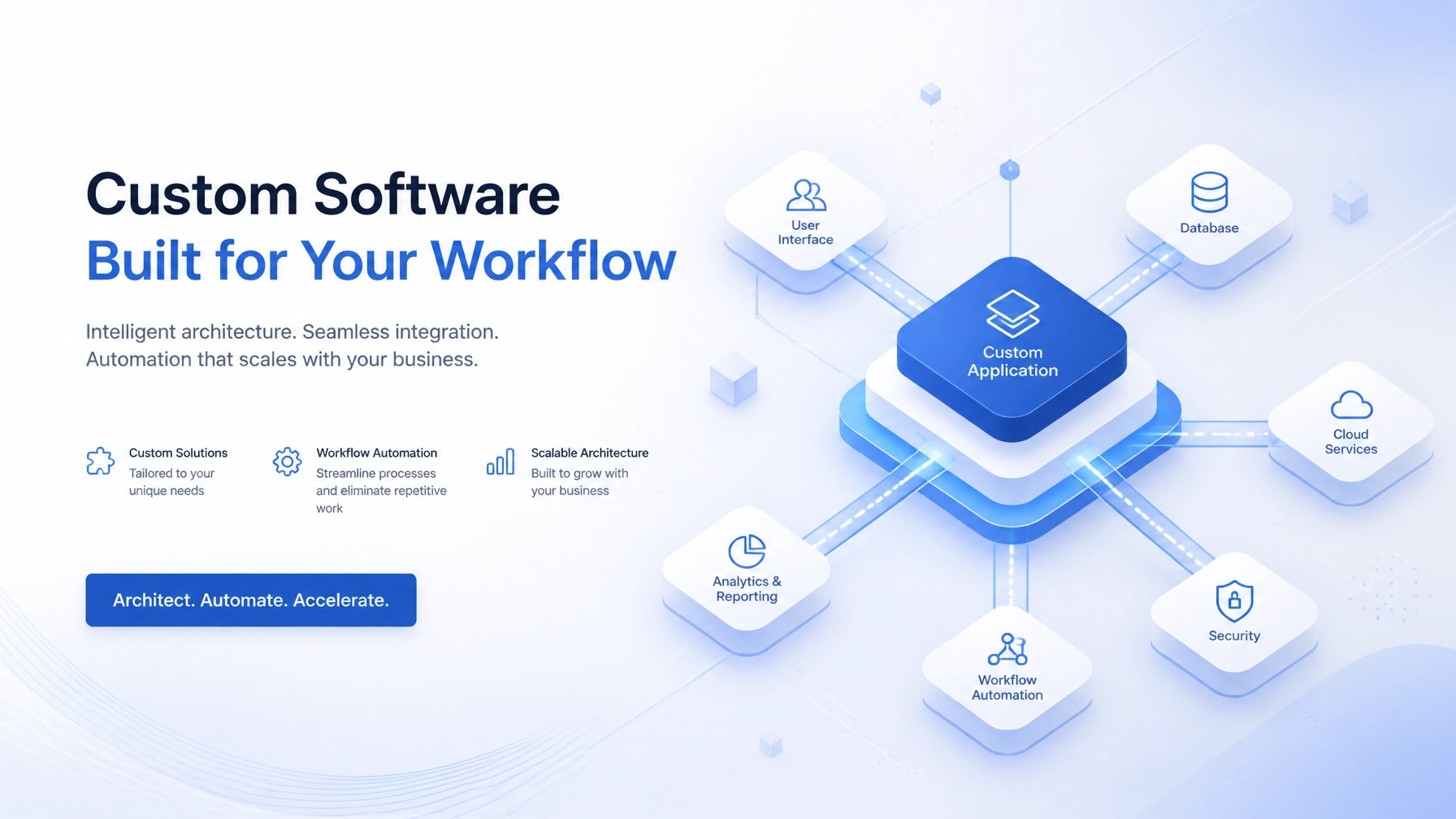
Building a custom enterprise SaaS platform requires moving away from monolithic patchworks toward purposeful, scalable architecture. At Pure Technology Consulting, our work with growing enterprises across healthcare, specialized operations, and fintech highlights four core architectural pillars that create sustainable business value:
1. The Productized Platform Mindset
Treating your internal systems as productized platforms: complete with clear roadmaps, lifecycle management, and commercial telemetry: changes how engineering investments are evaluated. When you connect feature development directly to revenue growth, throughput, and cost-to-serve, technology decisions become tightly aligned with executive strategy.
2. Cloud-Native and Modular Design
Enterprise agility depends on decoupling services. Breaking monolithic applications into independent microservices or modular service layers allows different operational workflows: such as client onboarding, automated scheduling, and compliance verification: to scale and evolve independently without risking system-wide instability.
3. API-First Composition and Data Contracts
Enforcing API-first design ensures that services can be securely composed and integrated across internal teams and external partners. Formal data contracts between services eliminate integration friction, control technical debt, and make iterative updates safe and predictable.
4. Centralized Observability and Automated Pipelines
As workflows scale, operational risk increases. Embedding centralized logging, real-time tracing, and robust CI/CD deployment pipelines directly into the architecture ensures that performance bottlenecks are identified instantly and updates roll out without operational downtime.
Workflow Automation as the Core Operating Engine
Architecture is only as powerful as the workflows it orchestrates. True operational leverage comes from embedding intelligent automation directly into the codebase.
Whether it is automating 70-question clinical intake matching engines inspired by our work with platforms like EHRIO, deploying field-rep accountability and GPS logging for operations teams, or integrating complex telephony and lead attribution for high-ticket service providers, custom automation eliminates human bottlenecks.

When you digitize end-to-end workflows around your exact business rules:
- Cycle times decrease dramatically, accelerating time-to-revenue.
- Human error is minimized, protecting compliance and data integrity.
- Staff are liberated from administrative burdens, allowing them to focus on high-value client relationships and strategic growth.
The Roadmap: From Strategic Discovery to Deployment
Transitioning from a rigid standard stack to a bespoke architecture requires a disciplined, advisory-led roadmap. It begins long before writing code.
- Audit and Discovery: Map your existing operational bottlenecks, data silos, and manual workarounds to identify where custom automation yields the highest ROI.
- Architecture Blueprinting: Define the appropriate cloud-native patterns, data boundaries, and integration strategies tailored to your 3-to-5-year growth targets.
- Iterative Development & Governance: Build with modularity and security at the forefront, utilizing rigorous testing pipelines and cross-functional governance.
- Telemetry and Continuous Optimization: Instrument your platform with real-time feedback loops to continuously refine performance metrics and user experiences.
For leadership teams exploring this transition, our team offers structured discovery sessions to help map your operational ecosystem. You can explore our approach or schedule a discovery call to discuss your organization's unique requirements.
Conclusion: Engineering Your Competitive Future
Custom software architecture is an investment in autonomy. By moving beyond the limitations of off-the-shelf software and designing a platform engineered explicitly around your operating model, you establish a permanent operational moat.
Competitors can copy your marketing strategy or price points, but they cannot replicate an internal technology ecosystem built entirely to accelerate your unique strengths.
Ready to Explore Custom Architecture for Your Enterprise?
If your organization has outgrown standard SaaS tools and is ready to build scalable, high-performance web applications and automated workflows tailored to your exact operating model, let's start a conversation.
- Website: https://puretechconsult.com
- Direct Consultation: Schedule a discovery call with our team
- Phone: +1 (803) 921-0969
Written by
Amin Said, Founder of Pure Technology Consulting LLC
https://puretechconsult.com
Leave a Reply