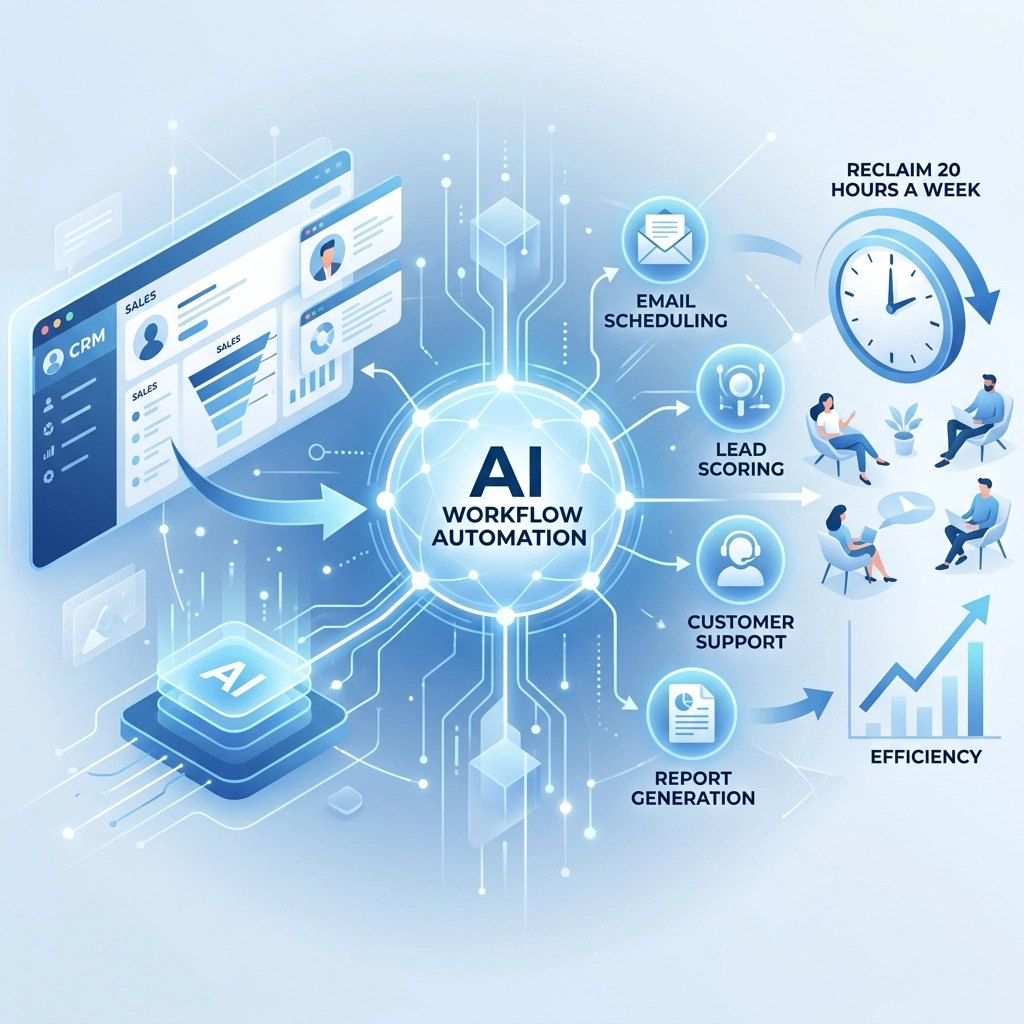
For most high-growth organizations, the Customer Relationship Management (CRM) system is intended to be the "source of truth." Yet, for the executives and teams tasked with maintaining it, the CRM often feels less like a strategic engine and more like an administrative anchor.
When we analyze the operating models of modern professional services: from legal firms to accounting practices: we consistently find a hidden "tax" on productivity. This tax is paid in the form of manual data entry, lead logging, and repetitive follow-up drafting. Research suggests that integrating AI workflow automation into your CRM can boost productivity by 20–40%. In practical terms, for a senior partner or a sales leader, that equates to reclaiming roughly 20 hours every single week.
At Pure Technology Consulting, we view this not just as a technical upgrade, but as a total operational transformation. Reclaiming half of your work week isn't about working faster; it’s about architecting a system that works for you.
The Invisible Leak: Where Your 20 Hours Are Going
Before you can automate, you must audit. Most leaders are surprised to learn where their time actually disappears. It isn’t usually lost to one large task, but rather to the "micro-friction" of daily operations:
- Manual Lead Logging: Taking information from a LinkedIn message or an email and manually creating a contact record.
- Data Enrichment: Searching for a prospect’s company size, current software stack, or recent news to prepare for a call.
- Meeting Synthesis: Spending 30 minutes after every hour-long consultation transcribing notes and assigning follow-up tasks.
- Context Switching: Toggling between the CRM, your inbox, and your project management tools to keep everyone aligned.
By identifying these leaks, we can begin to build a bespoke automation roadmap that targets high-impact, low-disruption wins first.

The Strategic Framework for AI-CRM Integration
To move from a manual workflow to an AI-driven one, we recommend a three-pillar approach. This is the same philosophy we use when building custom web applications and SaaS solutions for our clients in healthcare and finance.
1. The API-First Foundation
For automation to be seamless, your systems must talk to each other without intermediaries. An API-centric strategy ensures that your CRM isn't a silo. Whether you are using a standard platform like Salesforce or HubSpot, or a custom-built internal tool, the goal is to create a "connective tissue" that allows data to flow bi-directionally.
This foundation allows us to implement "Intelligent Workflows": actions that trigger automatically based on client behavior. For example, if a prospect views a proposal three times in 24 hours, the CRM shouldn't just record that; it should trigger an AI to draft a personalized follow-up email and alert the account executive in real-time.
2. Intelligent Data Matching and Intake
One of the most significant time-wasters is the manual intake process. This is a challenge we solved specifically with EHRIO Pro, our proprietary healthcare matching engine and intake solution. While designed for HIPAA-adjacent workflows and complex 70-question intakes, the underlying technology demonstrates the power of custom automation.
By applying similar matching logic to your CRM, we can automatically categorize leads, detect duplicates, and link new contacts to existing accounts based on complex variables, not just email addresses. This eliminates the "data cleanup" sessions that usually haunt Friday afternoons.
3. AI-Powered Content Synthesis
The generative power of AI is best used within the CRM to eliminate the "blank page" problem. Instead of drafting every follow-up from scratch, AI can analyze the notes from your last Zoom call (transcribed and synced automatically) and generate a summary, a list of action items, and a tailored next-step email.
Case Study in Capability: Beyond the Off-The-Shelf
While many "No-Code" tools promise easy automation, they often fall short when faced with complex, multi-stakeholder workflows. High-ticket firms in legal or accounting require more than just a basic connection; they require a bespoke operating model.
Consider how we approached development for our field operations clients. We integrated GPS logging and representative accountability directly into their workflow. This wasn't a standard CRM feature; it was a custom build that transformed how they viewed their data. When you transition from "using a CRM" to "operating through a custom-integrated platform," the 20-hour-a-week savings moves from a goal to a baseline.

High-Impact Use Cases to Implement Now
If you are looking to reclaim time immediately, focus on these four areas:
- Lead Scoring & Routing: Instead of a manual review, let AI analyze historical conversion patterns to prioritize high-value opportunities. This removes the guesswork from lead review.
- Automated Data Enrichment: Use AI to scan the web and automatically populate missing fields: like company size or industry: the moment a lead enters your system.
- Multi-Channel Alerts: Instead of checking the CRM for updates, have real-time intelligence delivered to where you already work (Slack, Teams, or SMS).
- Proposal Generation: Link your CRM data to your document generation tool so that a "Closed Won" status automatically triggers the creation of a tailored contract, pulling in specific deal terms without manual entry.
Transitioning to a Visionary Operating Model
The shift toward AI-powered CRM automation is not merely a trend; it is the new standard for professional services. Organizations that continue to rely on manual data management will find themselves unable to compete with the speed and personalization of AI-augmented firms.
At Pure Technology Consulting, we specialize in bringing these proven capabilities: honed in healthcare and fintech: into the legal and accounting sectors. We don't just "install" software; we architect custom web applications and integrations that fit your specific business logic.
When you remove the administrative drag, you don't just gain 20 hours. You gain the mental bandwidth to focus on strategy, relationship building, and high-level decision-making. You stop being an operator of your CRM and start being a leader of your firm.

Your Roadmap to 20 Extra Hours
Implementation should be phased to minimize disruption. We recommend starting with a workflow audit to identify your highest-friction tasks. From there, we build the API connections, implement the AI synthesis layers, and finally, train your team on the new, streamlined operating model.
If you are ready to stop fighting your CRM and start leveraging it as a strategic asset, we invite you to explore what is possible with a custom-built solution.
Ready to reclaim your time?
Review our video walkthroughs to see our automation logic in action, or schedule a discovery call with our team to begin your workflow audit. Our process is designed to identify the exact levers that will move the needle for your specific operation.
For more insights on how we are transforming professional services through custom software, visit our full blog archive.
Contact Information:
Pure Technology Consulting LLC
Phone: +1 (803) 921-0969
Assistant: Emily
Amin Said, Founder of Pure Technology Consulting LLC
https://puretechconsult.com
Leave a Reply