Amin Said, Founder of Pure Technology Consulting LLC
AI investments often receive attention in the places people can see: the model, the dashboard, the chatbot, or the customer-facing interface.
The less visible integration layer receives far less attention. Yet it is usually the factor that determines whether an automation initiative becomes a dependable operating capability or remains an impressive pilot that never reaches production.
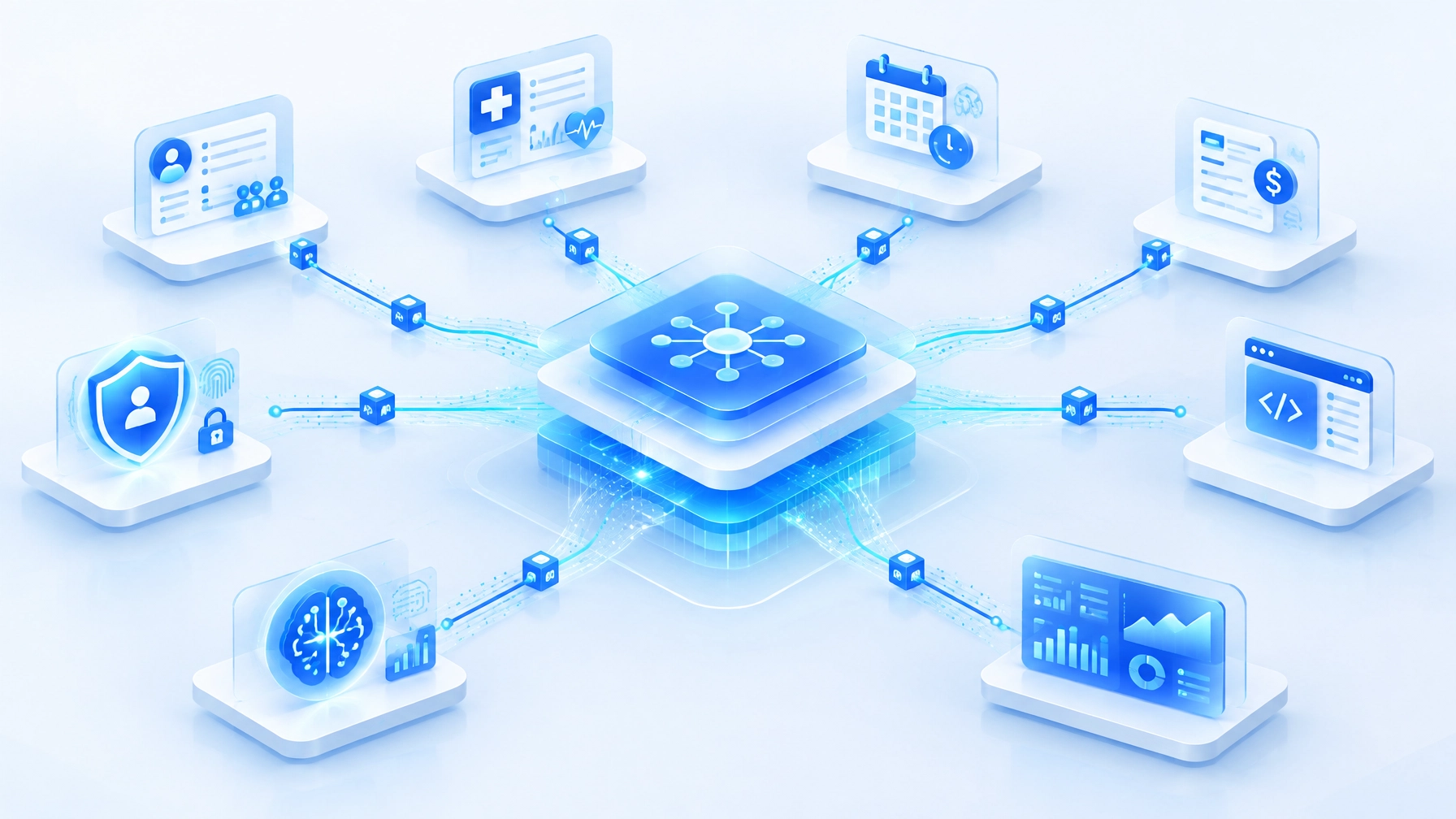
The integration layer includes the APIs, event streams, identity controls, data contracts, and orchestration logic that allow systems to work together. It connects the CRM to scheduling, the EHR to intake, billing to service delivery, and internal applications to the data employees need to act.
Without that layer, AI can generate useful recommendations while the business continues to rely on spreadsheets, email, duplicate data entry, and manual approvals.
Enterprise automation consulting should therefore begin with a practical question:
What must connect for this workflow to produce a measurable business outcome?
The visible AI layer is only one part of the system
A typical automation budget may prioritize:
- AI models and prompt design
- Customer-facing portals
- Executive dashboards
- Chatbots and conversational interfaces
- Automated content generation
- Robotic process automation tools
These capabilities can be valuable. However, they sit on top of a deeper operating structure.
An AI workflow may classify an inbound request, recommend the next action, or summarize a customer conversation. The business still needs reliable mechanisms to:
- Retrieve the right customer or account record
- Confirm that the user has permission to view the data
- Update the correct system of record
- Trigger scheduling, billing, or notification workflows
- Route exceptions to the right employee
- Record what happened for reporting and audit purposes
If those connections are incomplete, the AI layer becomes isolated from the work it is supposed to improve.
That is why an organization can have a capable model, a polished interface, and a promising pilot while employees still copy information manually between systems.

Why automation pilots stall before production
Automation pilots frequently succeed in a controlled demonstration and struggle in daily operations. The reason is often not the AI model. It is the absence of production-grade integration architecture.
One-off connections create fragile workflows
A quick integration may connect two applications for one specific use case. That can be sufficient for a demonstration, but it becomes difficult to maintain when the organization adds another location, service line, user role, or business system.
Point-to-point integrations often create hidden dependencies. A change in one system can break several downstream workflows because there is no stable contract governing how data is exchanged.
A reusable integration layer creates a more durable foundation. Systems can expose governed capabilities through APIs, while business workflows consume those capabilities without depending on internal database structures or undocumented assumptions.
Data has no shared definition
Different systems may use different names, formats, and rules for the same business entity.
A CRM may identify a customer by one field. A scheduling platform may use another identifier. Billing may contain a separate account record. An intake system may use a case number that is not recognized elsewhere.
Without defined data contracts, the automation must guess how records relate to one another. That leads to duplicate records, missing updates, incorrect routing, and reporting that cannot be trusted.
A data contract establishes what a field means, which values are permitted, who owns the information, and how changes are communicated to other systems.
Identity is treated as an afterthought
Automation often touches sensitive information and consequential actions. A workflow that can view a patient intake, assign a field employee, initiate a payment, or update a legal or accounting record must understand identity and authority.
Questions that should be addressed during architecture design include:
- Who can initiate the workflow?
- Which data can each role access?
- Which locations or client accounts are in scope?
- Which actions require approval?
- How are service accounts authenticated?
- Where are access events and changes recorded?
Identity controls are not merely a security feature. They express the operating model inside the software.
Exceptions remain manual and invisible
A workflow that handles only the successful path is not production-ready.
Real operations include incomplete forms, duplicate records, failed API requests, unavailable staff, conflicting data, missing documents, and ambiguous customer requests. If the system does not define what happens next, employees will create workarounds outside the platform.
A mature integration layer includes retry logic, alerts, dead-letter queues, human review, escalation paths, and a clear history of each workflow event.
What the integration layer should contain
A practical architecture usually combines several capabilities rather than relying on one automation tool.
APIs that expose reusable system capabilities
APIs allow applications to exchange information through defined interfaces. Instead of connecting directly to a database or building a custom script for every workflow, the organization can create governed access to customers, appointments, invoices, cases, or operational records.
A layered API approach commonly separates:
- System APIs: Access to CRM, EHR, billing, scheduling, identity, and other systems of record
- Process APIs: Business logic that combines data and actions across systems
- Experience APIs: Interfaces designed for portals, dashboards, mobile applications, or partner tools
This structure makes integrations easier to reuse as the organization grows.
Event streams that communicate change
Not every workflow should wait for a user to press a button.
Events can communicate that a new lead was created, a document was uploaded, an appointment was completed, a payment failed, or a service request changed status. Event-driven architecture allows systems to respond to business activity without creating tightly coupled chains.
For example, a completed appointment might trigger a review request, update a customer record, create a billing task, and refresh a management dashboard. Each action can subscribe to the relevant event while remaining operationally distinct.
Identity and permission services
Authentication verifies who is using a system. Authorization determines what that person or service is allowed to do.
A robust automation architecture applies both consistently across custom applications, APIs, dashboards, and background workflows. Role-based permissions, tenant isolation, audit logs, and secure credentials become especially important for multi-location businesses and white-label platforms.
Orchestration and business rules
Integrations become useful when they are organized around a business process.
The orchestration layer determines what happens, in what order, under which conditions, and with what approval requirements. It may coordinate intake, qualification, scheduling, service delivery, billing, notifications, and reporting.
This is where custom web application development becomes strategically valuable. A purpose-built application can give employees a clear queue, show exceptions, enforce the right business rules, and provide visibility across otherwise disconnected systems.

Where AI belongs in the operating model
AI is most effective when it is assigned work that benefits from interpretation, classification, summarization, or recommendation.
Examples include:
- Classifying an inbound request
- Extracting information from a document
- Summarizing a call or conversation
- Recommending a provider, employee, or service category
- Drafting a customer response
- Identifying missing information
- Prioritizing follow-up based on defined criteria
Deterministic software remains better suited to permissions, calculations, record updates, required fields, billing rules, and irreversible actions.
The strongest design is often a hybrid:
- A system receives an event.
- The integration layer retrieves authorized context.
- AI interprets or recommends an action.
- Business rules validate the recommendation.
- A human approves it when risk or judgment requires review.
- The system executes the action and records the outcome.
This structure allows AI to contribute intelligence without giving an opaque model uncontrolled authority.
PTC’s platforms demonstrate the integration-first approach
Pure Technology Consulting has applied these architectural principles across several proprietary builds. They are not generic products that replace every organization’s systems. They serve as evidence of the integration, workflow, and product engineering capabilities available for high-ticket custom engagements.
AI Local Boost demonstrates multi-location Google Business Profile automation, tenant-aware workflows, role-based access, partner configuration, and connections between local visibility activity and broader business systems.
ChainHQ demonstrates location-aware scheduling and assignment logic for operators managing distributed teams and multiple operating environments.
EHRIO Pro demonstrates healthcare intake, provider-matching engines, 70-question assessments, scheduling logic, and HIPAA-adjacent workflows where data structure and controlled handoffs are essential.
FTP Inform demonstrates secure file ingestion, schema validation, exception handling, workflow orchestration, telephony integrations, and auditability for debt operations.
PTC’s broader work has also included D2D Tracking for GPS-based field accountability, debt agency telephony integrations with call attribution, and AI Local Boost’s Google Business Profile automation. These systems address different industries, but the underlying principle is consistent: the operating layer must connect people, data, decisions, and systems in a governed way.
That same capability can transfer into legal, accounting, healthcare, professional services, and complex local businesses without starting from zero.
How to scope an automation initiative that can scale
The integration layer should be part of the initial roadmap, not a phase added after the AI pilot.
A practical enterprise automation consulting engagement should examine:
- Current systems and ownership
- Existing APIs and integration limitations
- Core business entities and data definitions
- Identity and permission requirements
- High-value workflow triggers
- Approval and exception paths
- Reporting and audit requirements
- Baseline measures for cycle time, error rates, and manual effort
The first implementation does not need to connect every system in the organization. It should focus on one meaningful workflow with clear boundaries and measurable outcomes.
For a growth-focused service business, that might be intake through scheduling and billing. For a multi-location operator, it may be assignment, status tracking, and reporting. For a SaaS licensing or white-label partner, it may be tenant management, role-based access, and reusable workflow infrastructure.
The goal is to create a strong architectural pattern that can be extended, not another isolated automation that becomes technical debt.
Build the layer that makes AI useful
AI can accelerate work, but integration determines whether that acceleration reaches the business.
When APIs, event streams, identity, data contracts, and orchestration are designed as first-class capabilities, custom web applications and AI workflows become more reliable, measurable, and adaptable. Leaders gain visibility into how work moves. Employees spend less time coordinating systems. New locations, services, and partners can be added without recreating the architecture each time.
The right investment is not simply an AI feature. It is an operating layer that allows intelligence to move through the organization safely and consistently.
Pure Technology Consulting helps growth-focused businesses, operationally constrained service companies, and SaaS partners design and build that layer through custom web application development, AI workflow automation, and enterprise automation consulting.
To discuss a workflow audit or integration roadmap, book a discovery call, visit https://puretechconsult.com, or call +1 (803) 921-0969.
Amin Said, Founder of Pure Technology Consulting LLC
https://puretechconsult.com
Leave a Reply