Written by Amin Said, Founder of Pure Technology Consulting LLC
For a growing healthcare group, intake is rarely just a form. It is the first operational decision point in the patient journey.
The information collected during intake can determine eligibility, urgency, location, provider fit, scheduling options, insurance requirements, and the next action for staff. When that information remains trapped in PDFs, emails, spreadsheets, or disconnected software, administrative teams are forced to interpret and re-enter the same data repeatedly.
EHRIO Pro was developed as a proof of concept for solving that problem through custom software architecture.
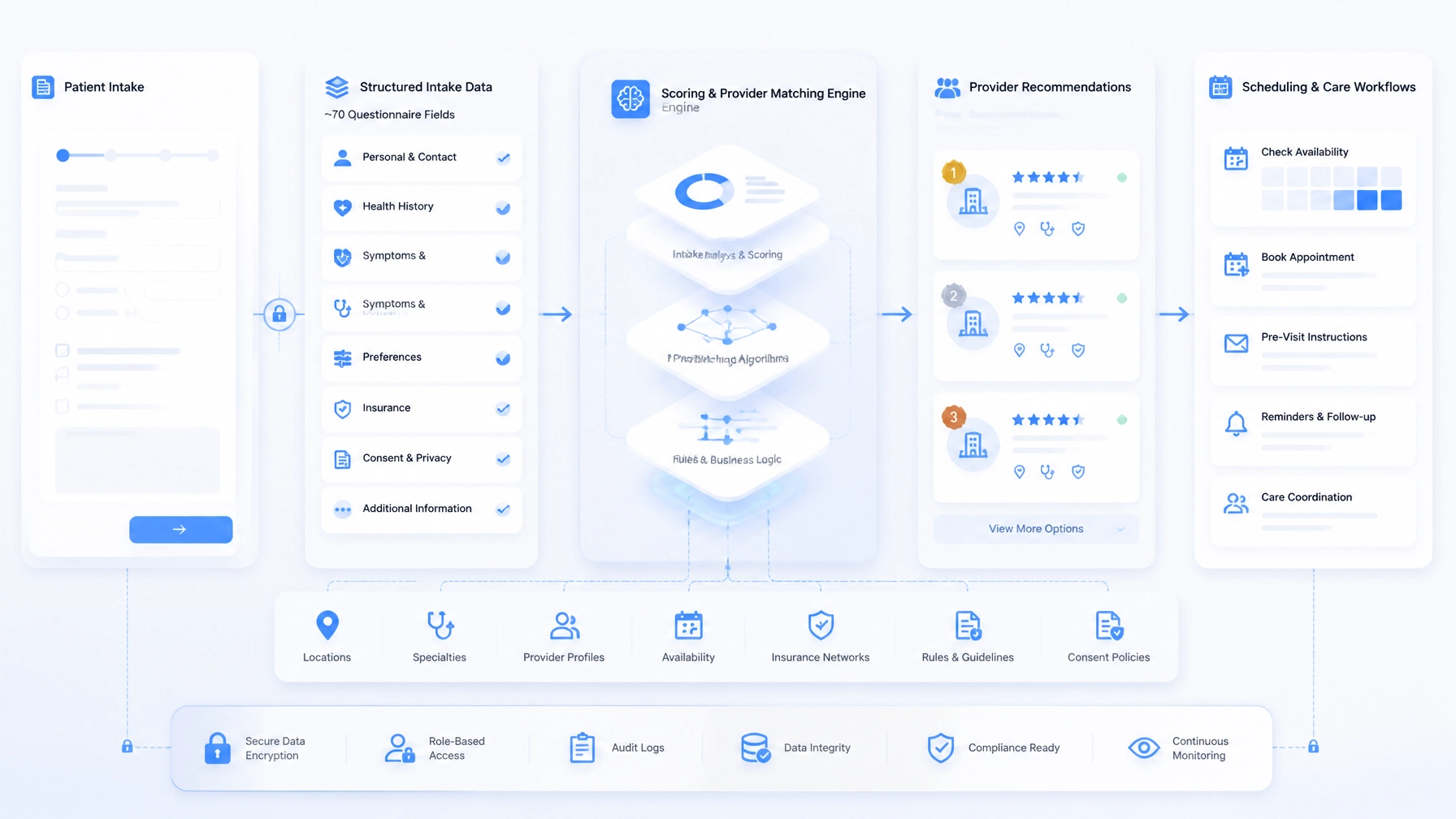
The system demonstrates how Pure Technology Consulting can turn a complex healthcare intake process into a structured, auditable workflow that connects patient data with provider-matching logic, scheduling, EHR and CRM integrations, and multi-location governance.
This is not a case study about adding another form to an existing software stack. It is about designing an operating layer around the way a healthcare organization actually works.
The operational challenge: intake data without workflow intelligence
Multi-location healthcare groups often manage different specialties, provider schedules, payer requirements, and operating procedures across several sites.
A chiropractic group may need to route a new patient based on injury type, treatment goals, insurance, and geographic preference. A physical therapy organization may need to consider referral details, treatment specialty, appointment availability, and location capacity. A behavioral health practice may need to account for modality, age range, provider specialization, availability, and patient preferences.
A generic intake form can collect some of this information. It cannot reliably convert that information into a next-best operational action.
Without an intelligent workflow layer, staff members must:
- Review lengthy patient questionnaires manually.
- Determine which location can serve the patient.
- Compare provider credentials and specialties.
- Check insurance or eligibility information.
- Search multiple calendars for availability.
- Re-enter information into an EHR, CRM, or scheduling system.
- Track exceptions through email, notes, or informal team communication.
The issue is not simply administrative inefficiency. Manual interpretation creates inconsistent decisions, incomplete records, avoidable delays, and limited visibility into how intake cases move through the organization.
EHRIO Pro was designed to address this gap by connecting structured data capture to configurable decision logic.
Structured intake that becomes usable operational data
The first architectural decision was to treat intake as a data model rather than a static questionnaire.
The proof-of-concept included a structured intake journey with approximately 70 questions. The purpose was not to make the form longer. It was to capture the details required for downstream routing without asking staff to reconstruct the patient’s situation later.
The intake framework was designed to support:
- Patient demographics and contact information.
- Care needs and presenting concerns.
- Insurance and eligibility details.
- Location and scheduling preferences.
- Provider preferences where relevant.
- Consent and communication preferences.
- Referral and documentation requirements.
- Structured answers that can trigger additional questions.
Conditional logic allows the system to show relevant questions based on previous responses. For example, a patient who selects a particular service type may receive additional questions related to history, treatment requirements, or scheduling constraints.
This creates a normalized intake record. Instead of storing the patient’s information as an unstructured document, the platform stores discrete fields that can be validated, scored, filtered, and passed into workflow automation.
That distinction is central to the architecture.
A form collects information. A structured intake engine creates information that other systems can use.

A matching engine built around constraints and fit
Once intake data is structured, the next challenge is deciding how a patient should be routed.
The provider-matching engine in EHRIO Pro was designed around two types of logic: hard constraints and weighted preferences.
Hard constraints determine whether a provider or location is eligible for the case. Examples may include:
- Service or specialty requirements.
- Geographic or location boundaries.
- Accepted payer or insurance conditions.
- Provider availability.
- Age or program eligibility.
- Licensure or operational restrictions.
Weighted preferences help rank eligible options. These may include:
- Preferred appointment times.
- Patient-requested provider characteristics.
- Telehealth or in-person preferences.
- Distance from the patient.
- Current provider capacity.
- Continuity-of-care considerations.
This distinction prevents the system from treating every preference as an absolute rule. If a patient prefers a specific appointment time but no provider is available during that window, the system can present the next-best options rather than returning no result.
The engine can also support configurable scoring. Each eligible provider receives a score based on the organization’s operating model, and the system can return ranked recommendations for staff review or automated scheduling.
The goal is not to remove judgment from healthcare operations. It is to ensure that staff judgment begins with consistent, relevant information instead of a blank inbox.
From recommendation to workflow automation
Matching is only valuable when it leads to a clear next action.
EHRIO Pro connects matching logic to workflow states that help intake teams understand what happens next. A case may move through stages such as:
- Intake started.
- Intake completed.
- Information validated.
- Eligibility or documentation review required.
- Provider recommendations generated.
- Staff review completed.
- Appointment requested or scheduled.
- EHR and CRM records synchronized.
- Follow-up task created.
These states allow organizations to replace informal handoffs with visible workflow ownership.
For example, a case that lacks a required document can be routed to an administrative queue. A case with a strong provider match can be prepared for scheduling. A case requiring human review can be flagged without blocking every other intake in the system.
Automations can also trigger communications, internal tasks, reminders, and status updates. This reduces the number of routine actions that intake teams must perform manually while preserving human review where the decision carries clinical, financial, or compliance significance.
The result is a workflow that supports the intake team instead of simply adding another destination for data entry.
Integrating with EHR and CRM systems
A custom intake platform cannot operate as an isolated application. Its value depends on how well it connects to the systems already used by the organization.
The EHRIO Pro proof of concept was structured as an orchestration layer between intake, matching, scheduling, EHR, CRM, and reporting processes.
Integration responsibilities may include:
- Creating or updating patient and lead records.
- Synchronizing intake completion status.
- Passing appointment details to scheduling systems.
- Sending qualified cases to CRM pipelines.
- Returning provider and location assignments.
- Recording communication and follow-up events.
- Capturing integration errors for review.
The architecture separates the user experience from the underlying integration logic. This allows the intake workflow to evolve without rebuilding every external connection.
It also creates a clearer source-of-truth strategy. Each system can remain responsible for the data it manages best while the orchestration layer coordinates the transitions between them.

HIPAA-adjacent access controls and auditability
Healthcare workflow automation requires more than secure login screens. It requires clear decisions about who can access which information, in what context, and for what purpose.
EHRIO Pro was designed with HIPAA-adjacent workflows and granular access controls in mind. The appropriate implementation depends on the client’s environment, data classification, vendors, contracts, and compliance obligations, but the architecture supports important control patterns.
These include:
- Role-based access for intake staff, providers, administrators, and managers.
- Location-aware permissions for multi-site organizations.
- Separation between operational intake data and clinical records.
- Limited access for users who do not need full patient details.
- Consent and status tracking.
- Audit logs for record access and workflow changes.
- Controlled overrides when staff need to bypass a standard rule.
- Integration monitoring and error visibility.
Auditability is especially important in a matching workflow. If a case is routed to a particular provider, the organization should be able to understand which rules, data points, or staff actions influenced that decision.
A system that records only the final outcome provides limited operational insight. A system that records the event history creates a defensible trail for quality improvement, governance, and troubleshooting.
Multi-location rollout without multiplying complexity
A multi-location system should centralize governance without erasing local operating context.
The EHRIO Pro architecture supports a shared platform model in which a healthcare group can define organization-wide rules while still configuring location-specific details.
Central governance may include:
- Standardized intake questions.
- Shared provider and service taxonomies.
- Common status definitions.
- Organization-wide access policies.
- Consistent reporting structures.
- Centralized workflow and integration monitoring.
Location-level configuration may include:
- Local providers and specialties.
- Appointment availability.
- Service areas.
- Payer participation.
- Local scheduling rules.
- Location-specific staff permissions.
- Local escalation workflows.
This model makes expansion more repeatable. Opening a new location should involve configuring a governed operating model, not creating a disconnected collection of forms, calendars, spreadsheets, and manual workarounds.

What this proof of concept demonstrates
EHRIO Pro is evidence of Pure Technology Consulting’s ability to design complex, domain-specific systems for organizations where workflow accuracy and data integrity matter.
The key capabilities demonstrated by the architecture include:
- Structured, conditional patient intake.
- Scoring and rules-based provider matching.
- Workflow automation from intake through scheduling.
- EHR and CRM integration.
- Role- and location-aware access controls.
- Audit-friendly workflow history.
- Multi-location governance.
- Operational dashboards and exception handling.
- Scalable foundations for additional specialties and locations.
These same architectural principles can support custom systems for chiropractic groups, physical therapy organizations, counseling and behavioral health practices, and specialty medical clinics.
At Pure Technology Consulting, we bring proven capabilities from healthcare, field operations, fintech, and local SEO automation into bespoke software engagements. EHRIO Pro is one example of how a custom platform can be engineered around a high-value operating model rather than forcing the business to adapt to generic software.
Build the workflow your organization actually needs
The right technology investment begins with a clear understanding of the operational decision being improved.
For healthcare groups, that may mean reducing intake rework, improving provider utilization, standardizing multi-location processes, or creating a more reliable path from first contact to scheduled care.
If your organization has complex intake requirements, disconnected systems, or inconsistent routing between locations, Pure Technology Consulting can help map the current workflow and define a practical custom development roadmap.
Ready to scope a custom healthcare workflow? Contact Pure Technology Consulting at +1 (803) 921-0969 or book a discovery consultation.
Amin Said, Founder of Pure Technology Consulting LLC
https://puretechconsult.com
Leave a Reply