By Amin Said, Founder of Pure Technology Consulting LLC
For compliance-sensitive operations, moving a file from one system to another is not simply a transfer problem. It is a governance problem.
A partner file may contain account records, payment data, call activity, customer identifiers, or operational instructions. Once that file enters an organization’s environment, leaders need to know where it came from, whether it met the expected schema, who owns exceptions, which systems received the data, and whether downstream records can be defended later.
That was the design challenge behind FTP Inform, a proprietary proof-of-concept developed by Pure Technology Consulting for high-volume, file-driven operations in debt and fintech environments.
The purpose was not to create another generic file-monitoring utility. The deeper objective was to demonstrate how a custom web application and automation engine could establish a governed data exchange layer between external partners, internal operations, telephony systems, CRMs, ledgers, and reporting environments.
This case study examines the architectural decisions behind that approach and what they reveal about building scalable, complex systems for high-ticket organizations.
The strategic problem: file movement without operational governance
Many organizations still depend on partner files delivered through SFTP, secure portals, shared folders, email attachments, or scheduled exports. The transfer may be encrypted, but encryption alone does not answer the operational questions that matter.
A compliance-sensitive operator also needs to understand:
- Which partner submitted the file?
- Was the file received within the expected service window?
- Did it match the partner’s approved schema?
- Which records failed validation, and why?
- Who is responsible for resolving the exception?
- Was the file processed, rejected, reprocessed, or superseded?
- Which downstream systems consumed the validated data?
- Can the organization reconstruct the full sequence during an audit or dispute?
Without these controls, file exchange becomes dependent on tribal knowledge, inbox searches, scripts, and informal escalation. The organization may still be processing data, but it lacks a reliable operating model for governing that data.
FTP Inform was designed around a different premise: every file should be treated as a governed business event, not an isolated object in a folder.
A governed exchange architecture, not just an ingestion tool
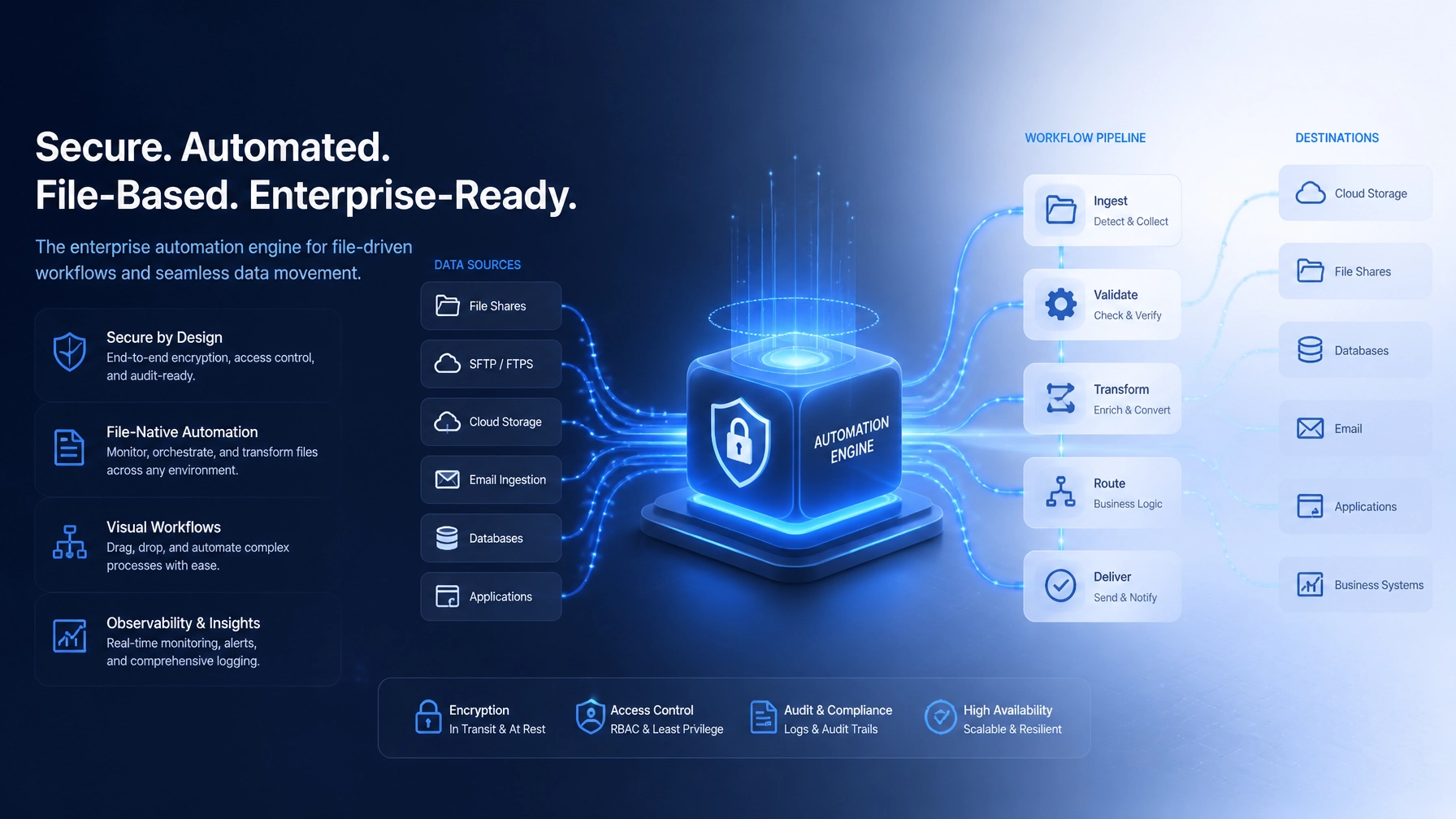
The architecture begins at the partner boundary and continues through validation, exception management, deterministic routing, delivery, and audit.

The system separates the exchange lifecycle into controlled stages:
- Secure partner ingestion
- File and schema validation
- Transformation into a canonical data model
- Business-rule evaluation
- Exception classification and ownership
- Deterministic routing
- Downstream delivery and reconciliation
- Audit and service-level reporting
This structure gives operations and technology teams a shared view of what happened to a file and what should happen next.
The architecture also supports the principles used in broader enterprise automation consulting: isolate external inputs, make decision rules explicit, preserve lineage, and ensure that every failure has a defined response.
Config-driven partner onboarding creates repeatable control
One of the most important design choices was making partner onboarding configuration-driven wherever possible.
Each partner may have different requirements for:
- File naming conventions
- Delivery windows
- Delimiters and encoding
- Required columns
- Data types and formatting
- Account identifiers
- Balance and status rules
- Telephony fields
- Accepted error tolerances
- Destination systems
- Notification recipients
- Retention and reprocessing policies
A rigid, hard-coded integration requires engineering work for every variation. A configuration-driven model instead allows the system to represent partner requirements as controlled rules and metadata.
That does not eliminate the need for engineering judgment. Some integrations still require custom transformations or bespoke logic. However, the approach creates a repeatable foundation for onboarding new partners without rebuilding the entire exchange process each time.
For a growing debt, fintech, or multi-location operation, that distinction matters. The organization can standardize governance while still accommodating legitimate partner differences.
This is a central principle of effective business process automation consulting: automate the repeatable structure while keeping exceptions visible and intentional.
Validation is a governance control
In FTP Inform, validation is not treated as a simple pass-or-fail technical check. It is part of the organization’s control environment.
The validation layer can evaluate:
- File type and size
- Filename and delivery metadata
- Required fields
- Data type and format
- Duplicate submissions
- Referential integrity
- Field-level business rules
- Invalid balances or statuses
- Missing consent or authorization indicators
- Partner-specific constraints
A file may be structurally valid but operationally unacceptable. For example, it may contain all required columns while including an invalid account status or a timestamp outside the allowed processing window.
That is why the architecture separates technical validation from business-rule validation. Both are important, but they answer different questions:
- Technical validation: Can the system safely read and process the file?
- Business validation: Should the organization accept and act on the information?
This distinction supports stronger governance and more defensible records. It also provides a clear basis for communicating issues back to the partner rather than allowing ambiguous data to move silently through the organization.
Exception governance gives every issue an owner
A mature exchange architecture must assume that some files and records will fail validation. The goal is not to pretend exceptions do not exist. The goal is to govern them.
FTP Inform treats exceptions as managed operational work. Each exception can be categorized, assigned, prioritized, tracked, and resolved according to defined service-level expectations.
A practical exception model can include:
- Ownership: partner, internal operations, compliance, finance, or technology
- Severity: blocking, material, informational, or recoverable
- SLA: expected response and resolution time
- Status: new, acknowledged, in progress, awaiting partner, approved, resolved, or rejected
- Evidence: original file, validation result, affected records, notes, and resolution history
- Reprocessing decision: whether the original file can be corrected and replayed
This gives leaders visibility into more than file volume. They can see whether a partner repeatedly misses a delivery window, whether a schema change is creating recurring exceptions, or whether a particular issue is consuming internal capacity.
That service-level visibility is one of the strongest benefits of a governed data exchange model. It connects technical processing with operating performance.
Deterministic routing connects data to action
Once data passes validation, the next question is where it should go and under which rules.
FTP Inform uses deterministic routing logic so that the path from an accepted file to downstream systems is explicit and repeatable. Routing may be based on partner, portfolio, jurisdiction, account type, status, business unit, or processing priority.
Potential destinations include:
- Collection or servicing CRMs
- Telephony and dialer systems
- Payment and accounting ledgers
- Reporting databases
- Data warehouses
- Compliance monitoring systems
- Partner-facing delivery folders
- Internal dashboards and operational queues
Deterministic rules are valuable because they reduce ambiguity. Instead of relying on a user to remember which folder or system receives a specific file, the architecture records the routing decision as part of the workflow.
This is also where custom software development can outperform generic SaaS. Off-the-shelf platforms may support basic imports, but they often lack the organization-specific decision logic required to coordinate multiple systems and stakeholders.
Telephony and call attribution require trustworthy upstream data
In debt and fintech operations, file exchange often connects directly to telephony activity.
Call detail records may need to be associated with:
- Customer or account identifiers
- Agent or representative IDs
- Campaigns
- Call outcomes
- Call timestamps
- Duration
- Contact attempts
- Promises to pay
- Disposition codes
If the upstream file is incomplete, duplicated, or incorrectly mapped, downstream call attribution becomes unreliable. A CRM may show activity against the wrong account. A ledger may not reconcile with the operational record. A compliance report may lack the evidence required to explain how a contact event was classified.
FTP Inform’s governed approach creates a controlled path from partner file to attributed operational record. The architecture can preserve the original source file, normalized record, transformation rules, routing decision, and downstream delivery status.
That lineage helps the organization answer a critical question: How did this final record get here?

Audit trails turn processing history into evidence
An audit trail is most valuable when it records business context, not just technical events.
For each file and processing cycle, a governed exchange architecture should be able to capture:
- Source partner and connection
- Receipt timestamp
- File name and integrity information
- Validation results
- Transformation version
- Exceptions and ownership
- Approval or rejection decisions
- Routing outcomes
- Downstream delivery confirmations
- Reprocessing activity
- User and system actions
This creates a defensible record for internal reviews, partner disputes, compliance inquiries, and operational troubleshooting.
It also supports better executive reporting. Instead of asking whether files are “working,” leaders can evaluate delivery reliability, exception aging, partner performance, processing throughput, and the operational consequences of data-quality issues.

What FTP Inform demonstrates about custom systems
FTP Inform is a proof-of-concept for a broader capability: designing custom systems around the real operating model of an organization.
The build demonstrates how custom web application development, integration architecture, workflow governance, and data engineering can work together to create a system that is:
- Configurable across multiple partners
- Secure at the exchange boundary
- Explicit about validation and routing
- Transparent about exceptions
- Connected to operational systems
- Measurable through service-level reporting
- Structured for future automation and AI enrichment
AI can add value later through anomaly detection, partner behavior analysis, exception prioritization, or intelligent document and data classification. However, AI-powered business systems still require governed inputs and clear decision boundaries. An AI workflow cannot compensate for unclear ownership, incomplete lineage, or inconsistent source data.
That is why our approach to bespoke AI solutions, AI consulting services, and digital transformation consulting begins with the operating model and data foundation.
When a governed data exchange architecture is the right investment
This approach is especially relevant when an organization:
- Receives recurring files from multiple external partners
- Operates across CRMs, telephony platforms, ledgers, and reporting tools
- Handles sensitive financial or customer information
- Needs defensible processing records
- Has recurring schema and delivery variations
- Requires clear exception ownership and escalation
- Is outgrowing scripts, inbox-based workflows, or disconnected imports
- Needs automation designed around its own rules rather than generic assumptions
For high-volume operators, the investment is not only about moving data faster. It is about creating a controlled operating layer that makes data exchange observable, accountable, and scalable.
Scope your next automation initiative
Pure Technology Consulting builds custom software and automation systems for organizations with complex workflows, multiple stakeholders, and meaningful governance requirements. FTP Inform illustrates how we bring proven capabilities from fintech, debt operations, healthcare, field operations, and local SEO into bespoke technology engagements.
If your organization is managing partner files, exception queues, telephony data, CRM updates, or ledger integrations through fragmented processes, request a workflow audit or book a discovery conversation. We can help map the current exchange model, identify control gaps, and define a practical roadmap for a custom solution.
Learn more about our approach to custom software development for complex operations or visit https://puretechconsult.com.
For direct inquiries, contact Pure Technology Consulting at +1 (803) 921-0969.
Amin Said, Founder of Pure Technology Consulting LLC
https://puretechconsult.com
Leave a Reply