Amin Said, Founder of Pure Technology Consulting LLC
This representative engagement illustrates how Pure Technology Consulting approaches custom web application development for a growing physical therapy group. The organization had four clinics, approximately 40 staff members, and a referral-driven growth model. Its clinical and administrative tools each performed a useful function, but they did not operate as one coordinated system.
The result was familiar across locations: staff entered the same information more than once, referral sources were difficult to attribute, appointment capacity was not consistently visible, and leadership lacked a reliable view of intake-to-visit performance.
The objective was not to replace every existing platform. It was to create a governed operating layer connecting intake, referrals, scheduling, integrations, and reporting.
The operational context: four clinics, several disconnected workflows
The group received referrals primarily from physician offices, orthopedic practices, employers, and existing patient relationships. Intake was handled through a combination of phone calls, faxed documents, printed forms, and email attachments.
Scheduling occurred in one system. Clinical documentation lived in an EMR or EHR. Billing and claims activity moved through a third platform. Referral sources were tracked manually in spreadsheets, often after the patient had already entered care.
This created several forms of operational drag:
- Front-desk staff repeatedly re-entered demographic and insurance information.
- Referral source data was incomplete or inconsistent.
- A referral could remain uncontacted without a clear escalation path.
- Schedulers lacked a unified view of provider skills and location capacity.
- Cancellations and no-shows created open appointment slots that were difficult to recover.
- Leadership could see activity in individual systems but not the complete operational journey.
The business had software. What it lacked was an integrated operating model.
The architecture decision: one operating layer instead of point fixes
The first discovery question was not, “Which task should we automate?” It was, “Where should the workflow become structured and measurable?”
A series of isolated point fixes could have added an online form, a scheduling plug-in, or another referral spreadsheet. That approach would have improved individual steps without solving the handoffs between them.
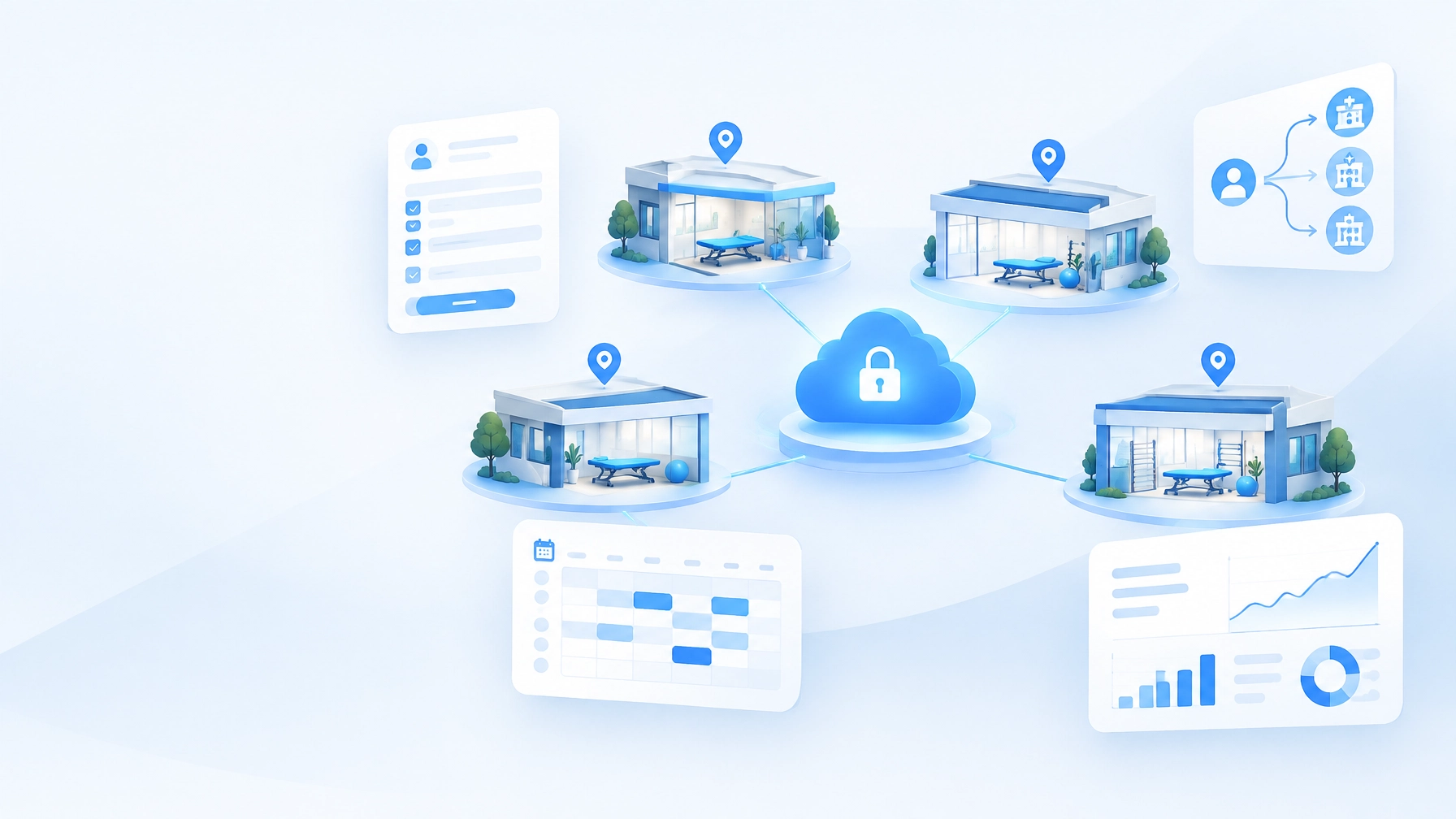
The recommended architecture was a custom web application that would serve as the workflow and orchestration layer while allowing the existing EMR/EHR, clearinghouse, scheduling, and billing systems to remain in place.
The core design included:
- A shared patient and referral data model.
- Explicit workflow states from referral received through first visit and billing handoff.
- Integration services for inbound and outbound data exchange.
- Role-based access for front-desk staff, clinicians, location managers, billing teams, and administrators.
- Audit-oriented activity history for key record changes.
- Dashboards based on operational events rather than manually assembled reports.
This model also created a clearer boundary around protected health information. Sensitive data would be minimized where possible, transmitted through controlled channels, restricted by role, and logged when accessed or changed. These safeguards support responsible HIPAA-adjacent workflow design, but they do not constitute a blanket compliance guarantee. A production deployment would still require a client-specific security, legal, vendor, and compliance assessment.
Designing the intake and referral data model

The intake experience was designed as a guided workflow rather than a static digital version of a paper packet.
Patients could complete questions related to:
- Medical history and current condition.
- Insurance coverage and member information.
- Consent and communication preferences.
- Referring physician or organization.
- Preferred clinic location and scheduling availability.
- Relevant symptoms, limitations, and treatment goals.
Conditional logic displayed questions based on earlier responses. For example, insurance questions could change based on coverage type, while clinical history prompts could expand when a patient identified a prior surgery or related condition.
This approach reduced unnecessary questions while producing more structured information for staff review.
The referral record connected the patient to the originating physician office or referral source. Each referral could move through defined states such as:
- Received.
- Awaiting patient contact.
- Intake incomplete.
- Ready for scheduling.
- Scheduled.
- First visit completed.
- Closed, declined, or lost.
This gave the organization a consistent way to identify where referrals stalled and which sources generated completed evaluations rather than simply sending paperwork.
The design drew on proof-of-concept patterns from PTC’s work on EHRIO Pro, including a 70-question conditional intake and provider-matching engines. Those capabilities were treated as architectural evidence, not as a packaged product being sold to the physical therapy group.
Connecting the EMR, clearinghouse, and billing workflow
The custom application did not attempt to become the clinical record or claims system. Instead, it created a controlled handoff between operational intake and downstream platforms.
Depending on the capabilities of the existing vendors, integration work could include:
- Sending verified demographic and insurance data to the EMR/EHR.
- Receiving appointment or patient identifiers from the existing system.
- Submitting eligibility requests through an approved insurance or clearinghouse connection.
- Returning eligibility status, payer details, or follow-up requirements to the intake queue.
- Passing completed intake information to the appropriate clinical workflow.
- Triggering billing readiness after required documentation and visit milestones were met.
Integration discipline was especially important when systems did not share identical data structures. A payer name might be represented differently in the intake form, EMR, and clearinghouse. Patient matching required controlled identifiers and duplicate-handling rules. Failed requests needed retry logic and human review rather than silently disappearing.
PTC’s work on FTP Inform provided a relevant proof point for governed data exchange with external systems. The lesson was straightforward: integrations should be observable, permissioned, recoverable, and designed around clear ownership of each data field.
Intelligent scheduling across locations and provider skill sets

The scheduling layer used rules to recommend suitable appointment options without removing human judgment from the process.
The rules could account for:
- Patient location preference.
- Clinic operating hours.
- Provider availability.
- Provider skill sets and treatment specialties.
- Required visit type or evaluation category.
- Room and resource constraints.
- Existing appointment patterns.
- Travel or access considerations where relevant.
The system could identify viable options across all four clinics rather than relying on a single location’s calendar. Staff could still override recommendations, but the reason for an override could be recorded for future workflow refinement.
Assignment and scheduling logic patterns proven in ChainHQ informed this design. Again, ChainHQ was referenced as evidence of PTC’s ability to build complex assignment logic, not marketed as a product for physical therapy organizations.
The workflow also included cancellation and no-show recovery:
- Open slots were flagged for review.
- Patients with suitable preferences could be placed into recovery queues.
- Staff received prioritized follow-up tasks.
- Repeated no-shows could trigger an alternate scheduling or confirmation process.
- Recovered appointments were tracked separately from ordinary bookings.
The goal was not to promise a specific utilization increase. It was to make recoverable capacity visible and actionable.
Operations dashboards for measurable improvement
A leadership dashboard consolidated the operational measures that had previously been distributed across spreadsheets and individual systems.
The first version focused on four questions:
How efficiently are referrals converting?
The dashboard displayed referral volume by source, location, and period, along with progression from referral received to intake completion, scheduled evaluation, and completed first visit.
How long does intake take?
Cycle-time reporting measured the elapsed time between referral receipt, completed intake, eligibility review, scheduling, and first visit. Teams could distinguish delays caused by missing patient information from delays caused by scheduling capacity.
Where is capacity available?
Utilization views showed booked versus available appointment blocks by clinic, provider, visit type, and time period. This gave managers a basis for reallocating attention across locations.
Where are referrals or appointments being lost?
The system surfaced incomplete intakes, uncontacted referrals, failed eligibility checks, cancellations, and no-shows requiring follow-up.
Illustrative outcomes and measurement discipline
Because this is a representative case study rather than a published client performance report, the following ranges are planning assumptions, not guaranteed results.
For a four-clinic organization with approximately 40 staff members, a reasonable measurement window would be 8–12 weeks after stabilization, compared with a documented 4–8 week pre-launch baseline.
Depending on referral volume, adoption, and integration quality, comparable engagements may target:
- A reduction of approximately 10–25 front-desk administrative hours per week across the group.
- A reduction of roughly 1–3 business days in the intake-to-first-visit cycle.
- A measurable improvement in schedule utilization, often assessed as a percentage-point change by clinic and provider group.
- Fewer dropped referrals through visible ownership, automated reminders, and exception queues.
These outcomes should be validated against the group’s actual starting point. The dashboard is valuable because it makes those baselines visible rather than replacing one unverified claim with another.
Delivery roadmap and investment framing
A comparable phased build would typically run approximately 8–14 weeks, depending on integration access, workflow complexity, and the number of locations included in the first release.
Phase 1: Discovery and architecture
The team maps current workflows, data ownership, permissions, integration constraints, and success measures. Deliverables include the target operating model, data model, architecture, and prioritized release plan.
Phase 2: Core intake and scheduling
The first working release includes conditional intake, referral states, eligibility workflow foundations, provider matching, and multi-location scheduling logic.
Phase 3: Integrations and handoffs
The application connects to the existing EMR/EHR, clearinghouse, and billing processes. Testing focuses on data quality, duplicate handling, permissions, failure recovery, and human review.
Phase 4: Reporting and rollout
Dashboards, training, user acceptance testing, deployment procedures, and early-life support complete the initial operating layer.
Comparable custom engagements of this scope may fall in the $35,000–$90,000+ range, depending on the number of integrations, security requirements, workflow depth, and reporting needs. A phased approach allows value to land early: intake and referral visibility can be delivered before every downstream integration is complete.
A practical next step for a growing therapy group
Custom software is most valuable when it reflects the organization’s actual operating model. For this physical therapy group, the opportunity was not another disconnected form or dashboard. It was a coordinated system for moving a referral from first receipt to completed care while preserving the role of existing clinical and financial platforms.
If your organization is managing referrals, intake, scheduling, and reporting across disconnected tools, book a discovery call or request a workflow audit. Pure Technology Consulting can help map the current process, identify the highest-value automation opportunities, and define a practical scope for a bespoke web application.
Explore Pure Technology Consulting’s custom web development capabilities or visit https://puretechconsult.com.
Contact Pure Technology Consulting
Call +1 (803) 921-0969 to discuss a discovery engagement or workflow audit.
Amin Said, Founder of Pure Technology Consulting LLC
https://puretechconsult.com
Leave a Reply