Amin Said, Founder of Pure Technology Consulting LLC
https://puretechconsult.com
This representative composite case study illustrates a common operating challenge for document-heavy professional services firms. It combines recurring workflow patterns and design decisions; it does not describe a named client or claim specific measured results.
For a professional services firm, document work is rarely just paperwork. Intake answers become proposals and engagement letters. Supporting files feed compliance reviews. Approvals determine what can be sent to the client. When each step lives in a different inbox, spreadsheet, or document template, staff spend valuable time coordinating work rather than advancing it.
The opportunity is to connect that lifecycle in one governed workflow. In this composite engagement, the goal is a custom web application that captures information once, assembles documents consistently, routes decisions to the right people, and gives clients a clear way to receive and return materials.
The manual state: disconnected steps and uncertain handoffs
The firm’s process relied on familiar tools: online forms, shared folders, email, spreadsheets, and a library of templates. Each tool worked in isolation, but no shared workflow made it clear what had happened or what needed attention next.
Staff copied client details from intake forms into proposals and engagement letters, then rechecked the documents for missing or inconsistent information. Compliance documents and supporting files arrived through separate channels. If a reviewer requested a change, the request might live in an email thread while an older document version remained in circulation.
These conditions created several kinds of operational drag:
- Repeated data entry: The same client, service, and matter details were entered in multiple places.
- Version confusion: Staff had to determine which template or draft was current.
- Hidden work: An incomplete submission or unanswered approval request could sit in an inbox without clear ownership.
- Manual client delivery: Sending documents, collecting revisions, and confirming receipt required additional coordination.
The issue was not simply that staff needed faster document editing. The underlying process lacked a reliable connection between information, decisions, documents, and delivery.
The design phase: map the lifecycle before automating it
The first design decision was to map the document lifecycle from the initial request through final delivery. That meant identifying who provides information, which details are required, where judgment is needed, who has approval authority, and what conditions must be met before a document can leave the firm.
The team then defined a structured data model for the workflow. Rather than treating each document as a standalone file, the application would maintain a central record for the client request, its service type, relevant dates, required inputs, supporting attachments, current status, and related document versions. A shared record gives each step a consistent source of information while preserving a history of changes.
The intake layer was designed around the firm’s actual service pathways. Clients would see relevant questions based on the type of engagement, with clear instructions for required materials. Staff would be able to identify incomplete submissions and request corrections without starting a separate email chase.
This design work is where business process automation consulting creates value beyond connecting software. The workflow must reflect real responsibilities and exceptions, not simply automate the current sequence of clicks.

The build: one application for intake, assembly, review, and delivery
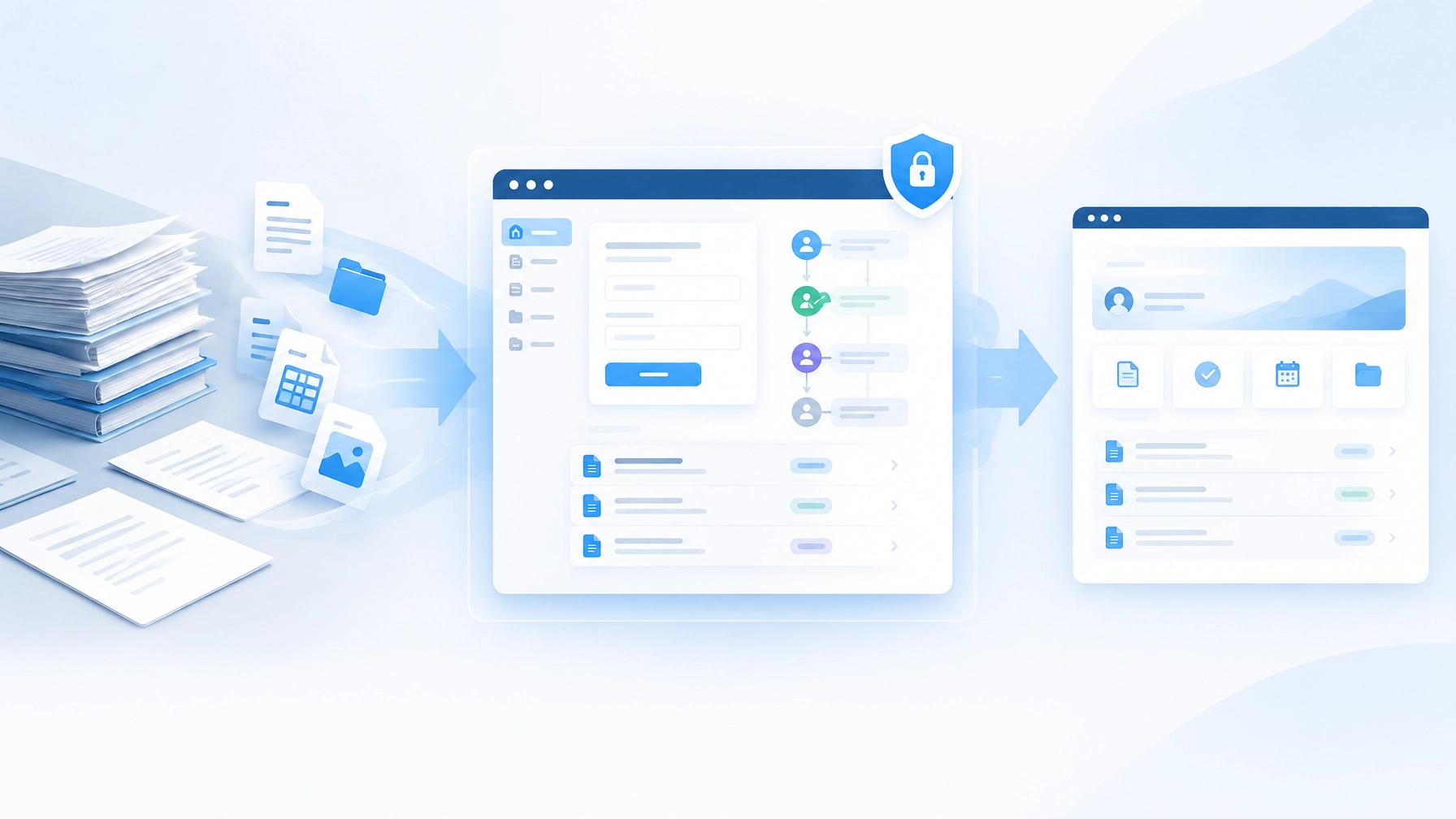
The proposed custom web application brings the core lifecycle into a connected system. Its components are deliberately practical: collect information, generate the right documents, make decisions visible, and deliver approved materials through a secure client-facing experience.
Structured intake and a shared record
Clients complete guided forms and submit requested files through a web interface. Conditional questions help keep each intake relevant to the service being requested. Required-field checks and completeness indicators help staff distinguish ready-to-review submissions from those that need follow-up.
Submitted information populates a central record rather than remaining confined to a form response. Access is role-based, so team members see the information and actions appropriate to their responsibilities.
Template-driven document generation
Approved data feeds version-controlled templates for proposals, engagement letters, intake summaries, and compliance documents. Templates can include conditional sections where services or client circumstances require different language. This reduces routine copy-and-paste work while keeping staff in control of the content and decisions that require professional judgment.
The system records which template version was used to generate a document. If information changes, the workflow creates a distinguishable new version instead of obscuring the history of the earlier draft.
Approval routing and audit history
Documents move through defined review steps, with assignments based on the firm’s roles and rules. Reviewers can approve, request changes, or return a document for clarification. Each action is tied to a user and recorded with a timestamp, status, and relevant notes.
This audit trail helps staff answer operational questions: Who reviewed this version? What changed? Is approval complete? Has the client received the final document? It also makes handoffs more visible, while keeping authorization and approval responsibilities explicit.
A client-facing delivery portal
Once internal review is complete, approved documents can be shared through a client portal. Clients can access the materials and submit requested information or revisions in the context of the same workflow. Staff can see delivery status and follow up on specific outstanding steps instead of reconstructing the history from email.

The application can also connect with the firm’s existing systems where appropriate. Integration decisions should follow the workflow requirements: what information needs to move, which system owns it, and how errors or retries are handled. This keeps the custom build focused on the firm’s operating model rather than adding integrations for their own sake.
The rollout: phased adoption with a parallel run
A workflow application changes how people coordinate work, so rollout is part of the technical solution. A phased approach can begin with one service line or document pathway, allowing the firm to validate intake fields, template behavior, approval rules, and client instructions before broadening the scope.
During a parallel run, staff continue to follow the existing process while comparing it with the new workflow. This provides a controlled way to identify missing exceptions, unclear ownership, or templates that need adjustment. Training can then focus on role-specific tasks: submitting an intake, correcting a submission, reviewing a document, approving a version, or monitoring delivery.

The result is a more deliberate transition than switching tools all at once. It also gives the firm an opportunity to document process ownership and define how future changes to forms, templates, and routing rules will be managed.
What changes operationally
In this model, staff spend less time transferring information between tools and chasing the status of individual documents. Routine documents can be assembled from structured data, while reviewers retain authority over content and approvals. Clients receive a clearer path for submitting information and accessing completed materials.
The expected outcome categories are qualitative: hours returned to staff for higher-value work, fewer opportunities for data-entry and version errors, and faster turnaround by reducing avoidable waiting between steps. The actual impact would depend on the firm’s baseline process, document volume, exception rates, and adoption. Those measures should be established during discovery and reviewed after rollout rather than assumed in advance.
This is also where AI-powered business systems may be considered carefully. For example, AI might help classify incoming files or extract candidate information, but extracted data should be treated according to risk and confidence, with human review where accuracy matters. The core workflow should remain understandable and auditable whether or not AI is introduced.
PTC’s work across platforms such as AI Local Boost, ChainHQ, EHRIO Pro, and FTP Inform demonstrates experience building scalable web applications and automation systems, not a requirement to buy those platforms for this engagement.
Lessons for firms considering custom development
A custom application is worth considering when the process is important to the business, spans multiple roles or systems, and remains difficult to manage with disconnected tools. It is not automatically the right answer for every form or document. A firm should first clarify its workflow, identify the systems that must remain in place, and decide which decisions need human review.
For established firms, effective digital transformation consulting starts with the operating model: define the source of truth, ownership at each handoff, approval rules, and records the business needs to retain. Then build the smallest complete workflow that solves the end-to-end problem. That is a more durable foundation than layering automation onto unclear processes.
An experienced custom software development agency should be able to advise on that scope, explain integration and governance tradeoffs, and support the application as the business evolves. The aim of enterprise automation consulting is not simply to digitize documents. It is to create a dependable system in which information, decisions, and client delivery work together.
Plan your next workflow
If document assembly, intake, approvals, or client delivery are creating operational drag, Pure Technology Consulting can help assess the workflow and define a practical custom web application roadmap. Schedule a discovery conversation, explore custom web development services, or call +1 (803) 921-0969.
Amin Said, Founder of Pure Technology Consulting LLC
https://puretechconsult.com
Leave a Reply