For a multi-location operator, growth creates a governance challenge.
Each new location adds another operating environment to monitor, another team to support, another set of standards to maintain, and another source of performance data to reconcile. At a small scale, spreadsheets and email-based audits may appear manageable. As the network expands, they make it difficult to answer basic leadership questions with confidence:
- Which locations are meeting performance expectations?
- Where are brand standards being missed?
- Which operational issues remain unresolved?
- What capital investments are pending or complete?
- Can regional and executive reports be verified back to source activity?
Pure Technology Consulting developed ChainHQ as a proprietary proof-of-concept for solving this class of problem. It is not presented as a standalone product to purchase. Instead, ChainHQ demonstrates how PTC approaches custom web application development for organizations that need a governed operating layer across locations, teams, standards, and reporting.
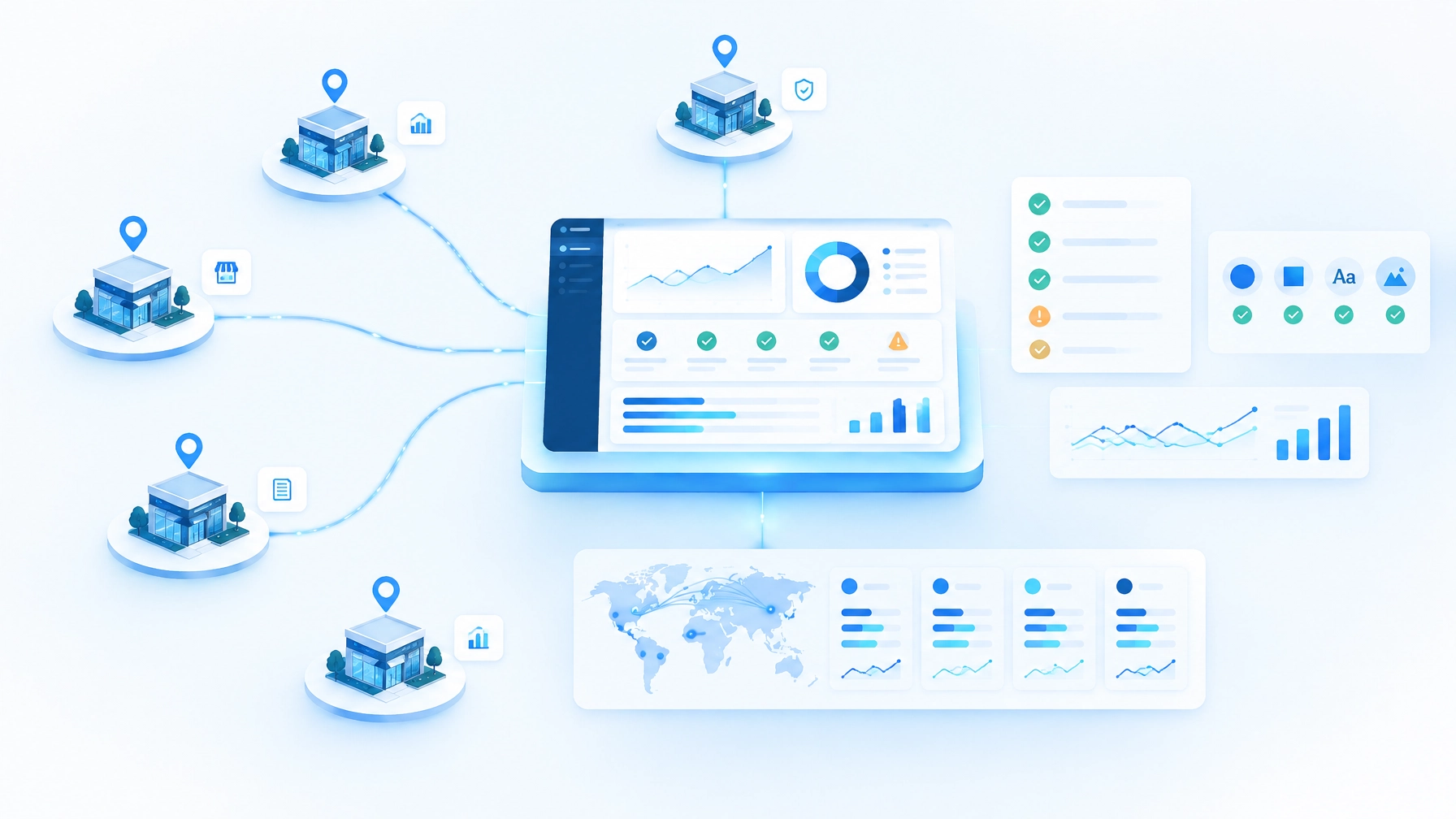
The system brings location performance, brand compliance, capital reporting, and operational intelligence into one structured environment.
The business stakes of multi-location drift
Multi-location performance rarely declines because leadership lacks commitment. More often, the operating model makes consistency difficult.
Corporate teams may define clear expectations, but execution varies by location. A manager may use an outdated checklist. An audit may be completed without sufficient evidence. A regional leader may receive a report that cannot be traced to the underlying inspection. Capital projects may be discussed in email but remain difficult to compare across sites.
Over time, small inconsistencies create material business risk:
- Brand standards are interpreted differently from one location to another.
- Performance reports are assembled manually and may use inconsistent definitions.
- Corrective actions are tracked in inboxes or separate spreadsheets.
- Capital requests lack a standardized status and approval history.
- Leadership sees summary numbers without the context behind them.
- Regional teams spend time validating reports instead of improving performance.
The central issue is not the absence of data. It is the absence of a governed system that connects data to accountability.
ChainHQ was designed around that distinction.
Discovery began with the operating model
A successful custom build does not begin with screens. It begins with the organization’s operating model.
PTC’s discovery process mapped how information moves through a multi-location business:
- How locations are structured across regions, brands, and ownership groups.
- Which performance metrics are defined centrally and which vary by location.
- How brand standards are distributed, acknowledged, inspected, and updated.
- How audits are documented and how exceptions become corrective actions.
- How operational and capital reports are submitted, reviewed, approved, and rolled up.
- Which roles require access to local, regional, or enterprise-level information.
- Which existing systems should remain in place and which workflows required orchestration.
This work shaped the data model before development began. A location was not treated as an isolated record. It became part of a connected structure involving users, regions, standards, audits, initiatives, performance indicators, capital items, tasks, and evidence.
That foundation is what allows a custom application to act as a source of truth rather than another reporting interface.

The architecture behind ChainHQ
ChainHQ was organized around four architectural principles: a unified data model, an integration layer, governed permissions, and traceable activity.
A unified location and performance data model
The system establishes consistent identifiers for locations, regions, teams, standards, reporting periods, audits, capital items, and operational initiatives.
That structure makes it possible to view information at several levels:
- Individual location
- Regional portfolio
- Brand or operating group
- Enterprise network
- Reporting period
- Performance or compliance category
Leadership can see a network-level summary without losing the ability to examine the source records behind it. Regional managers can focus on their portfolio. Location leaders can see the actions and standards relevant to their responsibilities.
The data model also supports consistent metric definitions. A compliance score, capital status, or operational KPI should mean the same thing across locations unless an explicit business rule says otherwise.
An integration layer for connected reporting
ChainHQ was designed to operate as an intelligence layer rather than require every existing system to be replaced.
An integration layer can receive structured information from relevant operational, financial, project, or reporting systems. It can also send approved updates, notifications, and tasks to the systems or teams responsible for action.
The exact integration approach depends on the client environment. APIs, webhooks, scheduled imports, and controlled exports may all be appropriate. The important design decision is to make data movement visible, validated, and accountable.
This prevents the application from becoming another isolated database. It becomes the governed point where operational information is normalized, reviewed, and presented for decision-making.
Roles and permissions that reflect responsibility
Multi-location systems require more than a basic administrator and user model.
ChainHQ’s approach separates access by organizational responsibility. A location manager may see local audits and assigned corrective actions. A regional manager may compare sites within a territory. A corporate standards team may manage templates and compliance criteria. Executives may need enterprise-level reporting without editing operational records.
Role-based permissions help establish the appropriate balance between local ownership and central governance.
Permissions can control:
- Which locations a user can view
- Which records a user can create or edit
- Which standards can be changed
- Which reports require approval
- Which corrective actions can be closed
- Which information is available at regional or enterprise level
This is a core requirement in enterprise automation consulting. Automation must clarify ownership, not obscure it.
Audit trails for defensible reporting
A report is more valuable when leadership can understand how it was created.
ChainHQ includes an audit-oriented approach to changes, approvals, submissions, and status updates. A governed system should be able to show:
- Who submitted or changed a record
- When the action occurred
- Which standard or form version was used
- What evidence was attached
- Who reviewed or approved the item
- Whether an exception was overridden
- When a corrective action was assigned and closed
This history improves accountability and makes reporting more defensible. If a score changes, the organization can investigate the underlying record rather than rely on conflicting email threads.
What was built
ChainHQ brought several operating functions into one application experience.
Location performance dashboards
Dashboards organize performance by location, region, category, and period. Instead of waiting for a manually assembled report, leaders can review current indicators and identify where additional attention is required.
The dashboard model is designed to emphasize decisions rather than activity. A useful view should help answer:
- Which locations are improving or declining?
- Which standards have the most recurring exceptions?
- Where are open actions aging?
- Which regional patterns require intervention?
- Are performance issues isolated or systemic?
Brand standards and compliance workflows
Brand standards become more actionable when they are connected to structured checklists, evidence, scoring, and follow-up.
ChainHQ supports a governed standards library with version-controlled guidance and defined compliance criteria. Auditors or location leaders can complete inspections using consistent forms, attach supporting evidence, and route exceptions into an action workflow.
This creates a complete path from standard to observation to corrective action.
Capital and operational reporting
Capital initiatives and operational improvements often require different data fields, approval paths, and reporting views.
ChainHQ was designed to distinguish between the two while still allowing leadership to see them together. Capital records may include requested investment, location, category, status, approval stage, owner, and completion details. Operational records may track recurring issues, action plans, responsible teams, deadlines, and verification.
A centralized view gives executives a better understanding of how location performance relates to investments and operating priorities.

The operational leverage, with assumptions stated
The value of a system like ChainHQ should be measured against a client’s baseline rather than a generic promise.
For planning purposes, consider a network of 20 locations completing one monthly audit cycle. If each location currently requires 2–4 staff hours for preparation, consolidation, follow-up, and report assembly, the network may be spending approximately 40–80 hours per cycle on administrative coordination.
If a governed workflow reduces that effort by an estimated 30–60%, the modeled capacity recovered would be approximately 12–48 hours per month. The actual result would depend on audit complexity, integration quality, adoption, and the number of exceptions requiring human review.
Additional leverage may come from:
- Reducing duplicate report preparation
- Shortening the time required to identify overdue actions
- Improving the percentage of audits supported by verifiable evidence
- Reducing rework caused by inconsistent submissions
- Increasing the number of locations a central team can oversee without proportional administrative growth
These are planning ranges, not guaranteed outcomes. The important point is that a custom system creates measurable operating baselines. Leadership can track cycle time, exception volume, completion rates, and reporting effort before and after implementation.
What executives should learn from the ChainHQ build
ChainHQ illustrates several principles for organizations evaluating a custom system.
Start with governance, not features
A dashboard cannot compensate for unclear metric definitions, ownership, or approval rules. Establish the operating model first.
Design the data model before the interface
The quality of location, performance, compliance, and capital relationships determines whether the system can scale. A polished interface built on fragmented data will eventually reproduce the same reporting problems.
Automate repeatable coordination while preserving judgment
A system can assign actions, validate submissions, notify owners, and calculate scores. Human leaders should retain control over exceptions, standards changes, and high-impact decisions.
Make evidence part of the workflow
If compliance cannot be verified, it becomes a matter of interpretation. Evidence capture, version history, and approval records should be designed into the process rather than added later.
Pilot with a meaningful but controlled scope
A practical first phase might include a defined group of locations, a focused standards program, and one reporting cycle. Once the data model and governance are validated, the system can expand across additional regions and workflows.
Why this capability transfers across industries
ChainHQ is one proof-of-work example within PTC’s broader custom software development agency capabilities.
The underlying disciplines also appear in other proprietary builds and engagements:
- Healthcare: EHRIO matching engines and approximately 70-question adaptive intakes demonstrate structured decision workflows in HIPAA-adjacent environments.
- Field operations: D2D Tracking connects rep accountability with GPS logging and distributed activity.
- Fintech and debt: Debt-agency telephony integrations support call attribution, workflow history, and operational reporting.
- Local SEO: AI Local Boost demonstrates governed Google Business Profile automation across multiple locations and entities.
Across these projects, the recurring objective is the same: create an operating layer that connects data, people, decisions, and accountability.
That is the role of business process automation consulting and AI-powered business systems when they are designed around the client’s actual operating model.
Build a governed operating layer for your locations
ChainHQ demonstrates how a multi-location business can move from spreadsheet-based oversight and email-driven audits to a more reliable system for performance, brand standards, capital visibility, and operational accountability.
If your organization is evaluating a custom web application, enterprise reporting layer, or multi-location workflow transformation, book a discovery call with Pure Technology Consulting. A workflow audit can clarify the current-state process, identify the highest-value opportunity, and define a practical roadmap for a custom build.
Learn more about custom web application development and explore how PTC brings proven automation capabilities into complex operating environments.
Contact: +1 (803) 921-0969
Amin Said, Founder of Pure Technology Consulting LLC
https://puretechconsult.com
Leave a Reply