A technical case study by Amin Said, Founder of Pure Technology Consulting LLC
For multi-location organizations, Google Business Profiles are not isolated marketing pages. They are operational records that influence how customers discover a location, evaluate its credibility, request directions, visit a website, or make a call.
Managing one profile manually can be straightforward. Managing dozens or hundreds introduces a systems problem.
Business information changes. Reviews arrive continuously. Content requires approval. Local teams need flexibility, while corporate teams need consistency. API limits, publishing errors, permission boundaries, and incomplete data can all create operational risk.
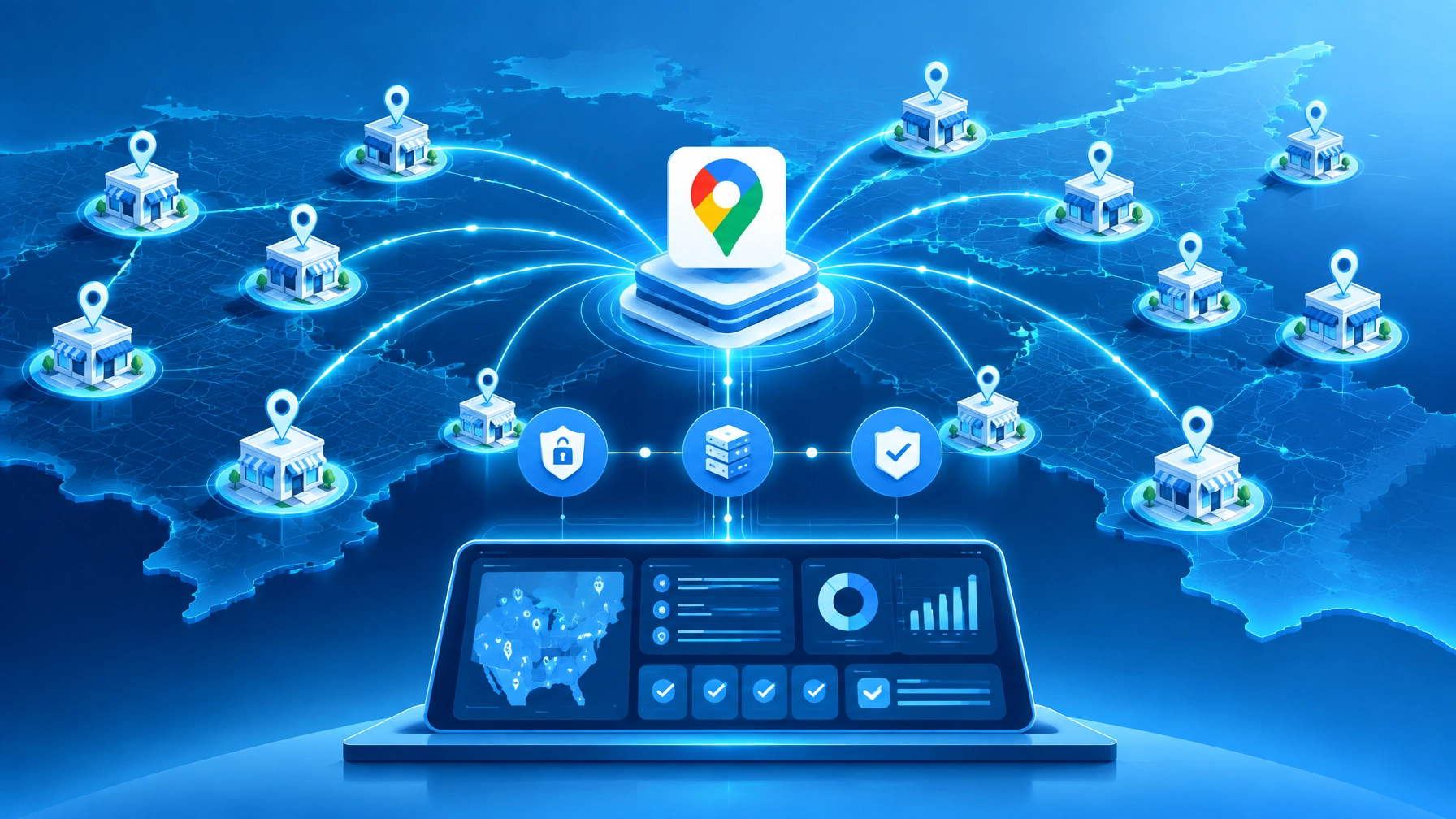
At Pure Technology Consulting, we engineered AI Local Boost as a proof-of-concept for solving that class of problem through custom software. The objective was not to promote a standalone SEO product. It was to demonstrate how a governed automation engine can coordinate distributed business data, AI-assisted workflows, external APIs, human approvals, and audit trails within one scalable operating model.
The same architecture applies to custom CRM platforms, healthcare intake systems, financial operations software, field-service applications, and enterprise workflow automation.
The engineering challenge: automation must remain controlled
Google recommends that businesses maintain complete and accurate profile information, respond to reviews, and keep profile content current. Those activities become difficult when every location is managed through separate logins, spreadsheets, reminders, and disconnected tools.
The core challenge is not simply publishing more content. It is maintaining a reliable system of record across a distributed business footprint.
A multi-location automation engine must answer questions such as:
- Which business entity owns each location?
- Who is authorized to approve a change?
- Which fields are centrally controlled?
- Which updates can be handled automatically?
- What happens when an API request fails?
- How can an operator identify the source of a change?
- Can a published update be reversed?
- How should local exceptions coexist with corporate standards?
These questions led us toward a governed architecture rather than a collection of scripts.

Designing a normalized location data model
The foundation of AI Local Boost is a structured data model for businesses, locations, users, content, reviews, actions, and integrations.
Instead of treating each Google Business Profile as an independent record, the system organizes location data into a broader business context. A location can be associated with:
- A parent organization or account
- A regional or franchise grouping
- Address, phone number, hours, and service areas
- Categories, services, attributes, and descriptions
- Local brand or compliance requirements
- Approved media and content sources
- Assigned managers and approval roles
- External profile identifiers
- Historical changes and workflow status
This normalization layer matters because external systems rarely represent business data in exactly the same way. A CRM may use one location identifier. Google may use another. An internal reporting system may organize locations by region or operating unit.
The application needs a stable internal representation that can reconcile those differences without losing source information.
That model also allows automation to work with context. A post for a physical therapy clinic should use different language and business facts than a post for a permanent jewelry brand. A regional holiday-hours update may apply to a subset of locations, while a corporate policy may apply across the entire organization.
The goal is not merely to store data. It is to make business rules executable.
Building the API orchestration layer
The external API is only one part of the system. The more important engineering work happens in the orchestration layer around it.
AI Local Boost was designed to coordinate data synchronization, content generation, approvals, publishing, reporting, and exception handling through controlled workflows.
A typical workflow includes:
- A scheduled audit or business event creates a task.
- The system identifies the affected organization and locations.
- Existing profile data is compared with the internal source of truth.
- The engine determines whether the change is low-risk, reviewable, or restricted.
- AI generates a draft or recommendation where appropriate.
- The workflow routes the action to the correct approver.
- Approved changes are sent to the external platform.
- The response is recorded, including success, failure, or pending status.
- The final state is reflected in dashboards and audit history.
This approach avoids the fragility of a single bulk operation. If one location fails because of invalid data, a temporary API issue, or an authorization problem, the rest of the workflow should not disappear with it.
A production-grade orchestration layer generally requires:
- Queued jobs instead of uncontrolled parallel requests
- Rate limiting for external APIs
- Idempotent actions that can safely be retried
- Backoff rules for temporary failures
- Validation before publishing
- Per-location status tracking
- Dead-letter or exception queues
- Monitoring for repeated failures
- Reconciliation jobs to detect state drift
These design principles are useful far beyond local search. Any custom application that coordinates multiple external systems needs a similar control plane.
Governance: AI should operate within policy
The defining characteristic of this case study is governance.
An AI model can draft a review response or suggest a profile improvement. It should not automatically change every business-critical field without considering authority, context, or risk.
AI Local Boost uses a risk-based approach to automation:
Lower-risk actions
These may be candidates for automated execution when they meet defined rules:
- Drafting routine profile posts
- Classifying incoming reviews
- Suggesting content topics
- Flagging incomplete fields
- Preparing recurring reports
Review-required actions
These typically require a human approval step:
- Publishing location-specific promotional content
- Responding to sensitive or negative reviews
- Changing service descriptions
- Updating local attributes
- Applying regional exceptions
Restricted actions
These should receive elevated controls or remain fully manual:
- Business name changes
- Primary category changes
- Core address changes
- Major operating-hours updates
- Actions involving legal, compliance, or reputational risk
This distinction allows teams to gain operational leverage without treating automation as permission to bypass judgment.

Exception handling is part of the product
A common weakness in automation projects is designing only for the successful path.
Real systems encounter incomplete data, conflicting instructions, expired credentials, duplicate locations, rejected content, API timeouts, and unexpected responses. A reliable platform must make those conditions visible and actionable.
For AI Local Boost, exception handling is treated as a first-class workflow rather than a technical afterthought.
Each action can carry a state such as:
- Draft
- Awaiting approval
- Approved
- Queued
- Published
- Rejected
- Retry scheduled
- Failed
- Escalated
This gives operators a clear view of what requires attention. It also prevents a failed action from being confused with a completed one.
A useful exception record should include the location, workflow, request type, timestamp, response details, retry count, and responsible user or process. That information gives engineering and operations teams enough context to resolve the issue without reconstructing events from scattered logs.
Auditability creates operational trust
When a system changes customer-facing business information, the organization needs to know what happened and why.
AI Local Boost was designed around location-level auditability. Every significant action can be associated with:
- The initiating user, workflow, or AI process
- The previous value
- The proposed or updated value
- The approval decision
- The publishing result
- The timestamp
- The affected location
- The relevant policy or workflow
This supports more than compliance. It improves day-to-day operations.
A regional manager can review why a location was flagged. A corporate team can confirm whether a holiday-hours update reached the intended locations. An administrator can identify which workflow produced a problematic response. Engineering teams can trace a failed integration without relying on assumptions.

What the architecture proves
AI Local Boost demonstrates several capabilities that are central to custom web application development:
- Designing normalized data models around complex business entities
- Integrating external APIs through resilient orchestration layers
- Building multi-tenant and multi-location permission structures
- Combining AI generation with deterministic business rules
- Creating human-in-the-loop approval workflows
- Managing retries, failures, and exception queues
- Providing audit history and operational reporting
- Supporting centralized governance with local flexibility
The public AI Local Boost platform shows the business-facing result of this work, including automated posts, review workflows, profile management, and reporting. Its value as a PTC case study, however, is the engineering pattern underneath those capabilities.
The pattern generalizes to other high-value systems.
In healthcare, similar architecture can support structured intake, matching engines, and permission-sensitive workflows. In field operations, it can coordinate GPS logging, representative accountability, and assignment logic. In debt and financial operations, it can connect telephony events, call attribution, and case workflows. In legal and accounting environments, it can support secure intake, document routing, client approvals, and reporting.
When a governed custom system is justified
Off-the-shelf software is often appropriate when a business can adapt its processes to the product.
A custom system becomes more compelling when the workflow itself is strategically important or when existing tools cannot coordinate the required data, permissions, and approvals.
A purpose-built platform may be appropriate when you need to:
- Connect several systems around a unified operating model
- Apply different rules to different business units or locations
- Preserve human approval for sensitive decisions
- Reduce repetitive administrative work without removing oversight
- Create reliable audit trails for customer-facing changes
- Support future integrations and new operating units
- Build a proprietary advantage around internal processes
The right question is not simply whether custom software costs more than a subscription. It is whether better control, scalability, data ownership, and operational leverage justify the investment.
Build the operating system behind your growth
AI Local Boost began as a proof-of-concept for governed local-search automation. It became a practical demonstration of how Pure Technology Consulting approaches complex software systems: begin with the operating model, define the controls, then build the architecture that makes reliable execution possible.
If your organization is managing critical workflows through spreadsheets, disconnected applications, or manual handoffs, the next step may not be another point solution. It may be a custom system designed around the way your business actually operates.
Book a discovery call with Pure Technology Consulting to map your workflow, identify the highest-value automation opportunities, and define a practical development roadmap.
+1 (803) 921-0969
Amin Said, Founder of Pure Technology Consulting LLC
https://puretechconsult.com
Leave a Reply