Amin Said, Founder of Pure Technology Consulting LLC
https://puretechconsult.com
Composite case study: This illustrative example draws on patterns across engagements. It does not describe a specific named client. Any figures, if present, are discussion heuristics rather than measured results. No performance metrics or financial results are claimed here.
Create a clearer path from quote request to renewal
For a growing independent insurance agency, the work of serving a client rarely happens in one system. Quote requests arrive through different channels, documents follow in separate emails, information is entered into carrier portals or comparative raters, and follow-ups depend on individual reminders. Later, renewal work brings the same coordination challenge back, often across a larger book of business.
The business impact is operational drag. Producers and customer service representatives (CSRs) spend time locating information, checking what is missing, and confirming who owns the next step. Clients may have to repeat details or wait while staff reconcile updates across tools. As the agency grows, informal processes become harder to oversee and maintain consistently.
This composite case study explores a custom client intake and policy operations platform designed for a growing independent agency serving personal and small-commercial lines. The objective is not to replace the agency’s existing systems or automate insurance decisions. It is to make the work around them more visible, coordinated, and accountable.
Bring submissions, quotes, and client onboarding into one workflow
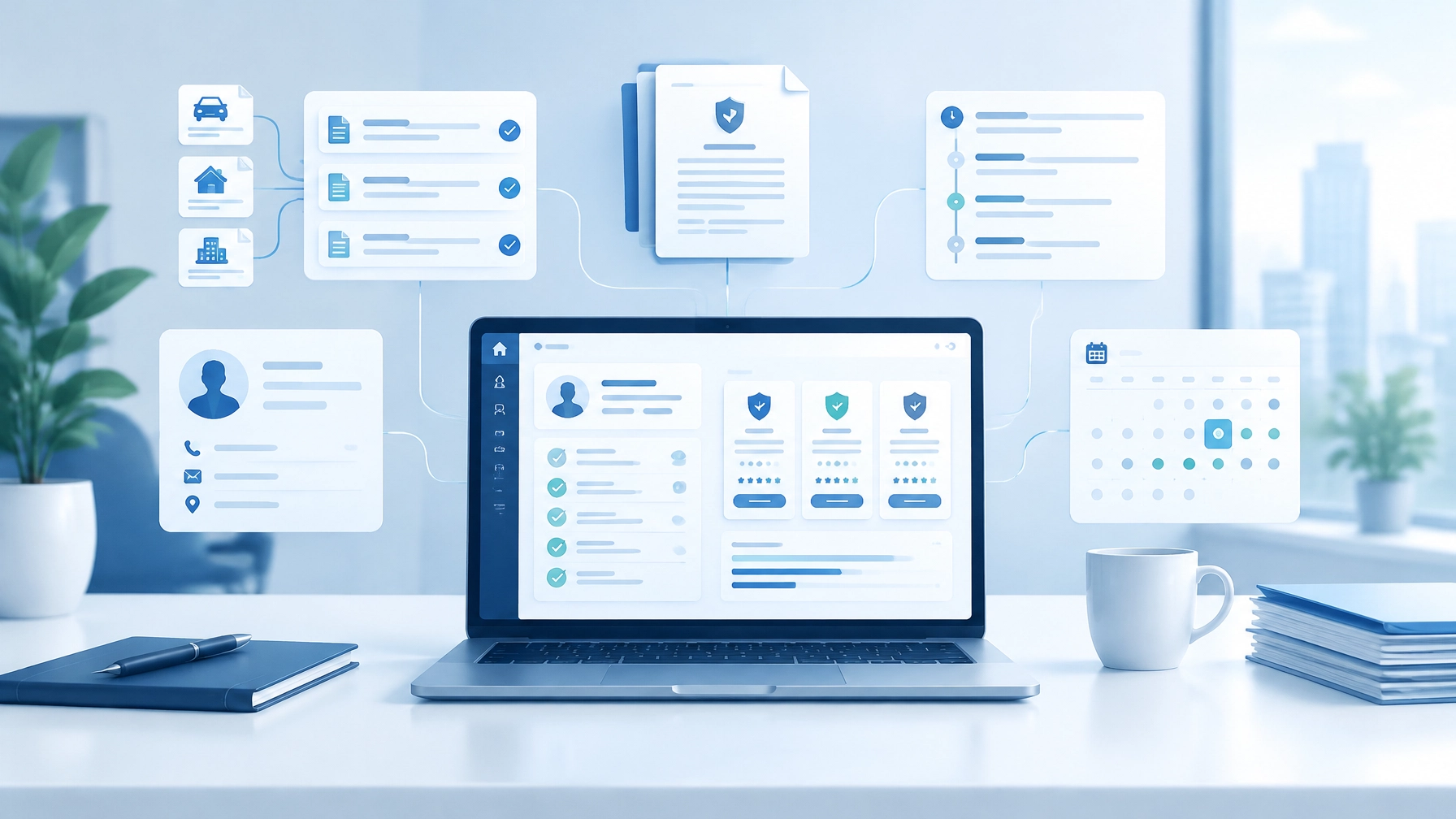
The platform gives staff a shared workspace for each prospect or client request, from initial intake through quote presentation and onboarding. Rather than treating each email, form, and carrier response as a separate thread, the workflow keeps key information and next actions together.

The core capabilities include:
- Guided intake and document checklists. Forms collect information relevant to a personal or small-commercial submission and prompt applicants for supporting documents. Staff can see which items are complete and which need follow-up.
- Submission assembly. A structured case file organizes information for a quote request, making missing fields and open questions easier to resolve before work moves forward.
- Side-by-side quote comparison. Where quote data can be brought into the workspace, staff can review carrier options together with the associated limits, deductibles, assumptions, and documents. Producers remain responsible for evaluating options and discussing them with clients.
- Client onboarding. After the agency and client select a path forward, the workflow can coordinate digital identity verification when appropriate, required documents, and an e-signature process for policy documents.
- Renewal calendar and escalation. Policy dates create visible renewal tasks, assigned owners, and escalation paths when work is overdue or requires producer review.
- Role-scoped access. Producers, CSRs, and other staff see information and actions appropriate to their responsibilities. Role-scoped access means system permissions are tailored by job function, rather than giving every user the same access.
This design supports a more complete view of each case without assuming that every task can or should be automated. It also creates a clearer record of what was received, what was reviewed, and who is expected to act next.
Keep the agency management system as the system of record
A custom workflow platform should fit the agency’s technology environment, not create a competing source of truth. In this design, the agency management system (AMS) remains the system of record for customer, policy, and account records. The new platform coordinates intake and work around it.
When documented APIs are available, the platform can exchange relevant data with carrier portals, comparative raters, and the AMS. An API is a defined way for software systems to exchange information. Each connection needs to be evaluated for what data it supports, how it handles errors, and what access the agency or vendor permits.
Not every carrier or tool will support a suitable integration. Where an API is unavailable, the workflow can structure manual steps instead. Staff can see what information needs to be entered, track the status, and record the result in the right place. This makes manual work more deliberate without implying that every quote can be automatically retrieved or processed.
A careful integration approach also accounts for exceptions. A quote request may be incomplete, a carrier response may be delayed, or a data update may not reach the AMS. Those cases should appear as actionable work for a person, not disappear behind a generic “complete” status. The platform can maintain a case timeline and reconciliation tasks so staff can identify and resolve differences between systems.
For a custom software development agency, the central challenge is not simply connecting tools. It is defining which system owns each piece of data, who can change it, and how the workflow behaves when a connection or response fails.
Make renewal ownership visible across the book of business
Renewals are a recurring operational responsibility, not a one-time reminder. A useful renewal workflow brings upcoming policy dates into a shared calendar, assigns each case to a producer or CSR, and prompts the right preparation and client follow-up.

The platform can surface renewal cases based on policy dates and agency-defined lead times. It can also escalate cases when a client has not responded, required information is still missing, a carrier decision needs review, or a producer must make a judgment call. The exact timing and escalation rules should reflect the agency’s lines of business, carrier expectations, and operating procedures.
Renewal automation also depends on disciplined book-of-business data. Dates, client details, policy status, assignments, and source information need to be consistent enough to trigger useful tasks. The workflow can flag missing or conflicting values for review instead of treating uncertain data as reliable. That discipline supports better visibility while keeping staff accountable for validating consequential changes.
Protect review and access boundaries
Different roles need different views of the work. Producers may need to review carrier options and manage client recommendations. CSRs may coordinate intake, documents, service tasks, and renewal follow-ups. Other staff may need limited access to administrative queues without access to all client information.
Role-scoped permissions can reflect these responsibilities, with actions recorded in an audit trail. An audit trail is a chronological record of meaningful activity, such as a field update, assignment, document event, or approval. Together, permissions and activity history make the workflow easier to supervise and help clarify how information moved through a case.
Client identity verification should be included only when the agency has a defined business reason and has considered the relevant requirements. It is not a universal requirement for every quote request. NIST’s digital identity guidance discusses authentication and identity assurance as design topics, but it is not an insurance compliance certification. The earlier NIST SP 800-63B guidance has been superseded; consult the current NIST SP 800-63-4 publications as a general technical reference. Any identity, signature, record-retention, or privacy approach should be reviewed in light of applicable laws, state requirements, carrier rules, and the agency’s own policies.
Likewise, e-signature workflows should route the correct documents, record their status, and provide a path for incomplete or declined signatures. A software workflow does not itself establish legal sufficiency or regulatory compliance.
Improve coordination without promising a business result
The intended operational outcomes of this design are qualitative: fewer dropped follow-ups, clearer ownership, less repetitive searching across email threads, and a more complete view of quote and renewal work. Staff can spend less effort reconstructing case status and more effort on review, communication, and decisions that require professional judgment.
These are design goals, not measured results for a named agency. An implementation should establish a baseline and evaluate its own indicators, such as intake completeness, follow-up timeliness, integration exceptions, and the proportion of renewal cases with an assigned owner. Measurement can help an agency decide where to refine its process without assuming that software alone will improve conversion, retention, or revenue.
Industry context also matters. The Insurance Information Institute’s references on the insurance claims payment process and homeowners insurance market conditions provide general background on insurance and policyholder processes. They are not guidance on agency software design, legal advice, or endorsements of any platform.
Start with the operating model, then scope the software
For an agency considering custom web application development, the first step is to map the real workflow: how requests arrive, how quotes move across carriers, where the AMS is updated, who owns each follow-up, and how renewals are prepared. That discovery shapes a practical build scope, including integrations, structured manual steps, permissions, exception handling, and data governance.
This is where business process automation consulting earns its keep: connecting technical decisions to operating priorities instead of treating software as a standalone fix. AI workflow automation may be relevant for specific, reviewable tasks, such as organizing incoming documents or identifying missing information. It should not be treated as a substitute for producer judgment, carrier decisions, or the agency’s review of sensitive information. PTC’s work in enterprise automation consulting and digital transformation consulting brings experience designing systems around complex workflows, rather than asking teams to reshape their operations around generic software.
A discovery conversation can clarify which workflows are candidates for a custom build, what existing tools should remain in place, and where integration is feasible. Book a discovery call. No obligation.
General references
- Insurance Information Institute, Understanding the insurance claims payment process
- Insurance Information Institute, State of the Line: Homeowners
- NIST SP 800-63-4, Digital Identity Guidelines
This article is for general informational purposes only. It does not provide legal advice, guarantee regulatory compliance, or imply endorsement by any regulator, standards body, insurer, or carrier.
Amin Said, Founder of Pure Technology Consulting LLC
https://puretechconsult.com
+1 (803) 921-0969
Leave a Reply