How an Equipment Dealer Added a Recurring Software Layer to Its Business
Amin Said, Founder of Pure Technology Consulting LLC
https://puretechconsult.com
This is a composite case based on patterns from real engagements, with identifying details changed. It is illustrative, not a report of one client engagement or a claim of measured results.
What opportunity did the equipment dealer see?
The composite business had a strong services operation, an installed base of specialized equipment, and customers operating across multiple locations. Its team already helped customers maintain equipment and manage related service needs. But information about assets, service history, warranties, consumables, and compliance was spread across spreadsheets, email, and disconnected systems.
As the customer base grew, this approach became harder to manage consistently. Service depended on staff remembering context and manually coordinating follow-ups. Customers, meanwhile, wanted a clearer way to view their equipment records, request service, and find relevant documentation.
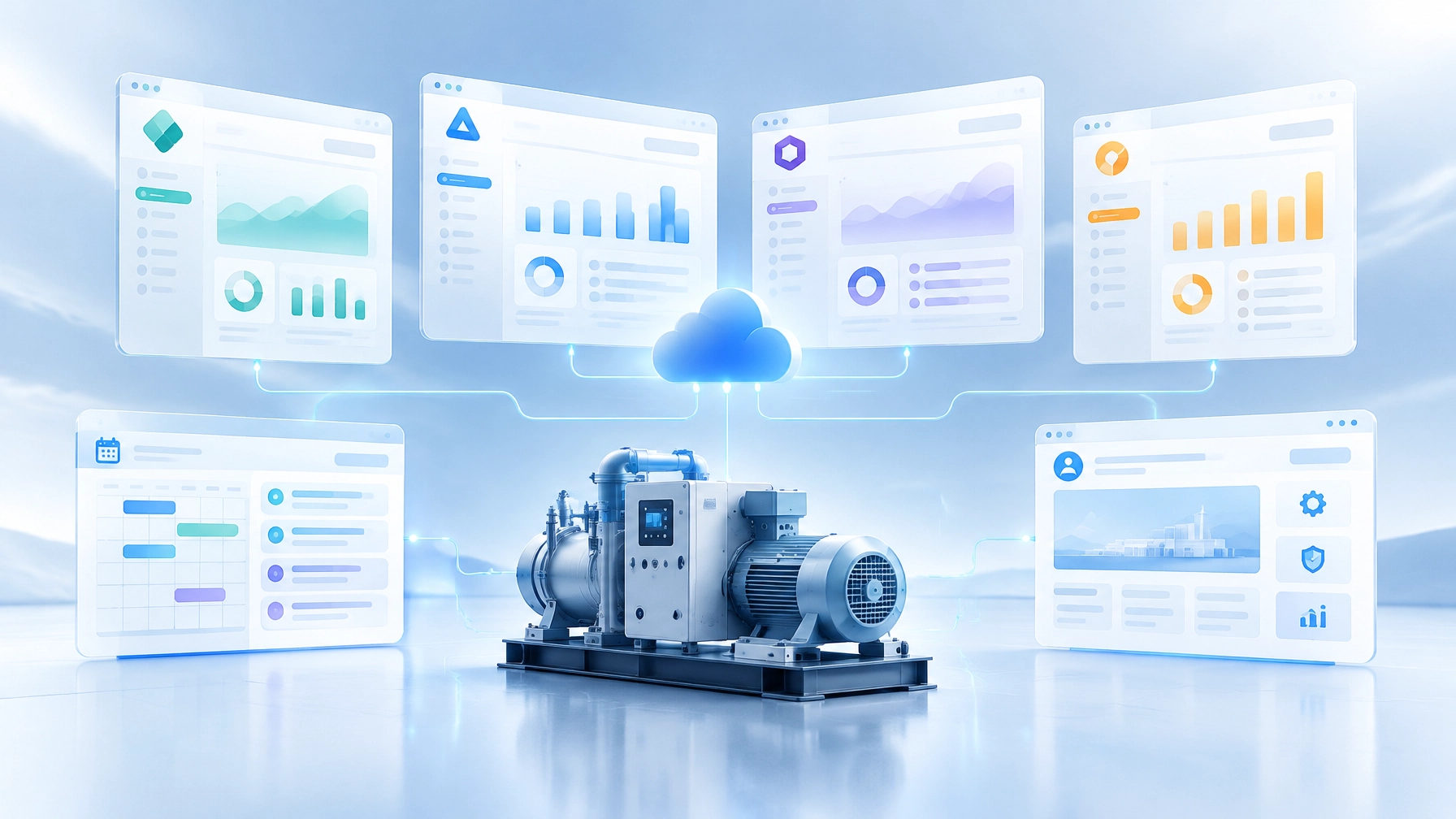
The dealer saw a strategic opportunity: create a software layer around the equipment and services it already understood. Rather than sending customers to third-party tools, it could offer a branded portal that supported asset registration, service scheduling, warranty and consumable tracking, compliance documentation, and customer self-service.
That would create a potential recurring revenue stream, but it also meant taking on a new responsibility. The business was not simply adding a feature to its website. It was considering the move from equipment and service provider to software operator.
Why not license an existing platform?
Licensing an established tool can be the right decision when the product aligns with the business’s workflows and commercial model. In this case, the composite dealer found that available tools did not fit well enough in three areas.
- Industry-specific workflows: Equipment records, service events, warranty terms, consumable schedules, and compliance documents needed to relate to one another in ways generic service software did not support.
- Brand and customer experience: The software needed to feel like a natural extension of the dealer’s customer relationship, not a referral to a separate vendor’s portal.
- Data and roadmap control: The dealer wanted a defined position on who could access customer and asset data, how customers could export it, and how the platform could evolve as its service model changed.
Those requirements do not automatically justify a custom build. They do, however, call for a disciplined comparison of licensing, configuration, integration, and custom development. When the software is intended to support a differentiated customer relationship and a long-term operating model, custom web application development can offer greater control over workflows and product direction.
What did the platform need to do first?
The initial product scope focused on a practical workflow, rather than trying to digitize every part of the dealer’s business at once. The asset registry became the core data object: a reliable record connecting each piece of equipment to its owner, location, service history, warranty details, consumables, and relevant documents.

From that foundation, the platform could support a coherent set of capabilities:
- Asset registry: Create and maintain equipment records, with relationships to customers, locations, and service history.
- Service scheduling: Let authorized users request or coordinate service while giving dealer teams a shared view of upcoming work.
- Warranty and consumable tracking: Record relevant terms, dates, and usage-related details to support timely follow-up.
- Compliance documentation: Associate equipment with required records and make them available to the appropriate users.
- Customer self-service: Give customers access to their own assets, records, and service requests without exposing other organizations’ information.
The goal was not to reproduce an entire CRM, ERP, or accounting package. It was to own the workflow where the dealer had specific operational knowledge, while connecting to existing systems where those systems remained the source of truth.
How should a white-label platform be architected?
A white-label SaaS platform needs to make multiple organizations feel supported without turning every customer into a separate software project. The central design choice was to build one governed platform with tenant-level configuration, not a different codebase for each dealer, franchise, or customer.
That distinction affects the economics of future development. Separate forks can appear convenient when early partners request different features. Over time, they make upgrades, security fixes, testing, and support harder to coordinate. A configurable shared platform requires more upfront product thinking, but keeps common capabilities in one maintainable system.
The core architecture decisions included:
- Strict tenant isolation. Every user, record, request, background job, integration, and export needed to be scoped to the correct tenant. A branded domain or customer identifier alone is not a security boundary. Identity and authorization must be checked server-side throughout the application. The OWASP Multi-Tenant Security Cheat Sheet provides useful guidance on tenant context and isolation controls.
- Configuration instead of code forks. Branding, workflow options, notifications, and selected feature availability could vary by tenant through validated settings. Shared logic stayed in the common product foundation.
- A role model matching operating responsibility. Vendor administrators needed platform-level controls. Dealer administrators needed to manage their own customer base and service workflows. End customers needed access only to their own organization’s equipment and records.
- Integration providers at the edge. A provider layer could connect the platform to existing CRM, ERP, or accounting systems without making those systems part of the asset registry itself. This creates room to support different customer environments while keeping the core workflow coherent.
- Subscription and entitlement readiness. Even if billing begins with a straightforward plan, the platform should be able to represent tenant plans, enabled capabilities, usage limits, and account status. Billing events should not be the only control on access; the application needs reliable entitlement logic of its own.
- Auditable activity. Changes to access, configuration, asset records, and important service events should be traceable. Audit trails help teams investigate issues and establish operational accountability.

These are familiar concerns in multi-tenant software design. For example, Microsoft’s guidance on multitenant control planes and deployment stamps describes ways to coordinate tenant lifecycle and staged deployment. The right implementation depends on the platform’s risk profile, customer commitments, and operating capacity.
What had to change beyond the code?
The software could provide a shared record and customer portal, but it could not decide who would own support, onboarding, and release communication. Those responsibilities needed an operating model of their own.
The dealer and its technology partner had to establish how new tenants would be set up, what customers would receive during onboarding, and which team would respond when a user could not access a record or a service request was delayed. They also needed a way to distinguish a product defect from a configuration question or a request for a new feature.
Before launch, the operating model needed clear answers to questions such as:
- Who handles first-line customer support, and when does an issue escalate to the platform team?
- What response expectations apply to different issue types?
- Who approves changes to shared workflows, and how are requests from one tenant evaluated for wider use?
- How are releases communicated, tested, and introduced across a pilot cohort and the wider tenant base?
- What data can a customer export, in what format, and under what circumstances?
- How do contracts describe data ownership, access, export rights, and offboarding?
These decisions should be reflected in contracts, support procedures, and product design. For example, a data export commitment is easier to fulfill when exportable records and relationships are considered in the data model from the beginning.
What did the vendor gain, and what did it take on?
The opportunity was to extend existing service expertise into a more structured customer experience, make equipment and service information easier to coordinate, and create the basis for recurring software revenue. The platform could also give the dealer a consistent way to support customers across locations.
The tradeoff was a continuing operational commitment. Software licensing means maintaining the platform, managing security and access, supporting users, reviewing product requests, monitoring integrations, and communicating changes. A build can establish the foundation; it does not make the ongoing responsibilities disappear.
For a scope like this, three to six months to a credible first release is a planning estimate, assuming the team can agree on the initial workflows, integration boundaries, and pilot cohort. It is not a guaranteed delivery schedule. Existing data quality, identity and security requirements, integration access, and the availability of decision-makers can all affect timing. The first release should prove the essential workflow with a defined group of users, not attempt to accommodate every future customer variation.

Who is this path right for?
A white-label platform is worth evaluating when the business already has a meaningful customer base and an operational workflow it is well positioned to own.
It may be a good fit for:
- Vendors or equipment manufacturers with a substantial installed base.
- Franchise and multi-location networks managing fragmented customer workflows.
- Service-dependent businesses that coordinate recurring maintenance or compliance activity.
- Industry partners seeking a branded digital layer around services or equipment they already provide.
It may be a poor fit when:
- The business lacks capacity to support software users and maintain a product.
- Customers have no recurring workflow that the platform can meaningfully improve.
- The opportunity depends mainly on selling a software label, rather than solving an operational problem.
- An existing tool meets the requirements without unacceptable compromises in workflow, data governance, or customer experience.
What experience supports this kind of work?
Pure Technology Consulting operates multiple proprietary multi-tenant SaaS platforms, which provides a practical basis for evaluating tenant configuration, access boundaries, and platform operations. AI Local Boost, for example, serves as a proof of concept for multi-tenant local SEO automation infrastructure, not a product pitch.
The firm’s experience also spans complex, connected workflows: healthcare systems involving EHRIO matching engines, 70-question intakes, and HIPAA-adjacent processes; field operations involving rep accountability and GPS logging; and debt-agency telephony integrations with call attribution. These are distinct domains, not claims about the equipment-dealer composite. Together, they reflect experience building systems where data relationships, permissions, integrations, and operational workflows must work together.
For organizations evaluating a similar initiative, a custom software development agency should be able to discuss not only application features but also architecture, ownership, integration boundaries, and the operating model required after launch. Pure Technology Consulting’s web development practice supports that kind of scoping through custom web application development, business automation consulting, digital transformation consulting, and enterprise automation consulting. AI workflow automation and bespoke AI solutions may also be relevant where intelligent routing or decision support has a defined role in the workflow.
What is the right next step?
A white-label SaaS opportunity is strongest when product scope follows a real customer workflow and the business is prepared to support the platform as an ongoing service. The first step is to map the workflow, identify the system of record for each data category, define tenant and role boundaries, and agree on what a pilot must demonstrate.
To discuss the scope and operating model for a white-label platform, book a discovery call or call +1 (803) 921-0969.
Amin Said, Founder of Pure Technology Consulting LLC
https://puretechconsult.com
Leave a Reply