Enterprise automation should create operational leverage, not another layer of complexity.
For many organizations, the challenge is not a lack of software. It is the distance between how work is supposed to move and how it actually moves. Teams re-enter information across systems, managers rely on spreadsheets for visibility, and important decisions depend on individual memory rather than governed workflows.
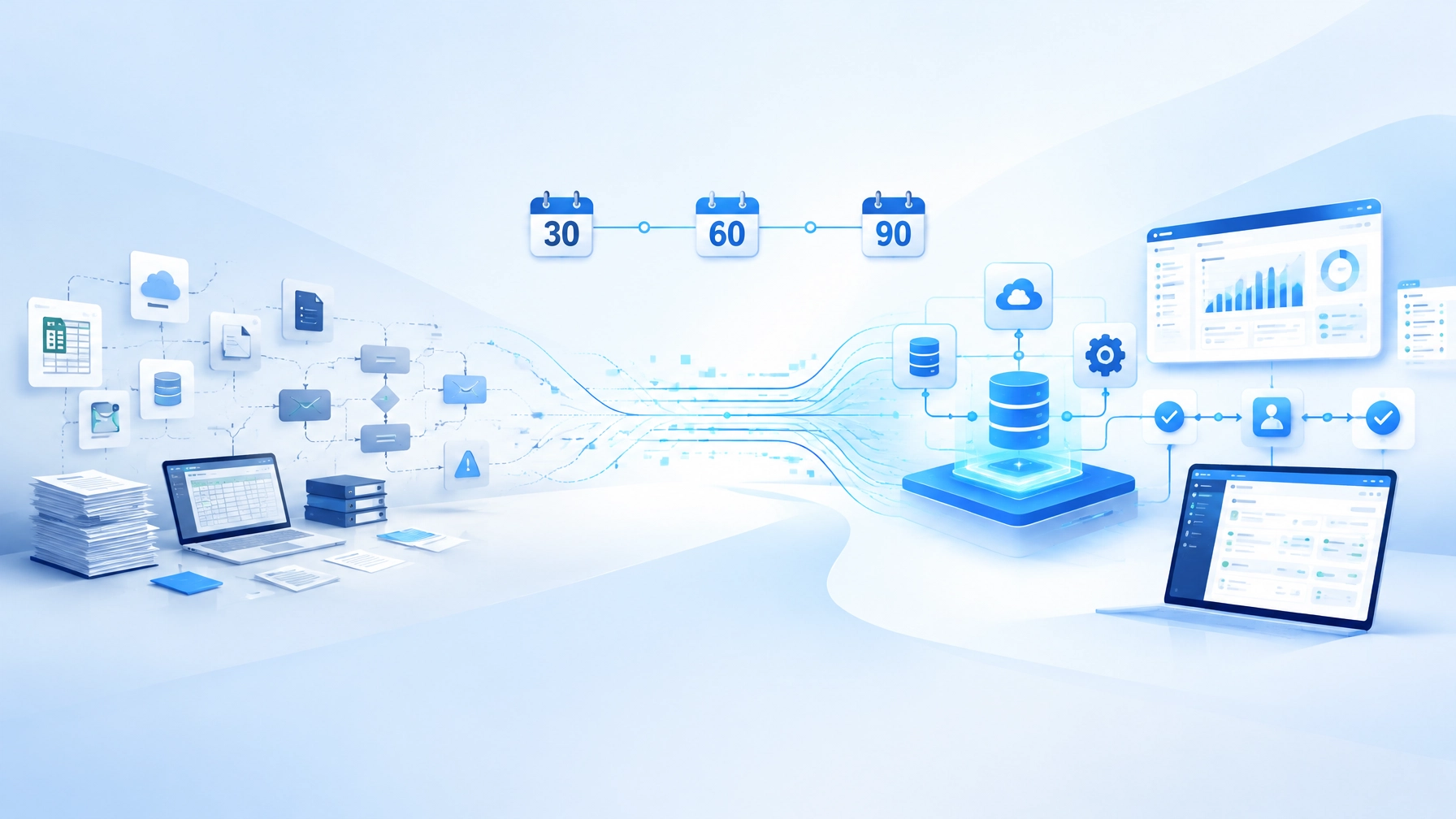
A realistic engagement with an enterprise automation consulting firm does not attempt to automate the entire organization in one quarter. The first 90 days should establish a durable foundation:
- Understand the current operating model.
- Select one high-value workflow.
- Design the data and integration architecture.
- Ship a production-shaped automation.
- Measure its impact.
- Create the governance required to scale.
The central principle is straightforward: automation follows the operating model. It does not define the operating model.
That is why custom web application development often becomes important. When the workflow includes specialized rules, multiple systems, role-based decisions, exceptions, or complex reporting, a durable solution may require more than configuring an off-the-shelf platform.
What the first 90 days should accomplish
A successful first quarter is not measured by the number of automations launched. It is measured by whether the organization can operate one improved workflow with clearer ownership, better data, measurable performance, and a credible path to scale.
By Day 90, the organization should have:
- One named business owner for the pilot workflow.
- A documented current-state and target-state process.
- A baseline for cycle time, errors, throughput, and manual effort.
- Defined system-of-record and data ownership decisions.
- A tested automation operating in a controlled production environment.
- Human approval and exception paths where judgment is required.
- A runbook for support, monitoring, rollback, and change management.
- A prioritized roadmap for the next three to six automation opportunities.
This is the difference between a technology demonstration and an operating capability.
Days 1–30: Discover the process, data, and operating constraints

The first month is dedicated to understanding how work moves through the organization today.
This stage is often underestimated. Leaders may already know that a workflow is slow or inconsistent, but effective business process automation consulting requires more than identifying visible frustration. The consulting team must understand the complete process, including the steps that employees have created to compensate for limitations in existing systems.
Map the current state
Discovery should examine:
- How work enters the organization.
- Which teams own each stage.
- Where information is created, copied, validated, and stored.
- Which decisions are rules-based.
- Which decisions require expertise or approval.
- Where work waits in queues.
- Which exceptions regularly interrupt the standard process.
- Which systems exchange data, and which do not.
- What security, privacy, or retention requirements apply.
Interviews should be supported by workflow observation, document review, system logs, and process data where available. A process map should distinguish active work from waiting time, human judgment from repetitive coordination, and required controls from legacy habits.
The goal is not to document every process in the enterprise. It is to identify the workflows most likely to produce measurable value and reusable architecture.
Establish a baseline
Before automation is introduced, the organization needs a point of comparison.
Useful baseline measures may include:
- End-to-end cycle time.
- Active staff time per transaction.
- Queue or waiting time.
- Manual touches and duplicate data entry.
- Error and rework rates.
- Throughput by team or location.
- Exception volume and aging.
- Cost per completed case.
- Customer, patient, employee, or partner response time.
Not every process requires every metric. The important discipline is to define the measurement model before the system is changed.
A workflow that appears inefficient may have a different root cause than expected. The delay may come from incomplete intake data, unclear ownership, inconsistent policy, or a missing integration rather than a lack of staff effort.
Select the first automation
Candidate workflows should be evaluated across several dimensions:
- Business value.
- Transaction volume.
- Avoidable manual effort.
- Data quality.
- Process stability.
- Integration complexity.
- Compliance and operational risk.
- Change readiness.
- Reusability for future initiatives.
The best first workflow is usually important enough to matter, contained enough to control, and stable enough to measure. An organization should avoid starting with a process whose ownership, policy, or source data is still unsettled.
The first 30 days should conclude with a current-state map, data inventory, risk register, prioritized use case, target outcomes, and accountable owners.
Days 31–60: Design the architecture and ship the first automation

The second month converts the selected workflow into a technical and operational design.
This is where enterprise automation consulting must move beyond tool selection. The team needs to decide what should remain in existing systems, what should be orchestrated through integrations, where artificial intelligence is appropriate, and where custom web application development is justified.
Define the target operating model
The future-state workflow should clearly separate:
- Deterministic automation.
- AI-assisted activities.
- Human approvals.
- Escalation paths.
- Exception handling.
- Manual fallback procedures.
- Reporting and performance visibility.
For example, an AI workflow automation system may classify an inbound request, extract information from a document, recommend an assignment, or draft a response. It should not make a high-impact decision without appropriate review simply because the technology can produce an answer.
AI is most useful where variability and unstructured information create the bottleneck. Deterministic rules remain preferable for policy-critical calculations, required validations, permissions, and control points.
This is a core principle of responsible AI consulting services: use AI to direct human attention, not to obscure accountability.
Design the data architecture
The pilot should define the major entities, identifiers, statuses, relationships, and lifecycle transitions involved in the workflow.
For each important field, the team should identify:
- The system of record.
- The owner of the data.
- Who can create or modify it.
- How quality is validated.
- How changes are synchronized.
- How long it should be retained.
- How access is audited.
Without these decisions, automation can move bad information faster while creating new versions of the truth.
Design integration boundaries
The architecture should document how data moves between CRM, ERP, scheduling, billing, document, communication, reporting, and operational systems.
Where possible, durable integrations should use APIs and events rather than fragile point-to-point workarounds. Legacy systems may still require controlled adapters or interface automation, but those dependencies should be visible and bounded.
For AI-enabled workflows, architecture should also address:
- Model and prompt versioning.
- Grounding sources.
- Output validation.
- Confidence thresholds.
- Tool permissions.
- Human review requirements.
- Audit history.
- Usage and cost controls.
A custom application may be appropriate when the organization needs a unified intake experience, operational workbench, exception console, role-specific dashboard, or domain-specific decision interface that packaged tools cannot provide.
The objective is not to replace every existing platform. It is to create the orchestration layer that allows those systems to work together.
Ship a production-shaped pilot
The first automation should be built with production requirements in mind, even if its initial scope is limited.
Typical deliverables include:
- Secure user access and role-based permissions.
- Workflow states and ownership.
- Data validation.
- API or file-based integrations.
- Notifications and task routing.
- Audit logs.
- Error handling and retry logic.
- Monitoring and alerts.
- Reporting dashboards.
- Manual override and rollback procedures.
- Staging and test environments.
The pilot should be tested for functional behavior, integration reliability, data quality, security, usability, performance, and failure modes.
The result should not be a prototype that works only during a demonstration. It should be a controlled first release that real users can evaluate safely.
Days 61–90: Scale responsibly through governance and measurement

The final month turns the pilot into an operating capability.
The workflow should run with real users and a safe manual fallback. Performance should be compared against the same definitions used during discovery.
Relevant measures may include:
- Cycle-time change.
- Hours of manual coordination reduced.
- Error and rework change.
- Throughput.
- Exception rate.
- SLA attainment.
- Adoption and override rates.
- Cost per completed transaction.
- Data completeness.
- Customer or employee experience.
The organization should distinguish between theoretical time saved and realized business benefit. If a workflow saves staff time, leadership should determine whether that capacity is being redeployed, whether hiring can be deferred, or whether service quality and throughput are improving.
Create the governance model
A practical enterprise model often combines centralized standards with domain-level ownership.
A central automation enablement function can own:
- Reference architecture.
- Approved platforms and vendors.
- Reusable connectors and components.
- Security patterns.
- Automation and AI inventory.
- Training and delivery standards.
- Value measurement.
Business or domain teams should own process outcomes, prioritization, user acceptance, and day-to-day decisions. IT and platform teams should own environments, identity, integration reliability, and operational support. Security, legal, privacy, and compliance teams should provide risk-based review.
Every production workflow should have a named process owner and technical service owner.
The organization should also maintain a registry documenting each automation or AI-enabled workflow, including its purpose, owner, systems, permissions, data categories, dependencies, current version, and next review date.
Build the runbook and scale plan
Before the engagement closes, the team should document how the workflow operates after handoff:
- What normal performance looks like.
- How alerts are handled.
- How failed transactions are retried.
- How records are reconciled.
- When staff should use manual override.
- How incidents are escalated.
- How access is reviewed.
- How model or workflow changes are tested.
- How rollback is performed.
The final deliverable should include a measured outcome report, architecture decisions, lessons learned, and a sequenced six- to twelve-month roadmap.
Proof of capability across complex operating environments
Pure Technology Consulting brings proven engineering patterns into new custom engagements rather than starting from a blank page.
- EHRIO Pro demonstrates structured healthcare intake, approximately 70-question workflows, provider and location matching, scheduling logic, and HIPAA-adjacent operational controls.
- ChainHQ demonstrates multi-location operations, centralized visibility, assignment logic, location-aware permissions, and cross-location reporting.
- AI Local Boost demonstrates governed local SEO automation across Google Business Profile workflows, approvals, reporting, and location-level activity.
- FTP Inform demonstrates controlled data exchange, validation, transformation, permissions, monitoring, and audit-oriented workflow management.
These proprietary builds are proof-of-work examples, not generic products being promoted as a substitute for strategy. They show how custom applications, integrations, automation, and governance can be combined around complex business requirements.
The same capabilities can support legal, accounting, healthcare, field operations, debt, e-commerce, and professional services organizations that need technology aligned with the way they operate.
The outcome after 90 days
A credible 90-day result is not “the enterprise is fully automated.”
It is more practical and more valuable:
One important workflow is operating under clear ownership. The organization understands its baseline and can measure improvement. Users have a safe, usable system. Exceptions and failures are visible. Security and governance controls are documented. The architecture can support the next phase. Leadership has a prioritized roadmap rather than an unstructured list of AI ideas.
That is how digital transformation consulting becomes durable. The organization builds an operating model that can improve over time, rather than collecting disconnected automations that become another form of technical debt.
If manual workflows, disconnected systems, or limited operational visibility are constraining growth, book a discovery call with Pure Technology Consulting to scope the opportunity. You can also explore PTC’s custom web application development capabilities and review the operating-model approach to automation.
Contact: +1 (803) 921-0969
Amin Said, Founder of Pure Technology Consulting LLC
https://puretechconsult.com
Leave a Reply