Amin Said, Founder of Pure Technology Consulting LLC
AI workflow automation can improve speed, consistency, and operating leverage. But the first automation initiative is rarely the one with the most visible technology or the largest number of AI features.
The strategic question is simpler:
Which workflow creates the greatest business value while remaining controlled, measurable, and technically ready?
For a high-ticket service business, the wrong starting point can create expensive complexity. Automating an unclear process may only make poor decisions happen faster. Automating a high-risk workflow before governance is in place can damage client trust. And automating a low-value administrative task may produce activity without meaningful operational impact.
A better approach is to sequence automation deliberately.
Start with the business constraint, not the AI tool
Before evaluating platforms, identify where growth is being constrained.
Common examples include:
- Valuable leads waiting too long for qualification or follow-up
- Intake information being copied between forms, CRMs, and industry systems
- Staff manually assigning cases, appointments, or field work
- Client onboarding depending on email reminders and spreadsheets
- Leadership relying on delayed or incomplete reporting
- Revenue leakage caused by missed tasks, incomplete records, or poor attribution
- High-value employees spending time on coordination instead of judgment
The workflow with the most manual effort is not always the best first candidate. A process may be repetitive but strategically unimportant. Another may run only a few times each month but directly influence a significant contract, referral, renewal, or client outcome.
That is why an automation roadmap should begin with workflow visibility. Document the trigger, inputs, systems, handoffs, decisions, exceptions, approvals, and final output before deciding what to build.
A practical scoring framework for AI workflow automation
A useful prioritization method combines business value, feasibility, and risk. Score each candidate workflow from 1 to 5, using the following criteria.
| Dimension | What to evaluate | Higher score means |
|---|---|---|
| Volume | How often the workflow runs | The process occurs frequently enough to create recurring leverage |
| Exception rate | How often cases depart from the standard path | There is meaningful manual effort in interpreting or routing exceptions |
| Revenue proximity | How closely the workflow affects sales, delivery, retention, or expansion | The workflow sits near a revenue or client “moment of truth” |
| Business impact | Potential effect on cycle time, capacity, error reduction, or client experience | Improvement would materially affect operations |
| Data readiness | Quality, accessibility, and structure of the required information | Reliable data already exists across usable systems |
| Process clarity | Whether the current workflow and decision rules are understood | The process can be mapped without relying on undocumented tribal knowledge |
| Integration readiness | Availability of APIs, exports, webhooks, or stable system access | The required systems can communicate reliably |
| Risk | Financial, compliance, client-trust, or reputational impact if automation fails | The workflow has lower consequences or strong approval controls |
A simple prioritization formula is:
Priority score = Value × Feasibility × Risk modifier
You can calculate value using:
- Revenue proximity
- Business impact
- Volume
- Exception burden
You can calculate feasibility using:
- Data readiness
- Process clarity
- Integration readiness
Then apply a risk modifier:
- 1.0: Low-risk workflow with reversible outcomes
- 0.75: Moderate risk with clear human review
- 0.5: High-risk workflow requiring stronger governance and staged deployment
This approach prevents a high-value but poorly understood process from automatically becoming the first build.

What to automate first
The first phase should usually focus on workflows that are valuable, bounded, and observable.
First: intake, triage, routing, and preparation
High-ticket service businesses often benefit from automating the early coordination layer.
Examples include:
- Classifying inbound inquiries
- Extracting structured information from forms or emails
- Scoring lead fit against defined criteria
- Routing requests to the correct team, location, or specialist
- Preparing a briefing before a discovery call
- Identifying missing information
- Creating follow-up tasks and reminders
These workflows are often strong starting points because they affect revenue proximity while allowing human review before a final decision.
The goal is not necessarily to replace the sales or service professional. It is to give that person a complete, prioritized record instead of an unstructured inbox item.
Second: onboarding and internal coordination
Once intake and routing are reliable, the next opportunity is often the transition from signed agreement to active delivery.
A custom onboarding workflow may coordinate:
- Agreements and required documents
- Client questionnaires
- Access provisioning
- Scheduling
- Internal task creation
- Billing or payment milestones
- CRM updates
- Notifications and escalation rules
This is where disconnected systems often create hidden operational cost. A custom web application can provide a client-facing portal while orchestrating internal tasks across the CRM, scheduling platform, document storage, and reporting environment.
Later: high-consequence decisions and broad autonomy
Workflows involving legal terms, financial commitments, clinical decisions, compliance determinations, or irreversible client communications should generally come later.
AI can still assist with these processes by extracting information, identifying inconsistencies, drafting recommendations, and flagging exceptions. However, final authority should remain with an accountable professional until the system has demonstrated reliability within a governed operating model.
The principle is to automate coordination before automating authority.
Why exception rate matters more than simple task volume
Traditional automation often targets the most repetitive process. AI workflow automation creates a different opportunity: helping employees handle variation.
A process with a high exception rate may be more valuable than a simple high-volume task because staff spend disproportionate time interpreting unusual cases, locating context, and deciding where work belongs.
For example, PTC’s proof-of-work includes:
- Healthcare: EHRIO Pro demonstrates adaptive intake across approximately 70 questions, matching logic, scheduling considerations, and HIPAA-adjacent workflow design.
- Operations and field teams: D2D Tracking demonstrates rep accountability and GPS logging, while ChainHQ reflects intelligent assignment logic across distributed operations.
- Fintech and debt operations: Debt agency telephony integrations and call attribution show how communications can be connected to operational records and outcomes.
- Data exchange: FTP Inform demonstrates a governed, observable, permissioned approach to file-based integration, including validation and exception handling.
- Local SEO: AI Local Boost demonstrates Google Business Profile automation across multiple locations, roles, and approval policies.
These are not being presented as generic products to purchase. They are architectural evidence of the types of complex systems that can be designed for organizations with proprietary workflows, sensitive data, multiple user roles, and demanding integration requirements.

Where custom development beats off-the-shelf SaaS
Off-the-shelf SaaS is often the right choice when a workflow is:
- Common across many industries
- Relatively stable
- Easy to configure
- Supported by existing integrations
- Not a major source of differentiation
Custom development becomes more compelling when the workflow:
- Encodes proprietary business rules
- Requires multiple systems to operate as one process
- Has complex exception paths
- Serves multiple locations, brands, or user roles
- Requires granular permissions or auditability
- Creates a differentiated client experience
- Must support a long-term operating or product roadmap
A collection of SaaS tools may solve individual tasks while leaving the most important handoffs untouched. A custom web application or orchestration layer can connect those handoffs into one governed system.
The decision should not be framed as “custom versus SaaS” in the abstract. The more useful question is:
Which parts of the operating model should be standardized, and which parts create strategic advantage?
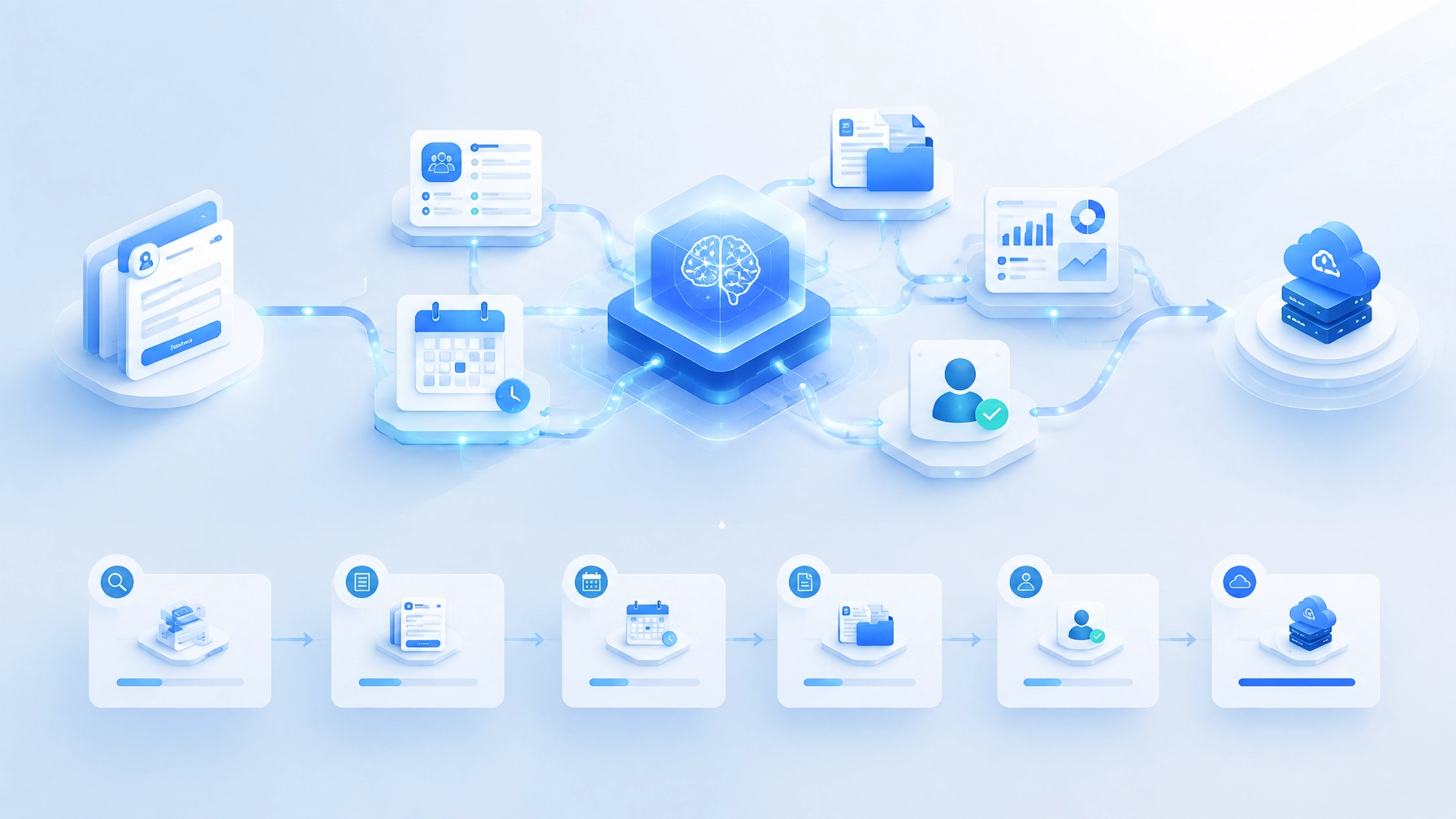
A phased roadmap from discovery to deployment
A responsible AI workflow automation engagement should be staged.
1. Discovery and workflow audit
Document the current process, systems, ownership, data sources, exceptions, and baseline performance.
Typical duration: 1–2 weeks
Indicative investment: $3,000–$8,000, depending on the number of workflows and stakeholders
2. Prioritization and architecture
Score candidate workflows, define the target operating model, select the first use case, and design integrations, permissions, data structures, AI responsibilities, and human approval points.
Typical duration: 1–3 weeks
Deliverables: workflow map, prioritization matrix, technical architecture, implementation scope, and measurement plan
3. Bounded pilot
Build one focused workflow, often with a custom dashboard, portal, queue, or internal interface. Keep the scope narrow enough to test outcomes without disrupting live operations.
Typical duration: 4–8 weeks
Indicative investment: $15,000–$40,000, assuming a bounded workflow with two to four integrations
4. Measurement and calibration
Compare results against the baseline. Review completion time, exception rate, manual touches, routing accuracy, staff adoption, and client experience.
5. Scale-out
Extend the operating layer into adjacent workflows only after the first system is stable and measurable.
A broader multi-system platform may take 8–16 weeks or more and commonly exceeds $40,000, depending on integrations, compliance requirements, user roles, data migration, reporting, and deployment complexity. These are planning ranges, not fixed quotes. The appropriate scope depends on the business constraint and the level of operational change required.

Measure leverage, not activity
The success of AI workflow automation should be evaluated through operational outcomes.
Useful measures include:
- Time from inquiry to qualified opportunity
- Time from signed agreement to onboarding completion
- Manual touches per case
- Exception and rework rates
- Response time for revenue-critical requests
- Staff capacity returned to client-facing work
- Percentage of cases routed correctly
- Revenue leakage from missed follow-up
- Visibility into high-risk or stalled work
The objective is not to eliminate human involvement. It is to reserve human attention for expertise, judgment, relationships, and decisions that materially affect the business.
Build the right workflow first
AI workflow automation is most valuable when it is sequenced as an operating model initiative rather than purchased as a collection of features.
The right first workflow should be close enough to revenue or client value to matter, structured enough to implement, visible enough to measure, and controlled enough to deploy responsibly.
Pure Technology Consulting helps growth-focused service businesses evaluate workflow opportunities, design custom web applications, connect fragmented systems, and build governed automation layers for long-term scale.
To request a workflow audit and discuss the right starting point, book a discovery call. You can also review our custom web development services and related insight on bringing proven automation into legal and accounting firms.
Contact: +1 (803) 921-0969
Amin Said, Founder of Pure Technology Consulting LLC
https://puretechconsult.com
Leave a Reply