Amin Said, Founder of Pure Technology Consulting LLC
Distributed field teams create a complex operating challenge. Managers need to know where work is happening, dispatchers need reliable visibility into assignments, finance teams need accurate activity records, and representatives need a practical mobile workflow that works in real-world conditions.
For a door-to-door sales organization, these requirements are closely connected. A visit is not simply a location event. It may affect rep accountability, territory management, customer records, commission calculations, payroll preparation, and management reporting.
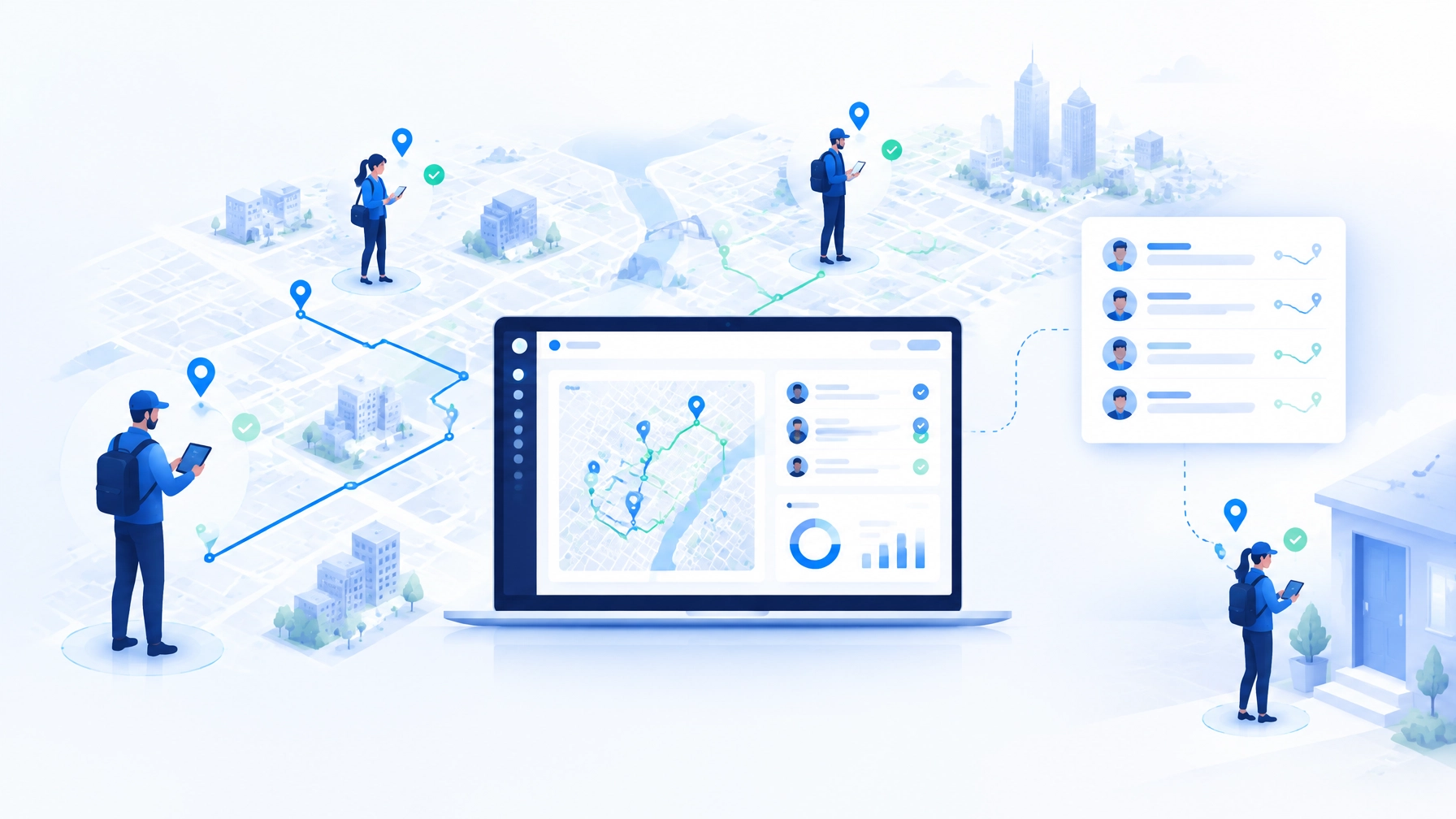
Pure Technology Consulting built a proof-of-concept D2D field tracking platform to address that broader challenge. The objective was not another isolated GPS tracker. It was a unified operating layer connecting dispatch and routing, location-verified visit logs, exception reporting, CRM data, and commission reconciliation.
The architecture demonstrates how custom web application development can turn fragmented field activity into a governed, auditable business process. The same patterns can support field service technicians, inspectors, multi-location operators, installation teams, and other distributed workforces.
The operating problem: field activity and financial processes were disconnected
Many field organizations manage operations across a combination of spreadsheets, messaging applications, mapping tools, CRM records, and payroll workflows.
Each tool may perform a useful function, but the overall process remains fragmented:
- Dispatchers assign work in one system.
- Representatives report activity through another.
- GPS information is reviewed separately.
- Managers investigate exceptions manually.
- Finance teams reconcile approved activity against commissions or payroll.
- CRM records may not reflect what happened in the field.
This creates a gap between planned work and verified work.
A route may be assigned but not completed. A visit may be reported without sufficient location evidence. A representative may perform activity that is valid but difficult to reconcile with a customer record. A commission may be calculated from incomplete or outdated data.
The platform was designed around a more complete question:
How can a business plan field activity, verify what occurred, manage exceptions, and connect approved activity to financial outcomes through one system?
That question shaped both the user experience and the technical architecture.

The unified operating layer
The central design decision was to treat the platform as an orchestration layer rather than a standalone tracking application.
The system connects several operational domains:
- Dispatch and route assignment
- Mobile field activity capture
- GPS and visit verification
- Exception management
- CRM synchronization
- Commission calculation
- Payroll-ready reconciliation
- Immutable audit history
- Management reporting
This approach reflects the principles behind Pure Technology Consulting’s web development practice: the application is built around the client’s operating model, data relationships, user roles, and integration requirements.
The platform includes a browser-based operations console for managers and dispatchers, supported by a mobile workflow for field representatives. Each side of the system is designed for its operating context.
Dispatchers need a portfolio view of work. Representatives need a focused mobile interface. Finance teams need approved records and reconciliation logic. Leaders need reporting that explains performance without requiring manual spreadsheet preparation.
Dispatch and routing designed around operational rules
Dispatch is more than assigning a name to a location. A practical field operations system must account for territories, availability, route sequence, workload, priority, and the status of current assignments.
The proof-of-concept architecture supports a dispatch workflow in which managers can:
- Create or receive field assignments
- Organize work by territory, date, or priority
- Assign visits to specific representatives
- Monitor planned and active routes
- Review incomplete or delayed activity
- Reassign work when operational conditions change
- Identify exceptions requiring human review
Routing logic can be configured according to the organization’s needs. A simple operation may assign visits by geography. A more complex model may consider representative experience, territory ownership, customer type, travel time, or service-level requirements.
The important architectural principle is separation between the dispatch interface and the underlying event history. A dispatcher can change an assignment, but the system should retain a record of what changed, when it changed, and who made the decision.
That distinction preserves operational flexibility without sacrificing accountability.
GPS verification is part of a larger evidence model
The earlier GPS-verified tracking concept focused primarily on confirming field presence. This platform expands that idea into a broader evidence model.
A verified visit may include:
- Assignment details
- Representative identity
- Start and completion timestamps
- Device and session information
- GPS coordinates
- Location accuracy metadata
- Route or territory context
- Visit status
- Optional notes, forms, or supporting information
- Changes made after the initial capture
GPS is therefore one component of a verifiable activity record, not the complete record by itself.
The system can apply configurable rules to determine whether activity should be automatically accepted, flagged for review, or held for additional context. For example, an activity record may be flagged when the location accuracy is insufficient, the visit occurs outside an expected territory, or the timing does not align with the assigned route.
This creates a structured exception process rather than forcing managers to inspect every visit manually.
Offline-tolerant mobile capture for real field conditions
Field teams cannot always depend on continuous connectivity. A mobile workflow that assumes a stable network can create incomplete records, frustrated users, and unreliable synchronization.
The platform was designed with offline tolerance in mind. The mobile experience can preserve key workflow actions locally and synchronize them when connectivity returns.

A representative mobile workflow may include:
- Downloading assigned work when connectivity is available.
- Opening a route or visit from the device.
- Capturing status changes and GPS metadata.
- Storing events locally when the network is unavailable.
- Placing unsynchronized events in a protected queue.
- Synchronizing those events when a connection is restored.
- Resolving conflicts according to defined business rules.
Offline support requires more than adding local storage. The architecture must define which data can be safely captured offline, how duplicate events are prevented, how timestamps are handled, and what happens when a manager changes an assignment while a representative is disconnected.
Those decisions are part of responsible business process automation consulting. The goal is not merely to automate a happy path. It is to create reliable behavior when real operating conditions are incomplete or inconsistent.
Event ingestion and an immutable audit trail
At the center of the platform is an event-oriented data model.
Instead of storing only the latest status of a visit, the system records meaningful lifecycle events such as:
- Assignment created
- Route updated
- Representative dispatched
- Visit started
- GPS location captured
- Visit completed
- Exception raised
- Manager review completed
- Commission approved
- Payroll record exported
This design provides two benefits.
First, it creates a more accurate operational history. Managers can see how work progressed rather than only its current state.
Second, it establishes a foundation for auditability. Critical events can be stored in an append-oriented audit trail that is separate from editable business records. This helps preserve the history of important decisions, including changes to assignments, approvals, payout rules, or exported records.
An immutable audit trail is especially valuable when a field activity record affects compensation. If an approved commission later changes, the organization should be able to identify the original activity, the adjustment, the person who approved it, and the reason for the change.
Connecting verified activity to commission reconciliation
The most important distinction in this case study is the connection between verified field work and financial reconciliation.
A tracking system can show where a representative was. A unified operating layer can help determine which verified activities qualify for compensation and how those activities should be reconciled with payroll or finance systems.
The platform can support a sequence such as:
- Capture field activity from the mobile workflow.
- Validate location, assignment, timing, and required data.
- Route exceptions to a manager or operations reviewer.
- Approve qualifying activity.
- Apply commission rules based on the organization’s model.
- Compare calculated commissions against CRM or sales records.
- Produce a reconciliation view for finance.
- Export approved records to a payroll or accounting system.
Commission logic may vary by product, territory, representative, team, customer outcome, or approval status. For that reason, it should be implemented as governed business logic rather than hidden inside a spreadsheet or hard-coded into a single screen.

The platform can also distinguish between operational exceptions and financial exceptions. A missing GPS signal may require an operations review. A mismatch between an approved visit and a CRM opportunity may require sales or finance review.
That separation makes exception reporting more useful. Instead of presenting managers with an undifferentiated list of errors, the system can direct each issue to the appropriate owner.
CRM and payroll integration as part of the architecture
Integrations were treated as core components rather than afterthoughts.
The CRM may remain the source of truth for customer, opportunity, or account information. The field platform may become the source of truth for route execution and verified activity. Payroll or accounting systems may remain authoritative for final payment processing.
A well-designed integration layer defines how those systems exchange information:
- Which system owns each data type
- When records are created or updated
- How duplicate records are identified
- What happens when synchronization fails
- How changes are retried
- Which events require human review
- How synchronization history is recorded
This is the same operating-layer principle used in broader AI-powered business systems: automation works best when it coordinates existing systems through clear rules, permissions, and auditability.
AI could later support route recommendations, anomaly detection, or exception prioritization. However, deterministic rules should remain responsible for core verification, approvals, calculations, and financial exports where consistency is essential.
How the architecture generalizes beyond door-to-door sales
The D2D use case provides a demanding proof of concept because it combines mobile users, distributed activity, location data, assignments, exceptions, and compensation.
The same architecture can be adapted for:
Field service technicians
Dispatchers can assign service calls, technicians can capture arrival and completion evidence, and approved work can flow into billing or payroll.
Inspectors and auditors
The platform can record visits, checklists, photographs, location metadata, exceptions, and review decisions in one auditable workflow.
Multi-location service businesses
Regional teams can manage assignments across locations while leadership receives standardized reporting on completion, productivity, and exceptions.
Installation and maintenance teams
Route planning, proof of service, materials used, customer signatures, and compensation rules can be connected through one operational system.
The user interface and business rules will change by industry. The underlying patterns remain valuable: event ingestion, offline-tolerant capture, role-based access, integration boundaries, immutable history, and governed reconciliation.
What this proof of concept demonstrates
The D2D field tracking platform demonstrates PTC’s ability to build beyond a basic dashboard or mobile form.
It combines:
- Custom web application development
- Mobile-first field workflows
- Event-driven architecture
- GPS and route verification
- Offline synchronization
- Exception reporting
- CRM integration
- Commission and payroll reconciliation
- Audit-focused data design
- Operational dashboards
For organizations evaluating enterprise automation consulting, the broader lesson is that custom software should be measured by the operating model it enables.
A serious system does not simply collect more data. It connects planning, execution, verification, review, and financial outcomes in a way that gives leaders a clearer view of how work moves through the business.
Scope a custom field operations platform
If your organization manages distributed teams, disconnected systems, or manual reconciliation between field activity and financial records, the next step is to define the operating layer around your actual workflows.
Book a discovery call to scope a custom build. Pure Technology Consulting can help map the current process, identify integration boundaries, define the first release, and determine which architecture decisions will support future growth.
Contact
+1 (803) 921-0969
Amin Said, Founder of Pure Technology Consulting LLC
https://puretechconsult.com
Leave a Reply