Author: Amin Said, Founder of Pure Technology Consulting LLC
For a growing healthcare, behavioral health, or specialty clinic network, patient intake is not simply a form submission. It is the beginning of a coordinated operational process involving clinical needs, provider qualifications, locations, appointment types, insurance requirements, availability, consent, and follow-up.
When those decisions are managed across disconnected tools, staff members become the integration layer. They review submissions manually, transfer information between systems, contact patients for missing details, and determine which provider or location is the right fit.
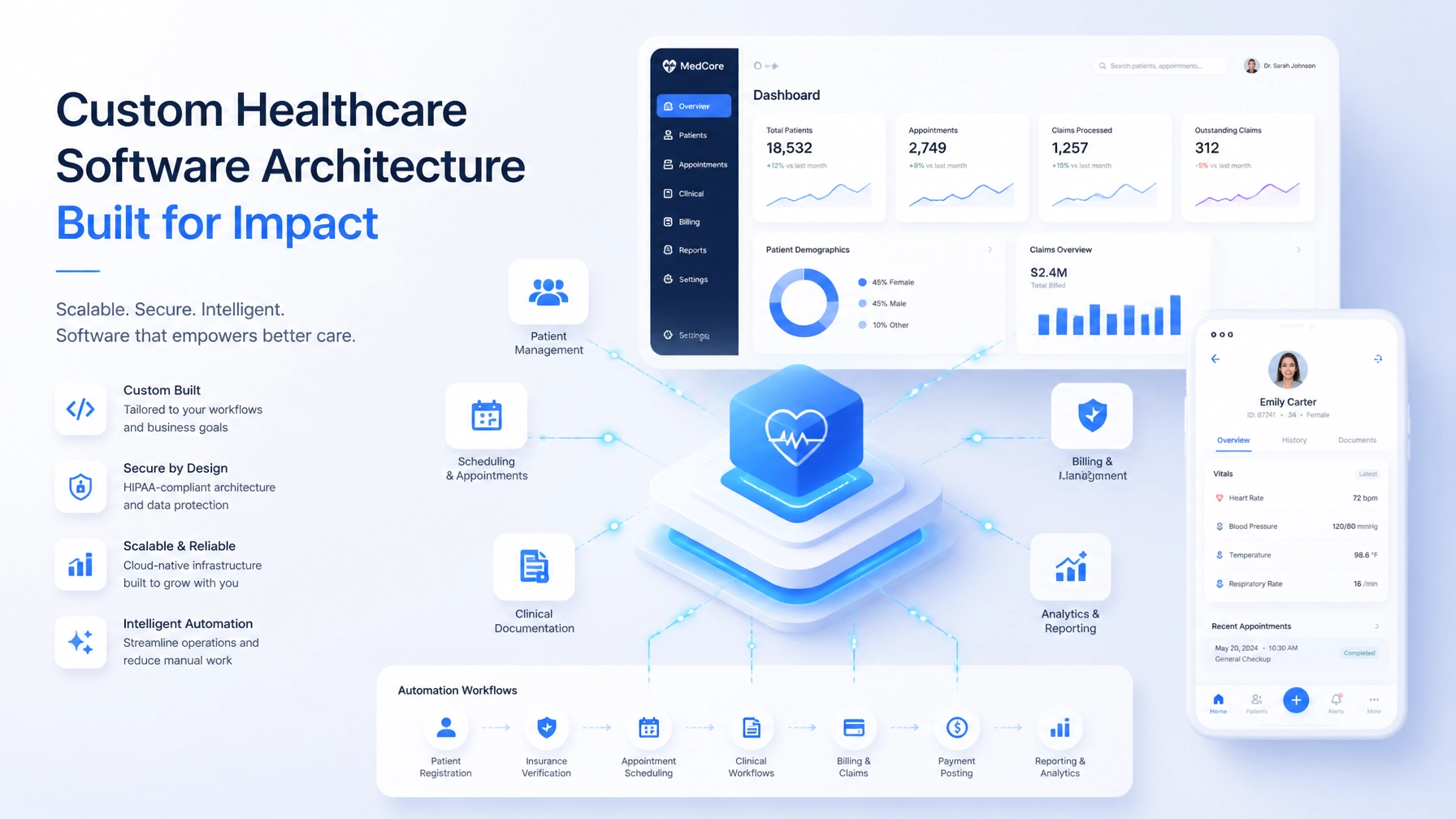
Pure Technology Consulting built EHRIO Pro as a proof-of-concept for a more intelligent operating model: a scalable custom web application that combines adaptive intake, provider matching, workflow orchestration, integration, and reporting in one governed system.
EHRIO Pro is not being presented here as a standalone SaaS product for purchase. It is a demonstration of PTC’s ability to design and build complex, healthcare-focused systems for high-ticket clients whose operational requirements exceed the capabilities of generic intake software.
The business stakes behind healthcare intake
Poorly designed intake processes create consequences well beyond administrative inconvenience. They can affect growth, patient access, staff capacity, and leadership visibility.
The most common risks include:
- Referral leakage when prospective patients are not followed up with consistently
- Intake abandonment caused by long, confusing, or irrelevant forms
- Manual triage time spent interpreting every submission from the beginning
- Mis-matched appointments involving the wrong provider, site, or modality
- Delays caused by missing insurance, consent, or clinical information
- Limited visibility into referral sources and demand patterns
- Difficulty comparing intake throughput across locations or service lines
An off-the-shelf form tool may collect information effectively. It usually does not understand the operational decisions that must happen after the form is submitted.
That distinction shaped the EHRIO Pro architecture.
Why custom web application development was the right approach
A standard intake tool is generally designed around a fixed sequence of questions and a limited set of downstream actions. That model can work for simple appointment requests. It becomes restrictive when a clinic must evaluate multiple variables before routing a patient.
A multi-provider healthcare network may need to consider:
- Specialty and clinical needs
- Provider qualifications and service capabilities
- Insurance participation
- Patient location and travel preferences
- In-person or telehealth requirements
- Provider availability and new-patient capacity
- Appointment duration and modality
- Referral source and urgency
- Clinic-specific escalation conditions
These rules are rarely identical from one clinic to the next. They also change as services, staffing, locations, and payer relationships evolve.
Custom web application development made it possible to create an intake and matching engine around the organization’s actual operating model rather than forcing the organization to redesign its processes around a generic product.
The system could separate routine automation from cases requiring human review. High-confidence matches could move forward through the workflow, while ambiguous or incomplete submissions could be routed to an appropriate staff queue.
This is a central principle of PTC’s approach to AI-powered business systems: automation should improve decision flow without making accountability invisible.
An adaptive intake workflow built for approximately 70 questions
At the center of EHRIO Pro is an adaptive intake workflow capable of supporting approximately 70 questions.
A static form presents every patient with the same path. An adaptive workflow changes based on the patient’s previous responses, the clinic’s configuration, and the operational context of the request.
For example, a patient reporting a particular condition may receive additional questions about symptoms, prior treatment, medications, or relevant history. Another patient may be routed through a shorter path based on the service requested.
The intake engine can be configured to capture:
- Demographic and contact information
- Insurance and coverage details
- Medical history, medications, and allergies
- Symptoms and reason for seeking care
- Referral information and uploaded documents
- Provider, location, and modality preferences
- Consent and communication preferences
- Appointment requirements and scheduling constraints
The value is not simply a shorter form. It is structured data that can be used by the matching engine, work queues, dashboards, notifications, and downstream EHR-adjacent workflows.

Configurable logic instead of hard-coded workflows
A healthcare network should not need a new software build every time it adds a provider, opens a location, changes a service line, or updates an intake requirement.
EHRIO Pro was designed around configurable entities and rules. Clinic administrators and authorized operators can define the conditions that influence routing without rebuilding the entire application.
The architecture separates:
- Questions and response types
- Required versus optional fields
- Conditional question paths
- Provider and location attributes
- Matching rules and scoring criteria
- Escalation and exception conditions
- Appointment and modality requirements
- Notification and follow-up actions
This approach supports bespoke AI solutions without treating artificial intelligence as a black box. Matching can combine deterministic business rules with intelligent recommendations, while the organization retains visibility into the factors influencing a result.
For healthcare operations, that transparency matters. Staff need to know not only what was recommended, but also why the recommendation was made and whether a case requires review.
Intelligent patient matching across provider, site, and modality
The matching engine was designed to answer a more useful question than “Who is available?”
The better question is: Which provider, location, and appointment format are the best operational fit for this patient?
Depending on the clinic’s requirements, the matching process can evaluate:
- Clinical service requirements
- Provider credentials and specialties
- Accepted insurance plans
- Location and travel preferences
- Telehealth eligibility
- New-patient capacity
- Appointment duration
- Scheduling availability
- Practice-defined escalation rules
A recommended match can then be passed into scheduling or routed to staff for confirmation. If required information is missing, the system can generate a follow-up task instead of allowing the submission to disappear into an inbox.
This creates a more controlled path from inquiry to appointment. It also gives front-desk and intake teams a prepared operational record rather than an unstructured message that must be interpreted manually.
Versioning and auditability for governed change
Configurable systems create flexibility, but flexibility without governance can introduce risk.
EHRIO Pro was designed with versioned intake and matching configurations so that changes could be tracked over time. A clinic may need to know which question set, rule set, or provider configuration was active when a patient was routed.
Relevant audit information can include:
- The version of the intake workflow used
- The rules applied during matching
- The user or administrator who made a change
- The date and time of the change
- The reason for an override or manual decision
- The system events that moved a case between workflow stages
This supports operational troubleshooting and continuous improvement. If match quality changes after a rule update, leadership can investigate the change rather than relying on memory or scattered notes.
It also creates a foundation for responsible AI governance. Recommendations can be reviewed, exceptions can be analyzed, and automated decisions can remain connected to human oversight.
Integrations that preserve the existing operating environment
The objective was not to force clinical teams to abandon every system already in use. The objective was to create an orchestration layer that could connect intake with scheduling, CRM, and EHR-adjacent systems.
A typical workflow may include:
- Receiving an inquiry, referral, or digital intake submission
- Validating required information
- Normalizing structured data
- Applying matching logic
- Flagging insurance or authorization requirements
- Requesting staff review when necessary
- Presenting appropriate scheduling options
- Synchronizing approved information with connected systems
- Triggering reminders or follow-up tasks
- Reporting on throughput, outcomes, and exceptions
The exact integration approach depends on the client’s existing technology environment, available APIs, data ownership, security controls, and compliance obligations.
EHRIO Pro therefore reflects a HIPAA-adjacent architecture and engineering capability. A production deployment would require a client-specific assessment of security practices, access controls, vendor agreements, retention requirements, and applicable regulatory responsibilities.

A rollout model designed to protect live clinical operations
A healthcare workflow cannot be treated like an isolated software experiment. Intake and scheduling continue while the new system is being introduced.
The rollout strategy prioritized controlled adoption rather than a disruptive cutover. A practical implementation model includes:
- Mapping the current intake and triage process before configuration
- Starting with one clinic, service line, or workflow
- Testing rules with representative scenarios
- Running selected workflows in parallel when appropriate
- Using feature flags to activate capabilities incrementally
- Providing staff with clear exception and override paths
- Monitoring integration events and workflow completion
- Expanding only after operational owners validate the process
This approach reduces the risk of introducing automation before the organization understands its effects. It also allows clinical and administrative teams to shape the workflow based on real operating conditions.
The goal is not to automate everything on day one. The goal is to establish a reliable foundation that can expand without interrupting patient access or staff responsibilities.
Reporting that connects intake activity to business decisions
A workflow is only as valuable as the visibility it creates.
EHRIO Pro includes a reporting layer designed to help leadership understand how demand moves through the intake process. Useful measures may include:
- Inquiry-to-intake completion rate
- Intake abandonment by step
- Time from referral to scheduled appointment
- Manual touches per patient
- Match acceptance and override rates
- Exception volume by location or service line
- Referral source performance
- Appointment rescheduling caused by incomplete information
- Intake throughput by provider or site

These measures should be evaluated against the organization’s own baseline. The purpose is not to promise a universal result. It is to create an operating system in which improvement can be observed, managed, and refined.
Proof of capability for complex custom systems
EHRIO Pro demonstrates the type of work that becomes necessary when standard software leaves critical decisions fragmented.
The resulting deliverables for a comparable custom engagement may include:
- Application and data architecture
- Adaptive intake and form configuration
- Provider, location, and modality matching logic
- CRM, scheduling, and EHR-adjacent integrations
- Role-based access and audit-oriented logging
- Exception queues and staff review workflows
- Intake throughput and match-quality dashboards
- Deployment, testing, training, and post-launch support
The same engineering principles extend beyond healthcare. PTC applies them to field operations, debt and fintech workflows, local SEO automation, professional services intake, and other environments where data, decisions, and accountability must work together.
EHRIO Pro is one example of how bespoke AI solutions can become practical operating infrastructure, not a layer of disconnected features, but a system designed around the way an organization actually works.
Build the operating model your growth requires
Healthcare organizations do not need more software for its own sake. They need technology that reduces friction between demand, intake, triage, scheduling, and care delivery.
When the workflow is complex, the right solution may be a custom web application designed around the organization’s rules, integrations, governance requirements, and growth roadmap.
To discuss a healthcare intake platform, intelligent matching workflow, or broader automation initiative, call +1 (803) 921-0969 or book a discovery consultation. You can also review Pure Technology Consulting’s custom web development services and explore additional case studies on complex intake automation.
Contact: +1 (803) 921-0969
Amin Said, Founder of Pure Technology Consulting LLC
https://puretechconsult.com
Leave a Reply