By Amin Said, Founder of Pure Technology Consulting LLC
Growth creates operational complexity. The systems that support a company at ten employees may become a constraint at fifty. A CRM, scheduling platform, accounting tool, spreadsheet library, and collection of automation connectors can each work adequately in isolation while creating friction across the business.
At a certain point, the question is no longer whether another SaaS subscription can solve one more problem. The strategic question becomes whether the organization needs a business system designed around its own operating model.
A custom software development agency can help answer that question and translate the answer into a practical roadmap. At Pure Technology Consulting, we design custom web applications, AI-powered workflow automation, and integrated operating systems for organizations managing complex processes, multiple locations, high data volumes, or demanding compliance requirements.
The fragmentation tax of disconnected SaaS tools
Disconnected SaaS tools are not inherently bad. For standardized processes, they provide speed and affordability. The challenge begins when a company’s competitive advantage depends on workflows that generic platforms were never designed to support.
Common symptoms include:
- Staff re-entering the same information across several systems.
- Leaders relying on manual spreadsheet consolidation for reporting.
- Important data being trapped inside individual applications.
- Exceptions being handled through email, messaging, or tribal knowledge.
- Teams using exports and imports to compensate for weak integrations.
- Compliance records and approvals being difficult to trace.
- New locations, service lines, or business units requiring increasingly complex workarounds.

This is the fragmentation tax: the cumulative cost of reconciling systems that were never designed to operate as one. It appears as slower cycle times, duplicated labor, inconsistent reporting, missed handoffs, and limited visibility into the business.
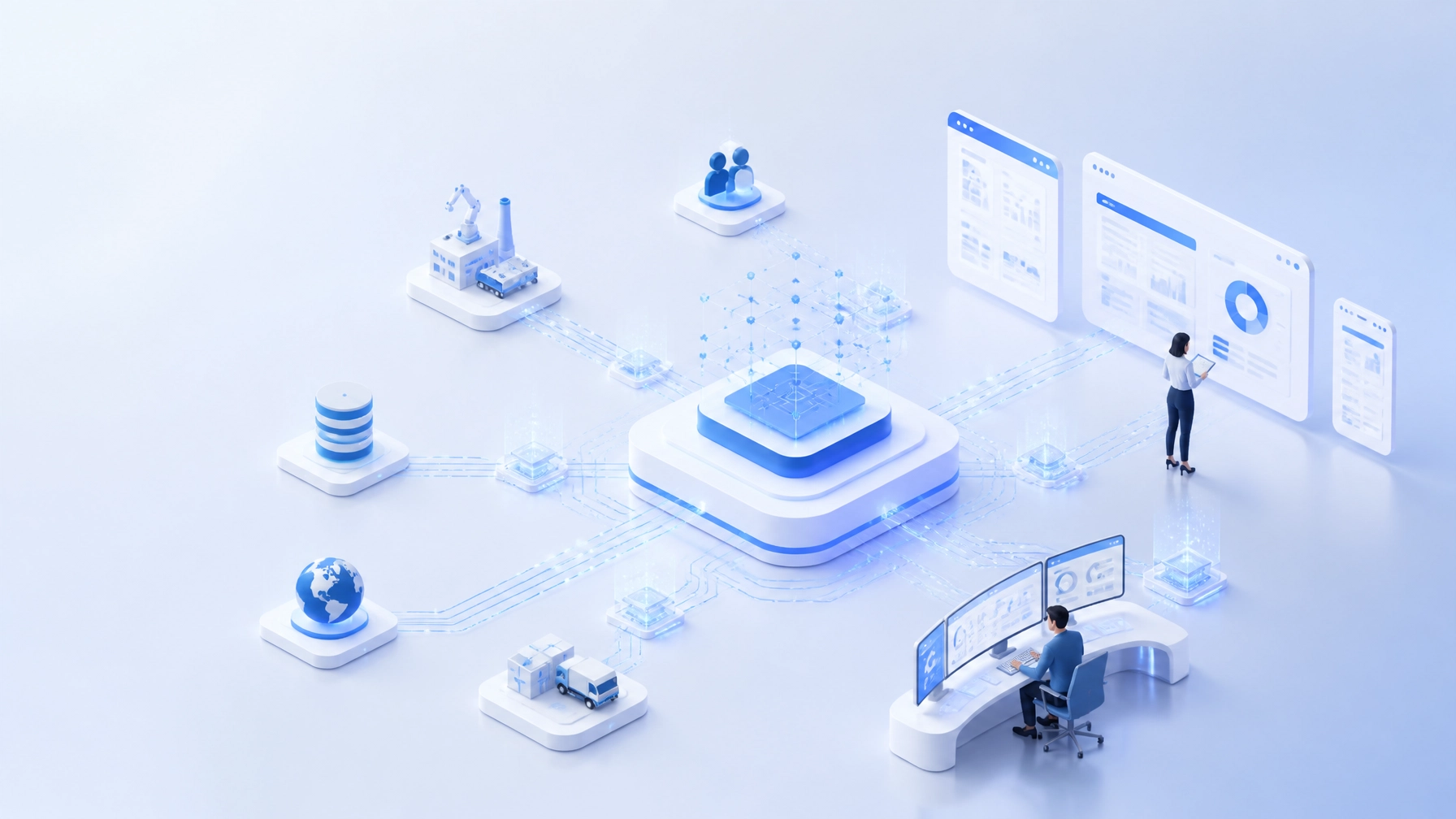
The right response is not always to replace every existing tool. In many cases, a custom web application becomes an orchestration layer that connects valuable systems, standardizes the data between them, and automates the workflows that generic software cannot manage well.
When should an organization move beyond off-the-shelf software?
The decision should be based on operational economics and strategic importance, not on the novelty of artificial intelligence.
A custom system becomes worth evaluating when several of the following conditions are present:
Your workflows are a competitive advantage
If your intake process, routing logic, matching engine, approval sequence, or service delivery model differentiates your business, forcing it into a generic template may limit growth.
For example, a healthcare organization may need a detailed intake process, provider matching based on multiple conditions, and secure synchronization with existing systems. A multi-location operator may require location-specific inventory, event profitability, commissions, and scheduling within a single operating model.
Manual coordination is becoming a permanent cost
Automation is most valuable when it removes recurring coordination work. If employees spend substantial time checking files, updating statuses, copying information, reconciling reports, or routing requests, those processes deserve an architectural review.
The goal is not to eliminate human judgment. It is to reserve human attention for exceptions, relationships, and decisions that genuinely require expertise.
Your data is valuable but not accessible
AI cannot create reliable operational insight from fragmented, inconsistent, or inaccessible data. Before introducing an AI assistant or autonomous workflow, an organization needs a dependable data model, clear ownership, and defined rules for how information moves through the business.
Governance requirements are increasing
Organizations in healthcare, financial services, legal services, accounting, and other regulated environments need more than convenience. They need permissions, auditability, retention rules, secure integrations, and traceable decisions.
A custom system allows these requirements to be designed into the workflow instead of added as manual controls after the fact.
Tool costs and complexity are scaling faster than the business
A growing collection of per-user subscriptions, add-on modules, middleware tools, and custom connectors can become more expensive and difficult to manage than a purpose-built platform. For multi-location or high-volume organizations, a custom build is often a strategic capital investment, frequently scoped at $10,000 or more depending on integrations, security, workflow complexity, and ongoing support requirements.
What belongs inside an AI-powered business system?
AI should be applied where it improves a defined business process. It should not be added simply because a project includes the word “AI.”
Effective use cases often include:
- Classifying incoming forms, emails, files, or service requests.
- Extracting structured information from documents.
- Routing leads, cases, patients, accounts, or tasks.
- Summarizing activity for managers and decision-makers.
- Detecting anomalies or incomplete records.
- Recommending next actions based on business rules and history.
- Drafting communications for human review.
- Generating operational reports from connected systems.
- Escalating exceptions when confidence or policy thresholds are not met.
The strongest systems combine conventional software, rules-based automation, and AI assistance. A deterministic rule may be the right choice for a compliance requirement. A language model may be useful for summarizing a long document. A human reviewer may still be required before an important action is finalized.
This combination creates a more dependable operating model than treating AI as an all-purpose replacement for process design.
Governance is the foundation, not a final feature
AI workflow automation must be governed before it is scaled. A production-ready system should define:
- Who can access each type of data.
- Which actions an AI system may recommend or execute.
- When human approval is mandatory.
- How decisions, changes, and overrides are recorded.
- How data is encrypted, retained, and removed.
- How integrations authenticate and recover from failure.
- How accuracy, exceptions, and model performance are monitored.

Governance also requires clear accountability. Someone should own the business process, someone should own the data, and someone should be responsible for reviewing the system as workflows evolve.
This is especially important when a platform handles sensitive healthcare information, financial records, customer communications, or operational decisions across multiple locations.
Integration strategy: preserve what works and connect what matters
A bespoke system does not have to mean rebuilding every application from the ground up. The more practical approach is often to identify which existing systems are valuable and which gaps create the most operational drag.
A strong integration strategy typically includes:
- Workflow mapping: Document the current process, including handoffs, exceptions, data sources, and failure points.
- System inventory: Identify the role of every CRM, EHR, accounting platform, file store, communication tool, and database.
- Canonical data model: Define the common structure that allows systems to exchange accurate information.
- Orchestration layer: Build the central workflow engine, portal, or dashboard that coordinates activity.
- Secure API connections: Move data through authenticated, controlled integrations with clear error handling.
- Real-world testing: Validate the system against normal workflows, edge cases, permissions, and recovery scenarios.
PTC has applied this approach across several proof-of-concept platforms. EHRIO Pro demonstrates complex intake, matching engines, and HIPAA-adjacent workflow architecture for healthcare operations. ChainHQ demonstrates how a custom operating system can coordinate multi-location activity, inventory, event management, and reporting. FTP Inform demonstrates secure file ingestion, validation, transformation, and downstream orchestration for high-volume financial operations. AI Local Boost demonstrates scalable content and reputation workflow automation across large numbers of local business profiles.
These platforms are not presented as standalone products for every organization. They are evidence of the underlying engineering capabilities required to design custom systems around specialized rules, data, integrations, and user experiences.
What should a strategic AI roadmap include?
A roadmap should connect technology decisions to measurable operating outcomes. At minimum, it should address five stages:
1. Business framing
Define the business objective first. Is the priority to reduce cycle time, improve visibility, increase throughput, reduce errors, support expansion, or create a new digital revenue channel?
2. Workflow and data discovery
Map how work actually moves through the organization. Include the informal steps that may not appear in process documentation. This is where hidden dependencies and manual workarounds become visible.
3. Use-case prioritization
Rank potential automations by business impact, feasibility, data readiness, risk, and implementation effort. A focused first release is more valuable than an ambitious platform with no clear adoption path.
4. Architecture and governance
Define the system boundaries, integrations, roles, security model, data structures, AI components, and monitoring requirements before development begins.
5. Pilot, adoption, and optimization
Launch with a defined user group and measurable success criteria. Gather feedback, monitor exceptions, refine the workflows, and expand the system in phases.

For legal and accounting firms, this roadmap can incorporate proven capabilities from healthcare intake, field accountability, debt operations, and local SEO automation without requiring the firm to start from zero. The architecture changes to fit the industry, but the core disciplines remain consistent: structured intake, secure data movement, role-based workflows, auditability, and intelligent automation.
The objective is operational leverage
A custom AI system should make the business easier to manage as it grows. It should give leadership a clearer operating picture, give teams fewer administrative steps, and give customers a more consistent experience.
The best result is not simply a new application. It is a more coherent operating model in which data moves reliably, important decisions are visible, exceptions are managed intentionally, and automation supports the people responsible for delivering value.
Pure Technology Consulting helps growth-focused organizations evaluate that opportunity through digital transformation consulting, custom web application development, enterprise automation consulting, and AI workflow automation.
To discuss your current systems, request a workflow audit, or scope a strategic technology roadmap, contact the team at +1 (803) 921-0969 or book a discovery call. The first step is not choosing a tool. It is understanding how your operation should work when technology is designed around its future.
Amin Said, Founder of Pure Technology Consulting LLC
https://puretechconsult.com
Leave a Reply