Amin Said
Operational complexity is not automatically a disadvantage. In many organizations, complexity exists because the business has developed specialized processes, valuable customer data, multiple locations, or differentiated service models.
The problem begins when those processes remain trapped in spreadsheets, disconnected SaaS tools, email threads, and manual workarounds.
At that point, complexity stops creating value and starts creating drag.
Custom web applications provide a strategic path forward. Instead of forcing an organization to adapt to generic software, a custom application can encode the company’s operating model into a scalable digital system. Workflows become repeatable. Data becomes visible. Decisions become faster. Proprietary processes become technology-enabled advantages that competitors cannot simply purchase from the same software marketplace.
At Pure Technology Consulting, we design and deploy custom web applications and automation systems for growth-focused organizations across healthcare, local services, professional services, e-commerce, field operations, and financial services.
Our proprietary platforms: AI Local Boost, ChainHQ, EHRIO Pro, and FTP Inform: serve as proof-of-concept examples of the architecture, automation, and integration principles we bring to high-ticket custom engagements.
The strategic case for custom web application development
Off-the-shelf software is effective when an organization’s workflows are relatively standard. A general CRM, scheduling platform, or accounting system may provide a strong foundation for common business functions.
However, established companies often operate at the edges of those standard workflows.
They may need to:
- Coordinate operations across dozens or hundreds of locations.
- Match customers or patients to providers using multiple decision variables.
- Ingest files from external partners with inconsistent schemas.
- Connect marketing, operations, billing, telephony, and reporting systems.
- Enforce different permissions for executives, managers, specialists, and local teams.
- Preserve compliance records and audit trails across complex processes.
When a business reaches this level of operational maturity, adding more disconnected tools can increase technical debt. Teams spend time transferring data between systems instead of acting on it. Managers create manual reports because leadership lacks a unified view. Employees develop workarounds that only a few people understand.
Custom applications address the underlying operating model rather than treating each symptom separately.
The objective is not to automate everything indiscriminately. It is to identify the workflows where software can create measurable leverage, then build an architecture that supports governance, integration, scalability, and continuous improvement.
Case study one: AI Local Boost and the challenge of location-scale visibility
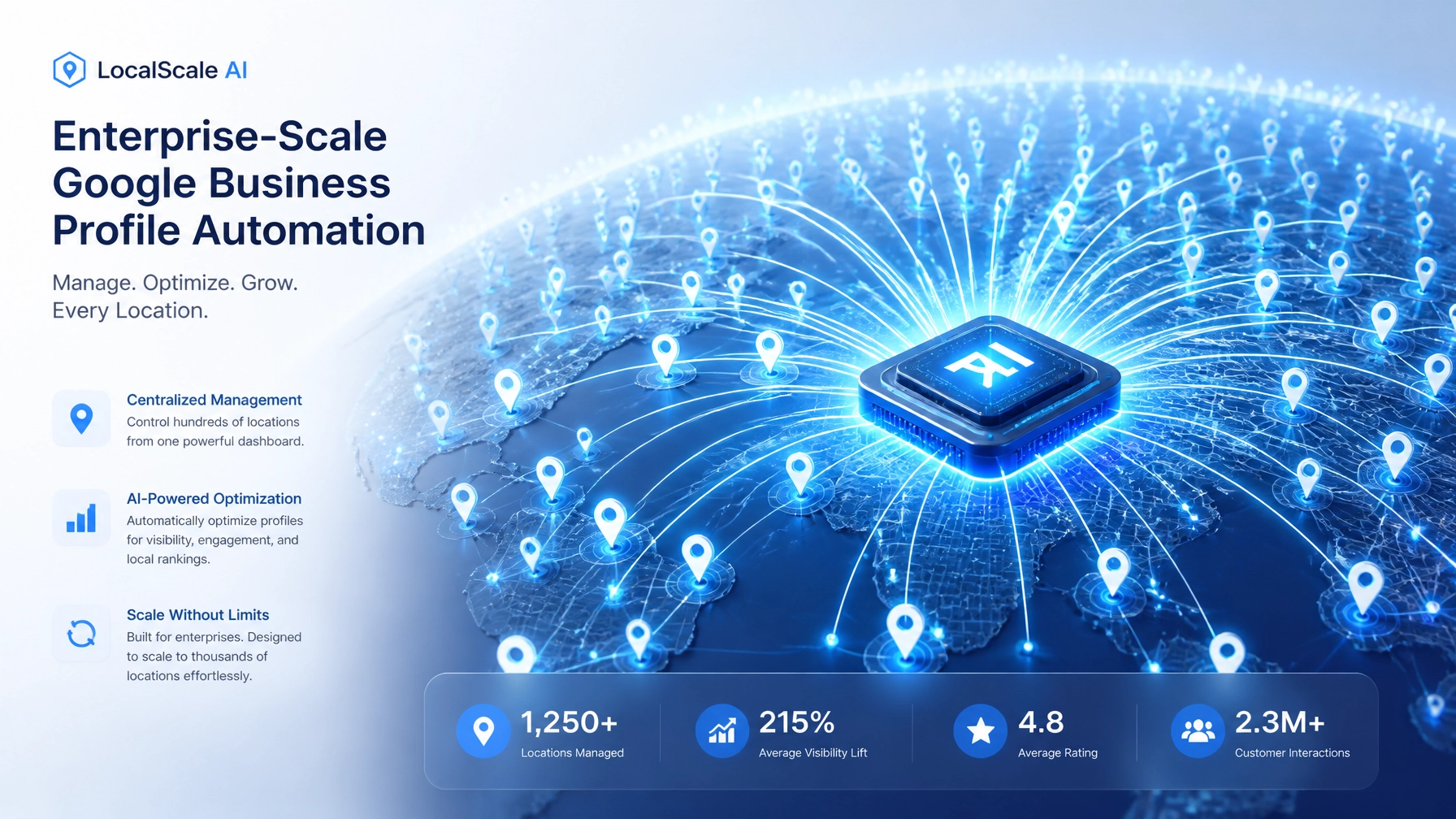
For multi-location businesses, Google Business Profiles are operational assets as well as marketing channels. Each profile represents a local point of visibility, customer interaction, review activity, and lead generation.
Managing several locations manually is demanding. Managing hundreds introduces a different class of problem.
A large network may need consistent posts, media updates, review monitoring, response workflows, and location-specific content. Those activities must remain aligned with brand standards while still reflecting local audiences and business conditions.
PTC developed AI Local Boost as a demonstration of how a custom web application can coordinate this complexity through a centralized automation engine.
Architecture and automation principles
The platform is designed around several core principles:
- Centralized management: Teams can coordinate many local profiles through a unified operational interface.
- Location-aware content: Automation can account for the industry, location, audience, and local context of each profile.
- AI-assisted governance: Incoming reviews can be analyzed for sentiment and used to generate context-aware response drafts.
- Event-driven integrations: Customer events from CRMs, point-of-sale systems, and other applications can trigger review requests or downstream actions.
- Human oversight where appropriate: High-confidence tasks may be automated, while sensitive or lower-confidence actions can follow a suggest-and-approve workflow.
The referenced AI Local Boost case study describes an architecture designed to manage more than 500 locations without requiring a proportional increase in manual administration.
The strategic value extends beyond local search. A system like this turns a fragmented marketing responsibility into a governed operating process. Leadership gains visibility. Local teams receive consistent support. The organization can scale its digital presence without scaling administrative effort at the same rate.
Case study two: ChainHQ and the architecture of multi-location operations
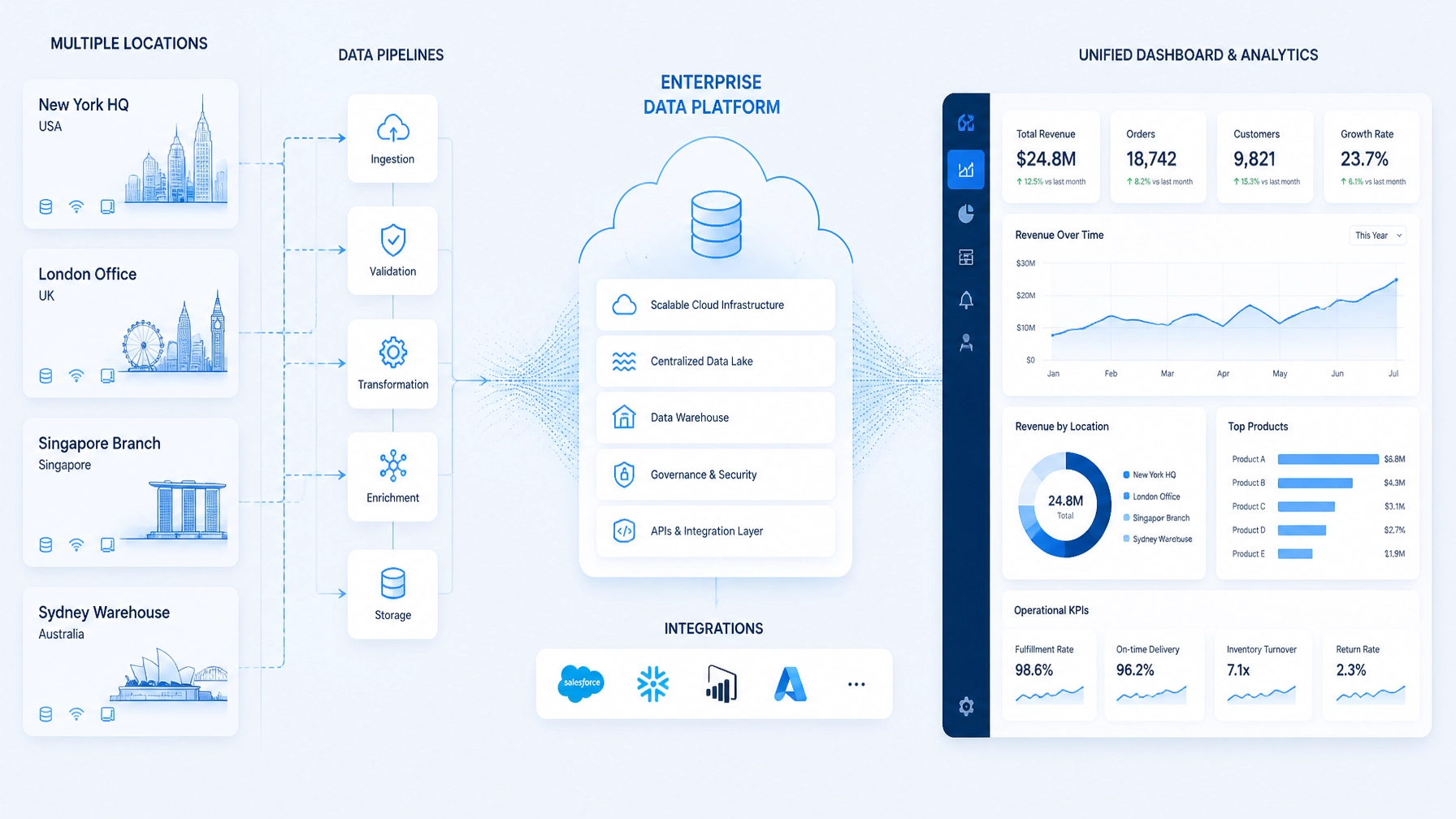
Multi-location growth creates a data architecture challenge. A business may have different branches, clinics, storefronts, regional offices, pop-ups, or warehouses. Each location generates operational data, but leadership still needs a unified view.
Traditional approaches often produce one of two outcomes:
- Separate software instances create isolated data silos.
- A rigid global platform forces every location into the same workflow, even when local variations are operationally necessary.
ChainHQ demonstrates a third approach: a unified, location-aware architecture.
Architecture and automation principles
The platform concept is built around:
- Scoped entities: Shared records can be associated with both a tenant and a location, giving headquarters visibility while preserving local data boundaries.
- Hierarchical inventory modeling: Inventory can be tracked across warehouses, regional hubs, storefronts, and other operational layers.
- Role-based access control: Executives, regional leaders, managers, and local employees receive interfaces and permissions appropriate to their responsibilities.
- Event-driven workflows: Inventory thresholds, transfers, reconciliation events, and other operational triggers can initiate automated actions.
- Unified reporting: Leaders can compare performance across locations without waiting for manual spreadsheet consolidation.
The ChainHQ case study illustrates how a custom system can centralize governance without eliminating local flexibility.
This is particularly valuable for permanent jewelry brands, healthcare groups, franchise operators, and other businesses where growth depends on replicating a strong operating model across locations.
The competitive advantage comes from visibility and consistency. Leaders can see where inventory is moving, how locations are performing, and which processes require intervention. Local teams can work within workflows that reflect their day-to-day responsibilities. Expansion becomes an architectural capability rather than a recurring software crisis.
Case study three: EHRIO Pro and specialized healthcare workflows
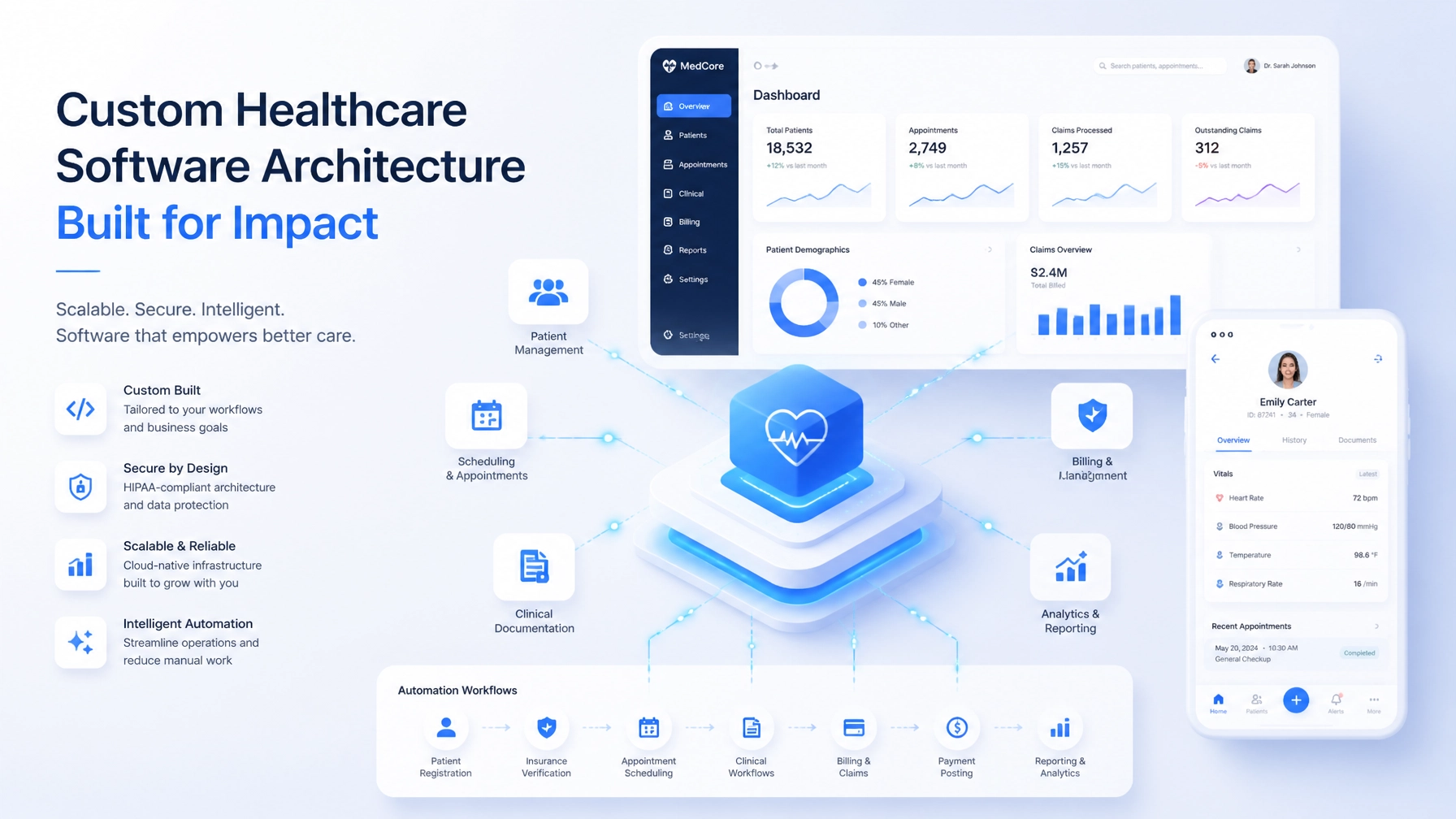
Healthcare practices often use multiple systems for scheduling, intake, patient records, billing, communications, and follow-up. Each system may perform its individual function well, yet the overall patient journey can remain fragmented.
A growing physical therapy group, chiropractic practice, behavioral health organization, or specialty clinic may need to coordinate detailed intake requirements, insurance information, provider availability, clinical specialties, and location constraints.
EHRIO Pro demonstrates how custom engineering can connect these requirements into one operational workflow.
Architecture and automation principles
The platform’s proof-of-concept architecture includes:
- Dynamic intake journeys: A detailed intake process can adapt based on a patient’s answers instead of presenting every user with the same static form.
- Matching engines: Patient information can be evaluated against provider specialization, location, scheduling availability, and insurance considerations.
- Secure data synchronization: Status changes and appointment milestones can move between the custom application and existing healthcare systems through encrypted integration pipelines.
- Role-based workflows: Front-desk staff, providers, administrators, and leadership can work from views designed for their responsibilities.
- Operational status automation: Intake completion, eligibility checks, and follow-up requirements can trigger next steps without relying on manual reminders.
The EHRIO Pro case study shows why custom development can be appropriate when a practice’s patient journey is itself a competitive differentiator.
In regulated environments, architecture must be designed with security, permissions, auditability, and data-handling requirements in mind. The goal is not simply to digitize a paper form. It is to create a dependable operating layer that reduces re-entry, improves coordination, and gives staff more capacity for patient-facing work.
Case study four: FTP Inform and file-driven enterprise automation
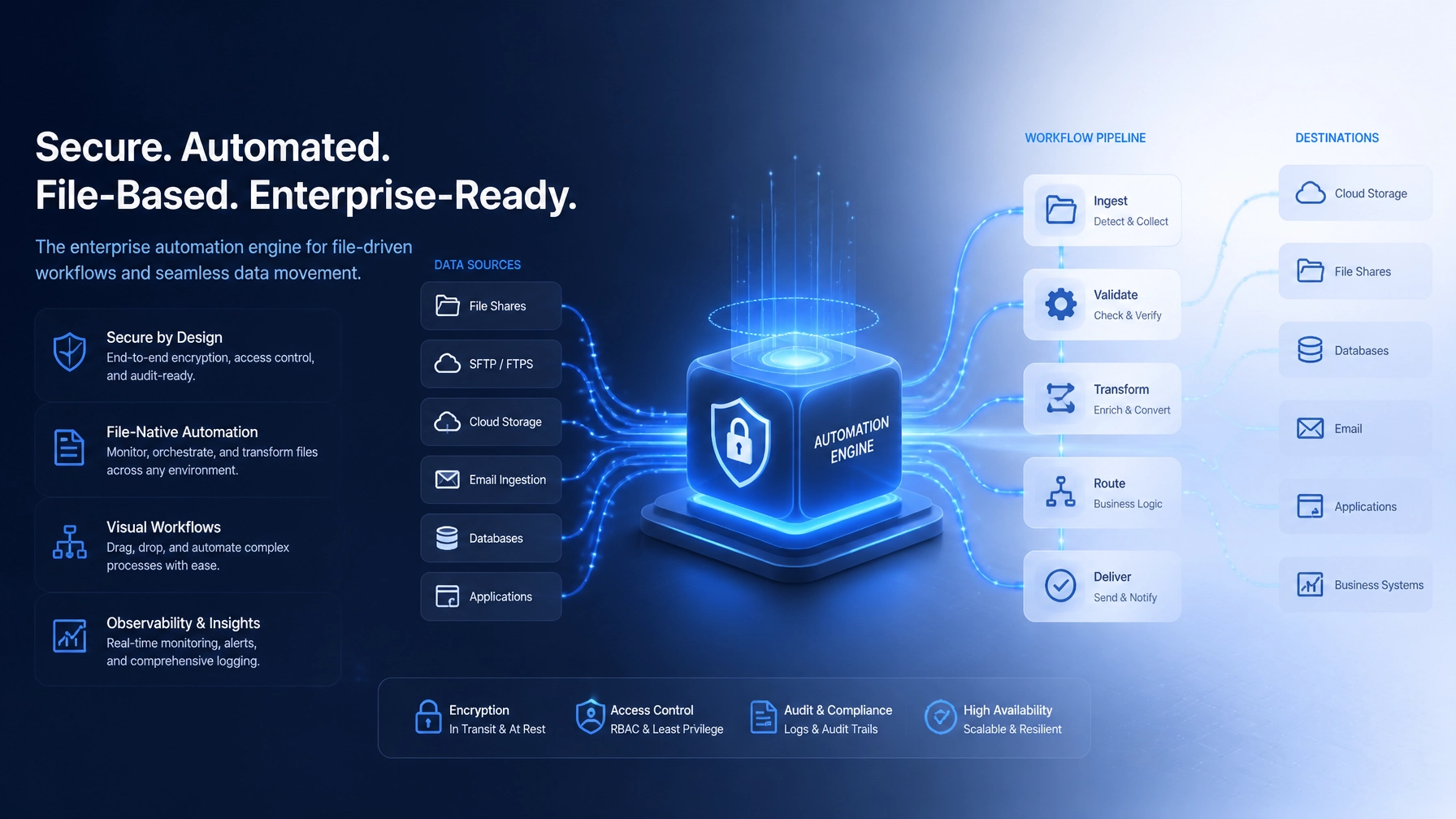
Many organizations still depend on files as a critical part of their operating model. Debt collection agencies, financial service organizations, logistics companies, and enterprise vendors may receive large volumes of CSV, Excel, fixed-width, or other structured files from external partners.
The challenge is rarely file transfer alone. The real complexity lies in validating, transforming, routing, reconciling, and auditing the data after it arrives.
PTC developed FTP Inform to demonstrate how a custom file-based automation engine can replace fragmented enterprise tooling with a coordinated system.
Architecture and automation principles
FTP Inform is structured around:
- Secure SFTP ingestion: Incoming files are detected and processed through controlled, isolated endpoints.
- Schema validation: Records are checked against client-specific rules before entering downstream workflows.
- Exception handling: Invalid or incomplete records are quarantined for review rather than silently contaminating operational data.
- Canonical data modeling: Validated information is normalized into a common internal structure.
- Rules-based orchestration: Business logic can segment accounts, route work, and trigger actions based on defined criteria.
- Audit-ready observability: Processing events, errors, status changes, and downstream actions can be logged for governance and review.
According to the FTP Inform case study, the system consolidated three enterprise tools, reduced cycle time by 40 percent, and reduced manual intervention by more than 75 percent in the described deployment.
The strategic lesson is broader than debt collection. When file-driven work is central to revenue delivery, custom software can turn an unreliable batch process into a dependable operational pipeline.
A practical roadmap for turning complexity into leverage
A successful custom web application begins with business strategy, not technology selection.
Before development begins, leadership should identify:
- The highest-cost friction points: Where do delays, errors, duplicate work, or missed handoffs affect revenue and service quality?
- The data intersections: Which systems need to share information, and where is staff manually transferring data today?
- The proprietary logic: Which matching rules, approval paths, routing decisions, or service processes differentiate the business?
- The governance requirements: What permissions, audit trails, compliance controls, and approval workflows must be built into the system?
- The future operating model: Will the application need to support new locations, business units, customer segments, integrations, or licensing models?
Typical deliverables may include workflow maps, a technical architecture roadmap, integration specifications, role-based interfaces, automation rules, dashboards, security controls, and a phased deployment plan.
For organizations with complex operations, a custom build is often a premium, scoped investment: frequently beginning at $10,000 or more depending on integrations, compliance requirements, user roles, and workflow depth. The decision should be based on measurable operational leverage and long-term strategic value, not on the lowest initial software cost.
Build the system your growth requires
AI Local Boost, ChainHQ, EHRIO Pro, and FTP Inform represent different industries and different operational challenges. Their common foundation is the same: purpose-built architecture designed around how a business actually works.
Custom web applications can unify fragmented data, automate high-value workflows, preserve institutional knowledge, and make differentiated processes scalable. They can help an organization move from reactive administration to a more intentional operating model.
Pure Technology Consulting brings proven capabilities from healthcare, field operations, fintech, debt management, and local SEO into custom engagements for legal, accounting, professional services, and other growth-focused organizations.
If disconnected systems or manual processes are limiting your next stage of growth, contact PTC at +1 (803) 921-0969 or book a discovery call to scope a practical technology roadmap.
Amin Said, Founder of Pure Technology Consulting LLC
https://puretechconsult.com
Leave a Reply