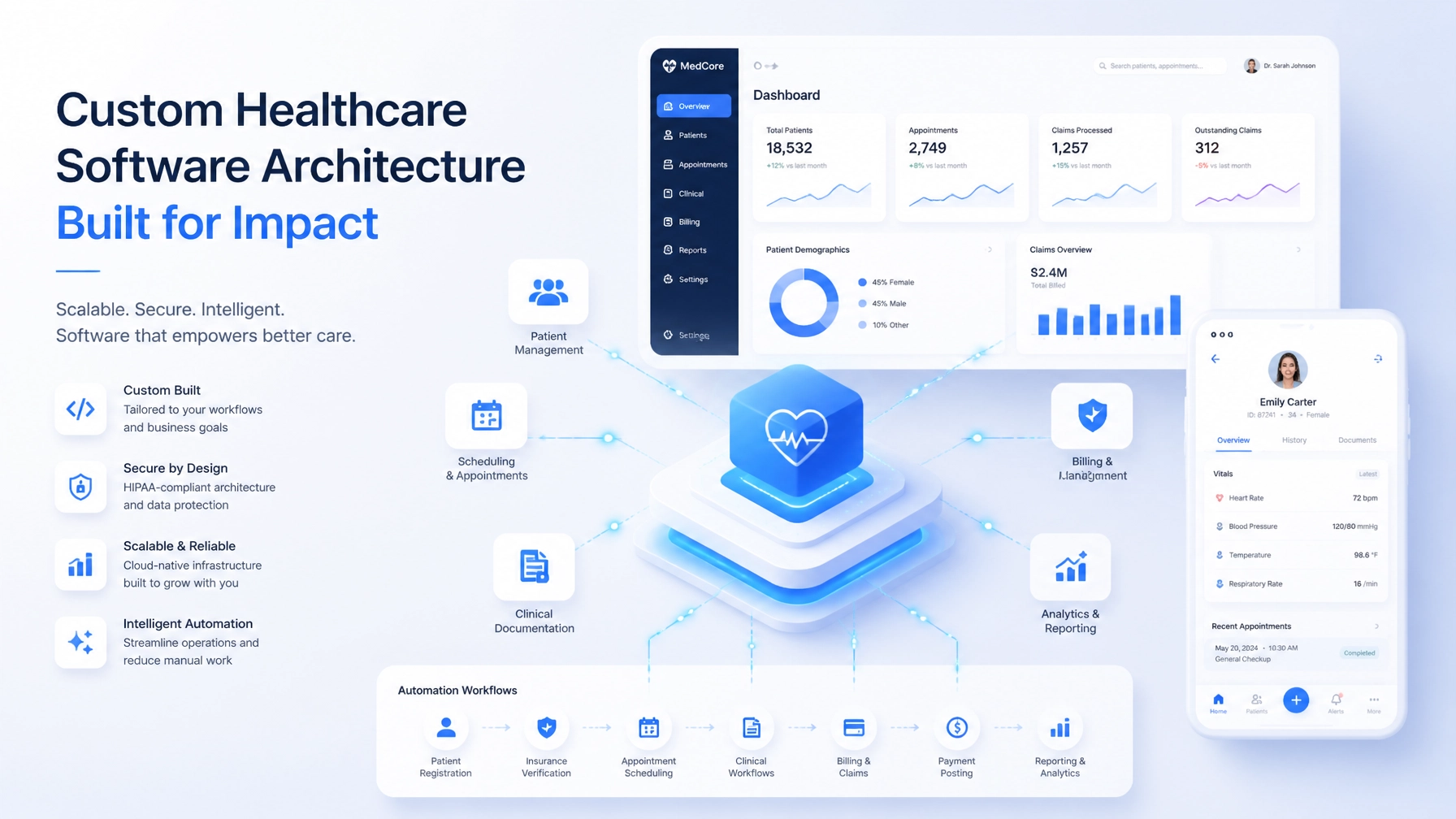
For a growing healthcare practice, intake is rarely just a form.
It is a chain of decisions involving patient history, insurance, provider availability, location, appointment type, consent, scheduling, and clinical handoff. When each part of that process lives in a different system, staff members become the integration layer. They move information between tabs, verify details manually, follow up on incomplete submissions, and attempt to keep every department aligned.
Pure Technology Consulting built EHRIO Pro as a proof-of-concept for a different operating model: one coordinated intake engine capable of collecting structured information, applying matching logic, routing exceptions, and preparing validated data for downstream workflows.
The result is not simply a better form. It is a scalable custom system designed to replace hours of repetitive administrative work with one governed workflow.
The operational challenge: intake had become a manual coordination job
The practice environment EHRIO Pro was designed to address included the familiar combination of separate tools:
- A CRM for inquiries, referrals, and prospective patients
- An EHR for clinical records and documentation
- A scheduling platform for appointments and provider availability
- Email, phone, and document workflows for follow-up
Each tool served a purpose. The difficulty was the handoff between them.
A new patient could enter the process through a website inquiry, referral, phone call, or uploaded document. From there, staff might need to:
- Enter the patient’s information into a CRM.
- Request demographic, insurance, and clinical details.
- Review a lengthy intake form.
- Determine which provider or location was appropriate.
- Confirm availability and appointment type.
- Check for missing information or authorization issues.
- Re-enter relevant data into the EHR.
- Send reminders and monitor pre-visit completion.
This work is repetitive, but it is not trivial. A missed field can delay scheduling. An incorrect provider match can create unnecessary rescheduling. A missing consent or insurance detail can create additional administrative work before the first visit.
The practice did not need more isolated software. It needed an orchestration layer that could connect the patient journey from first inquiry through scheduled appointment.
The design objective: automate decisions without removing accountability
The goal of a custom intake engine should not be to automate every decision without oversight. In healthcare, the stronger model is selective automation.
Routine, rules-based work can move automatically. Exceptions can be routed to the appropriate staff member. Sensitive or ambiguous cases can remain visible for human review.
That principle shaped the architecture behind EHRIO Pro.
The system was designed to distinguish between:
- Information that can be validated automatically
- Decisions that can be supported by matching rules
- Conditions that require staff confirmation
- Events that should trigger a notification or follow-up task
- Data that needs to be synchronized with another system
This created a workflow that was faster without becoming opaque. Staff could see what had been completed, what remained unresolved, and why a particular patient or appointment path had been recommended.
A dynamic intake engine built around approximately 70 questions
The core of the system is a structured intake journey capable of supporting approximately 70 questions.
A static form presents every patient with the same sequence. A custom intake engine can respond to the information already provided.
For example, a patient reporting a specific condition may be presented with additional questions about symptom duration, prior treatment, medications, or relevant history. A patient with a simpler request may move through a shorter path. The system can also alter the workflow based on location, appointment type, referral source, insurance status, or practice-defined criteria.
The intake architecture can capture:
- Demographics and contact details
- Insurance and coverage information
- Medical history, medications, and allergies
- Symptoms and reason for seeking care
- Referral information and uploaded documents
- Provider and location preferences
- Consent and communication preferences
- Appointment requirements and scheduling constraints
The important distinction is that responses are captured as structured data rather than being trapped in an email, PDF, or unsearchable note.
Structured information can be used by the matching engine, work queues, reporting dashboards, and EHR preparation workflows. It becomes part of an operating system for the practice rather than another document for staff to process manually.

The matching engine: finding the right operational path
A generic scheduling platform often begins with one question: “Who is available?”
A custom matching engine begins with a better question: “Who is the right fit for this patient and this appointment?”
EHRIO Pro demonstrates how matching logic can evaluate several variables before recommending a routing path. Depending on the practice’s operating model, those variables may include:
- Clinical needs and specialty requirements
- Provider qualifications and service capabilities
- Accepted insurance plans
- Patient location preferences
- In-person or telehealth requirements
- Provider availability and new-patient capacity
- Appointment type and expected duration
- Practice-defined escalation conditions
The system can apply configurable rules or scoring logic to identify appropriate providers, locations, or appointment categories. High-confidence matches can proceed through the workflow, while incomplete or ambiguous cases can be sent to a staff review queue.
This changes the role of the front desk. Instead of manually interpreting every intake submission from the beginning, staff receive a prepared workflow with relevant information, recommended next steps, and visible exceptions.
The technology does not replace judgment. It directs judgment to the cases where it creates the most value.
One workflow from inquiry to appointment
A custom intake engine becomes more valuable when it manages the entire progression of a case rather than only collecting information.
The EHRIO Pro proof-of-concept organizes the patient journey into defined workflow stages:
- A new inquiry or referral is received.
- The patient begins the digital intake.
- Required information is validated.
- Matching logic identifies provider and location options.
- Insurance or authorization requirements are flagged.
- Staff review is requested when necessary.
- Appointment availability is presented.
- Scheduling information is synchronized.
- Relevant intake data is prepared for the EHR.
- Pre-visit tasks and communications are triggered.
Each stage creates a clearer operational state. Leadership can see where cases are progressing, where they are stalled, and which exceptions are consuming staff time.
This is the difference between automation and a collection of integrations. Integrations move data. An operating workflow gives that data meaning, ownership, and a next action.
Secure integration and workflow governance
Healthcare systems require more than convenience. They require careful treatment of sensitive information, access controls, auditability, and clear responsibility.
EHRIO Pro is best understood as a HIPAA-adjacent workflow automation architecture and proof of engineering capability. A production implementation would need to be evaluated against the client’s specific compliance program, vendor agreements, security controls, and legal obligations.
Relevant design considerations include:
- Role-based access to sensitive workflow data
- Encryption in transit and at rest
- Controlled API access and authentication
- Audit-oriented activity logging
- Data minimization between connected systems
- Secure document handling
- Defined retention and deletion policies
- Human review and escalation paths
- Vendor and business associate requirements
Where supported, secure APIs and healthcare data standards can help synchronize information with existing systems. The exact approach depends on the EHR, available interfaces, data ownership, and the practice’s broader technology environment.

Measuring the impact of custom intake automation
The value of a custom system should be measured against the organization’s actual baseline.
For a healthcare practice, useful measures may include:
- Time from inquiry or referral to scheduled appointment
- Staff touches required per patient
- Intake completion rate
- Volume of incomplete submissions
- Exception and escalation volume
- Time spent on manual data entry
- Rescheduling caused by missing or incorrect information
- Percentage of cases routed without manual intervention
- Staff time spent on pre-visit administration
EHRIO Pro’s architecture is designed to make these operational measures visible. That visibility allows leadership to evaluate whether the system is reducing cycle time, improving routing consistency, and returning staff capacity to higher-value work.
The objective is not to claim that every practice will achieve the same result. It is to create a system in which improvement can be observed, managed, and refined over time.

Why this proof-of-concept matters beyond healthcare
EHRIO Pro demonstrates a broader capability: designing software around the decisions and constraints that make an organization unique.
The same engineering principles apply to other high-complexity environments:
- Field operations: D2D Tracking demonstrates rep accountability and GPS-logged activity workflows.
- Debt and fintech operations: Custom telephony integrations can connect calls, attribution, records, and follow-up actions.
- Local SEO: AI Local Boost demonstrates automated Google Business Profile workflows and multi-location visibility management.
- Professional services: Intake, qualification, document collection, and assignment logic can be combined into a governed client onboarding system.
These proprietary platforms are not presented as substitutes for a custom engagement. They are proof-of-work examples showing how Pure Technology Consulting approaches complex software architecture.
The question is not whether a business can purchase another application. The strategic question is whether its current operating model is being limited by software that was never designed for the way the business actually works.
Build the operating system your growth requires
Custom software is most valuable when it connects the parts of the business that generic tools leave fragmented.
For healthcare organizations, that may mean combining intake, matching, scheduling, EHR coordination, communications, and reporting in one scalable workflow. For other industries, it may mean unifying CRM activity, field accountability, telephony, document processing, or operational analytics.
Pure Technology Consulting helps growth-focused organizations define that roadmap, design the architecture, and deploy the system required to support the next stage of scale.
To discuss a custom intake engine or workflow automation initiative, call +1 (803) 921-0969 or book a discovery consultation. You can also explore EHRIO Pro and read Beyond Off-the-Shelf: How We Built EHRIO Pro to Automate an Entire Healthcare Practice for additional context.
Amin Said, Founder of Pure Technology Consulting LLC
https://puretechconsult.com
Leave a Reply