Amin Said, Founder of Pure Technology Consulting LLC
For high-ticket clients, enterprise automation consulting should deliver more than another dashboard, integration, or collection of software subscriptions.
It should create a durable operating advantage.
A well-designed custom build connects fragmented systems, reflects the way the business actually operates, strengthens governance, and gives leadership better control over growth. The objective is not to automate for its own sake. It is to remove operational friction from the workflows that influence revenue, compliance, customer experience, and scalability.
At Pure Technology Consulting, we bring proven capabilities from healthcare, multi-location operations, debt management, field services, and local SEO automation into complex custom engagements. Our proprietary platforms: including ChainHQ, EHRIO Pro, FTP Inform, and AI Local Boost: serve as proof of work: each demonstrates how bespoke architecture can solve operational problems that generic SaaS cannot fully address.
What a custom enterprise build is designed to deliver
A custom automation engagement begins with the operating model, not a software catalog.
Instead of asking a business to adapt its process to the limitations of an off-the-shelf application, the consulting and engineering team maps the current workflow, identifies decision points, reviews system dependencies, and defines a target-state architecture.
The result typically includes:
- A purpose-built web application or workflow platform
- Integration with CRM, ERP, EHR, accounting, telephony, payment, or marketing systems
- Role-based access controls and approval paths
- Automated data validation and exception handling
- Centralized reporting and operational dashboards
- Documented processes, governance rules, and support procedures
- An architecture that can expand with new locations, teams, products, or business units
The value is not limited to the initial software release. The client receives a technology foundation that can evolve as the organization changes.
Case study: ChainHQ turns multi-location complexity into one operating system
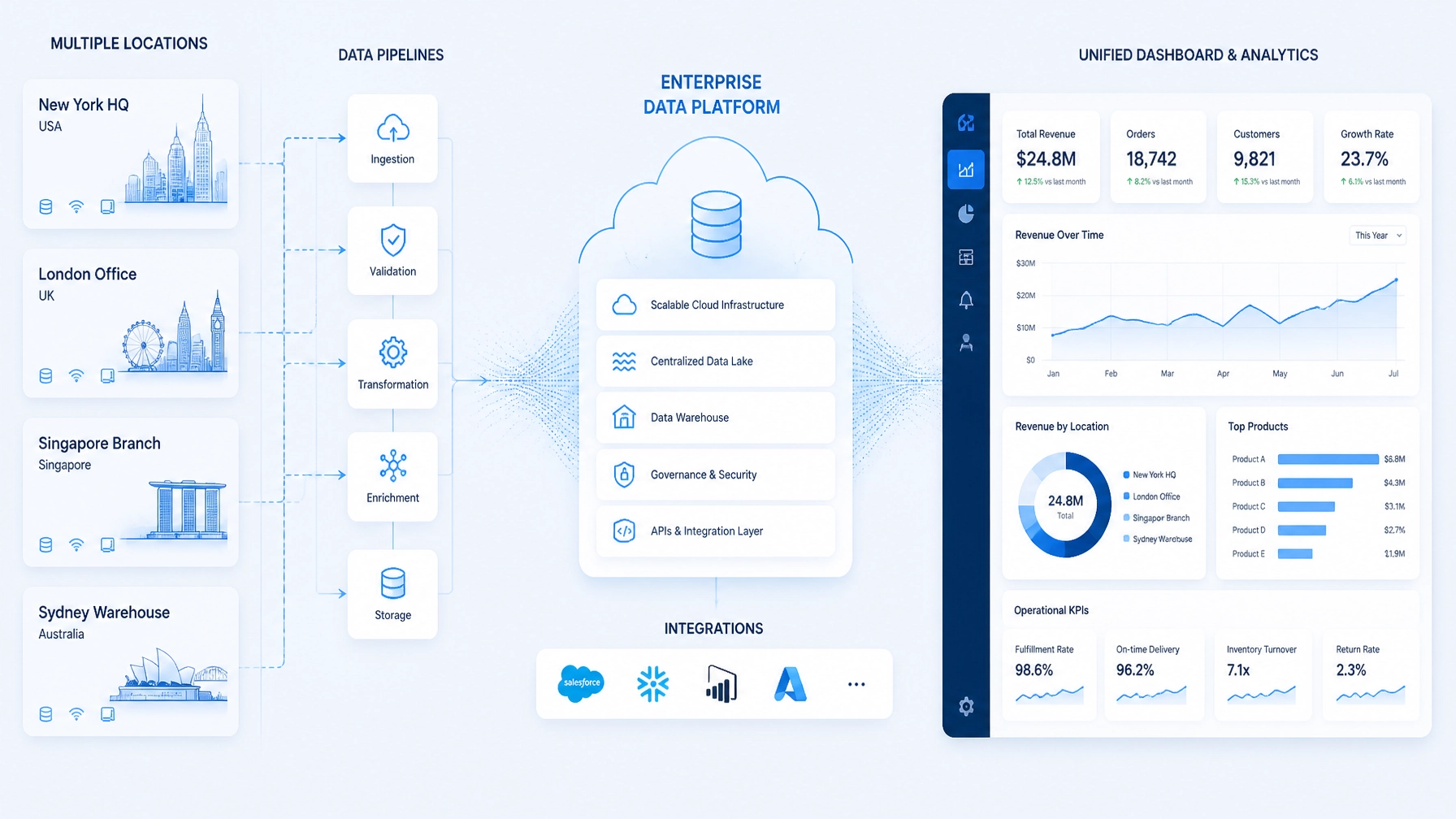
Multi-location businesses often reach a point where each branch has its own tools, spreadsheets, customer records, and informal workarounds. Leadership then spends valuable time consolidating reports instead of managing performance.
ChainHQ was designed around this problem. Rather than treating every storefront or branch as an isolated instance, the platform uses a unified, location-aware architecture.
The system centralizes core data while associating transactions with the appropriate organization and location identifiers. This gives headquarters a complete view of performance while allowing local managers to access only the data and workflows relevant to their branch.
The architecture also supports:
- Hierarchical inventory management across warehouses, regional hubs, and storefronts
- Automated transfer and replenishment workflows
- Granular role-based access control
- Cross-location customer profiles
- Consolidated financial and operational reporting
This is what custom development delivers when the challenge is structural rather than cosmetic. The client does not simply receive a prettier interface. They receive a shared operating model that preserves local flexibility while establishing enterprise-wide visibility.
Case study: EHRIO Pro connects intake, matching, and practice operations
Healthcare practices frequently use several systems to manage scheduling, intake, patient records, billing, and follow-up. Each system may perform its individual function well, but the gaps between them create administrative drag.
EHRIO Pro demonstrates how a custom build can address those gaps through workflow design and integration.
The platform was engineered around complex healthcare practice requirements, including a dynamic 70-question intake process, eligibility checks, provider matching, and secure data synchronization. Instead of relying on staff to copy information from one portal to another, the system uses completion triggers and structured data flows to keep operational status current.
The matching engine can evaluate factors such as:
- Patient responses and care requirements
- Provider specialization
- Geographic location
- Insurance panel acceptance
- Scheduling availability
- Authorization considerations
For practices with specialized patient journeys, this level of orchestration is difficult to achieve with a generic form builder or scheduling tool. The custom platform becomes an intelligent coordination layer that supports the front desk, clinicians, billing teams, and leadership.
The broader lesson applies beyond healthcare: when the workflow includes branching logic, sensitive information, multiple stakeholders, and operational consequences, custom software can provide the control and precision that disconnected tools lack.

Case study: FTP Inform replaces fragmented enterprise tooling
A national debt collection agency approached Pure Technology Consulting with three separate enterprise tools, fragile scripts, manual CSV exports, and spreadsheet-based reconciliation.
The problem was not simply that the software was old. The underlying workflow was fragmented. File intake, validation, account routing, reporting, and compliance tracking operated across different systems.
FTP Inform was built as a unified file-based automation engine for secure ingestion, validation, transformation, and downstream orchestration.
The platform included:
- Secure SFTP ingestion endpoints
- Client-specific schema validation
- Data normalization and transformation
- Exception quarantine for invalid records
- Automated portfolio segmentation
- Telephony and payment gateway integrations
- Immutable event and compliance logging
- Role-based access and encrypted data handling
According to the case study, the system consolidated three enterprise tools, reduced cycle time by 40%, and reduced manual intervention by more than 75%. These outcomes came from redesigning the entire data flow rather than automating one isolated task.
For high-ticket clients, this distinction matters. A workflow automation project should not merely accelerate a broken process. It should establish a more reliable operating model.

Case study: AI Local Boost proves that automation must scale with volume
Automation becomes more valuable: and more technically demanding: as volume increases.
AI Local Boost was developed to demonstrate how a custom AI orchestration layer could manage Google Business Profile activity across more than 500 locations. The challenge involved generating and distributing localized content, managing review workflows, coordinating media, and connecting marketing activity with external systems.
The AI Local Boost case study shows the importance of combining automation with governance.
The platform was designed to support:
- Location-specific content generation
- Review sentiment analysis and response drafting
- Suggest-and-approve workflows
- Automated review request triggers
- Multi-platform content distribution
- Integrations with thousands of external tools
The key capability is not simply artificial intelligence. It is the orchestration layer around the AI: rules, approvals, integrations, user roles, and exception handling. Enterprise automation becomes dependable when intelligent systems operate within a defined governance framework.

What high-ticket clients should expect from the consulting process
A premium custom development engagement should include strategic advisory before engineering begins.
At a minimum, the process should clarify:
1. Which workflow should be automated first?
The best starting point is usually a high-volume process with measurable operational drag. Examples include intake, reconciliation, scheduling, account routing, reporting, or customer follow-up.
2. Which systems must remain in place?
Custom software does not always mean replacing every existing tool. In many cases, the right architecture acts as an orchestration layer that connects the systems already central to the business.
3. What governance controls are required?
Sensitive data, regulated workflows, and multi-user systems require defined permissions, approval paths, audit logs, retention rules, and exception management.
4. How will value be measured?
The roadmap should establish practical metrics, such as:
- Cycle time from intake to completion
- Manual touches per transaction
- Error and rework rates
- Time spent consolidating reports
- Throughput per employee or location
- Revenue delayed by process gaps
- Adoption across teams and business units
These measures create a business case for the investment and provide a framework for continuous improvement.
Where custom development creates the strongest advantage
Custom development is most valuable when a company has one or more of the following characteristics:
- Its workflows are a meaningful part of its competitive advantage
- It operates across multiple locations or business units
- Its data is distributed across disconnected systems
- Its processes include complex rules or exceptions
- Its team relies heavily on spreadsheets and manual handoffs
- Its industry requires stronger auditability or access control
- Its growth plans exceed the capabilities of current SaaS tools
A custom build is not automatically the right choice for every business. If a process is standardized and adequately supported by an existing platform, buying may be more efficient. The strategic question is whether the software constraint is becoming more expensive than the investment required to remove it.
Build a technology roadmap around the business
Enterprise automation consulting should leave leadership with more than working software. It should provide a clearer view of how the organization can operate at the next stage of growth.
Pure Technology Consulting brings proven capabilities into custom engagements for healthcare practices, professional services firms, legal and accounting organizations, debt agencies, e-commerce brands, and multi-location operators. Clients do not have to start from a blank page. They can build on architectures and lessons developed through complex systems such as ChainHQ, EHRIO Pro, FTP Inform, and AI Local Boost.
If manual workflows, disconnected systems, or rigid SaaS tools are limiting your growth, book a discovery consultation or contact Pure Technology Consulting at +1 (803) 921-0969. We can review your operating model, identify the highest-value automation opportunities, and outline a practical roadmap for a custom solution.
Amin Said, Founder of Pure Technology Consulting LLC
https://puretechconsult.com
Leave a Reply