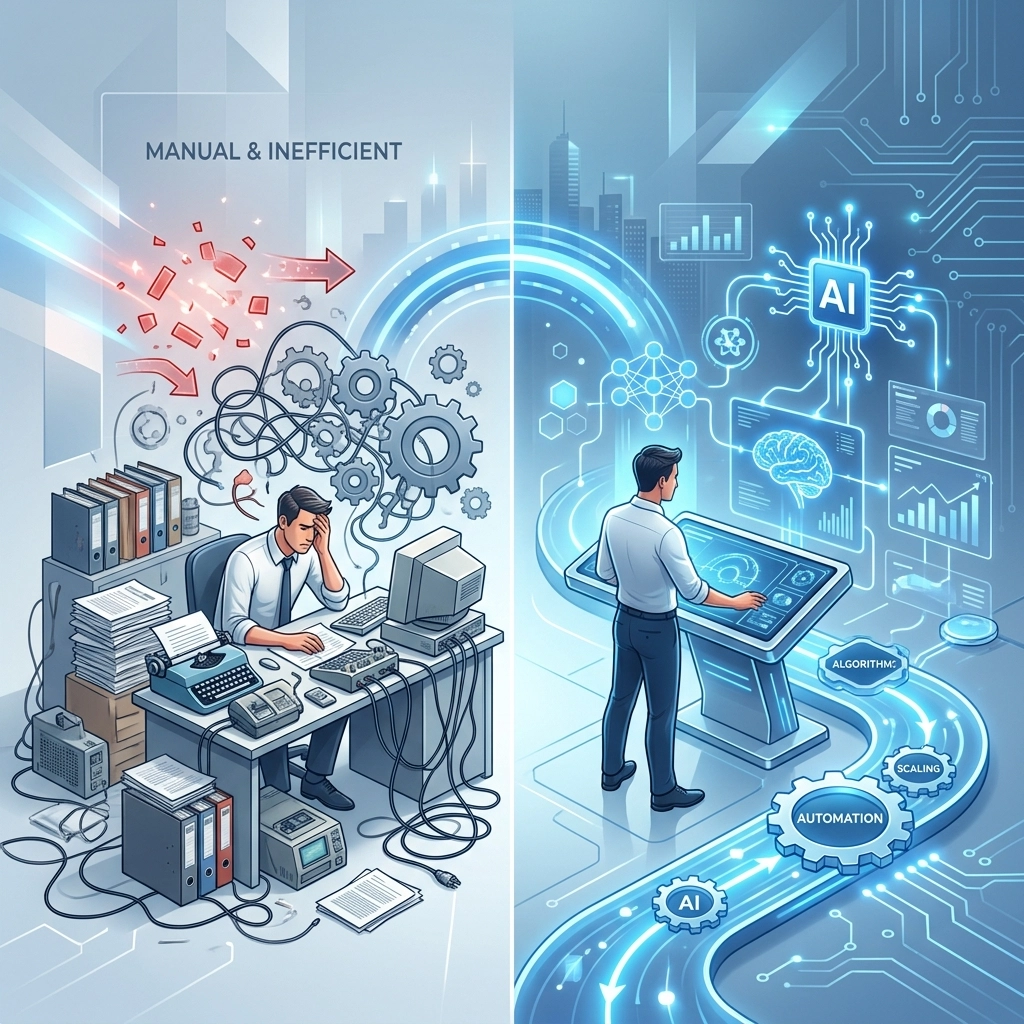
For many founders and executives, growth is the ultimate objective. However, there is a silent threshold where the very processes that built your company begin to act as an anchor. In the early stages of a business, manual intervention is a badge of honor: it represents agility and a "whatever it takes" attitude. But as volume increases, those manual workarounds transition from being your greatest strength to your most significant bottleneck.
At Pure Technology Consulting, we work with organizations that have reached this friction point. They are successful, but they are tired. Their scaling efforts are met with diminishing returns because their operating model is still tied to human linear capacity rather than algorithmic exponentiality.
If your growth has slowed or your operational costs are ballooning, it is likely because your manual operations simply cannot scale. Here are ten reasons why, and how transitioning to custom AI workflow automation provides the necessary roadmap for sustainable expansion.
1. Manual Workarounds Have Become Critical Dependencies
In the beginning, a spreadsheet or a manual data entry step is a quick fix to a gap in your software stack. Over time, these fixes become embedded in your company culture. Employees build their entire workday around these "temporary" workarounds.
When you try to double your output, these workarounds become dependencies that cannot be easily replicated or taught. They become "black boxes" of tribal knowledge. Custom automation replaces these fragile human links with robust, codified logic, ensuring that your process remains intact regardless of who is operating the system.
2. The Visibility Gap Leads to Reactive Decision-Making
As operations grow, the distance between the executive suite and the front-line data increases. If your data relies on manual updates, you are likely looking at information that is 24 to 48 hours old. This lack of real-time visibility creates a "lag" in leadership.
Without a single, automated source of truth, decisions are made on intuition or outdated reports rather than live operational metrics. By integrating custom web applications: similar to the architecture we’ve deployed for complex matching engines in healthcare: you gain a dashboard that reflects reality in real-time, moving your leadership style from reactive to proactive.

3. Inconsistency Multiplies at Scale
A manual process is only as consistent as the person performing it on a given Tuesday. While one team member might follow the protocol perfectly, another might take a shortcut. At a small scale, these discrepancies are manageable. At a large scale, they result in uneven customer experiences and brand erosion.
AI-driven workflows do not have "off days." Whether you are processing ten applications or ten thousand, the logic remains identical. This is the level of consistency we bake into proprietary tools like ChainHQ, where logistics and workflows must be precise to maintain operational integrity.
4. Latency Turns Into Lost Revenue
In the modern economy, speed is a competitive advantage. Manual steps introduce latency: leads wait hours for a follow-up, contracts sit in an inbox for days, or rate changes take a week to reflect across all platforms.
At scale, these manageable delays collectively translate into massive amounts of lost conversion. Automation eliminates the "wait time" between steps. Leads can be qualified, routed, and responded to in seconds, ensuring that your revenue velocity matches your growth ambitions.
5. The Mathematical Trap of Error Multiplication
Human error is a statistical certainty. At low volumes, an error rate of 1% is easily caught and corrected. However, when you scale to thousands of transactions or data points, that 1% becomes a deluge of mistakes that require a dedicated team just to fix.
Manual operations force you to spend more time "cleaning up" than "moving forward." Custom-built software, such as our FTP Inform integrations, ensures data integrity at the point of entry, drastically reducing the downstream cost of human fallibility.
6. Fragmented Data Sources (The Lack of a Single Source of Truth)
When a business scales manually, information often ends up trapped in silos: email chains, local Excel files, and disparate SaaS tools that don't talk to each other. This fragmentation makes it impossible to get a holistic view of the customer journey.
Custom development allows for the creation of a centralized hub where all data resides. Whether we are building for legal, accounting, or fintech, our goal is to eliminate data duplication and ensure that every stakeholder is working from the same set of facts.

7. Increasing Compliance and Regulatory Exposure
As your business grows, so does your profile. Regulatory bodies and industry standards (such as HIPAA in healthcare or GDPR in data privacy) become more stringent as you capture more market share. Managing these requirements manually is not only exhausting; it’s a high-stakes legal risk.
We leverage our experience in high-compliance sectors: demonstrated by our work on EHRIO Pro: to build automation that has compliance "baked in." Automated logging, encrypted data handling, and standardized reporting ensure that your growth doesn't outpace your governance.
8. Processes Fail to Adapt to Emerging Complexity
Scaling is rarely a linear process of "doing more of the same." It usually involves adding new channels, more complex product tiers, or diverse geographic locations. Manual systems are rigid; they are built for the current state of the business, not the future state.
Bespoke web applications are designed with modularity in mind. They are built to adapt as your business logic evolves, allowing you to introduce complexity without breaking the underlying operational model.
9. Reaching the Ceiling of Human Capability
There is a physiological limit to how much a human team can process before accuracy drops. Research indicates that once manual systems hit high volumes (such as 300+ orders or entries per day), accuracy rates plummet below 97%.
AI workflow automation handles the "heavy lifting" of repetitive tasks, allowing your high-value employees to focus on judgment, strategy, and empathy: the things machines can’t do. This shift doesn't just improve efficiency; it improves employee retention by removing the burnout associated with "data drudgery."
10. The Unsustainable Headcount Scaling Model
The most dangerous trap in manual operations is the belief that doubling your business requires doubling your headcount. If your costs grow at the same rate as your revenue, you aren't truly scaling: you’re just getting bigger.
True scaling is about increasing the "leverage" of every employee. By implementing sophisticated automation and custom software, we help firms achieve 2x or 5x growth with only fractional increases in staff. This preserves your margins and ensures that your business remains profitable as it expands.

Moving Toward a Visionary Operating Model
At Pure Technology Consulting, we don’t just build software; we architect the future of your operations. Our approach is consultative and strategic. We look at your current manual bottlenecks and design a roadmap that replaces friction with flow.
Whether it's leveraging the automation principles of AI Local Boost for your marketing presence or building a deep-stack custom ERP for your field operations, our focus is on creating assets that you own and that grow with you.
Scaling shouldn't feel like a struggle against your own systems. If you find that your team is spending more time managing the "process" than serving the "client," it is time to move beyond manual operations.
We invite you to explore what is possible when your business logic is powered by custom AI and bespoke web applications. The transition from manual to automated isn't just an IT upgrade; it is a strategic evolution that defines the next chapter of your success.
To discuss your operational roadmap and how a custom-built solution can unlock your next phase of growth, reach out to us today.
Pure Technology Consulting LLC
Phone: +1 (803) 921-0969
https://puretechconsult.com/schedule
Amin Said, Founder of Pure Technology Consulting LLC
https://puretechconsult.com
Leave a Reply