By Amin Said, Founder of Pure Technology Consulting LLC
For decades, the path to success for industry vendors and equipment manufacturers was straightforward: build a high-quality physical product, sell it at a margin, and move on to the next lead. It was a linear, transactional model that worked: until the digital transformation of the 2020s turned "linear" into "limited."
Today, the most successful vendors are realizing that the physical product is no longer the finish line; it is the entry point. To capture long-term value, you have to own the ecosystem. You have to move from being a "vendor" to becoming the "operating system" for your customers' businesses.
The vehicle for this transformation? White-label SaaS.
At Pure Technology Consulting, we’ve seen a massive uptick in industry leaders: those who manufacture hardware, manage large supply chains, or provide specialized professional services: who are pivoting toward subscription-based software models. They aren't doing it just because "SaaS" is a buzzword. They’re doing it because it provides the ultimate business trifecta: predictable recurring revenue, deeper customer retention, and massive scalability without proportional overhead.
The Transactional Trap vs. The Ecosystem Edge
Traditional business models suffer from what I call the "Transactional Trap." Every month, your revenue starts at zero. To grow, you must constantly find new customers or convince old ones to buy a newer, shiny piece of equipment. The moment the sale is done, the relationship goes dormant until the next upgrade cycle.
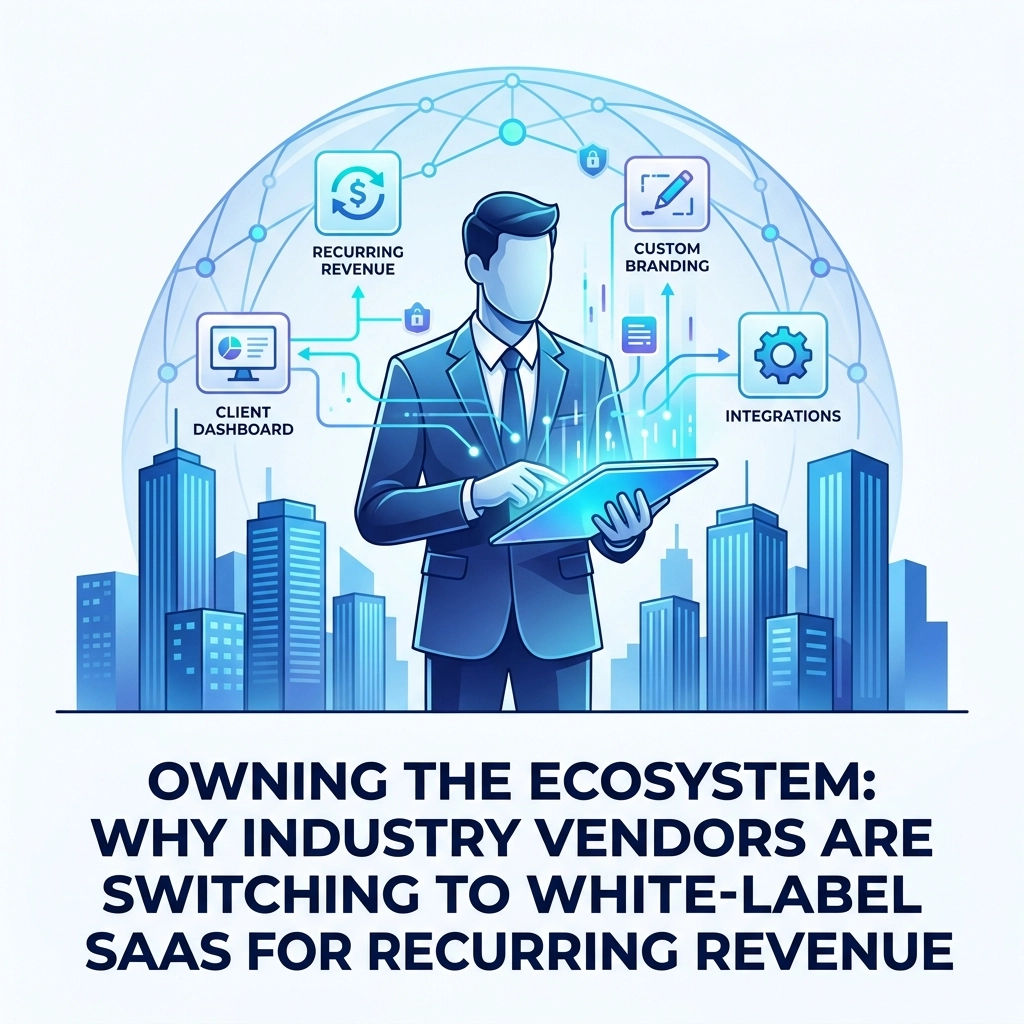
Compare that to an "Ecosystem Edge." By offering a white-labeled SaaS platform: perhaps one that manages the data from your hardware, automates the workflows of your service, or integrates your clients’ operations: you stay present in their business every single day.
When you own the platform, you don't just sell a tool; you sell a solution that becomes indispensable. And because it's a subscription, your revenue is predictable. You aren't hunting for the next deal to keep the lights on; you're building a foundation that scales.

Why White-Label? The "Technical Backbone" Without the Build
The biggest barrier for most industry vendors is the perceived cost and risk of software development. Building a robust, scalable, and secure SaaS platform from scratch is a multi-year, multi-million dollar endeavor. It requires a level of technical governance that most hardware-focused companies simply aren't equipped to handle.
This is where white-labeling: or more accurately, leveraging a proven technical backbone: becomes a strategic masterstroke.
White-labeling allows you to:
- Reduce Market Entry Time: Instead of a 12-to-18-month development cycle, you can bring a sophisticated platform to market in weeks or months.
- Mitigate Risk: You are using a platform that has already been stress-tested. The infrastructure, security, and core features are already proven.
- Focus on Your Core Competency: You know your industry better than any software developer. White-labeling lets you focus on tailoring the user experience and the value proposition while we handle the underlying code.
At Pure Technology Consulting, we specialize in building these custom web applications that serve as the technical backbone for our clients. Whether it's a healthcare matching engine like our work with EHRIO or a GPS-logged accountability tool for field operations like D2D Tracking, we provide the high-level automation and architecture that allows our clients to brand and sell the solution as their own.
The Financial Reality: Why Investors Love White-Label SaaS
If you are looking to increase the valuation of your company, nothing moves the needle like recurring revenue. Investors and buyers value SaaS revenue at a much higher multiple than one-time hardware sales.
Why? Because it’s predictable.
When an industry vendor switches to a white-label SaaS model, they are essentially creating a new, high-margin revenue stream with minimal additional investment. You aren't hiring a massive new sales force; you are leveraging your existing customer base and distribution networks. Your partners and resellers do the heavy lifting of market-specific sales, while you collect a share of the recurring subscription fees.
By 2030, the SaaS market is projected to reach $887 billion. For an equipment manufacturer, capturing even a tiny sliver of that by bundling software with your hardware is a game-changer for your balance sheet.

From Healthcare to Field Ops: Proof of the Model
We’ve seen this strategy work across radically different sectors. The common thread is always a vendor who identifies a repetitive, manual process their customers face and provides a digital solution to solve it.
- In Healthcare: We’ve built platforms that handle 70-question intakes and HIPAA-adjacent workflows, turning complex data entry into a streamlined matching engine. A vendor providing medical devices can white-label this software to offer hospitals a complete "device + data" package.
- In Field Operations: For companies managing door-to-door teams, we developed tracking systems that ensure rep accountability via GPS logging. A uniforms or equipment vendor could provide this software to their clients, moving from a commodity supplier to a vital operations partner.
- In Local SEO: Through our AILB (AI Local Boost) initiatives, we’ve automated Google Business Profile management. This is a perfect example of a service that can be white-labeled by marketing agencies or business consultants to provide ongoing value without manual labor.
Each of these examples represents a move away from "one-and-done" sales and toward a "platform-first" mentality. You can see more of how these complex systems come together in our video walkthroughs.
Controlling the Brand Experience
One of the biggest fears vendors have with third-party software is losing their brand identity. White-labeling solves this by allowing the core platform to power multiple customer-facing solutions under your own flag.
You maintain the underlying relationship. You control the data. You own the brand experience. Your customers don't see a third-party developer; they see a visionary partner who is providing them with the tools they need to succeed in a digital world. This strengthens brand loyalty and makes it significantly harder for a competitor to swoop in with a lower-priced physical product.

Strategic Implementation: How to Start
Transitioning to a white-label SaaS model is a strategic pivot, not just a marketing one. It requires a clear roadmap and an understanding of where custom software beats off-the-shelf solutions.
- Identify the Friction: What is the one thing your customers struggle with every day that your products interact with? That’s where your software should live.
- Audit Your Workflow: Before building or licensing, you need a clear picture of the automation potential. We often recommend starting with a workflow audit to see where the most leverage exists.
- Choose a Partner, Not a Vendor: You need a technical partner who understands the business stakes, not just the code. Your partner should be able to provide the architecture, integrations, and dashboards that make the platform feel like yours.
The Visionary Path Forward
The "Great Convergence" of hardware, services, and software is already happening. Industry vendors who cling to purely transactional models will find their margins squeezed by those who offer complete, software-driven ecosystems.
By adopting a white-label SaaS strategy, you aren't just adding a product to your catalog. You are evolving your operating model. You are building a business that is more resilient, more profitable, and more valuable.
If you’re ready to stop selling parts and start owning the ecosystem, it begins with a conversation about your technical backbone. We invite you to schedule a discovery call to discuss how bespoke development can transform your industry presence.
The future belongs to those who own the platform. Let’s build yours.
Amin Said, Founder of Pure Technology Consulting LLC
https://puretechconsult.com
Contact: +1 (803) 921-0969
Pure Technology Consulting: Visionary Software Development & Custom Automation.
Leave a Reply