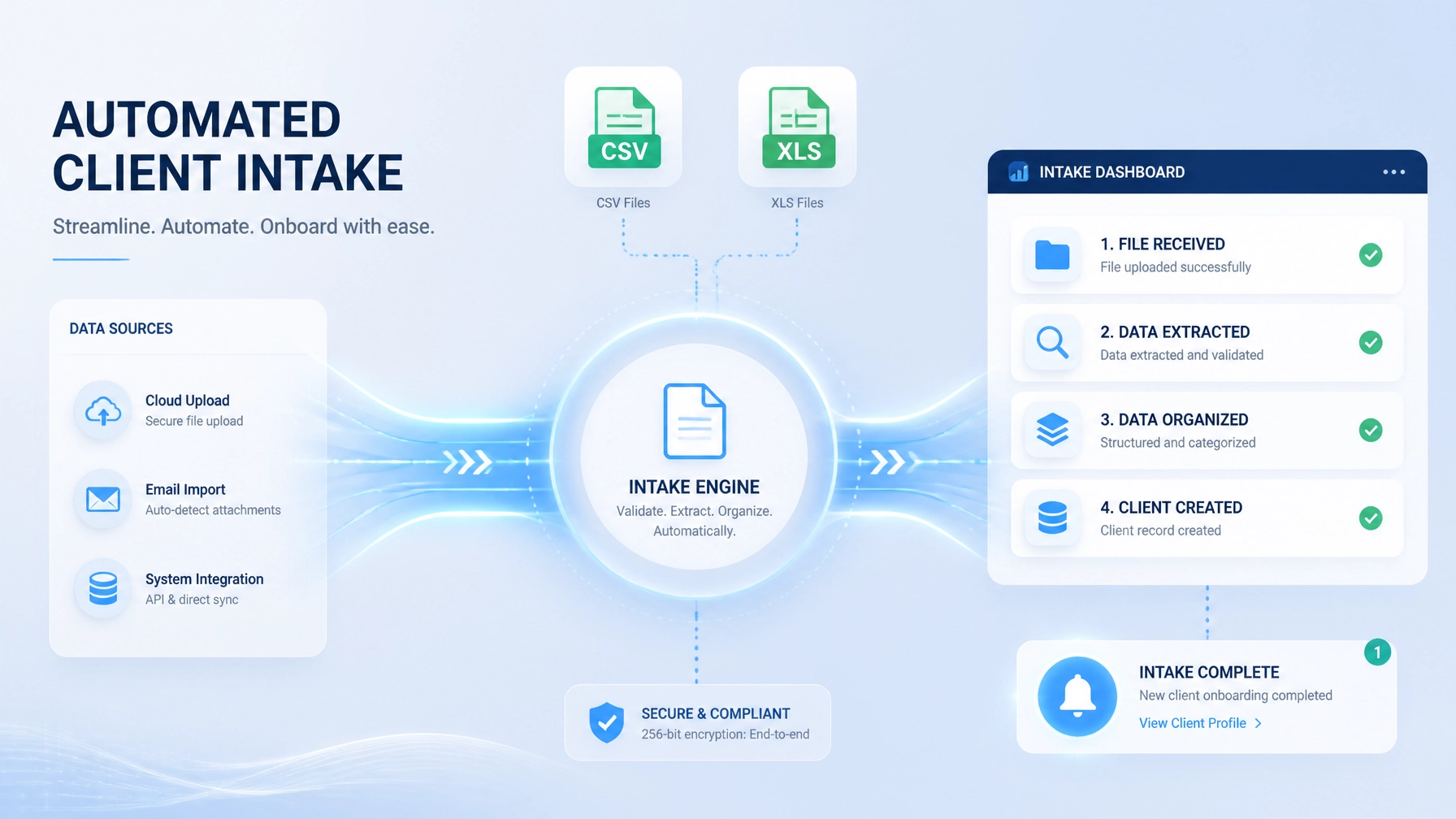
For most high-ticket service providers: whether you’re running a multidisciplinary healthcare clinic, a specialized debt collection agency, or a multi-location professional services firm: the "intake" process is the first handshake. It is the moment a prospect transitions from a lead into a partner. Yet, despite the high stakes, many organizations treat this critical bridge as a manual, administrative chore.
When your intake relies on manual data entry, physical paper, or staff checking "the folder" for new files, you aren't just losing time. You are losing visibility, scalability, and, ultimately, revenue.
At Pure Technology Consulting (PTC), we’ve spent years building bespoke automation and custom web applications for businesses that have outgrown their manual roots. We’ve seen the same seven mistakes cripple growth across industries. Here is a look at the friction points in manual intake: and how we’ve designed proprietary solutions like FTP Inform to act as the automated watchdog for your digital doorstep.
1. The "Retyping" Tax: Duplicate Data Entry
The most common friction point in manual intake is the "transcription trap." A client fills out a PDF, or a vendor sends a CSV file of new leads, and a staff member immediately starts retyping that data into your CRM or EHR.
This isn't just an "operational drag": it’s a high-risk liability. Every keystroke is an opportunity for a misspelled name, a wrong insurance ID, or a missed digit in a phone number. In healthcare settings, these errors lead to denied claims; in professional services, they lead to lost contracts.
The Visionary Shift: True digital transformation means data should only be entered once. If data exists in a file, it should move into your system programmatically.
2. The "Ghosting" Effect: Slow Response Times
In the modern economy, speed is a competitive advantage. Research shows that prospects often choose the provider that responds first. If your intake process involves waiting for a staff member to log into an FTP server or check an email inbox to see if a partner has uploaded a new batch of files, you are already too late.
If a lead or a data file sits for four hours before being noticed, that is four hours your competition has to close the deal.

3. The Data Silo: "Who Has the File?"
Manual intake often leads to data silos where critical information lives in one person's downloads folder or on a legacy server that only the IT lead can access. When your intake isn't centralized and automated, you lose the ability to track the "source of truth."
Was the file delivered? Was it processed? Who is working on it? Without an automated notification layer, these questions lead to endless internal emails and Slack messages that distract your team from high-value work.
4. Missing the "Golden Hour" of Follow-Up
There is a "Golden Hour" for client intake. This is the window immediately following the delivery of information where the client is most engaged. Manual processes often miss this window because the "notification" of a new client arrival is a human-dependent event.
If your team doesn't know the data has arrived, they can't act. This is where FTP Inform changes the operating model. By providing 24/7 automated monitoring, it ensures your team is alerted the second a CSV or Excel file lands on your server, allowing for near-instant follow-up.
5. Lack of Audit Trails and Accountability
"I didn't know the file was there" is the death knell of accountability. In manual systems, it’s difficult to prove when a client’s information was received or why it took three days to process. For debt collection agencies or healthcare clinics, compliance and governance are non-negotiable.
Automated intake systems create a digital paper trail. You know exactly when the data arrived, who was notified, and how long it took to move to the next stage of the workflow.
6. The Interrogation Style Intake
Manual intake often feels like an interrogation because staff are trying to capture every possible detail on a single phone call or paper form. This creates friction and lowers conversion rates.
The visionary approach to intake: which we implement through custom web apps: is to use "progressive disclosure." Capture the essentials automatically, and then use automated workflows to gather the rest over time. If you are starting with a data file from a partner, let tools like FTP Inform handle the arrival so your staff can focus on the human conversation, not the data collection.

7. Scaling via "More People" instead of "More Code"
The biggest mistake businesses make is thinking they can solve intake friction by hiring more administrative staff. This is a linear solution to an exponential problem. As you grow, the complexity of managing manual files and hand-entered data increases until your overhead eats your margins.
Scale comes from building a technology backbone. It’s about moving from "management by walking around" to "management by exception": where your team only steps in when the automation flags a problem.
How FTP Inform Bridges the Manual Gap
At Pure Technology Consulting, we don't just point out problems; we build the infrastructure to solve them. While we develop deep, custom web applications like EHRIO for complex healthcare matching, we also recognize that many businesses struggle with the "last mile" of data delivery: the FTP server.
FTP Inform is our proprietary solution for one of the most annoying manual bottlenecks. Many organizations receive high-value client data or reports via FTP from vendors, partners, or legacy systems. Historically, a human had to manually "check the folder" to see if anything new arrived.
The Fix:
- Automated Monitoring: It watches your FTP servers 24/7.
- Instant Intelligence: It detects CSV, XLS, and XLSX files the moment they appear.
- Proactive Alerts: It sends an email notification immediately, turning a passive process into an active one.
By implementing FTP Inform, you eliminate the "I didn't know it was there" excuse and drastically reduce the cycle time between data arrival and client action.
Beyond the File: Bespoke Automation
While FTP Inform solves the notification gap, it is just one piece of the digital transformation roadmap. For businesses looking to truly dominate their market, the goal is a fully integrated ecosystem.
Imagine an intake workflow where:
- A partner drops a CSV into an FTP server.
- FTP Inform triggers an alert to your intake team.
- A custom middleware script (built by PTC) automatically parses that file and pushes the data into your CRM.
- Your CRM triggers an automated "Welcome" SMS to the new client.
This isn't science fiction; it’s the standard operating model for our high-ticket clients. Whether we are leveraging AI Local Boost to automate your Google Business visibility or building a 70-question custom intake engine for a wellness clinic, our focus is always on operational leverage.

Strategy First, Software Second
At Pure Technology Consulting, we are a software development and automation consulting firm, but we are business strategists first. We help you identify where manual drag is costing you money and design the roadmap to fix it.
If you are tired of manual data entry, missed files, and slow client responses, it’s time to look at your intake process through a visionary lens. Stop hiring people to do what code can do better, faster, and cheaper.
Are you ready to audit your workflow?
Whether you need a simple monitoring tool like FTP Inform or a fully bespoke web application to manage your entire operation, we are here to help.
Contact us today to request a workflow audit:
📞 +1 (803) 921-0969
🌐 Book a Discovery Call
Amin Said, Founder of Pure Technology Consulting LLC
https://puretechconsult.com
Leave a Reply