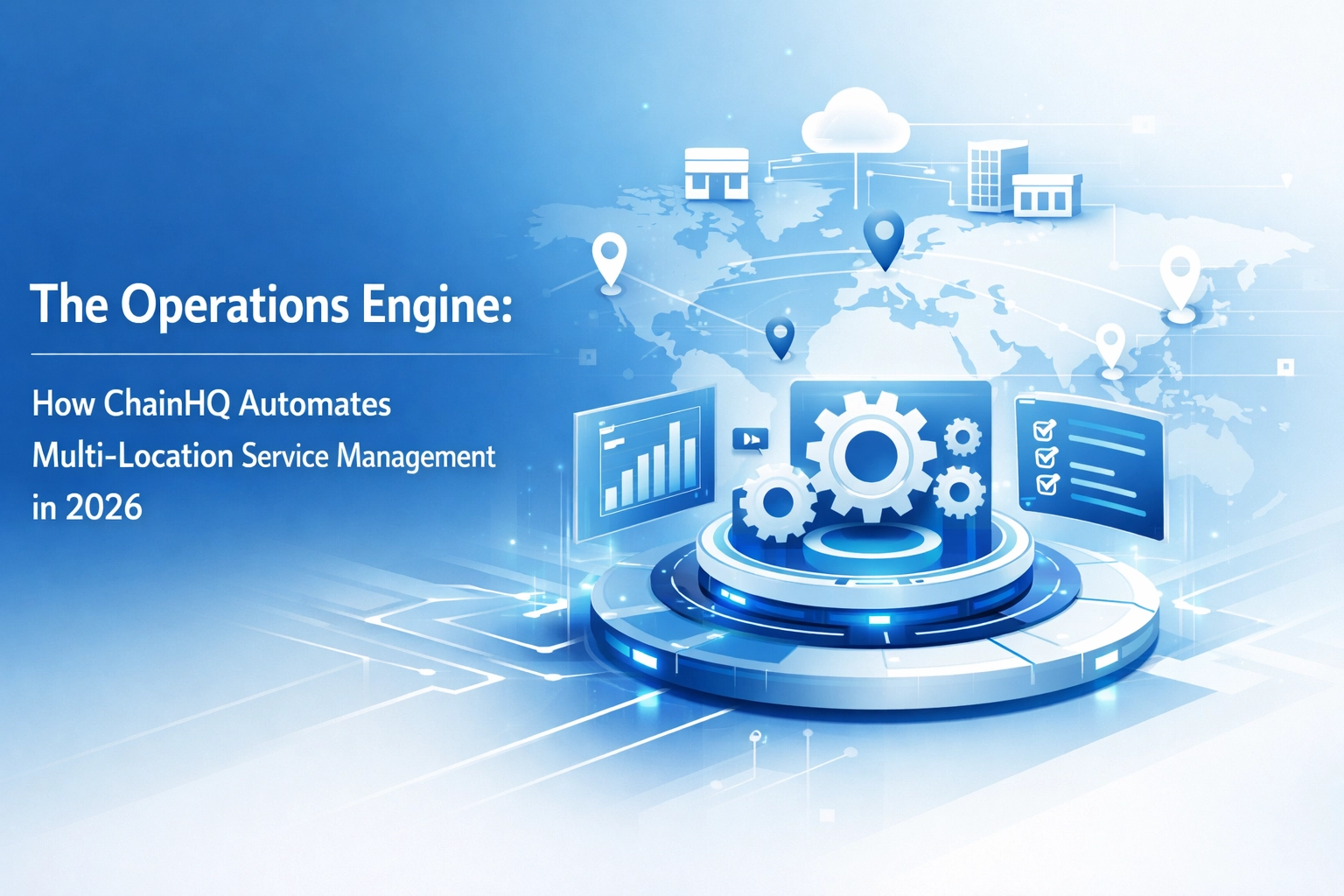
By 2026, the gap between "running a business" and "scaling an enterprise" has become a technological chasm. If you are managing a multi-location service business: whether it’s a chain of specialized clinics, a regional field service operation, or a network of professional service hubs: you’ve likely hit the "Operational Ceiling."
This is the point where adding another location doesn't just add more revenue; it adds exponential complexity, communication breakdowns, and data silos that threaten to suffocate your growth. At Pure Technology Consulting, we’ve seen this pattern across every industry we serve, from healthcare to high-stakes debt management. The solution isn't "working harder." It’s building an Operations Engine.
In this deep dive, we’re looking at how we leverage bespoke automation frameworks: specifically through the lens of our ChainHQ proof-of-concept: to centralize management and decouple growth from labor dependency.
The Multi-Location Trap: Why Scaling Often Leads to Stagnation
Most service operators start with a single, high-performing location. The processes are manual, but they work because the founder or a dedicated manager can "see" everything. When you move to three, five, or ten locations, that visibility vanishes.
You find yourself dealing with what we call Operational Drag:
- Data Silos: Each location has its own "way of doing things," its own spreadsheets, and its own local knowledge that isn't shared.
- Redundant Manual Workflows: Staff spend 30% of their day re-entering data from one system to another (e.g., from a CRM to a billing platform).
- The Labor Trap: To grow revenue by 20%, you’re forced to grow your administrative headcount by 20%. This is not true scaling; it’s just getting bigger and more fragile.
In 2026, the winners aren't those with the most locations, but those with the most efficient connection between those locations.

Enter ChainHQ: The Architecture of Centralized Command
When we consult with multi-location service operators, we often use ChainHQ as a roadmap for what’s possible. It’s not just a piece of software; it’s a demonstration of how a custom-built "Operations Engine" can unify a fragmented business.
The core philosophy of ChainHQ is Centralization by Default. Instead of each location acting as an island, every data point: from field rep GPS logs to intake form submissions: flows into a single, unified architecture. This eliminates the "blind spots" that usually plague regional managers.
1. Eliminating Redundant Manual Workflows
In a typical operationally constrained business, information is the bottleneck. A customer signs a contract in the field; that contract is emailed to the office; a clerk enters the data into the billing system; another clerk schedules the service.
A custom engine automates this entire chain. In our work with healthcare intake matching (the EHRIO Pro framework), we’ve automated 70-question intake processes that trigger immediate downstream actions without a single human click. In ChainHQ, this translates to automated dispatching and inventory triggers based on real-time field data.
2. Scalability Without Labor Dependency
The goal of a high-ticket custom automation engagement is to ensure that your "back office" remains lean while your "front office" (revenue-generating locations) expands. By automating the high-volume, low-logic tasks: like appointment reminders, data synchronization, and basic reporting: you allow your team to focus on high-value strategy.

Real-Time Reporting: From Post-Mortem to Predictive
One of the biggest risks for multi-location operators is "lagging data." Most CEOs don't know there’s a problem at Location B until the end-of-month reports come in. By then, it’s too late.
A bespoke Operations Engine provides Live Governance. Because every location is piped into the same data lake, executive dashboards can show:
- Real-time throughput: How many service tickets are being closed right now across the entire footprint?
- Labor efficiency: Which locations are over-staffed relative to their current volume?
- Quality Control: Automated sentiment analysis of customer feedback, flagging issues before they become bad reviews.
We’ve applied these same principles to D2D (Door-to-Door) tracking systems, where rep accountability and GPS logging provide managers with a literal map of their business's pulse. This isn't just "reporting"; it’s the ability to intervene in the moment.
The Strategy: Where Custom Software Beats SaaS
Many operators try to solve these problems with a stack of 15 different SaaS subscriptions. They have a CRM, a separate scheduling app, a separate billing app, and a "connector" like Zapier trying to hold it all together.
In 2026, this "Franken-stack" is a liability. It creates security risks, data inconsistencies, and high monthly "tech taxes."
When Pure Technology Consulting builds an engine like ChainHQ, we are building for integration and longevity.
- Bespoke logic: Your business has a unique "secret sauce" in how you handle customers. Off-the-shelf software forces you to change your process to fit the software. We build software to fit your process.
- Data Sovereignty: You own your data. It isn't locked in a proprietary vendor's cloud where you have to pay to export it.
- Operational Leverage: Because the system is built on a custom roadmap, it can grow with you. If you decide to pivot into a new service line, your engine can be updated to support it in weeks, not months.

Moving Beyond "Managed Chaos"
For "Segment 2" businesses: those that are operationally constrained: the path forward is a shift in mindset. You are no longer just a service provider; you are a technology company that happens to provide a service.
Whether you are in legal, accounting, healthcare, or field services, the administrative drag is your biggest competitor. By implementing a centralized engine, you aren't just "fixing" your operations; you are creating a platform that is ready for acquisition, franchising, or rapid regional expansion.
We bring the lessons we’ve learned from building matching engines in healthcare and call attribution systems in fintech to the world of multi-location service management. We don't start from scratch; we start with a proven framework of what works in 2026.
Your Roadmap to 2026 Operations
If you feel like your growth is being held back by the sheer weight of your own operations, it’s time to stop looking for a better "tool" and start looking for a better architecture.
Our process begins with a deep dive into your current operating model. We look for the "leaks": the places where data is lost, time is wasted, and managers are flying blind. From there, we build a roadmap for a custom build that unifies your locations and automates your core workflows.
Are you ready to build your Operations Engine?
The first step is a strategy session to audit your current workflows and identify where bespoke automation will yield the highest ROI. We specialize in high-ticket, high-impact transformations for businesses that are ready to move past manual constraints.
Book a discovery call with our team to discuss your roadmap.
No obligation. Just a visionary look at what your operations could look like with the right engine under the hood.
Amin Said
Founder of Pure Technology Consulting LLC
https://puretechconsult.com
+1 (803) 921-0969
To stay updated on our latest case studies and custom development insights, visit our blog at https://blog.puretechconsult.com.
Leave a Reply