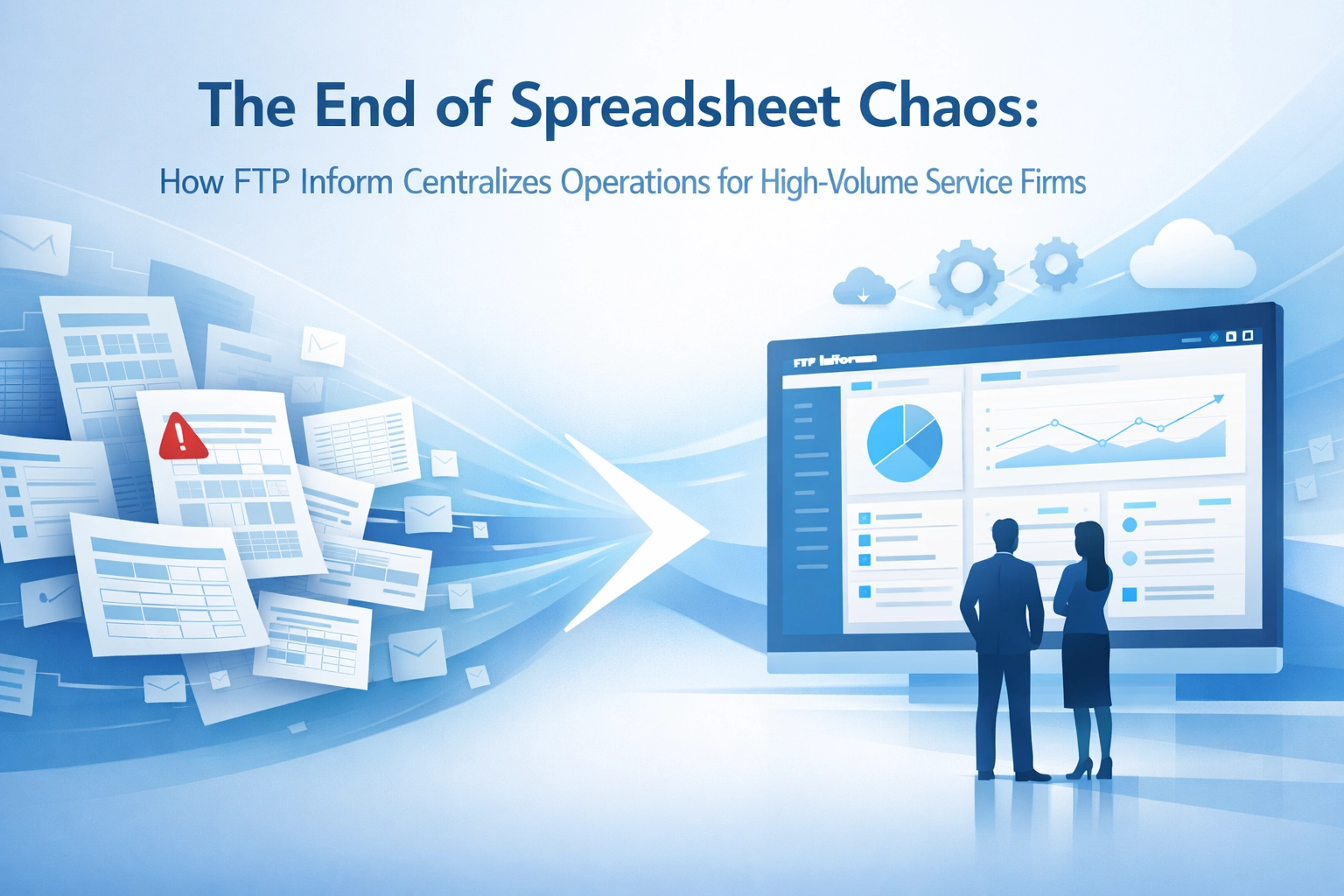
For high-volume service firms: particularly those in debt collection, legal services, and large-scale professional consulting: the spreadsheet is both a lifeline and a liability. In the early days of a firm’s growth, a well-constructed Excel sheet or a shared Google Doc feels like the ultimate flexible tool. It’s accessible, customizable, and requires no specialized training.
However, as volume scales into the thousands of records per day, that flexibility turns into "Spreadsheet Chaos." Data silos begin to form. Different departments operate off different versions of the same file. Reporting becomes a "post-mortem" exercise: looking at what happened last week rather than what is happening right now. For executives, this lack of visibility is more than an inconvenience; it is a strategic bottleneck that prevents effective assignment logic, resource scheduling, and profit maximization.
At Pure Technology Consulting, we view software not just as a set of features, but as an operating model. Centralizing operations requires moving away from manual file management and toward automated, real-time data ingestion. Tools like FTP Inform serve as the foundation for this transformation, acting as the bridge between fragmented data sources and a unified operational truth.
The High Cost of the "Spreadsheet Status Quo"
In the debt collection and fintech sectors, data is the primary asset. Every CSV, XLS, or XLSX file received from a client represents potential revenue. Yet, many firms still rely on manual processes to monitor FTP servers, download files, and update internal trackers.
When your operation is constrained by manual data handling, you face three primary risks:
- Reporting Latency: By the time a manager aggregates five different spreadsheets into a master report, the data is already 24 to 48 hours old. In high-velocity environments, old data leads to poor decision-making.
- Version Fragmentation: When multiple team members edit shared files, "Version 2_Final_Updated" quickly becomes the standard. This creates data silos where the left hand doesn't know what the right hand is doing.
- Human Error in Assignment Logic: If you are manually assigning accounts or tasks based on spreadsheet data, a single sorting error or a broken macro can result in thousands of missed opportunities or compliance risks.

Breaking the Silos: Why Manual Reporting Is Your Biggest Operational Bottleneck
Visionary leadership requires a clear line of sight into every corner of the organization. When data is trapped in silos: isolated folders on an FTP server or disconnected spreadsheets on a local drive: that sightline is broken.
High-volume service firms often struggle with "Reporting Limitations" because their tech stack isn't integrated. They might have a sophisticated telephony system for collections or a robust case management system for legal work, but the inputs to those systems are still handled via manual file transfers.
This is where the transition from "manual" to "automated" becomes a competitive advantage. By implementing automated monitoring systems, firms can ensure that every new file arrival triggers an immediate notification or a direct data injection into their core systems. This eliminates the "waiting period" between data arrival and data action.
Centralization as a Strategic Operating Model
Centralizing operations isn't just about putting all your files in one folder. It’s about creating a roadmap where data flows seamlessly from the point of origin to the point of execution.
For a debt collection agency, this might mean that as soon as a client uploads a new batch of accounts to an FTP server, the system identifies the file, validates the format, and alerts the management team. This allows for immediate assignment logic: determining which agents are best suited for these specific accounts based on real-time capacity and historical performance.
For professional services firms, centralization enables more accurate scheduling. When you have a real-time view of project data and resource availability, you can move away from "gut-feeling" scheduling and toward data-driven workforce management.

How FTP Inform Provides the Needed Visibility
While we specialize in bespoke web development and complex automation, we developed FTP Inform as a specific solution to the common problem of FTP-based data fragmentation.
In many high-ticket industries, clients still prefer FTP transfers for security and volume reasons. FTP Inform serves as a sentinel, monitoring these servers for CSV, XLS, and XLSX files. Instead of a staff member checking the server every hour, the system provides real-time notifications.
This capability is a proof-of-concept for how custom automation can solve broader operational drag. When you know exactly when data arrives, you can build workflows around that arrival. You move from a reactive stance ("Did the client send the file yet?") to a proactive stance ("The file is here; let's execute the strategy.").
Real-Time Reporting vs. Manual Post-Mortems
The difference between a firm that survives and a firm that leads is the speed of its feedback loop. Manual spreadsheets encourage a culture of "looking back." You look at the weekly report on Friday to see what went wrong on Monday.
A centralized, automated system encourages a culture of "looking forward." Real-time reporting allows you to:
- Identify bottlenecks as they occur.
- Pivot resources to high-priority tasks mid-day.
- Provide clients with instant updates on file processing status.
This level of transparency is inspirational for both the team and the clients. It signals that the firm is not just a service provider, but a technology-forward partner capable of handling complex, high-volume requirements with precision.

From Data Silos to Data-Driven Decisions
The ultimate goal of ending spreadsheet chaos is to empower leadership to make data-driven decisions. In our work with fintech and healthcare clients, we’ve seen how moving to custom-built dashboards and automated ingestion engines changes the executive mindset.
Instead of asking "What is the status of the files?", leaders start asking "How can we optimize our output based on this data?"
This shift requires a commitment to a custom-tailored tech stack. Off-the-shelf SaaS products often solve 80% of the problem, but for high-volume firms, the remaining 20%: the specific way you handle your unique data workflows: is where the profit lies. This is why we focus on custom software development that fits your specific operations, rather than forcing your operations to fit a generic tool.
The Vision for the Modern Service Firm
The firm of the future is an automated firm. It is an organization where the "operating model" is baked into the software architecture. By centralizing data and automating the monitoring of your most critical inputs, you free your human capital to focus on high-value strategy rather than low-value data entry.
If your firm is currently drowning in spreadsheets or struggling with the limitations of manual FTP management, it’s time to audit your workflow. The transition from chaos to centralization is not just a technical upgrade; it is a strategic evolution.
At Pure Technology Consulting, we bring proven capabilities from healthcare, fintech, and professional services to help you build the infrastructure needed for high-volume success. Whether it's through targeted tools like FTP Inform or comprehensive custom web applications, our mission is to eliminate operational drag and replace it with visionary efficiency.
Taking the Next Step
Ending spreadsheet chaos begins with a single decision: the decision to stop accepting "manual" as the standard.
If you’re ready to explore how custom automation and centralized data management can transform your service firm, we invite you to take a closer look at our approach to workflow audits and custom builds.
Don’t let your data stay siloed. Don’t let your growth be capped by the limits of a spreadsheet. It’s time to centralize, automate, and lead.
Amin Said, Founder of Pure Technology Consulting LLC
https://puretechconsult.com
Phone: +1 (803) 921-0969
Leave a Reply