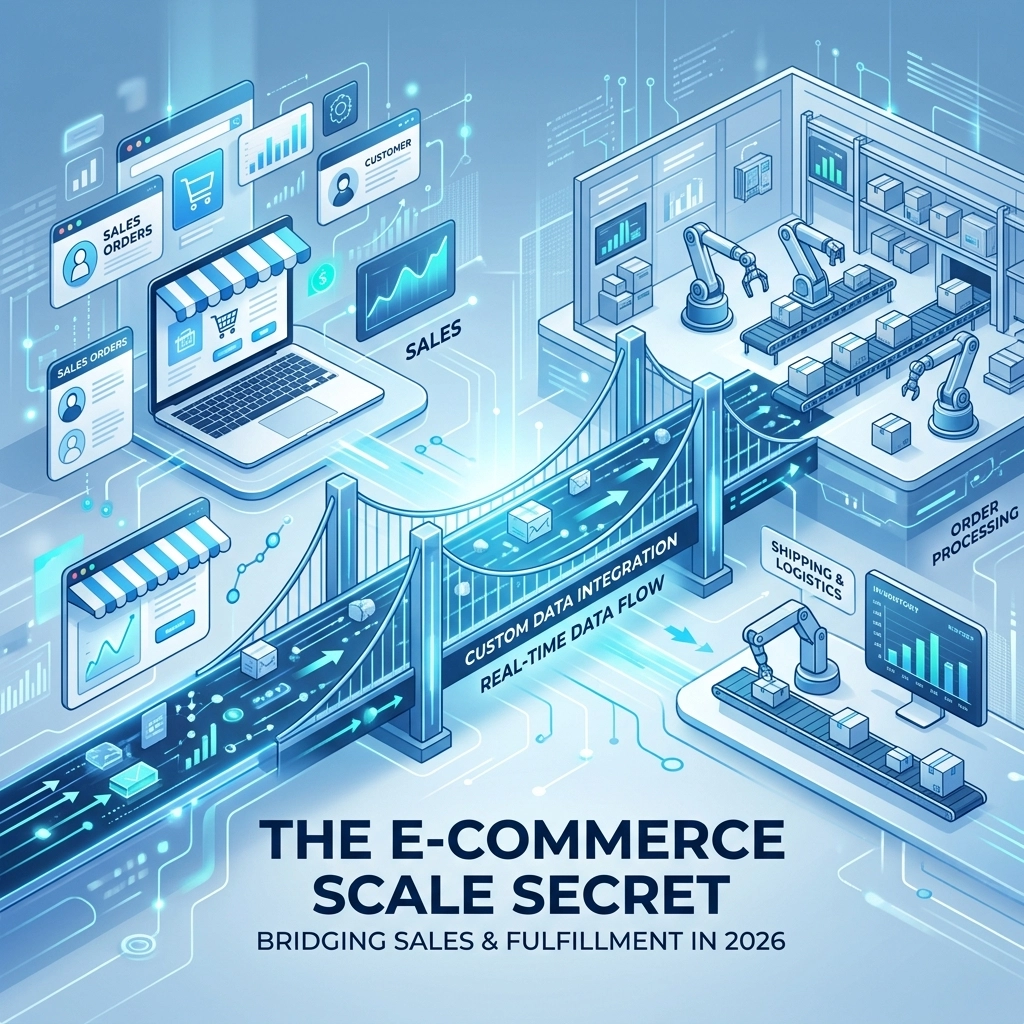
It’s Tuesday, March 31, 2026, and the e-commerce landscape looks radically different than it did even two years ago. If you’re running a high-growth brand on Amazon or eBay, you’ve likely realized that "more sales" is no longer your biggest challenge. In today’s market, the real battle is won or lost in the "gap", that chaotic space between a customer hitting the "Buy Now" button and the package arriving at their doorstep.
For many founders, scaling up used to mean hiring more people to manage spreadsheets, manually update inventory, and reconcile shipping labels. But in 2026, labor is expensive, and human error is a luxury your margins can’t afford.
The secret to scaling in this environment isn't more headcount; it’s custom data integration. At Pure Technology Consulting, we’re seeing a massive shift where the most successful brands are moving away from fragmented SaaS tools and toward a unified, automated operating model.
The Hidden Cost of Manual Workflows in 2026
If you’re still copy-pasting tracking numbers or manually checking if your Amazon stock matches your eBay listings, you’re operating with a "scaling tax."
Every manual step in your workflow is a friction point. When your sales team is disconnected from your fulfillment team, data silos form. Sales might be booming on a specific SKU on eBay, but if your warehouse management system doesn't see that in real-time, you’re looking at overselling, stockouts, and those dreaded negative reviews that can tank your seller rating in 48 hours.
The gap between sales and fulfillment is where profit goes to die. Through our digital transformation consulting, we’ve identified that mid-market e-commerce brands often lose between 15% and 20% of their potential efficiency purely due to data fragmentation.

Centralizing the Chaos: The Power of a Custom Dashboard
Most e-commerce owners are drowning in tabs. You have the Amazon Seller Central tab, the eBay Seller Hub, your 3PL portal, and perhaps a basic accounting tool.
The first step in a true data integration services engagement is centralizing this data. Imagine a single, visionary dashboard that doesn't just show you "sales," but shows you your entire ecosystem.
Why a Custom Dashboard Beats "Off-the-Shelf"
While there are plenty of $50/month apps that claim to sync your stores, they often lack the granularity required for complex operations. A custom-built dashboard from Pure Technology Consulting provides:
- Real-time Inventory Orchestration: When an item sells on Amazon, your eBay listing is updated in milliseconds, not minutes.
- Integrated Profitability Tracking: Most platforms show you revenue. A custom dashboard pulls in your COGS, shipping fees, and ad spend to show you real-time net profit per SKU.
- Predictive Demand Forecasting: Using historical sales patterns, we can build logic that tells you exactly when to reorder stock before you even realize you’re low.
This isn't just about looking at pretty charts; it's about executive-level governance of your business. It's about having the "single source of truth" that allows you to make strategic decisions in seconds.
Automation: The Bridge Between Sales and Fulfillment
In 2026, the brands that win are the ones that treat their operations like a software product. This is where business automation consulting becomes your most powerful weapon.
When a sale is made on a marketplace, a series of invisible events should trigger immediately. In an un-integrated business, these events are manual. In a "Pure Tech" optimized business, they are event-driven.
The Automated Workflow Journey
- The Trigger: A customer purchases a high-ticket item on eBay.
- The Sync: The custom integration immediately locks that inventory unit across all other channels.
- The Fulfillment Trigger: An API call is sent to your 3PL or warehouse system to generate a pick-list.
- The Communication: A personalized, branded email is sent to the customer, and the tracking number is automatically pushed back to the marketplace the moment the label is scanned.
- The Accounting: The transaction is logged in your finance system with the correct tax and fee breakdowns.
By automating these "invisible" tasks, your team stops being "data movers" and starts being "growth drivers." We’ve seen teams reduce their manual data tasks by over 60%, allowing them to handle 3x the order volume without adding a single new employee.

Scaling Without the Labor "Anchor"
The traditional model of e-commerce scaling is linear: more orders = more customer service reps + more warehouse admins. That model is broken.
The visionary approach, the one we advocate for at Pure Technology Consulting, is exponential scaling. By investing in custom web apps and bespoke integrations, you decouple your growth from your labor costs.
Think of it this way: a custom integration doesn't take a lunch break, it doesn't make typos, and it doesn't need a raise. Whether you process 100 orders a day or 10,000, the infrastructure remains the same. This is how you achieve "operational leverage."
Where Custom Software Beats SaaS
Many clients ask us: "Why not just use a standard connector?"
The answer lies in the edge cases. Every business has a unique way they bundle products, handle returns, or manage international shipping. Standard SaaS tools force you to change your business to fit their software. We build software to fit your business.
Whether it's a custom matching engine for healthcare data or a GPS-logged accountability system for field ops, our background in building complex, high-ticket web applications means we know how to handle the data nuances that generic tools miss. We bring that same level of rigor to e-commerce fulfillment.
The 2026 Strategic Roadmap
If you’re looking to bridge the gap between your sales and fulfillment this year, your roadmap should look like this:
- Audit Your Workflows: Identify every place where a human is currently moving data from one screen to another. That is your first target for automation.
- Prioritize Integration Integrity: Ensure your sales channels (Amazon/eBay) are talking directly to your backend systems with zero latency.
- Invest in Visibility: If you can’t see your real-time margins across all channels on one screen, you are flying blind.
- Schedule a Strategy Session: Don't guess which tools will work. Request a workflow audit to see where custom code can replace manual drag.

Final Thoughts: The Future is Integrated
The "secret" to scaling in 2026 isn't a secret at all, it’s architecture. It’s the realization that your data is your most valuable asset, but only if it’s moving freely between your sales platforms and your fulfillment centers.
At Pure Technology Consulting, we don't just build apps; we build the digital nervous systems for high-growth brands. We help you bridge the gap so you can stop worrying about the "how" of fulfillment and start focusing on the "what's next" of your brand’s vision.
If you’re ready to stop the manual grind and start scaling with precision, let’s talk. Our bespoke automation and integration engagements are designed for brands that have outgrown the "basic" tools and are ready for professional-grade infrastructure.
To your growth,
Amin Said, Founder of Pure Technology Consulting LLC
Phone: +1 (803) 921-0969
Website: https://puretechconsult.com
Discovery: https://puretechconsult.com/schedule
For any inquiries regarding this post or to book a consultation, please contact my assistant, Emily.
Leave a Reply