By Amin Said, Founder of Pure Technology Consulting LLC
Let’s be real for a second: Revenue is a vanity metric.
If you’re running a multi-channel e-commerce brand, it’s incredibly easy to get drunk on top-line growth. You see the Shopify notifications pinging, the Amazon Seller Central dashboard showing green arrows, and your eBay store moving units while you sleep. On paper, you’re winning.
But then the end of the month hits. You look at the bank account, and the math doesn’t quite add up. Despite the "record sales," the actual profit left over is thinner than a razor blade.
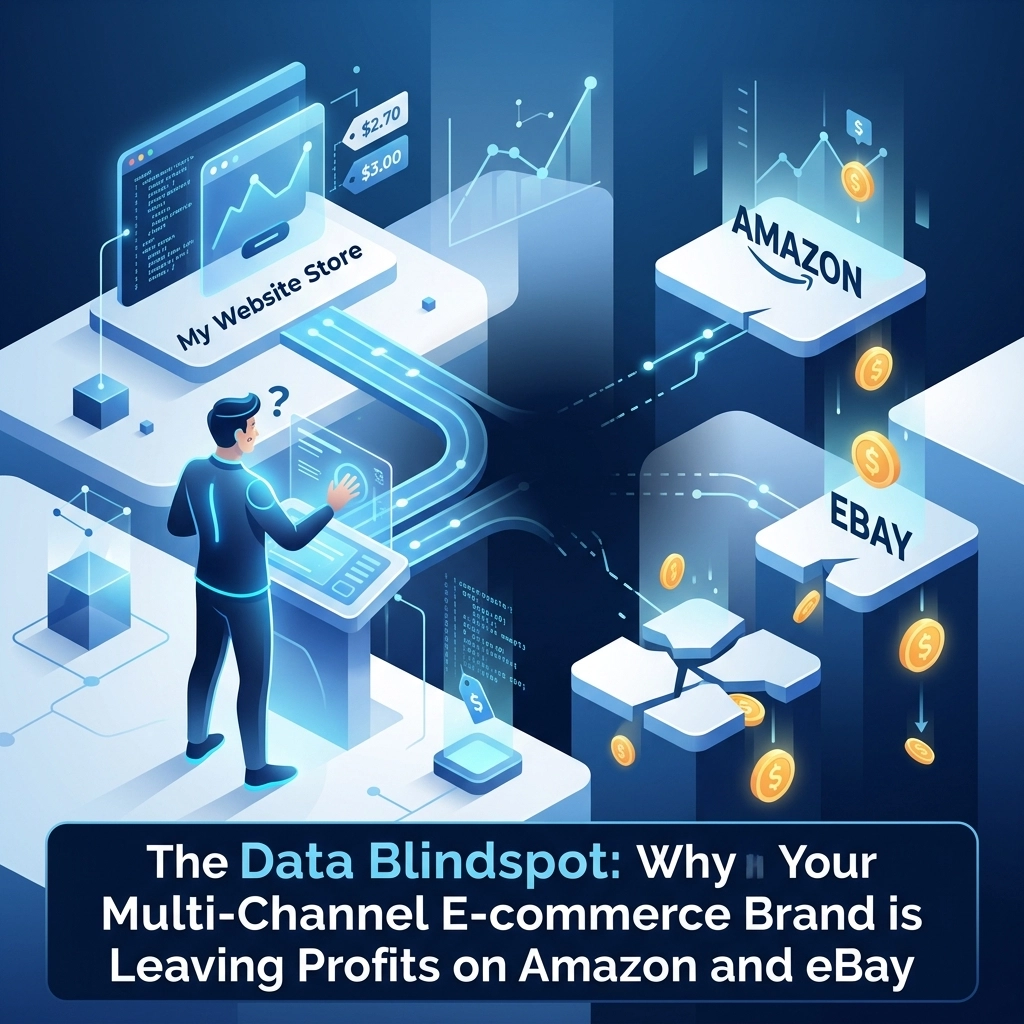
This is what I call the Data Blindspot. It’s the gap between what your sales channels tell you is happening and what is actually happening to your bottom line. If you are selling on Amazon and eBay alongside your own site, you aren’t just running one business; you’re running three distinct financial ecosystems, each with its own hidden taxes, fees, and operational traps.
At Pure Technology Consulting, we help high-volume operators move past the "revenue trap" by building custom reporting engines that expose these blindspots. In this post, I want to pull back the curtain on why your current setup might be costing you a fortune and how to fix it.
The Mirage of High-Volume Channels
Most merchants treat every dollar of revenue as equal. It’s a fatal mistake.
The research is clear: Native analytics dashboards: like the ones provided by Shopify or Amazon: are designed to show you sales, not profit. They want you to spend more on ads and list more products. They aren’t incentivized to show you that your 15% referral fee on Amazon, combined with returns and shipping overhead, is eating 85% of your margin.
Consider this scenario: You have a month where Amazon does $50,000 in sales and Shopify does $30,000. Most founders would say, "Amazon is our lead horse; let’s double down there."
But once you strip away the 8–45% category commission, the FBA storage fees, the $0.40 per-order eBay fees, and the return shipping costs, that "winning" Amazon channel might only yield $7,500 in actual profit. Meanwhile, your $30,000 in Shopify sales might be yielding $26,000 because you own the customer and the infrastructure.
Without a unified data layer, you are scaling your least profitable channels while starving your most profitable ones.

The Chaos of Data Silos
The reason most brands can’t see their true margins is that their data is trapped in silos.
Shopify doesn't talk to Amazon. Amazon doesn't care about your eBay metrics. Your warehouse management system (WMS) might be tracking stock, but it isn't factoring in the "true cost" of a return on a specific marketplace.
This forces founders and operations managers into the "Spreadsheet Shuffle." We see it all the time: a senior team member spends 5–10 hours a week manually exporting CSV files, trying to reconcile different time zones, fee structures, and currency conversions in Excel.
Not only is this a massive waste of high-level talent, but it’s also dangerous. Research shows that roughly 45% of marketing and operational data used for decision-making is incomplete or outdated by the time it reaches the CEO's desk. When you’re making million-dollar inventory bets based on 60% accurate data, you’re not a CEO: you’re a gambler.
Marketing Waste and the Attribution Nightmare
If you don't have a custom dashboard that integrates your ad spend (Google, Meta, YouTube) with your multi-channel sales data, you are almost certainly throwing money into a void.
Take YouTube ads, for example. You might spend $5,000 on a campaign and see only $2,000 in attributed orders inside Shopify. A logical person would cut that budget immediately. However, if your data was properly integrated, you might find that those YouTube viewers didn't buy on Shopify: they went straight to Amazon because they wanted Prime shipping.
If that YouTube campaign actually drove $8,000 in total cross-channel sales, but you couldn't see it because of a silo, you just killed your best growth engine.
At Pure Technology Consulting, we look at attribution as a holistic ecosystem. We build custom integrations that track the customer journey across platforms, ensuring that your ad spend is allocated based on reality, not just the limited "last-click" view of a single dashboard.
Inventory: The Silent Profit Killer
Inventory management is where the Data Blindspot becomes a literal nightmare.
According to Gartner, store-level inventory accuracy in omnichannel retail can be as low as 60%. When your inventory isn't synced in real-time across Amazon, eBay, and your warehouse, two things happen: both of them cost you money:
- Overselling: You sell a product on eBay that was already bought on Shopify five minutes ago. You have to cancel the order, take a hit on your marketplace rating, and lose a customer for life.
- Stockouts: You don't realize a specific SKU is "turning" faster on Amazon than on your main site. You run out of stock, lose your "Buy Box" ranking, and it takes weeks of ad spend to regain that momentum.
Custom automation is the only way to solve this. Off-the-shelf SaaS tools often have lag times or don't account for "reserved" inventory during the FBA transfer process. A bespoke system ensures that your "Available to Sell" number is the truth, across every platform, every second.

Moving Toward a "Single Source of Truth"
So, how do you stop leaving profits on the table? It starts with a shift in your operating model. You have to stop looking at each channel as a separate entity and start looking at your brand as a data-driven engine.
We recommend a three-pillar approach to our clients:
1. Custom Reporting Dashboards
Stop logging into five different apps. You need one screen that pulls in Amazon API data, eBay developer feeds, and Shopify webhooks. This dashboard should show you "True Contribution Margin" by SKU. If a product is a winner on Shopify but a loser on Amazon after fees, you need to know that instantly so you can adjust pricing or pull the listing.
2. Workflow Automation
If your team is manually moving data or updating stock levels, you have a bottleneck. We specialize in building the "middleware" that connects your systems. Whether it’s automating the flow of tracking numbers or syncing multi-channel returns into a single customer service view, automation buys you back the time to think strategically.
3. Strategic Governance
Data is only useful if it’s governed. You need a roadmap for how your data is collected, cleaned, and presented. This is where many brands fail: they buy a tool but don't have the architecture to support it.
Where Custom Development Beats "Off-the-Shelf" SaaS
You might be thinking, "Can't I just buy a $99/month app for this?"
For a small side hustle, maybe. But for high-volume service operators and brands looking to scale to the next level, "one size fits most" software is a trap. Generic apps don't understand your specific logic, your unique shipping contracts, or your complex bundle structures.
Custom software is a capital investment that pays for itself by finding the 5–10% of margin you're currently losing to errors, fees, and bad attribution. Whether it’s building a matching engine like we did with our EHRIO Pro framework or a complex call attribution system, we’ve proven that bespoke tools out-perform generic SaaS every single time.
Final Thoughts
The e-commerce landscape in 2026 is too competitive for "guesswork." Amazon and eBay are incredible tools for reach, but they are designed to prioritize their own profits, not yours.
If you want to protect your margins, you have to own your data. You have to eliminate the blindspots that allow fees and inefficiencies to eat your bottom line.
If you’re tired of the spreadsheet shuffle and ready to see the real truth behind your numbers, let's talk. We don't just build apps; we build the infrastructure that lets you run your business with total clarity.
Ready to audit your workflow and find those hidden profits?
Book a discovery call with our team or visit our video walkthroughs to see how we’ve solved these challenges for other high-ticket clients.
Amin Said, Founder of Pure Technology Consulting LLC
https://puretechconsult.com
Phone: +1 (803) 921-0969
Leave a Reply