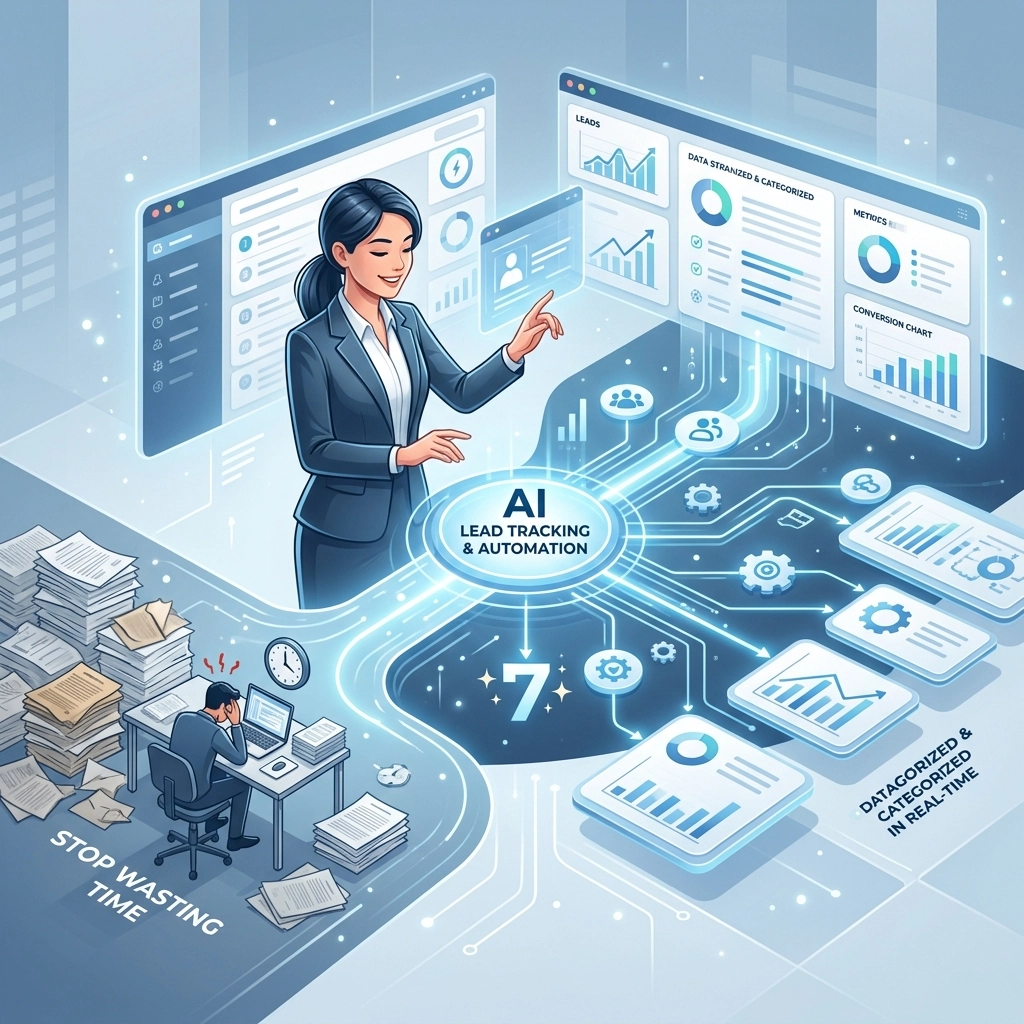
In the current landscape of high-ticket professional services and enterprise software, time is the ultimate currency. Yet, many executive teams still find their top talent bogged down by the administrative weight of manual lead tracking. When your sales engineers or senior consultants are manually updating spreadsheets or moving cards in a CRM, you aren't just losing time; you are losing the strategic momentum required to dominate your market.
At Pure Technology Consulting, we view automation not as a luxury, but as a fundamental operating model. Transitioning from manual processes to AI-driven workflows isn't just about efficiency: it’s about building a visionary infrastructure that scales without adding proportional headcount.
Here are seven AI workflow automation hacks to transform your lead tracking from a manual chore into a high-performance engine.
1. Implement Deep Lead Scoring and Automated Segmentation
The most common bottleneck in lead management is the "noise" generated by unqualified inquiries. Manual sorting is prone to human error and bias. By implementing AI-powered lead scoring, you can automatically rank prospects based on high-intent behaviors: frequency of site visits, specific whitepaper downloads, or engagement with technical documentation.
We applied this philosophy when developing EHRIO Pro. Designed for the healthcare sector, EHRIO Pro utilizes complex matching engines and extensive 70-question intake forms to ensure that data isn't just collected, but intelligently processed. By applying similar logic to your custom lead tracking system, you can ensure your sales team only touches leads that have cleared a pre-defined strategic threshold.

2. Deploy Behavioral Triggers for Real-Time Engagement
A lead’s interest has a shelf life. Waiting 24 hours to respond to a high-value interaction is an invitation for your competitor to step in. AI workflow automation allows you to set up "if-then" branches based on digital body language.
If a prospect visits your "Custom Enterprise Solutions" page three times in a single week, the system shouldn't just log it: it should trigger a personalized consultation invite or a bespoke case study relevant to their industry. This level of responsiveness signals to the prospect that your organization is proactive and technologically sophisticated.
3. Leverage Lead Enrichment via API Integrations
Manual data entry is the enemy of accuracy. Instead of asking a prospect to fill out a 15-field form, use AI tools to "enrich" a lead using only their business email. Automation can pull data points such as company size, estimated annual revenue, and current tech stack directly into your CRM.
This creates a comprehensive profile before a human even looks at the lead. This approach mirrors how we build bespoke web applications; we focus on integrating disparate data sources into a single, cohesive operating picture, reducing the friction for both the user and the administrator.
4. Automate Local Presence and Engagement
For businesses managing multiple locations or local service hubs, tracking leads across different geographies can become a logistical nightmare. Automation can bridge the gap between local visibility and centralized lead tracking.
Our proprietary tool, AI Local Boost, serves as a prime example of this capability. By automating Google Business Profile engagement and local SEO signals, it generates high-intent local leads without manual intervention. For a scaling enterprise, integrating this type of automated "always-on" local engine into your lead tracking workflow ensures that no regional opportunity is overlooked due to administrative bandwidth.

5. Intelligent Email and Communication Sequencing
The standard "drip campaign" is dead. Visionary leaders are moving toward intelligent sequencing where the AI adjusts the content based on interaction. If a lead clicks on a link regarding "security and compliance" but ignores "pricing," the next automated follow-up should pivot to address data governance and risk mitigation.
By segmenting leads dynamically, you ensure your communication is always consultative, never generic. This builds the trust necessary for high-ticket engagements, positioning your firm as a senior advisor rather than a mere vendor.
6. Automated Call and Meeting Documentation
High-stakes sales involve complex conversations. Relying on a sales rep’s memory to update a CRM is a significant operational risk. By integrating AI-driven telephony and meeting recording tools, you can automatically transcribe calls, summarize key pain points, and extract action items directly into your lead tracking system.
We have implemented similar high-level integrations for debt agencies, where call attribution and precise data logging are non-negotiable for compliance and performance. Whether it’s tracking a debt settlement negotiation or a software scoping session, the goal is the same: total data transparency without manual effort.
7. Strategic Performance Analytics and Reporting
You cannot optimize what you do not measure. Manual reporting is often retroactive and focuses on vanity metrics. An automated reporting layer: similar to the architecture we developed for FTP Inform: allows you to see the health of your lead pipeline in real-time.
While FTP Inform focuses on secure file transfer logs and data transparency, the underlying principle is universal: centralized, automated data visualization allows executives to make informed decisions quickly. Your lead tracking should provide a dashboard that highlights where leads are dropping off and which automation "hacks" are yielding the highest ROI.

Where Custom Software Beats Off-the-Shelf SaaS
While many SaaS platforms offer basic automation, they often force your business to adapt to their rigid workflows. This is where the "operational drag" creeps back in. For organizations with complex sales cycles: such as legal firms, accounting practices, or specialized healthcare providers: a bespoke solution is often the only way to achieve true automation.
At Pure Technology Consulting, we don’t just "set up" software; we engineer custom web applications and workflows that fit your unique operating model. Whether it’s building a supply chain transparency tool like ChainHQ or a custom GPS-logged tracking system for field operations, our focus is on creating high-leverage assets for your business.
What to Automate First?
If you are looking to start your digital transformation, we recommend a workflow audit to identify your highest friction points. Typically, these include:
- Initial lead qualification and scoring.
- Cross-platform data synchronization.
- Repetitive follow-up tasks.
The transition from manual tracking to AI-driven automation is not just a technical upgrade; it is a strategic shift. It allows your leadership to focus on vision and growth, while the "digital brain" of your company handles the execution.
Request a Workflow Audit
Are you ready to stop wasting time on manual processes and start building a scalable, automated engine for your lead tracking? Pure Technology Consulting specializes in creating bespoke software and high-level automation strategies for high-ticket clients.
Book a discovery call or request a workflow audit today to see how we can transform your operations.
Amin Said, Founder of Pure Technology Consulting LLC
URL: https://puretechconsult.com
Phone: +1 (803) 921-0969
Leave a Reply